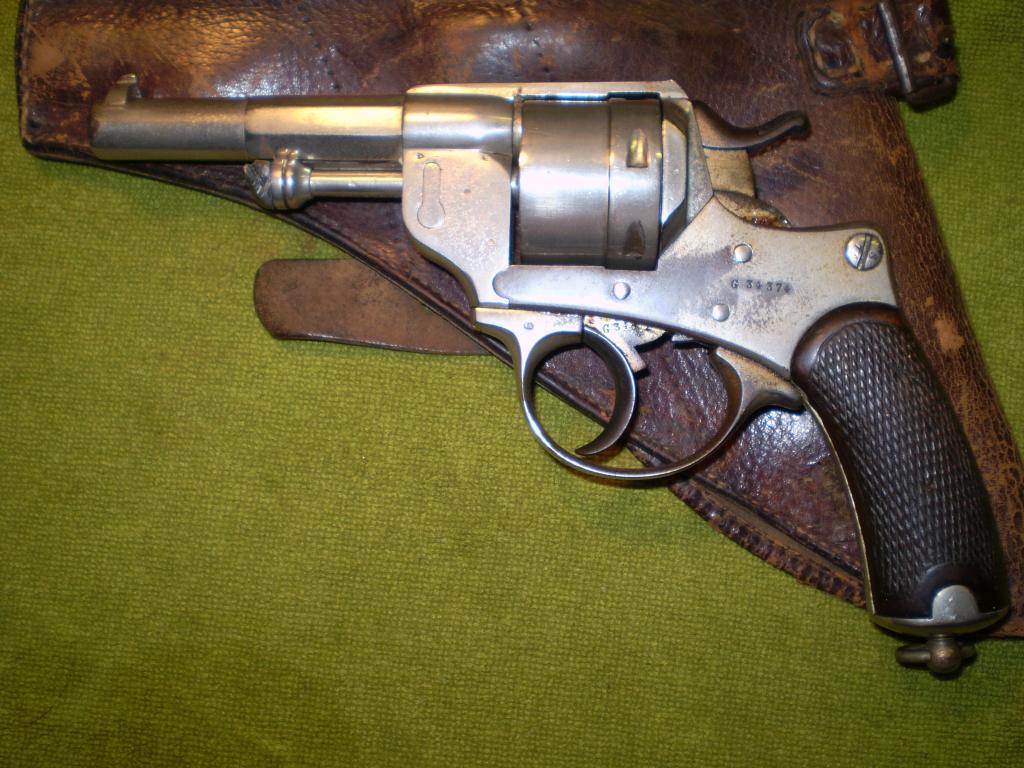
Sure it qualifies as an antique at the current time but I am pretty sure this wasn't the original intent of the law when they wrote it. Who can say that things won't change in the future? We could end up losing the freedom we enjoy with all antiques just because of the actions of a few. In France an 1873 MAS in the original caliber falls into their antique class. One converted to .45ACP does not.
There are other reasons why converting these is a bad idea and who better to ask then the French themselves?
During WW2 there were some that were converted to 45acp. This was done in DESPERATION. It wasn't like anyone thought it was a particularly good idea. They knew that it could only fire a few before it had a catastrophic failure. Still, a gun that can fire a couple of rounds was better than a gun that had no bullets at all. The strategy was to kill the German officer with the converted gun and then capture the Germans sidearm for future use, discarding the now damaged 45.
Years later when the 1873 MAS was plentiful the but 11mm French ordnance rounds were not; people started to ask about reloading. To begin with they knew a few things. First of all they knew that the .45acp round was much to powerful as it destroyed the guns. Second they knew that it was always the top strap that failed. The third thing they observed is that after firing a few of the more powerful rounds that the top strap would still eventually fail even if much lower power rounds were used after.
An engineer and some other folks got together to figure out what was safe and it is my understanding that they eventually published a series of articles about it in a French gun magazine. I was only ever able to find a translation of this one part but it has some very good information.
REVOLVER CHAMELOT DELVIGNE TYPE 1873
Computation of the forces transmitted to the top strap during firing:
At firing, pressure is transmitted to the cylinder frame through the case’s base.
Area of the chamber : 11.43mm X 11.43mm X 3.14/4 = 1.02 sqcm (0.1581 sqin)
Distribution of the force over the upper and lower surfaces of the frame, (distance of the application point of the force to the reaction points)
Distance from top of frame to barrel axis: 8.5 mm (.335â€), top strap thickness: 3 mm (.118â€).
Distance from top strap cross-section mid-point to barrel axis: 8.5 mm + 1.5 mm= 10 mm (.393â€)
Distance from the bottom of the frame to the barrel’s axis: 37 mm (1.456â€)
Lower frame thickness: 12 mm (.472â€)
Distance from lower frame cross-section mid-point to barrel axis: 37 mm + 6 mm= 43 mm (1.69â€)
Distance between mid-points of top and bottom frame cross-sections: 10 mm + 43 mm=53 mm (2.09â€)
Force exerted on the rear of the frame, assuming an 800 bar [11,600 psi] loading:
800 x 1.02 = 824 kgf (1816 lbs)
Force acting on top strap:
824 x 43/53 = 669 kgf (1475 lbs)
Force acting on frame bottom:
824 x 10/53 = 155 kgf (342 lbs)
Case of a 48 kg/sqmm (34.136 ton/sqin) yield strength steel revolver frame :
Area of the top strap at its weakest point: 36 sqmm (.056 sqin)
HENCE: firing a 800 bar (11,600 psi) load exerts a force on the top strap of:
669/36 = 18.6 kg/sqmm (13.2 ton/sqin)
Without precisely knowing the tensile limit of a 48 kg/sqmm steel, which is somewhere between 70 and 80% of the minimum yield strength, an 18.6 kg/sqmm is only 39% of the yield strength and is well within the tensile limit of the steel.
Dangerous loads:
If the minimum tensile limit of a 48 kg/sqmm steel is 70% (or 33 kg/sqmm), the danger point for the top strap is therefore 36 x 33 = 1180 kgf; the force applied to the rear of the frame is therefore 1180 X 53/43 = 1464 kg/sqmm, which would require a 1464/1.02 – 1435 bar (20813 psi) load minimum to be dangerous.
These calculations do not take into consideration the friction between cylinder chamber and cartridge case which will reduce the rearward force by at least 10%.
The use of 800 bar (11,600 psi) loads in the Mle, 73 is quite reasonable IF the revolver has never fired loads that might have overstressed the top strap beyond its tensile limit (in which case top strap rupture would be inevitable as even weak loads induce stretching).
Note the last comment about an overstressed top strap. This is the reason that it fails even if low power loads are used. There isn't any obvious crack or anything I am told either. I imagine it might show up if you xrayed it like they do for aircraft parts. Also, 45acp is normally rated at 21000psi which fits with the statement that 20813psi is dangerous.
So this is the reason why you don't convert these to 45 and you don't buy one if it has been converted. You don't know what has been fired previously and a visual inspection isn't going to tell you if you are holding a sound piece or a dangerous one.
Besides, 11600 psi is a pretty anemic load so you are going to have to hand load for it anyway. It isn't that difficult to make brass for these and proper heeled bullets can be purchased and molds for them are available as well. Just be sure that you are using soft lead projectiles as 11600psi isn't much and jacketed or even hard (Wheel Weight) bullets will cause the pressure to spike quite a bit. I reload for my own 1873 MAS and I have made the brass as well as cast my own bullets. I shoot mostly black powder and it is great fun.