













































You are using an out of date browser. It may not display this or other websites correctly.
You should upgrade or use an alternative browser.
You should upgrade or use an alternative browser.
Aiming question - handguns
- Thread starter Somerset Bar
- Start date


Yep, a flinch isn't due to being worried about recoil. It's more about thinking deep down that you can control the recoil. It's tough to get to where you simply don't react to the kick. But that's where we need to be to shoot the handguns well.
The focus on the follow through and holding the trigger back through the BANG! will help. That and working on the smooth pressure build. I've seen more than one shooter hold some pressure on the trigger than snap at it when they think the sights are "just right". At that point the bullet seldom goes where they had the sights.
A note about the bore sighting light. Handguns kick from the moment the bullet starts to move. The sights take this into account. In particular with the revolvers. You'll find that the 586 bore axis is pointed down quite a lot compared to the sight line. The amount of compensation varies based on the loads you're shooting. The heavier and slower the bullets the more the bore axis points down. That's because the heavier and slower bullets spend more time in the barrel and leave later during the muzzle rise from the kick.
Semi autos don't do this as much because the initial kick is absorbed by the recoil spring. But there's still SOME sights compensation to allow for the muzzle rise.
So if you stick a laser pointer boresighter in the guns don't be surprised if the dot isn't where the sights are pointing.
The focus on the follow through and holding the trigger back through the BANG! will help. That and working on the smooth pressure build. I've seen more than one shooter hold some pressure on the trigger than snap at it when they think the sights are "just right". At that point the bullet seldom goes where they had the sights.
A note about the bore sighting light. Handguns kick from the moment the bullet starts to move. The sights take this into account. In particular with the revolvers. You'll find that the 586 bore axis is pointed down quite a lot compared to the sight line. The amount of compensation varies based on the loads you're shooting. The heavier and slower the bullets the more the bore axis points down. That's because the heavier and slower bullets spend more time in the barrel and leave later during the muzzle rise from the kick.
Semi autos don't do this as much because the initial kick is absorbed by the recoil spring. But there's still SOME sights compensation to allow for the muzzle rise.
So if you stick a laser pointer boresighter in the guns don't be surprised if the dot isn't where the sights are pointing.
Isn't necessarily you. How well do the pistols fit your hand? Too big will do that. So will a poor trigger. And every commercial firearm, except a Python, needs a trigger job. If you can't reach the trigger correctly, you'll never be able to shoot 'em well. Plus revolvers and pistols are shot differently. Has to do with how you grip 'em.
Merc's chart should be a sticky if it isn't there already.
Merc's chart should be a sticky if it isn't there already.

Brutus
CGN Ultra frequent flyer
What a pant load of half a$$ bs. Maybe it is not him, but chances are with a relatively novice shooter, it probably is the trigger actuator versus the handgun. There is no shame in this fact as we all had to start from somewhere. As for your second pretty much baseless & worthless statement sunray, I guess my Hammerli Model 150 target pistol designed from the ground up for 50 meter competition needs a trip to the gunsmith for a trigger job!Isn't necessarily you. How well do the pistols fit your hand? Too big will do that. So will a poor trigger. And every commercial firearm, except a Python, needs a trigger job. If you can't reach the trigger correctly, you'll never be able to shoot 'em well. Plus revolvers and pistols are shot differently. Has to do with how you grip 'em.
Merc's chart should be a sticky if it isn't there already.
I value my presence here, so I'll just hold my tongue from further comment.


Heh I didn't want to start a big argument, I can almost 100% guarantee that it's -me- and not the gun, as I said my buddy fired off 10 in a loonie sized hole without blinking, looked at me and said "it's not the gun". 
Also, I didn't want to come off macho or anything, I think I'm doing something horribly wrong, and didn't think it had anything to do with fear, although it's probably best not to forget that if my mind isn't on the task at hand 100% of the time, someone could get hurt or killed, maybe that's part of it.
Probably I'm just jerking the trigger. It would be nice if it was that simple. I need to find more time for the range, but real life is being a bugger.
Also, I didn't want to come off macho or anything, I think I'm doing something horribly wrong, and didn't think it had anything to do with fear, although it's probably best not to forget that if my mind isn't on the task at hand 100% of the time, someone could get hurt or killed, maybe that's part of it.
Probably I'm just jerking the trigger. It would be nice if it was that simple. I need to find more time for the range, but real life is being a bugger.
I dont think your being macho. You being respectful and polite.
The "Macho" comment was more general and geared towards the dismissal of anticipation of recoil cause tensing up is a sign of weakness. (General comment, not directed at the OP)
The wonderful thing about the gun community.
Everyone is a professional with their own opinions...... and everyone else opinion are wrong
Inevitably, arguments will ensue.
I just like to argue with statements like "And every commercial firearm, except a Python, needs a trigger job."
Throwing money at a gun does not make one a better shooter.
Actually.... I just like to argue in general
The "Macho" comment was more general and geared towards the dismissal of anticipation of recoil cause tensing up is a sign of weakness. (General comment, not directed at the OP)
The wonderful thing about the gun community.
Everyone is a professional with their own opinions...... and everyone else opinion are wrong
Inevitably, arguments will ensue.
I just like to argue with statements like "And every commercial firearm, except a Python, needs a trigger job."
Throwing money at a gun does not make one a better shooter.
Actually.... I just like to argue in general
Last edited:
I dont think your being macho. You being respectful and polite.
The wonderful thing about the gun community.
Everyone is a professional with their own opinions...... and everyone else opinion are wrong
Inevitably, arguments will ensue.
I just like to argue with statements like "And every commercial firearm, except a Python, needs a trigger job."
Throwing money at a gun does not make one a better shooter.
Actually.... I just like to argue in general
It's funny, I'm trying to become a better shooter so that I don't have to worry about losing arguments anymore. (Oh man, I'll have the RCMP all over me now lol.)
That said, I would consider doing a trigger job on my AR, or on my norinco 1911 because I'm not overly happy with the feel of either, I think they could be better. The 1911 takes WAY too much effort and the AR just doesn't feel 'right', although it functions perfectly. I fired a friend's built-from-the-ground-up AR and the trigger was like glass, and I fired a kimber 1911 and same thing, the trigger was just soooo smooth.
On the 686 and the 226 i can't see changing them anytime in the near future, I really like the feel of the 226 right from the first shot. It was a "oh yeahhhhhh" moment.

Sunray, you had some very good points, probably more adapted to single handed bulls eye shooting, than any other type.
Somerset bar, hand guns are the hardest of all to learn to shoot well and no shooter will ever be good enough that he/she can't improve.
Single handed bulls eye shooting in slow fire, timed and rapid with three different calibres, reached a Zenith in the late years of the 1930s, early 1940s. There were many fabulous contests between various law enforcement agencies. Two forces that stood out in talent was the US Border patrol and the Detroit Police.
In the prime years of that type of shooting, someone put together a book, in which he interviewed about a dozen of the top, world class shooters of the day. Each of these shooters had a section in the book about how he, personally, became a world class shooter. I don't have the book at the moment, because I loaned it to a family member, but I think it is safe to say there is not a shooter in existence, beginner or expert, who could not learn something from that book.
I don't intend to share any part of that book with the world. But OP, you are trying and listening, so if you send me a PM, I will give you a few tips from the book.
Actually, there is not a great deal of difference in what the various shooters wrote, only each had his own way of how he accomplished his expertise.
Somerset bar, hand guns are the hardest of all to learn to shoot well and no shooter will ever be good enough that he/she can't improve.
Single handed bulls eye shooting in slow fire, timed and rapid with three different calibres, reached a Zenith in the late years of the 1930s, early 1940s. There were many fabulous contests between various law enforcement agencies. Two forces that stood out in talent was the US Border patrol and the Detroit Police.
In the prime years of that type of shooting, someone put together a book, in which he interviewed about a dozen of the top, world class shooters of the day. Each of these shooters had a section in the book about how he, personally, became a world class shooter. I don't have the book at the moment, because I loaned it to a family member, but I think it is safe to say there is not a shooter in existence, beginner or expert, who could not learn something from that book.
I don't intend to share any part of that book with the world. But OP, you are trying and listening, so if you send me a PM, I will give you a few tips from the book.
Actually, there is not a great deal of difference in what the various shooters wrote, only each had his own way of how he accomplished his expertise.

- Location
- Prince Edward Island
what about controlling breathing & shooting on exhale!

Sorry did not read the whole thread so I hope this is not a repeat.
I own a 226 that I originally shot horribly. My major fault was trigger pull, although grip and trigger finger position played a part too. The part that was getting me is the long light pull on the trigger before you could feel the harder pull on the sear.
My shooting improved drastically after I learned to pull through the light area quickly, hold prior to break, aim and then fire. Sounds like a long procedure, and it is at first, but now this is so quick no one would notice what I do. I found the difference in tension would mess up my aiming by a straight pull.
Best of luck and I will see if I can find my old notes for shooting pistol.
I own a 226 that I originally shot horribly. My major fault was trigger pull, although grip and trigger finger position played a part too. The part that was getting me is the long light pull on the trigger before you could feel the harder pull on the sear.
My shooting improved drastically after I learned to pull through the light area quickly, hold prior to break, aim and then fire. Sounds like a long procedure, and it is at first, but now this is so quick no one would notice what I do. I found the difference in tension would mess up my aiming by a straight pull.
Best of luck and I will see if I can find my old notes for shooting pistol.

- Location
- West Quebec
Very nice.. good link thanks..
Very nice.. good link thanks..
Agreed, most excellent!

Mind this is a correction target chart for right-handers.
There's another one for left-handers.
A piece of advice: rather than carrying this chart and comparing your shots on
target with the chart for a diagnosis. make tens, dozens, nay, hundreds of photocopies
and shoot at the chart. Never mind that the bullseye or the 10 or X rings are
not the same size as your regular targets. You want to see where each lands
while the memory of what you did is still fresh in your mind.
Just my $0.05 (They cancelled pennies.)
Excellent idea! I just made up this printer-friendly version for 8.5x11 and will be taking some to the range with me next time I go.
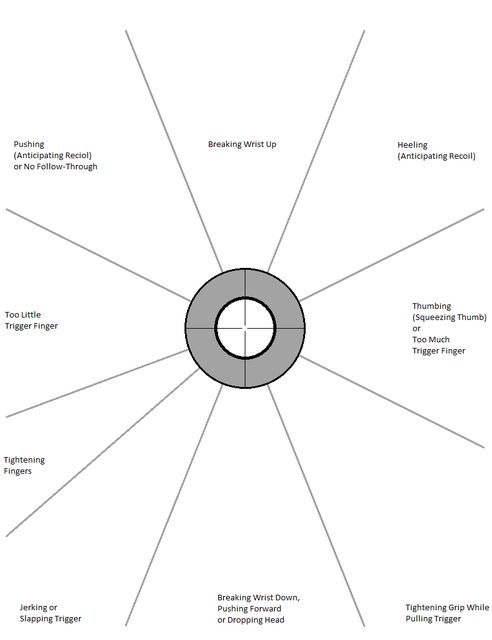
Click here for full size version
Guys, that chart is of limited usefulness for two handed shooting. The finer details of the pie sections relate to one handed classic bullseye shooting. Some of the basics still apply to a more action style two handed hold and stance but only some of them. Just keep that in mind.

Both those charts are useless. It's simple, don't disturb the sights when you pull the trigger. I can shoot the gun upside down with my pinky finger sucked up tight on the trigger and hit the bull every time. It has nothing to do with how much finger you have or anything. Don't disturb the sights when you pull the trigger. Once you learn how to do that you can worry about the finesse stuff.
- Location
- West Quebec
Both those charts are useless. It's simple, don't disturb the sights when you pull the trigger. I can shoot the gun upside down with my pinky finger sucked up tight on the trigger and hit the bull every time. It has nothing to do with how much finger you have or anything. Don't disturb the sights when you pull the trigger. Once you learn how to do that you can worry about the finesse stuff.
The simple version is good






















