308 Reloading, Federal Brass, IMR4064, bullets 'jamming' at 45.5gr

blsonne

BANNED
Regular
BANNED
Rating - 100%
9   0   0
Location
Toronto
Hello All,

The title pretty much says it all, but I'll expand on it here.

This past weekend I finished my first run of precision loads. I'm shooting 308, using federal brass once fired out of the this rifle. On top I've got 175gr SMKs and, as per standard advice, I got the reloading data and worked my way up from starting load (41.5gr) to max load (45.6gr but I used 45.5gr) in 0.5gr increments, and did 5 rounds of each. Case prep was thorough though (obviously) I only neck resized. Everything done by hand on a single stage.

Everything was fine until literally the very last round, when the bullet stayed stuck in the seating die. I was expecting this... but sooner, given that I saw the powder getting closer and closer to the case mouth as I added it, wondering when there'd be too much powder in the case for things to work.

But then why did the first 4 rounds of 45.5gr seat fine, but neither for love nor money could I get that last 45.5gr load to seat? I tried multiple different cases with different bullets, re-necked them again, but no go. I followed the die prep instructions and cleaned it like they said. Just to verify that I didn't f--k up the die I tried doing a bunch of 42gr seatings, and it worked great.

Is this a typical experience, and what I've come across is what happens when the die wears in a bit? Just a little nervous I've screwed something up.
 
Last edited:
I'm a noob, but I don't understand why the differing amount of powder would keep the bullet from seating, or why it would cause it to get stuck in the seating die.

Surely you only need to be able to push the bullet a few tenths of an inch into the case mouth in order for it to be held in place. It wouldn't be particularly concentric or stable or tightly held in there (I think the standard is 'at least one calbre's depth of bullet in the case neck') but it should at least stay in the neck. Are you saying there's so much powder in the case that the base of the bullet hits it, and it offers enough resistance that the bullet winds up being jammed into the die and sticks there?

> I tried multiple different cases with different bullets

Was this behaviour consistent across multiple cases and multiple bullets, where < 45.5 gr of powder would seat but >= 45.5 gr would get stuck?

Otherwise I'd be more tempted to say this was a case mouth issue (not enough chamfer?) and that the amount of powder was just a coincidence.

I'm super curious what more experienced people will say on this one.
 
Are you saying there's so much powder in the case that the base of the bullet hits it, and it offers enough resistance that the bullet winds up being jammed into the die and sticks there?

That's my current hypothesis.
 
Are you saying there's so much powder in the case that the base of the bullet hits it, and it offers enough resistance that the bullet winds up being jammed into the die and sticks there?

That's my current hypothesis.

That's what I was thinking - the powder load would be so heavily compressed at the OAL you are using that the bullet is forced back out when the die is retracted, and/or is jammed into the die. Backing off by at least one grain would likely remedy the situation.
 
Uhhhhh did you bother to measure the powder charge in the one that stuck? Are you certain it is correct? How are you measuring out powder?

Your comment about the powder being higher and higher in the case neck with each round suggests you have an issue with measuring powder. Personally I would not pull the trigger on any of those rounds till you have confirmed the powder charge is correct and the same for each round.

If the cases are of the same make (i.e. all Win or all Rem) then the powder should sit at roughly the same height for every round. One thing I do is to put all the cases in a case block and then do one operation to all of them. For example measure out the powder into every case before seating a bullet in any of them. Then use a flash light to visually check all the rounds to make sure they are at least close to the same. Anything that looks different should be culled or remeasured. Only then do the bullets go in the cases.
 
Your comment about the powder being higher and higher in the case neck with each round suggests you have an issue with measuring powder. Personally I would not pull the trigger on any of those rounds till you have confirmed the powder charge is correct and the same for each round.

I think OP is referring to the fact that he/she is varying the amount of powder in the cases in .5 gr increments (in groups of five) as part of load workup.
 
Did you trim all of your brass?

That one case may be shorter then the rest causing the bullet to not seat far enough in the neck to get enough tension on the bullet and therefore the seating die is grabbing the bullet harder then neck is.

I've had this happen before with a standard bullet seating die. It was with a batch of brass that was all within spec but was of different lengths. I guess I set up the standard seating die off of one of the longer pieces of brass and because I was seating to crowd the lead the bullets were sitting way out.

When I started to have problems was when I seated a bullet in a shorter piece of brass and that's when the bullet got stuck in the die.

Just my thoughts, I may be way out to lunch on this one;)
 
If the bullet is getting stuck in the seating die at the maximum powder charge, it is most likely a function of the shape of the seating plug in the die. With the long nose on the match bullets you are using, coupled with the need to compress the powder charge, the bullet is getting jammed into the plug. It doesn't happen with the previous loads because they are not as heavily (or at all) compressed and the pressure on the bullet into the plug is not an issue. A solution is to remove your seating plug, and try to polish it to get rid of the sharp edges. You might want to try custom fitting with some epoxy as well.
 
When I do research on a new load, I use info from several sources
I don't use max load
I would be watching very closely for pressure signs
Most sources list min / middle / Max

for a new load I would only do min to middle charge and maybe a bit past middle

be careful
 
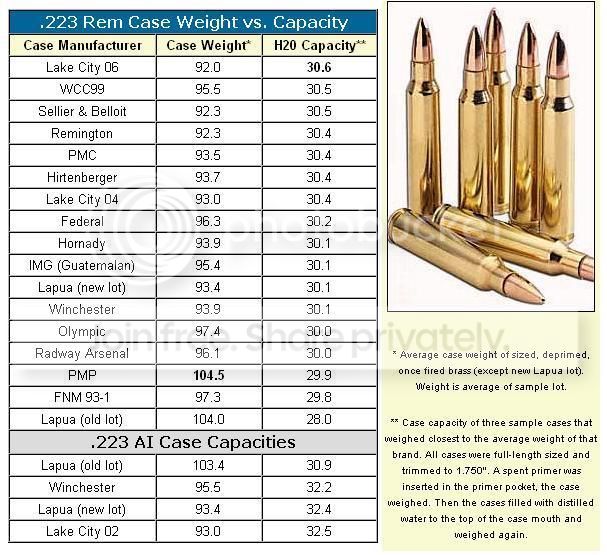
Different brands of brass have slightly different case capacities. Military cases for example are much thicker and the internal capacity is reduced by approx. 2 grs compared to many commercial 308 cases. You are reaching a max compressed load and it sounds like you are putting so much pressure on the powder trying to seat the bullet you are starting to swage to nose of your bullet to the exact shape of the bullet seating cone in your seating die. I doubt you have damaged your die but you are simply trying to put too much powder into a case. You are exceeding the elastic limit of the case neck to hold the bullet. I would suggest you back off a grain or two or go to a ball powder that takes up less space. Try W760
 
A previous post asked how the powder was being measured? Did you calibrate your scale with scale checking weights? Was each powder dump weighed or simply used out of the powder dump? When you're going to max loads a SMALL VARIATION in weight makes a signicant difference in volume. AND as previous posts mentioned different brands of brass can have SIGNIFICANT differing volumes.
 
Federal brass is one of the heaviest so you simply don't have the case capacity. I'm currently loading for 3 different cartridges and none of them will take max charge with federal brass without overpressuring
 
Check it out bro. Case volume for .223 can vary by as much as 2 grains between manufacturers.

223casecap_zps81d3f3e5.jpg
 
I'd be more worried about blowing my face off when you go to fire them.
I find those loads to be way too hot at least in my rifle with a Lake City brass.
I was getting sticky bolt lift at 41.5gr from my Savage 10BA which usually likes hotter loads.

I know the Hodgdons site has 41.5gr as a starting load and 45.5 as a max compressed load but other manuals have 41.3 and 42.8 as max loads with starting loads as low as low as 34.0 so never take what one manual says as gospel.
Fingers and eyes don't grow back.
If you get hard or sticky bolt lifts don't keep shooting hotter loads.
Just because it is a starting load in their rifle it doesn't mean that you can't start lower in yours.

Best of luck.
 
Wow, good answers. Thank you everyone.

I weighed every single charge with my RCBS digital scale. The scale was calibrated before using, and with each weighing out of powder I waited enough seconds until the 'stable' reading light lit up. The scale appears to be accurate to 1/10 of a grain repeatably (sp?). I filled the cases using one of those see-through plastic red Hornady powder funnels. All cases inspected afterwards for filling mistakes. The die I'm using (where they stick) is a Forster Bench Rest seater; I got all my kit from Mystic Precision.

I know it doesn't mean all that much, but I took apart several of the federal factory loads that I'm trying to duplicate and measured the amount of powder they held and studied it to see what it looked like... although obviously burn rate can vary, the form/cut of the powder was nearly identical so it gave me some estimation of what a case could hold.

Thankfully I took good notes, and I know I started feeling uncomfortable regarding case capacity around 44gr. So when I get home tonight I'm gonna pull the 44.5, 45, and 45.5 gr loads and I'll just do my work-up from 41.5 to 44gr, making sure to stop and check after each one for signs. I'm used to shooting factory Federals with the same bullet, so I know the magic spot is probably somewhere around 42, and maybe once I hit the sweet spot I'll do another work-up around .25gr increments to fine tune it.
 
It is worth keeping in mind that electronic scales can wander over time as they warm up. They are also susceptible to wind currents if you have a fan or open window. A cheap elec scale can go bad easily and you will not know it unless you have some calibration weights.

For all these reasons I prefer a balance beam scale.
 
It is worth keeping in mind that electronic scales can wander over time as they warm up. They are also susceptible to wind currents if you have a fan or open window. A cheap elec scale can go bad easily and you will not know it unless you have some calibration weights.

For all these reasons I prefer a balance beam scale.

Weeeell.. I've never seen a budget electronic scale that costs more than $50 that didn't come with a calibration weight. I've bought five scales, and the only one that didn't come with a weight was a $500 lab grade system that expected you have to insanely expensive, certified calibration weights you have to purchase separately.
 
Back
Top Bottom