1/2 HP 3-speed motor too big for small homemade tumbler?

mactroneng

CGN Ultra frequent flyer
Rating - 100%
29   0   0
Location
SW Ontario
Been thinking of making my own tumbler to try wet/SS pin tumbling as I have a bunch of wood to build a frame, a motor and other parts already so cost would be minimal (compared to buying a tumbler).

The motor is a 1/2 HP 3-speed (EDIT: 4-speed motor (lo, mi-lo, mi-hi, hi), 1050 rpm) furnace motor, I'm don't really do a huge amount of brass at any given time (maybe 2-3 lbs max) so I'm worried it'd be too big for my application, even if set up with proper belts/pulleys/shivs and running on low speed.

EDIT: Also pulled the motor from the vent blower, 120VAC, 0.75A, 3450 RPM... Probably too fast ti be useful.

But it does give me the option of making the setup larger later on if I need it.

Thoughts?
 
Last edited:
Too big is not a problem. The motor will spin only at its set speed, loaded or unloaded. Furnace motors are however intended to be in the air flow for cooling. Might not be a problem with very little load on it, but they don't have their own internal cooling fan because they sit in the air blow of the blower they power.
 
I have a older red high speed STM wet tumbler and it cleans the cases extremely well. "BUT" this form of tumbling can peen your case mouths, and the amount of peening depends on the speed of the tumbler and how long you tumble.

I trim my rifle cases every time I wet tumble to clean up the case mouths. It causes the case mouth to thicken and the edges of the mouth to roll over.

Bottom line with wet tumbling the less time you tumble the better off you are. In another reloading forum a person wet tumbled for 4 hours and was asking why his case mouths were thicker.

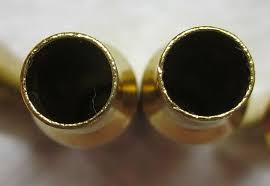
Below on the left is a case I let tumble over four hours, this case was fired once, trimmed and deburred before tumbling. And you can now see the mouth was pounded so much all traces of trimming and chamfering have been obliterated. The case on the right is right out of the factory bag and shows the effects of factory tumbling.

I'm not trying to dissuade anyone from wet tumbling I'm just warning about the effects on the case mouths. Even your hand cranked media separators can ding up the case mouths after any form of case tumbling. And when wet tumbling I try to limit my tumble times to 2 hours or less and take it easy with my media seperators. Wet tumbling is a learning process and you should check your cases with a magnifying glass every hour for peening.

CIxnlIW.jpg
 
Too big a motor doesn't exist.

You'll probably need some gear to reduce its speed/increase torque. Fan motors are typically ungeared to run fast but moving air doesn't require much torque.
 
I had though about the cooling issue, I think going to temporarily rig it and run it to see how hot it gets without airflow over it.

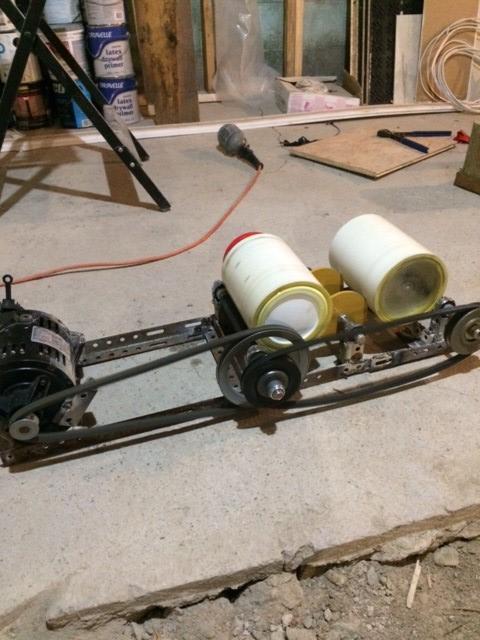
As far as gearing goes, I was thinking of rigging up a belt drive system to the motor shaft to slow down the tumbling action.
 
Well - The lowest speed is likely 1200 rpm. Practically, the largest reduction via two pulleys will be 10/1. Do you want a tumbler that spins at 2 revs per second ?
 
60 rpm at the drum seems about right for my homemade wet tumbler. I used a furnace motor but geared it down with pulleys and a 20:1 worm drive gearbox.

With a 1/3 HP motor and a 5 gallon tumbler (10 lbs of pins) the motor does not get hot.
 
Well - The lowest speed is likely 1200 rpm. Practically, the largest reduction via two pulleys will be 10/1. Do you want a tumbler that spins at 2 revs per second ?

If instead of spinning the drum directly, you spin one of the rollers it sits on and use grip tape or similar (maybe wrap a belt over the drum and the roller, extend the length of that roller so you have space without hitting the other one) on that roller, you could get a reduction much larger than 10:1.

Say you get 5:1 on the pulleys and then a further 5:1 on the roller/drum set up, that'd be 48 rpm from a 1200 rpm motor.
 
Your target drum speed should be ~60RPM (+/- 20RPM).

There are 2 stages of speed reduction; the pulleys on the belt drive (motor to roller) and from the roller to the drum.

Stepping 1040rpm down to 60RPM will require a reduction of 17:1.

You need to oversize the motor if you are using a blower/fan motor as these are designed with the expectation there will be airflow (as a result of a fan).
 
The motor size is not a problem, although you could get by with a much smaller motor. The speed will be what needs to be controlled, and as the above post mentioned, you can use the appropriate size pulleys to get it slowed down enough.
 
I have a older red high speed STM wet tumbler and it cleans the cases extremely well. "BUT" this form of tumbling can peen your case mouths, and the amount of peening depends on the speed of the tumbler and how long you tumble.

I trim my rifle cases every time I wet tumble to clean up the case mouths. It causes the case mouth to thicken and the edges of the mouth to roll over.

Bottom line with wet tumbling the less time you tumble the better off you are. In another reloading forum a person wet tumbled for 4 hours and was asking why his case mouths were thicker.

Below on the left is a case I let tumble over four hours, this case was fired once, trimmed and deburred before tumbling. And you can now see the mouth was pounded so much all traces of trimming and chamfering have been obliterated. The case on the right is right out of the factory bag and shows the effects of factory tumbling.

I'm not trying to dissuade anyone from wet tumbling I'm just warning about the effects on the case mouths. Even your hand cranked media separators can ding up the case mouths after any form of case tumbling. And when wet tumbling I try to limit my tumble times to 2 hours or less and take it easy with my media seperators. Wet tumbling is a learning process and you should check your cases with a magnifying glass every hour for peening.

CIxnlIW.jpg
Excellent advice have you noticed any significant accuracy affects from cleaning 2 to 4 hours
 
Your target drum speed should be ~60RPM (+/- 20RPM).

There are 2 stages of speed reduction; the pulleys on the belt drive (motor to roller) and from the roller to the drum.

Stepping 1040rpm down to 60RPM will require a reduction of 17:1.

You need to oversize the motor if you are using a blower/fan motor as these are designed with the expectation there will be airflow (as a result of a fan).

If I run the motor on the lowest speed heat should be less of an issue (or a non-issue altogether... heat is generated because of waste of power, and power is a cubic relationship with speed... so say the lowest speed is half, power usage/wastage should reduce to 1/8th or thereabouts), and stepping down the speed for the tumbler should be a lot easier.
 
If I run the motor on the lowest speed heat should be less of an issue (or a non-issue altogether... heat is generated because of waste of power, and power is a cubic relationship with speed... so say the lowest speed is half, power usage/wastage should reduce to 1/8th or thereabouts), and stepping down the speed for the tumbler should be a lot easier.

Speed isn't necessarily the only factor in how much the motor heats up, it's more the amount of load you're putting on the motor.
For example, a 1/2HP motor is designed to put out 1/2HP worth of power with constant airflow, however, it can work without cooling if you're not using anywhere near it's max output.

You can reduce the load presented to the motor by increasing the gear/pulley reduction, at the expense of tumbler drum speed, it can take significantly longer to tumble. So you'll need to match the motor power with the amount of brass you want to tumble.

My original tumbler with a 1/4HP motor would severely overheat, just putting 8lbs of stuff (media, water, brass) but would run ok with a high speed computer fan blowing directly into it. I've since swapped it for a 1/3HP motor and it now runs just warm with the same 8lb drum without the need for a fan. For what you're doing, I'd say something like a 1/4HP will do just fine, but I'd be hesitant using anything smaller.
 
If I run the motor on the lowest speed heat should be less of an issue (or a non-issue altogether... heat is generated because of waste of power, and power is a cubic relationship with speed... so say the lowest speed is half, power usage/wastage should reduce to 1/8th or thereabouts), and stepping down the speed for the tumbler should be a lot easier.

Don't know where you got your electric motor smarts from, but you need to study some more. :)

There are 3 things that cause heat in a motor: friction, hysteresis, and the amount of current passing through the windings to accomplish the work you want to do. You can't do anything about the first two, they are the product of the motor spinning. as for the aamount of current, well, the less work your motor does the less current needed and thus less heat.

Also, if you look at most motors, they have a temperature rating . That's above ambient. So if your motor has a temperature rating of 40C, it could be happily operating at 70C. Just because it is uncomfortable to touch, does not necessarily mean it's over heating.
 
I have a older red high speed STM wet tumbler and it cleans the cases extremely well. "BUT" this form of tumbling can peen your case mouths, and the amount of peening depends on the speed of the tumbler and how long you tumble.

I trim my rifle cases every time I wet tumble to clean up the case mouths. It causes the case mouth to thicken and the edges of the mouth to roll over.

Bottom line with wet tumbling the less time you tumble the better off you are. In another reloading forum a person wet tumbled for 4 hours and was asking why his case mouths were thicker.

Below on the left is a case I let tumble over four hours, this case was fired once, trimmed and deburred before tumbling. And you can now see the mouth was pounded so much all traces of trimming and chamfering have been obliterated. The case on the right is right out of the factory bag and shows the effects of factory tumbling.

I'm not trying to dissuade anyone from wet tumbling I'm just warning about the effects on the case mouths. Even your hand cranked media separators can ding up the case mouths after any form of case tumbling. And when wet tumbling I try to limit my tumble times to 2 hours or less and take it easy with my media seperators. Wet tumbling is a learning process and you should check your cases with a magnifying glass every hour for peening.

CIxnlIW.jpg

Yup. That's why I do my sizing / trimming & chamfering / deburring AFTER wet tumbling. Just don't those operations before and you'll be fine. I only decap prior to wet tumbling.
 
Don't know where you got your electric motor smarts from, but you need to study some more. :)

There are 3 things that cause heat in a motor: friction, hysteresis, and the amount of current passing through the windings to accomplish the work you want to do. You can't do anything about the first two, they are the product of the motor spinning. as for the aamount of current, well, the less work your motor does the less current needed and thus less heat.

Also, if you look at most motors, they have a temperature rating . That's above ambient. So if your motor has a temperature rating of 40C, it could be happily operating at 70C. Just because it is uncomfortable to touch, does not necessarily mean it's over heating.

My logic was that under less load I could turn it slower, I guess that doesn't make sense now that I think about it again... but that's why I'm here asking!
 
You don't need a big motor to power it.

Mine is pretty small (breadmaker motor and belt speed reducer) but does the trick. I use a 6 inch pvc pipe drum that holds 4.5 liter and is for sure big enough.
Also made a drum from 10 inch pipe and the moter can spin it no problem but a big drum gets uncomfortable to handle (very heavy when full of pins, brass and water) so if I have a larger batch I prefer to run my 4.5 liter drum twice.


Here are some more ideas. Mine is in post 33 and 35.
Good luck!

https://www.canadiangunnutz.com/forum/showthread.php/1487550-Homemade-tumbler-Who-s-made-one
 
Back
Top Bottom