1 first load devellopment: 300 Win Mag for Cadex Freedom lite

Icefire

CGN frequent flyer
Rating - 100%
42   0   0
So I’m doing a load dev. to be able to have some ammo to some 600-1200yd shooting this summer.
Current range is only 100M but I’ll probably get another range with at least 300M.

I bought a Cadex in 300WM which was suposed to shoot less than 1/3 MOA at 600, I loaded the same component and recipe at 100M: no luck.

I loaded 110 new hornady brass, FL sized .002 bump with .331 bushing, Federal Large Gold Primer, H-1000 and 208gr ELD-Match bullet seated at full mag length (2.890 ogive)

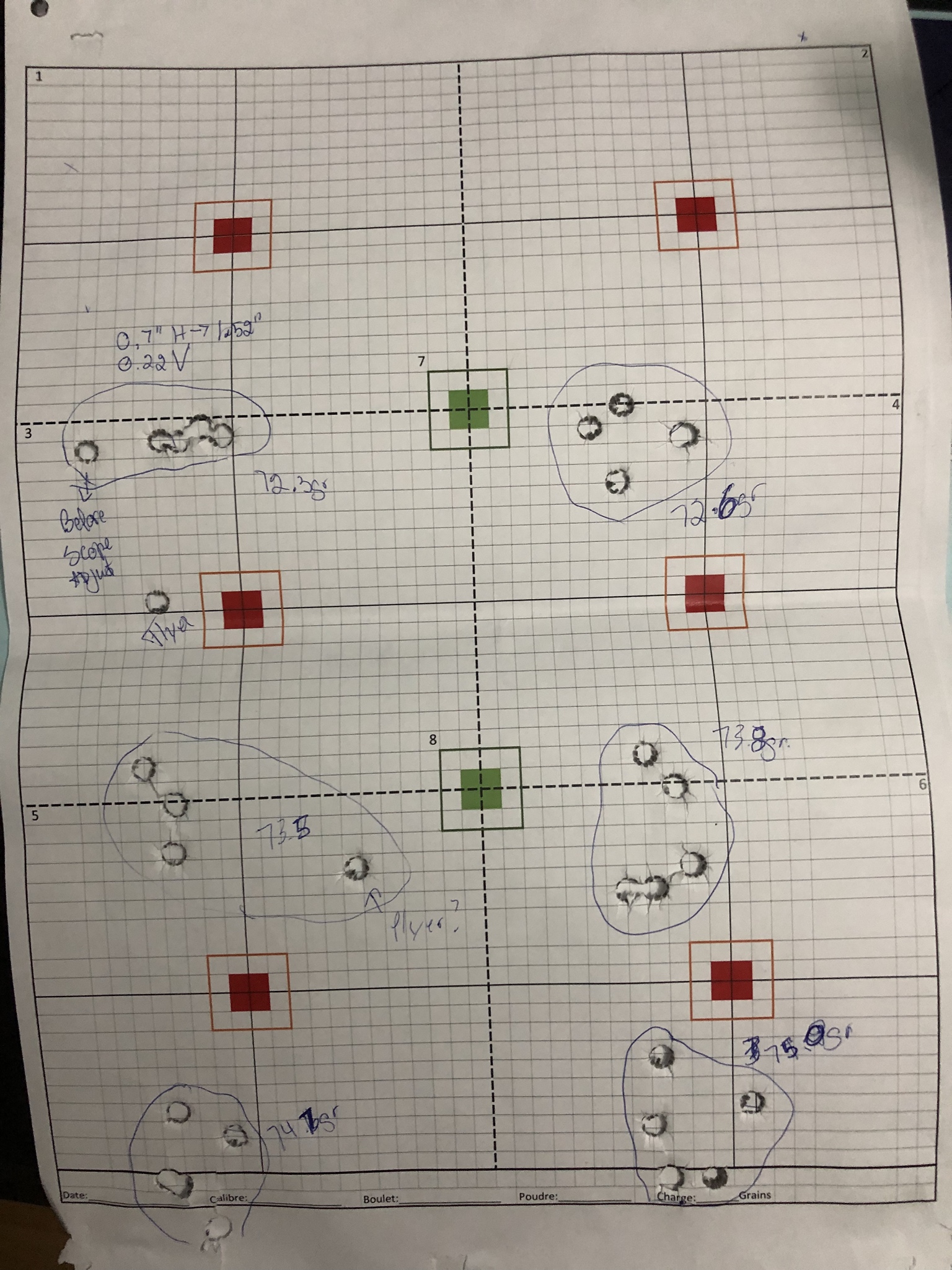
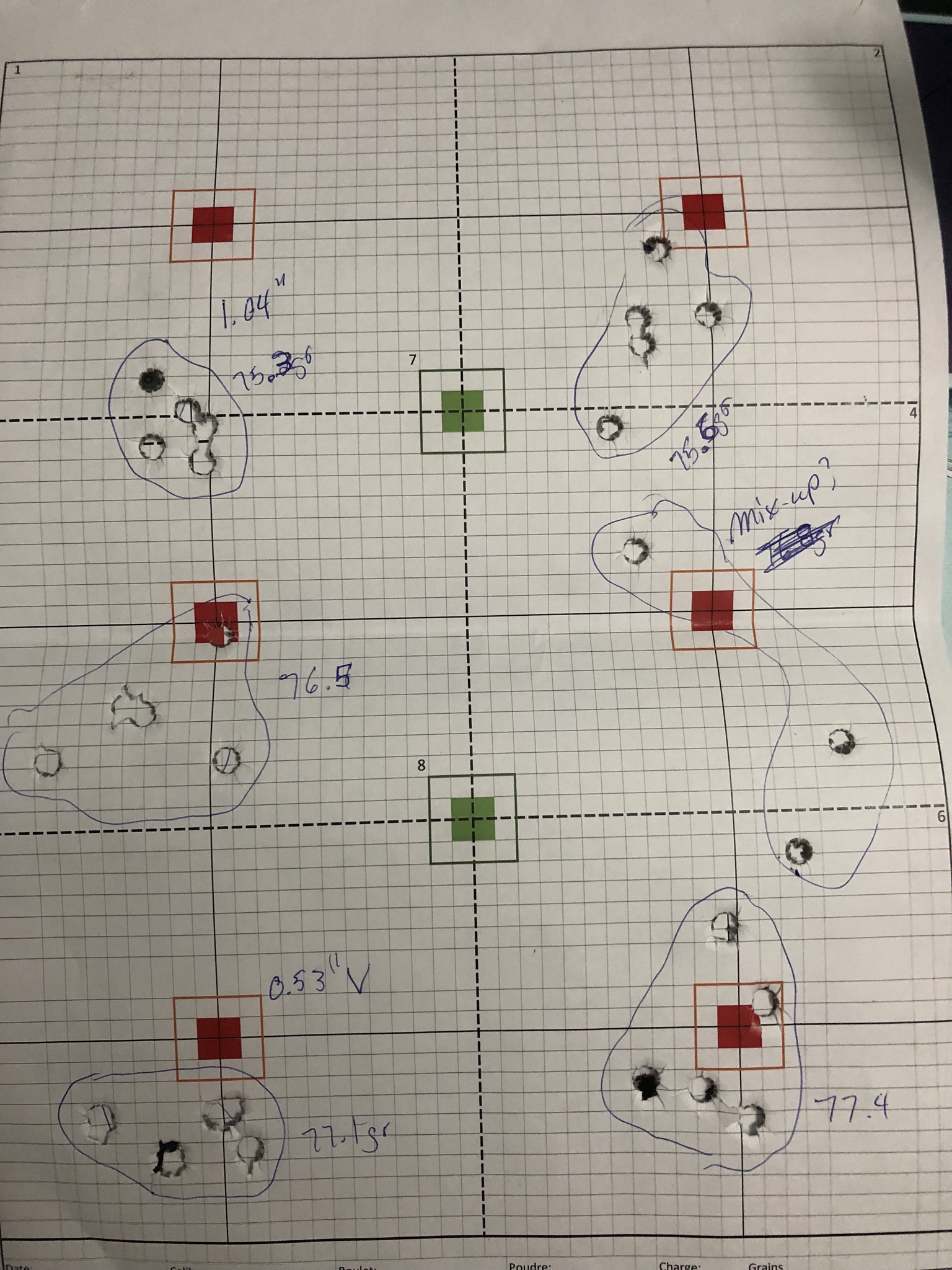
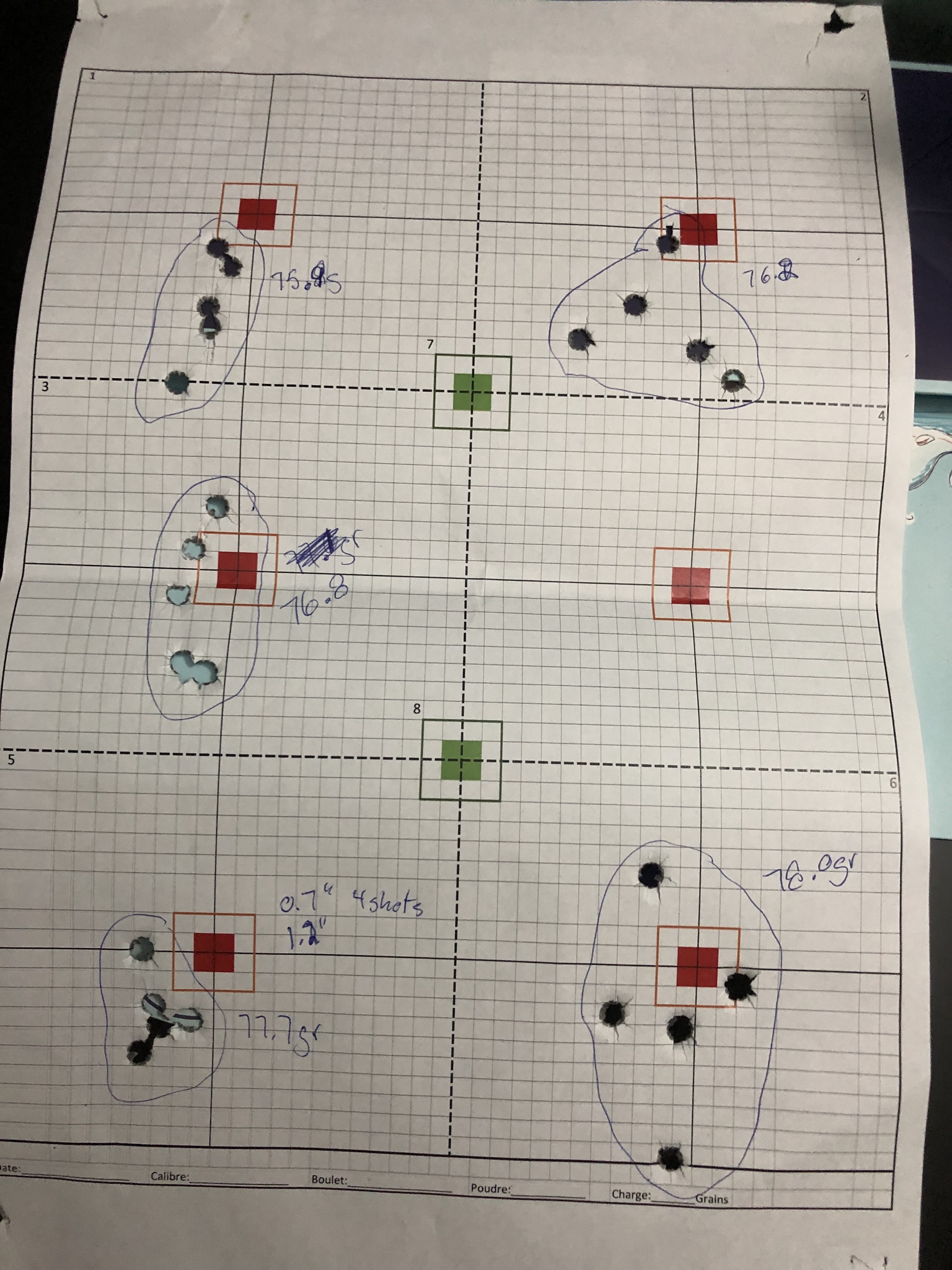
Load where 5rnd of each .3gr from 71.7 to 78.0C, shot from Harris bipod, 10-50x60 SIII Sightron on bench.

I need to work my trigger release but the worst is my heartbeat jump the crosshair at least 0.25-0.5” at 100M, when I’m steady on target. There was some brease which probably did not help, even with 12’ berms.

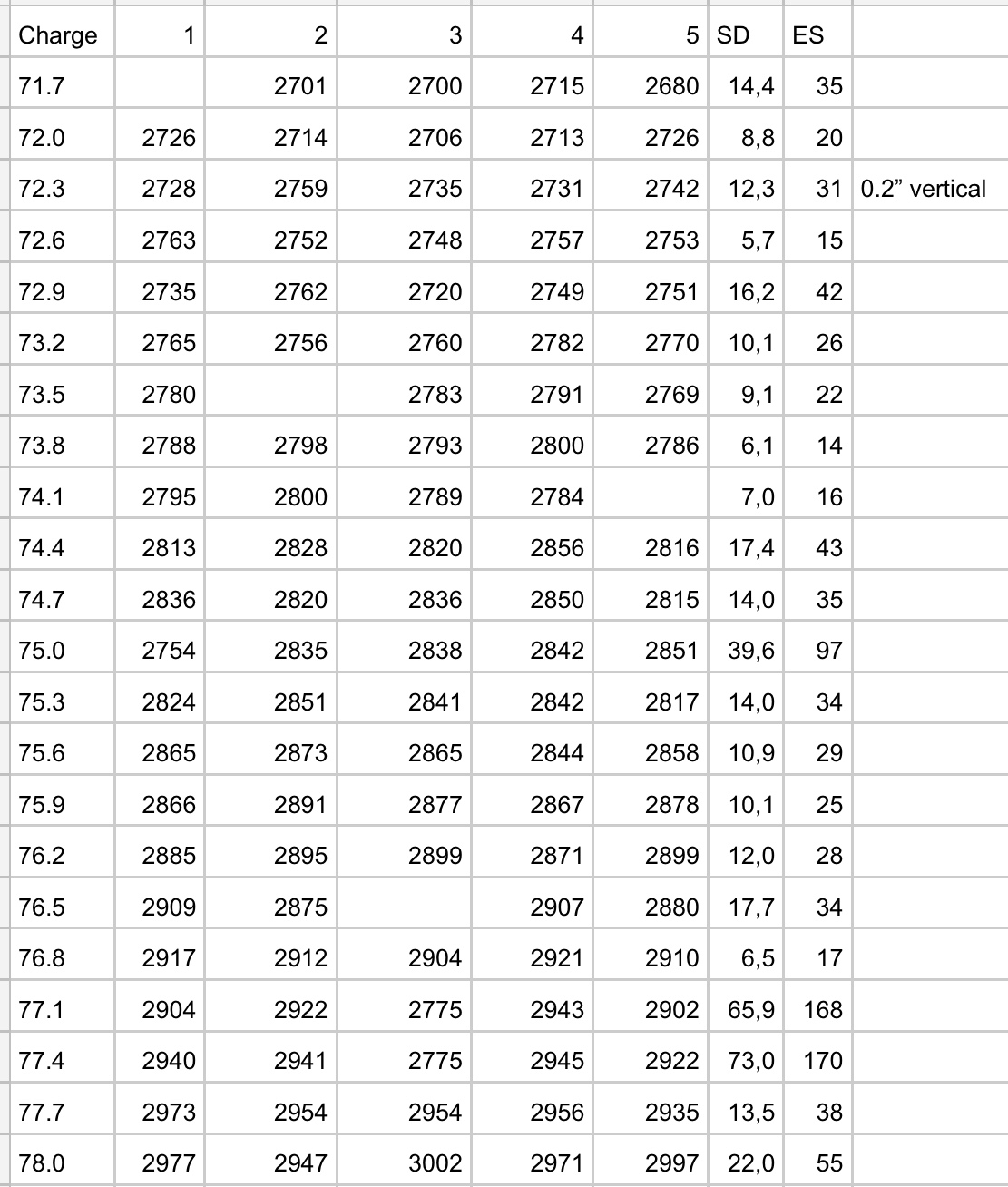
Here’s the result, Any help where to do +-.1gr load ? 72.3gr is flat with 0.2 vertical, 77.1gr has 0.5” vertical, 77.7gr 4 shot is touching
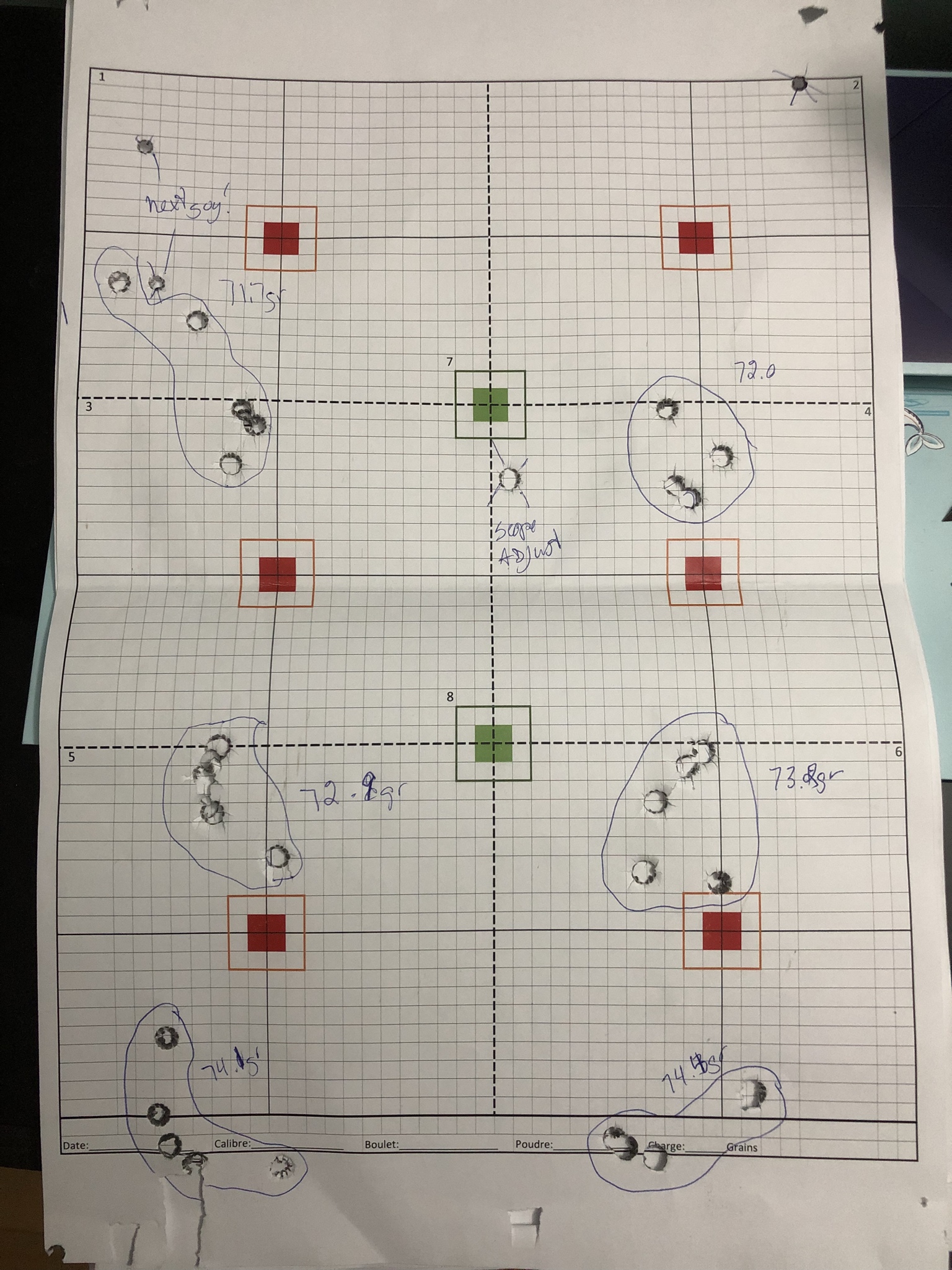
J0XXCEp.jpg


YQ7JtbF.jpg


DhGrHpY.jpg


liVj0hd.jpg


RygfiMD.jpg
 
Last edited:

I want to clarify something.

Did you really sized brand new brass and developed a load with brand new unformed brass in a brand new barrel that has not shot at least 200 rounds?

First: Get better brass.

Second: Don't try to develop any solid load until you shot 200 rounds. By doing so the barrel will have settled in and will be ready to give you solid and stable informations.

Third: Don't try to develop a load with new un-fireformed brass.

Fourth : Don't FL size new brass you will screw up more thing than not. You have bumped the shoulder of new brass that is already uber short versus your chamber....
If you really need to size new brass only neck size. Once you fired them, then do you FL bushing setup.( bump in relation of headspace taken from brass from maximum pressure safe load)

I'd load 74.1 gr and fireform all my brass with that charge. Then once I hit the 200 rounds I'd develop a load with my formed resized brass.
 
Last edited:

barrel has 400+ rnds, not a new firearm
Most ppl say to size new brass as some might get out of round, Die was setup with already fired cases, .002 shoulder bump, I could resetup with the 78.0gr load brass.
 
For starters 100yards doesn't mean anything. I have seen some bad looking groups at 100 look fantastic at 300. Also I have seen seating depth take a load form 1.25 moa down to .5 moa. One more thing turn your magnification down and see if that helps.
 
One thing I found with 208 AMAX in my 300wm was they needed to be pushed hard to show good accuracy. It was a lot of H1000...in my 300WSM they shot amazing at moderate velocity.

Again most groups at 200 were better than the groups at 100.

How far off the lands are they?
 
Second time with the bipod, I was loading it againt the bench end (window)

0.020 jump to lands

Those were shot at 50x max zoom
 
First thing you do with new brass is load them up with a low to moderate charge and cheap bullet. Off to the range and shoot them. Don't even try to get fancy. All you want to do is get the brass fire-formed close to your chamber size. Now that this step is basically done, you can move on to the next one. In particular - Do not bump the shoulder back more than a thou or so. Belted magnums are particularly prone to stretch and case separation issue just above the belt.

First reload you will want to use a Lee collet neck die (NOT the Lee factory crimp collet die) to neck size. No full length resize, no neck bushing resize, no shoulder bump on the first reload. About the only brass that I have seen consistent enough out of the box for neck wall thickness is Lapua for bushing neck sizing without turning. Since Lapua doesn't make 300WM and you have already stated that you are running Hornady they would in my opinion. On the first reload you shouldn't need to do anything else. Once the Lee neck sizing is done, load 'em up with your ladder. 0.3 gr increment is good but 0.5 with 300WM will work as well initially and you won't have to load up as many rounds. You can fine tune later. Going with 5 rounds per increment is a good idea from my point of view but others have different methods. Whatever works for you. Shoot them, preferably at a distance of more than 100m. 300m is much more useful.

You are looking for two items now, first one is a tight group with the least vertical spread. If you have a couple of good groups and one has more vertical spread than the other, then pick the one with the least. The reason for that is the smallest vertical at 300m will also be the smallest vertical at 1K. Horizontal variance can most often be attributed to wind even though you think there isn't enough to make a difference. Even small breezes push bullets around. The other thing to look for is good ES and SD. If you have two groups with good verticals and similar horizontal groupings, pick the one with the worst ES and SD! It means that the rifle likes it and is not as particular about what it is getting fed for ammo at that charge level and the resulting velocities are in that node.

Now you have a bunch of brass that is twice fired and being from a 300WM it will be starting to show some need for TLC. Some might even show some indications of pressure with stiff bolt lift after firing. If so it will definitely need resizing and likely trim to length.
Set up a full length die to bump the shoulder 1 thou to 1.5 thou maximum. If this die also neck sizes, and you didn't have any problems with bolt lift, you might be good to go. First off, check the case length to be sure it is within the max length limit. If so, reload and fine tune by shooting some ladders at 0.2gr increments around any of the accuracy node(s) you have identified. If you have a Redding body die, it doesn't do the neck and that will have to be taken care of in a separate step. You can use the Lee neck collet die or you can get the brass properly prepped for bushing neck sizing by neck turning. Some people just go ahead and neck size without neck turning. I'm not one of them. You will have to decide this for yourself.
 
Last edited:

Is the action bedded properly?

Those groups would be ok for a 30-06 Remington semi...

100 means nothing. Even if they were bug holes, they would not be indicative of a decent group at 600 yd. And only a 1000 yd group will tell you if the rifle will group at 1000.
 
rick those are good info, I didn’t have enought once fired to test so I bought all new one thinking they should be good to go as I have read around and most of the time they should be accurate, guess not.

I’ll load some 0.5gr amd retest. I tought 0.5 would easily miss a node so I tought about 0.3 first than 0.1 over and under good node.

For ES /SD, most talk about getting single digit low 10’s for ES/SD? you say to pick the worst? Those can also vary as 4 kernel of H-1000 is 0.1 gr, Can those change the spread with my scale accurate to +-0.1?
 
Your ES needs to be <10 ft/s

Bi-pod will compromise guilt edge accuracy.

H-1000 is a bit on the slow side (powder is burning progressively past peak pressure) , even with a 208gn bullet

Has you scope mounting system been degreased (even the oil from your finger prints) and torqued properly?

Does you scope hold zero? many don't when your looking for 0.33 moa at 600 yards.

Have you dispensed powder to the nearest 0.02gn's

Have you weigh sorted the brass, then velocity sort.

Using a primer that has less brisance , say a Federal 210M as compared to the average magnum primer like a CCI-250. This 'light' primer will have less dominance over the load...so any variances are limited.

The bullet needs to be on a vibration node when it exits the barrel. Acquire and study an internal ballistic program such as quick load.

And last work on your bench technique.

It's not easy to get 0.3 moa.
 
rick those are good info, I didn’t have enought once fired to test so I bought all new one thinking they should be good to go as I have read around and most of the time they should be accurate, guess not.

I’ll load some 0.5gr amd retest. I tought 0.5 would easily miss a node so I tought about 0.3 first than 0.1 over and under good node.

For ES /SD, most talk about getting single digit low 10’s for ES/SD? you say to pick the worst? Those can also vary as 4 kernel of H-1000 is 0.1 gr, Can those change the spread with my scale accurate to +-0.1?

Eventually you will want to fine-tune and hopefully the ES and SD numbers will stay as low as possible, but initially you want an excellent grouping with the worst numbers. It means the rifle likes what it is getting fed for ammo. If you are getting excellent grouping with the ammo and your ES is 50 and SD is 30, it means that ES (extreme spread) has a 50fps difference from top to bottom and yet the bullet is still hitting the target in the right spot. A way to look at this is that if you are getting excellent accuracy at 2810fps +/- 25fps then you have a bigger window of velocity range that works. It just means that this is a really good place to work from, both higher and lower by 0.2 or 0.3gr and try to find the peak accuracy node which should be very close and may show better ES/SD as it is approached. Bottom line is that you might get really lucky and find an accuracy node with very low ES and SD right off the get-go, but it is only good within very tight limits of velocity. If temp change or loading variations get in the way that node could be hard to keep inside of. Another way of putting it is that you get excellent accuracy at 2725fps +/- 5 fps but as soon as you step 10fps away from that velocity things go for crap.

As well, there are all sorts of slight accuracy variables that make things work at 100 and totally fail at 300, or things that work at 300 and totally fail at 750 or 1K but, the longer the distance you work on and are accurate for, the higher the probability it will still work or will work in a consistent manner at even longer distances.

I should add that throwing powder 0.1gr or better is great for .223. 0.1gr for 300WM is overkill.
 
Last edited:
Is the action bedded properly?

Those groups would be ok for a 30-06 Remington semi...

100 means nothing. Even if they were bug holes, they would not be indicative of a decent group at 600 yd. And only a 1000 yd group will tell you if the rifle will group at 1000.

It is a chassis gun nothing to gain with bedding.

Agree with the 100 means sfa
 
BcBrad I’m already using 210M primers, weighting with an hornady scale (0.1gr accuracy but I check often)

Scope is brand new, new harris xtr signature ring with SIII 10-50x60

Isn’t H-1000 the powder for 300WM?
 
A.331 bushing sounds small to me. You should have high neck tension with that. How are the bullets going into the brass? With a .336 And Nosler or PPU brass the bullet slides in with little effort. I haven't loaded Hornady in a while but I'm sure it was close with a .336
 
I’ll need to find a 300M+ range....

Yes, more distance is generally required, but you can have fun at 100m and work on the load development. You can use something like H4895 with a minimum of 60% of max load for that bullet as per Hodgdon loading charts, and work up to make up some gentle loads for practice with and work on the reloading skills as well. Use a relatively light bullet, something in the 168 to 175gr area for now too. One of the good things is that you will get used to the rifle reducing tendency to flinch and you should be able to follow through better. Once you get on to a longer range, then you can start working up the 208gr H-1000 loads and you will be fairly well versed in exactly what you should be doing and what you should be looking for.
 
A.331 bushing sounds small to me. You should have high neck tension with that. How are the bullets going into the brass? With a .336 And Nosler or PPU brass the bullet slides in with little effort. I haven't loaded Hornady in a while but I'm sure it was close with a .336

0.336" sounds too big to me.

0.336 - 0.308 = 0.028" (bushing minus bullet)

0.028 - 0.002 = 0.026" (minus tension)

0.026 / 2 = 0.013 (neck wall thickness)

I have never used Hornady 300WM brass but does it really have a neck thickness of 0.013"?

I definitely use a 0.330 bushing in both my Forster and Redding dies for my PPU brass which started with a neck wall thickness of around 0.011 to 0.012. I think I started with 0.332 bushings. Once I neck turned, it went down to 0.331, and now, with work hardening after 7 reloads, I have had to go to 0.330 to maintain tension. At some point I will have to decide whether to anneal (which means purchasing an annealer of some sort) or just buy new brass. I am definitely leaning towards the latter. It seems that my 6.5 brass has primer pockets loosening up starting around the 12-14 reload mark so they will head for the smelter before too long. If the same thing happens with my 308 and 300WM brass then annealing is probably a waste of money, at least for me.
 
H-1000 works well with the heavies in the 300wm, although powder is progressively burning past peak pressure. This seems to induce a higher ES than what could be, but marginally so.

I have exceptional accuracy in my rifle with H-1000 and 208gn A-maxes, ~0.4 moa, 5 shot groups out to 1000 yards on occasion.

Your scale has a 'built in' 8-10 ft/s ES already, case weights/volumes will induce an even greater ES if not sorted to as low a variance as practical. On good brass I typically get between 30 and 40 cases, out of 100, that are within a grain +/-, these are then velocity sorted out off that the population is reduced by ~ half. Last outing by this method yielded 2.25" vertical at 1000 yards (5 shots).

Adjusting the parallax on the scope is a must, testing the scope for adjustment accuracy and return to zero should be done as well. Sightrons are good scopes but I did have one fail as my groups at 300m started to open up to 1 moa from the normal 0.3-0.5 moa. It was sent for service and is fine now.

Not all doom and gloom from me, but there is a lot of ground work before you get to the range and expect 0.5moa accuracy.

A few things that helped me in the search for accuracy are:

A good accurate repeatable scale, AD FX 120i, weigh powder charge , cases, and bullets

A good chronograph, LabRadar, claimed accuracy is 0.1% or ~ 3 ft/s

An internal ballistic program, Quick Load works for me to find compatible powders for the components I'm using, these can be modeled to shorten the journey to a good load. For the system to work requires some study on the users part, the program basically does the math for you in finding an Optimal Barrel Time.

The scope and mounting system must be perfect. The rifle mechanically sound. The operator must have the proper technique, whether bench , prone, bags , bi-pods etc. Ammunition must be match grade .

A lot of stuff in the above , try to eliminate as many variables as possible. Good tools and procedures are the way, I still struggle with the human factor lol.
 
0.336" sounds too big to me.

0.336 - 0.308 = 0.028" (bushing minus bullet)

0.028 - 0.002 = 0.026" (minus tension)

0.026 / 2 = 0.013 (neck wall thickness)

I have never used Hornady 300WM brass but does it really have a neck thickness of 0.013"?

I definitely use a 0.330 bushing in both my Forster and Redding dies for my PPU brass which started with a neck wall thickness of around 0.011 to 0.012. I think I started with 0.332 bushings. Once I neck turned, it went down to 0.331, and now, with work hardening after 7 reloads, I have had to go to 0.330 to maintain tension. At some point I will have to decide whether to anneal (which means purchasing an annealer of some sort) or just buy new brass. I am definitely leaning towards the latter. It seems that my 6.5 brass has primer pockets loosening up starting around the 12-14 reload mark so they will head for the smelter before too long. If the same thing happens with my 308 and 300WM brass then annealing is probably a waste of money, at least for me.


Annealing helps in lowering ES, consistent bullet release and accurate sizing/shoulder bump are two items that help accuracy.

Brass longevity is another. Loose primer pockets should be the first sign of brass that is headed to the smelter.

There are many annealing machines that work great, gas or electric. I have not spent the $700- $2000 on such a machine, they work and are very convenient.

I am getting good results using a drill motor with appropriate sized socket and a small propane torch and 1 pound cylinder, 8 seconds in flame for 308/3006 sized cases and larger , 6 seconds for 223 cases.

Small rifle primed brass seems to last for ever and Large rifle primed cases have gone through 15+ cycles and counting with no issues.
A properly sized, annealed case is one that does not require much trimming either. Actually I trim to uniform new cases then that's about it.
 
Back
Top Bottom