1 first load devellopment: 300 Win Mag for Cadex Freedom lite

Annealing helps in lowering ES, consistent bullet release and accurate sizing/shoulder bump are two items that help accuracy.

Brass longevity is another. Loose primer pockets should be the first sign of brass that is headed to the smelter.

There are many annealing machines that work great, gas or electric. I have not spent the $700- $2000 on such a machine, they work and are very convenient.

I am getting good results using a drill motor with appropriate sized socket and a small propane torch and 1 pound cylinder, 8 seconds in flame for 308/3006 sized cases and larger , 6 seconds for 223 cases.

Small rifle primed brass seems to last for ever and Large rifle primed cases have gone through 15+ cycles and counting with no issues.
A properly sized, annealed case is one that does not require much trimming either. Actually I trim to uniform new cases then that's about it.


Loose primer pockets should be the first sign of brass that is headed to the smelter.

Nope! First signs for me are separation issues. Next up is any splitting. Primer pockets loosening up is a progressive (regressive?) process. It happens over time from not noticeable through primer won't stay in. Once that press handle gets really soft and easy when seating, it is time to cull the lot.

Small rifle primed brass seems to last for ever and Large rifle primed cases have gone through 15+ cycles and counting with no issues.

Yes, pretty much agree with that, with the exception of the 300WM. They definitely take a beating every time the trigger is pulled - or maybe that is me taking the beating. :) I definitely give the 300WM the white glove treatment. Never shoulder bump more than absolutely necessary - try to stay around 0.001" or slightly less. Every second reload goes for full length resize - the die is set to shoulder bump 0.001" too. The ones I have have a few miles on them (between 7 and 9 reloads depending on the lot) and they are going to get used up as is. On occasion I have to give them a bit of love in the Willis Belted Magnum Die. My next set will get fireformed to chamber, and then given the full treatment including neck turning. It is the last part of the process I use. I use a 21st century neck turning lathe and it works very well on the other calibers I neck turn. Since it spaces the cutter off the mouth of the case, the cases require all the rest of the steps be done first.

As to annealing, I am still on the fence. I keep on thinking about it but then I look at the results I get without doing so and I really don't see the value in the time, effort and cost involved. Cheaper just to shoot around 15 reloads and then toss the brass. Going to be tossed for reasons unrelated to annealing anyway. I'll continue to mull it over but it is going to take some pretty persuasive hard data to move me on this one.
 
A.331 bushing sounds small to me. You should have high neck tension with that. How are the bullets going into the brass? With a .336 And Nosler or PPU brass the bullet slides in with little effort. I haven't loaded Hornady in a while but I'm sure it was close with a .336

It might, I have no problem on the press but it could be too tight. Last I remember is .0.0125-0.013 wall + .308 bullet = .331-.332 with .002 neck tension. My caliper might induce an error that low. I'll mesure a finished round.
 
Nope! First signs for me are separation issues. Next up is any splitting. Primer pockets loosening up is a progressive (regressive?) process. It happens over time from not noticeable through primer won't stay in. Once that press handle gets really soft and easy when seating, it is time to cull the lot.


Yes, pretty much agree with that, with the exception of the 300WM. They definitely take a beating every time the trigger is pulled - or maybe that is me taking the beating. :) I definitely give the 300WM the white glove treatment. Never shoulder bump more than absolutely necessary - try to stay around 0.001" or slightly less. Every second reload goes for full length resize - the die is set to shoulder bump 0.001" too. The ones I have have a few miles on them (between 7 and 9 reloads depending on the lot) and they are going to get used up as is. On occasion I have to give them a bit of love in the Willis Belted Magnum Die. My next set will get fireformed to chamber, and then given the full treatment including neck turning. It is the last part of the process I use. I use a 21st century neck turning lathe and it works very well on the other calibers I neck turn. Since it spaces the cutter off the mouth of the case, the cases require all the rest of the steps be done first.

As to annealing, I am still on the fence. I keep on thinking about it but then I look at the results I get without doing so and I really don't see the value in the time, effort and cost involved. Cheaper just to shoot around 15 reloads and then toss the brass. Going to be tossed for reasons unrelated to annealing anyway. I'll continue to mull it over but it is going to take some pretty persuasive hard data to move me on this one.

An annealed case will give a reliably accurate bump. Annealing as I do it is not expensive at all, can do 100 cases in ~ 20-25 minutes. I don't want to toss a batch of cases that have been weigh and velocity sorted...that takes time and a trip to the range to record the velocities and sort through those.

For you , with out annealing, you will see splits in the neck, case separation is a function of an inaccurate bump. Also, when full length resizing the results will be variable due to the hardened unannealed brass.

I favor annealing, bumping shoulders back a thou or two then size neck with a Lee collet die.

I am ~9 cycles with my 300wm brass every thing is normal with them.

This morning I prepped 30 cases out of 50 (new brass as its an opportunity to use it as because of a bullet change) that did not meet the weight criteria I laid out for myself. These will be fire formed , sorted by velocity, annealed, sized neck turned a minimum amount, run through the Lee collet die and loaded. Out of these I generally get 15-20 that I can use for competition.

I surely don't want to chuck them after that , if the number is 15, that equates to ~ 225 loadings with those 15 pieces.

Annealing might be worth a look.
 
An annealed case will give a reliably accurate bump. Annealing as I do it is not expensive at all, can do 100 cases in ~ 20-25 minutes. I don't want to toss a batch of cases that have been weigh and velocity sorted...that takes time and a trip to the range to record the velocities and sort through those.

For you , with out annealing, you will see splits in the neck, case separation is a function of an inaccurate bump. Also, when full length resizing the results will be variable due to the hardened unannealed brass.

I favor annealing, bumping shoulders back a thou or two then size neck with a Lee collet die.

I am ~9 cycles with my 300wm brass every thing is normal with them.

This morning I prepped 30 cases out of 50 (new brass as its an opportunity to use it as because of a bullet change) that did not meet the weight criteria I laid out for myself. These will be fire formed , sorted by velocity, annealed, sized neck turned a minimum amount, run through the Lee collet die and loaded. Out of these I generally get 15-20 that I can use for competition.

I surely don't want to chuck them after that , if the number is 15, that equates to ~ 225 loadings with those 15 pieces.

Annealing might be worth a look.

Aaahh, but I didn't say that I have splitting issues. I said that if there were splitting issues they would be a 'holy sheepsh*t, grab the hammer and flatten that sucker out right now' moment. Same thing for head separation issues. I have never seen it because I take good care not to squsih the brass up any more than absolutely necessary. I DO however see primer pocket looseness which seems to start right around 10 reloads but I really notice it by around 14 reloads with my LP Hornady 6.5CM brass. I have gone 18 to 20 reloads with my LP .308 Lapua brass and it is starting to show some indications of loosening primer pockets as well. Never had a problem with getting consistent shoulder bump either. I have a Redding Instant Indicator set up for each of the 'precision' calibers I reload. While I don't bother checking every time I full length size or shoulder bump, a good portion of them get checked out. One indicator is set to the chamber size and the other is set to 1.5thou less. On any group of cases, the bump is very consistent at right around 1 thou. Anyway, I will still monitor my brass and if I think that I can get significantly better reloads than I get right now with annealing I might go for it. As for brass longevity, if the brass is going out due to primer pocket looseness, annealing won't resolve that issue and it will get tossed anyway.

The major reason I am discussing all this is because the OP is wanting to know about 300WM. It is one of the more finicky types of brass to work with due to the belt, relatively thin walls (generally 1 to 2 thou thinner than comparable .308 or 30-06 brass), and there is lots to think about and watch for. Bumping shoulders too much can lead to rapid head separation issues.
 
Last edited:
All this "development" to shoot a 300 Win Mag at 100 yards.

The results mean absolutely nothing about how it would group at 300, 600 or 900. The effect of barrel harmonics only show up at the longer range where you want to be accurate.

You are trying to learn basketball playing in a phone booth.

Take several loads to the range, shoot some groups at a meaningful distance and then go from there.

This is a 1 3/4" vertical group (20 shots) at 525 yards. It was not developed at 100 yards.

RAIL GUN 308 AT 525.jpg
 

Attachments

  • RAIL GUN 308 AT 525.jpg
    RAIL GUN 308 AT 525.jpg
    102 KB · Views: 93
All this "development" to shoot a 300 Win Mag at 100 yards.

The results mean absolutely nothing about how it would group at 300, 600 or 900. The effect of barrel harmonics only show up at the longer range where you want to be accurate.

You are trying to learn basketball playing in a phone booth.

Take several loads to the range, shoot some groups at a meaningful distance and then go from there.

This is a 1 3/4" vertical group (20 shots) at 525 yards. It was not developed at 100 yards.
That has been brought up multiple times already, but yes, the mental image of basketball in a phone booth is pretty interesting.
 
I hope I was not rude.

As it happens I have developed loads for my rifles. I usually have a 600 yard load and a 1000 yard load and over the last 50 years, have usually had a rifle each dedicated to short and long range.

The OP started by saying he wanted to develop loads for 600 to 1200 yards.

At those distances the only thing that matters about a load is how it relates to barrel harmonics. And the only way to know what works is range time at the appropriate distance.

At 1000 yards a single digit SD might be much worse than a SD of 20. It is not new information. A basic part of load development for over 100 years.

Read this: http://www.geoffrey-kolbe.com/articles/rimfire_accuracy/tuning_a_barrel.htm
 
Back in the day instruments for testing are not as good as they are now. Especially an optical chronograph like an Oehler, which requires an exacting set up and consistent lighting.

The article refers to a barrel oscillating like a sine wave. However, the action is more similar to peristalsis (a radially symmetrical contraction and relaxation down a tube).

This pulse of energy travels from breach to muzzle at 18-19,000 ft/s, depending on the type of steel. It is ideal that the bullet exits the muzzle when it is least disturbed.

Every barrel will have an optimum time (mS) for the bullet to exit, this varies due to the length of the barrel.

Therefore, the bullet must accelerate down the barrel in a consistent manner and exit when the barrel is least disturbed , this is referred to as Optimal Barrel Time (OBT).

To get the OBT each cartridge must have the same acceleration rate and velocity as it exits the barrel.

This is done by adjusting the powder charge to tune the load to the OBT.

An Optimum Charge Weight (OCW) aids in getting the bullet to exit at what ever velocity coincides with the acceleration rate (OCW is one that is tolerant to changes in load mechanics and atmospheric conditions) and the OBT . In addition, thinking a muzzle velocity is an accurate indicator of a node/OBT is misguided as it ignores the rate of acceleration.

There are internal ballistic programs that help with the math.

Therefore, an ES at least into the single digits are a must for long range.
 
The article refers to a barrel oscillating like a sine wave. However, the action is more similar to peristalsis (a radially symmetrical contraction and relaxation down a tube).

This pulse of energy travels from breach to muzzle at 18-19,000 ft/s, depending on the type of steel. It is ideal that the bullet exits the muzzle when it is least disturbed.

Every barrel will have an optimum time (mS) for the bullet to exit, this varies due to the length of the barrel.

Therefore, the bullet must accelerate down the barrel in a consistent manner and exit when the barrel is least disturbed , this is referred to as Optimal Barrel Time (OBT).


Therefore, an ES at least into the single digits are a must for long range.

I would agree that a single digit ES would be nice to have at long range - if it worked. But it might not work as well as another load with an ES in the teens.

The barrel is whipping up and down, when fired. It might be moving up when the bullet exits; or it might be moving down. So far as i know, the only way to know is to actually shoot it at long range (not at 100 yards).

If the barrel is moving down, the long range target will show a vertical group. The slower bullets will exit later than the fast ones. Because the barrel is moving down, they will be aimed lower and will print lower. This displacement is somewhat greater than the lower shot due to lower velocity.

If the barrel is moving up, the slower bullets will exit later and be aimed higher, compensating for their lower velocity. So the vertical spread due to velocity difference is reduced, not increased.

So far as I know, the only way to find the load that works at 1000 is to try a range of loads at 1000 and see the results.

I have shot matches at 1000 yards many more times than I can remember or count, and have shot 1200 a few times (maybe a dozen or so) and my impression of 1200 is that it is twice as difficult as 1000. If I was going to be serious about 1200, I would develop a load at 1200 for 1200 yards.

A barrel only has a limited number of accurate shots in it. I am guessing the 300WinMag is good for something in the order of 1500 to 2000. I have had calibers that would only last 1000. It is a race to find a good 600 and 1000 yd load before too much of the barrel life is used up. No testing is done at 100 because the information is useless for picking a longer range load.
 
The barrel is whipping up and down, when fired

It is after it is fired, the effect of peristalsis closes the loop on the Optimum Barrel Time concept.

Loading to achieve OBT and OCW along with mechanically impeccable hand loads yield very low vertical and shot to shot dispersion of ~5 ft/s all the way out to 1000 yds. With an ES of 20 ft/s, good for hunting at typical hunting distances, would be a non-starter on the 1000 yard range.

That's what I have found.

YMMV

Any larger groups at distance usually boils down to bench technique, wind and dealing with mirage.
 
So here's the plan:

Already deprimed and cleaned in Ultrasonic,
Adjust Match S FL Die to bump less than 0.001 datum on shoulder (Might not be able to use FL bushing for the neck as I think it's about 0.25" from the shellplate, if so, Will buy a collet die)
Sort brass (150) in 1gr lot (+-0.5)
Weight each charge and try to get the 1st kernel that change to 0.1gr, from 72 to 78 grain in 0.5gr step @ 5rnds/step (65 rounds)
Verify my OAL as I think I was jamming them (extractor started to show at 76+ which is not normal) will jump 0.020" from land
Find a range with 300M+ to chronograph and report.

Any suggestion?
 
So here's the plan:

Already deprimed and cleaned in Ultrasonic,
Adjust Match S FL Die to bump less than 0.001 datum on shoulder (Might not be able to use FL bushing for the neck as I think it's about 0.25" from the shellplate, if so, Will buy a collet die)
Sort brass (150) in 1gr lot (+-0.5)
Weight each charge and try to get the 1st kernel that change to 0.1gr, from 72 to 78 grain in 0.5gr step @ 5rnds/step (65 rounds)
Verify my OAL as I think I was jamming them (extractor started to show at 76+ which is not normal) will jump 0.020" from land
Find a range with 300M+ to chronograph and report.

Any suggestion?


I have an ultra sonic cleaner and have not used it in years.

The inside of the neck when cleaned as described leaves the brass as rough as pavement , this reeks havoc with consistent bullet release.

All do now is stick a nylon bore brush in my drill motor, give a couple in/outs and that's it.

This keeps the carbon in place , maybe actually smooths it into the irregularities of the inside neck brass.

The case is then chucked in a Lee universal shell holder and into the drill and rotated with 000 steel wool to clean the outside of the neck and body.

A clean outside of neck gives better consistency when using the Lee collet neck die.
 
I have a prep center with 0.30 nylon brush, I could do a pass.
Surprisly, the cheap ultrasonic cleaner with Lemishine, soap and warm water, 15-20 minutes per 27 rnds batch with remove all carbon, exept in the primer pocket where some remain (the prep center with the pocket cleaner does the job)

I tought of leaving the carbon there as I have read it lubrificate like graphite but I'm not sure it would be that appropriate for LR shooting.
 
I have a prep center with 0.30 nylon brush, I could do a pass.
Surprisly, the cheap ultrasonic cleaner with Lemishine, soap and warm water, 15-20 minutes per 27 rnds batch with remove all carbon, exept in the primer pocket where some remain (the prep center with the pocket cleaner does the job)

I tought of leaving the carbon there as I have read it lubrificate like graphite but I'm not sure it would be that appropriate for LR shooting.

That's what I do, leave carbon inside the neck.

My wind reading skills are not the best and mirage being another variable to deal with.

With a regular Tikka T3 rebarreled to 6 Dasher I can do a 10 shot 12" group at 1050 yards, 5 shots between 5 and 7".

Also, with a stock Tikka Tactical in 300wm , it will hold <0.5 moa and one time lucked into 4.00" 5 shot group at 1050 yards.

Don't think the carbon hurts at all, ES is close to single digit.
 
A.331 bushing sounds small to me. You should have high neck tension with that. How are the bullets going into the brass? With a .336 And Nosler or PPU brass the bullet slides in with little effort. I haven't loaded Hornady in a while but I'm sure it was close with a .336


Yep once fired brass is way too big for the .331 bushing, I had a jam.

I got 2 Calipers and they give me a way too low reading (308 bullet give 303 and neck thicknessat 0.009)
Will get a lee neck and neck turning to get consistancy.

Will try to get a bunch of bushing too in .002 step
 
Went back to the range:
rear scope ring was a bit loose, torqued
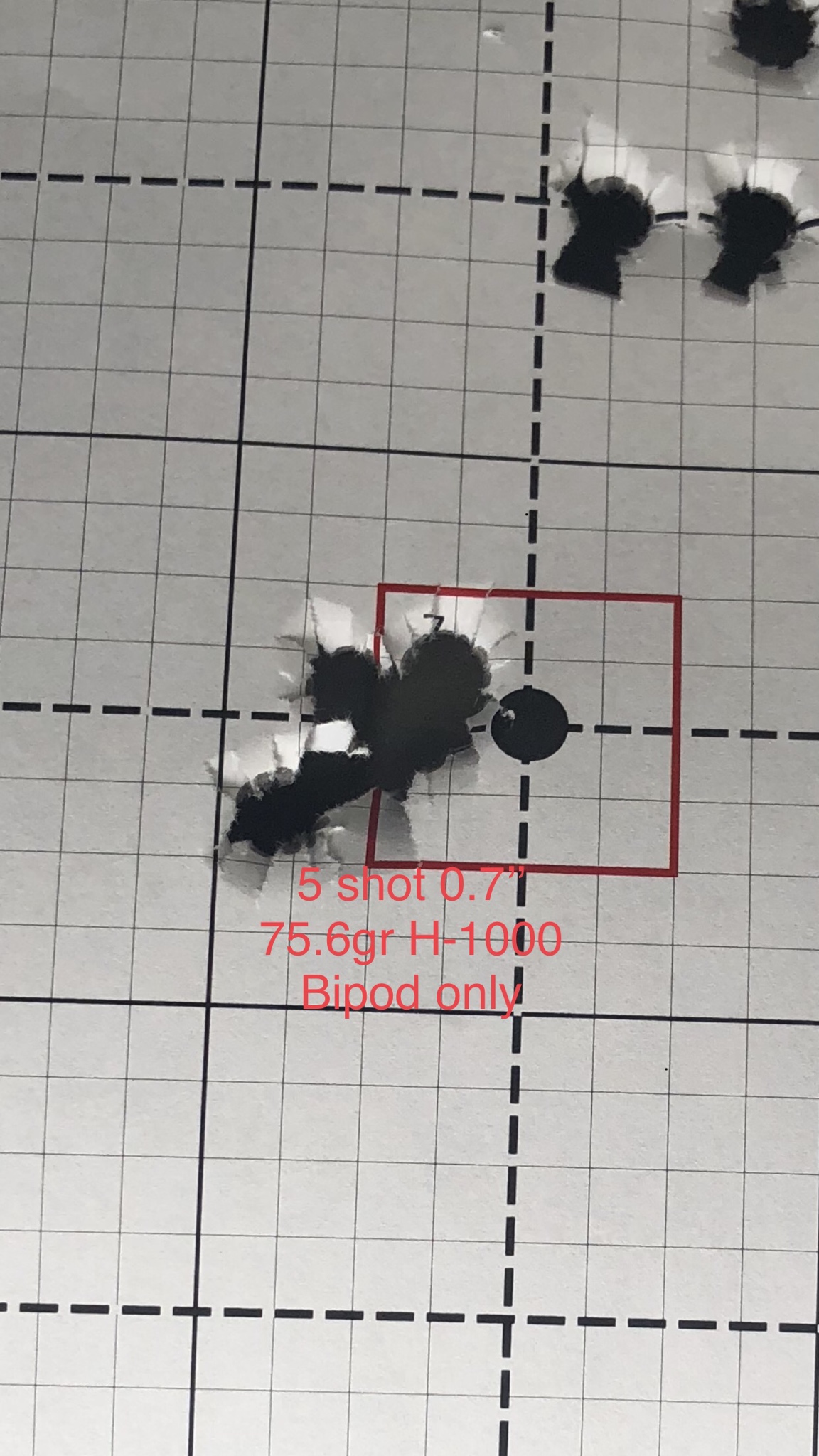
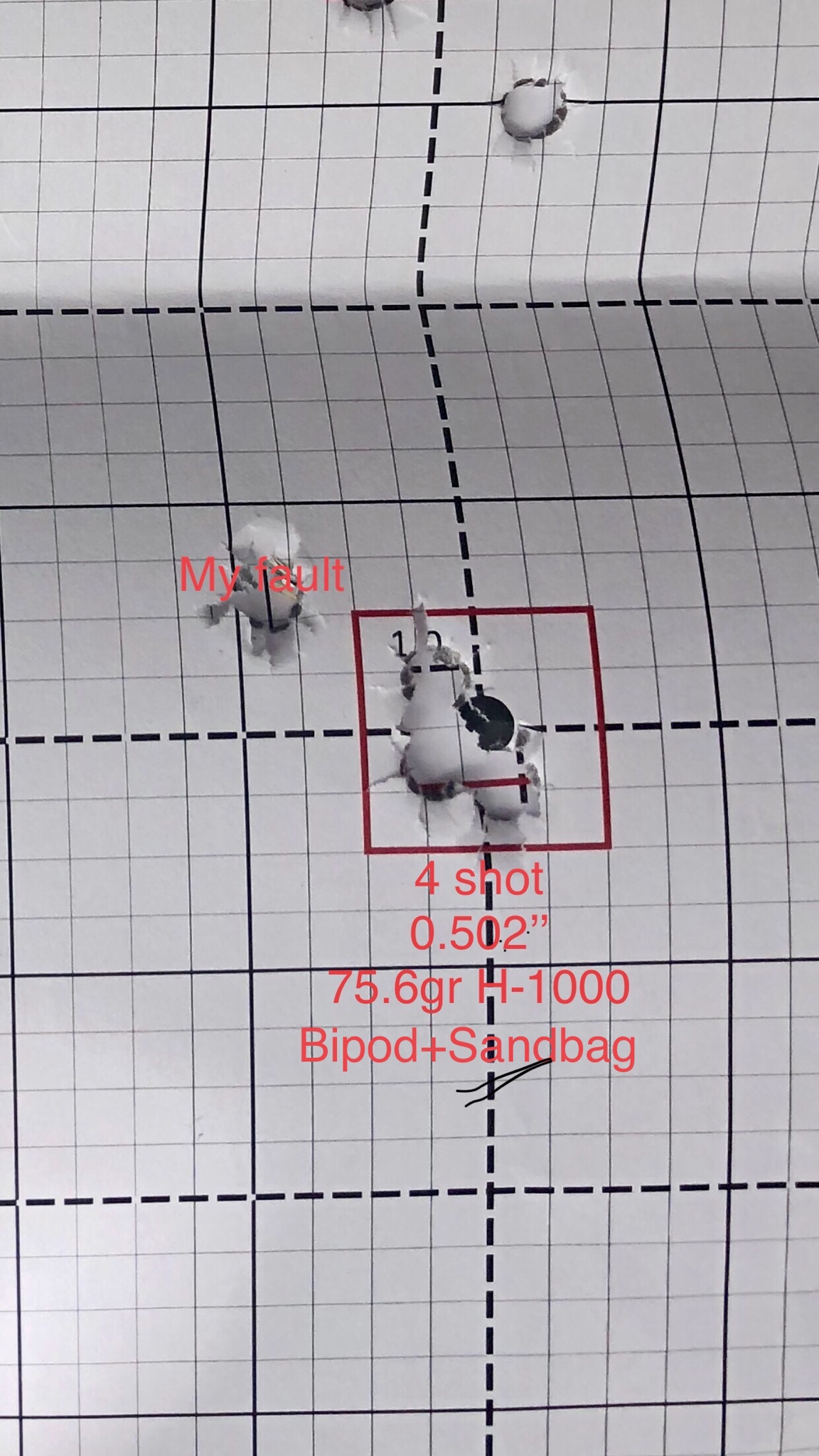
I tought I was pretty stable shooting but with the load the seller gave me, I was able to get more precise doing really my part and taking my time. Also, the last 5 string was with a sandbag in the rear, really more stable

ejrdwLe.jpg


bNz4ia9.jpg


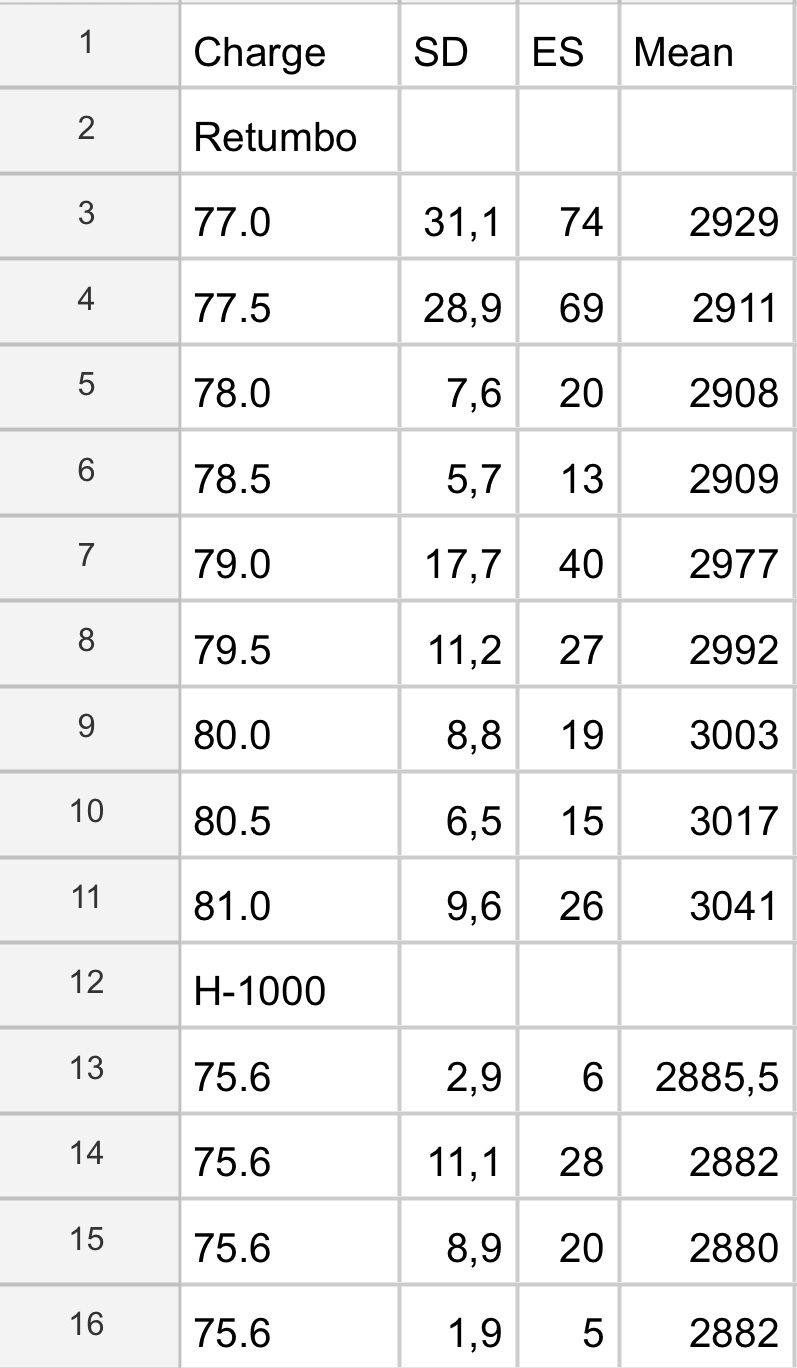
I was out of H-1000 so was the local store, tryed some retumbo, the H-1000 load look promissing!
mn3DOkB.jpg
 
Back
Top Bottom