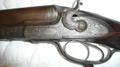
12 gauge Black Powder loadings

Sharps45-70

CGN Regular
Rating - 100%
41   0   0
Location
Edmonton
Hey all, this is more of a question to those who like their hammer guns and damascus guns, but what is a good 12 BP load for clays? For hunting? Mostly concerned about shot and powder charges.

Do you guys put any lube in the shells to keep the fouling soft or do you just clean it all out at the very end?
 
I would load an ounce of 7 1/2s with an equal volume of powder. Adjust wad column to suit. I put a dry wad over the powder, then a lubed one. Generally I'm using 2 1/2" cases, closed with a roll crimp over a card wad.
 
And avoid plastic wads...I did that once with black powder,it basically coats the inside of your barrel with plastic at the follow up shot...even with my chrome lined,it was a half hour of scrubbing to get that out again.

CG
 
I would load an ounce of 7 1/2s with an equal volume of powder. Adjust wad column to suit. I put a dry wad over the powder, then a lubed one. Generally I'm using 2 1/2" cases, closed with a roll crimp over a card wad.

What lubed wads do you use? Would pouring in melted lube over the over poweder wad be ok too?
 
I dip the wads in melted bullet lube. A simple beeswax/Crisco lube is great. Could use lube cookies too.

You probably want to avoid pouring it into the shell directly as it might migrate to the powder. Had a similar issue when trying to glue overshot cards in place. Ended up gluing the shot into a lump.
 
I have been loading Blackpowder ammo for a number of English doubles in 12, 16 and 20 gauge for about 15 years, I shoot my guns frequently and hunt with them as well.
All blackpowder shotgun loads were (are) with volume measure, not by weight like modern loading procedure. This is measured in drams and this equivalent is still marked on modern shotgun ammo boxes, commonly 2 3/4 and 3 dram target loads and these differences result in different velocities (and pressures). A 2 3/4 dram or 3 dram black powder load has the same velocity as the equivalent dram smokeless load and works just as effectively, but more fun! Also the different granulations result in different velocities and pressures so a load with FFFG will be faster and at higher pressure than the equivalent with FFG. 2 3/4 drams of GOEX FFG (my standard 12 gauge charge with 1 oz to 1 1/8 oz of shot) weighed at 78 grains, 3 drams at 86 grains on my scale for comparison BUT I DO NOT LOAD OR RECOMMEND LOADING BY WEIGHT, different brands of powder will weigh differently for the same volume. Large volume cases such as Federal, Kent, Fiocchi work best, the more room the better. I normally cut my cases to 2 1/2" because most vintage black powder proofed guns have 2 1/2' chambers. Any 209 primer will work fine. For traditional loads I seat a 1/8"-3/16" overpowder card wad. Next comes a filler wad or wads, waxed preferred, to adjust the wad column height to accomodate the shot charge and the crimp. This initially takes some trial and error. Most filler wads can be split to give varying thicknesses. Next comes the shot ( any size, lead only), I normally load 1 ounce in 12 gauge. The final component on the top of the load is the overshot wad and when this is firmly seated it should be about 3/16" to 1/4" below the case mouth. Then I finish with a roll crimp which allows for quite a bit more case volume than a folded (pie) crimp.
I have tried all types of cases and the listed ones have worked best for me for various reasons. I have also loaded and shot plastic wads and the main problem here is the limited room in the case and the length of most wads.The WAA 12 and WAA 12SL will work but by far the best is the WAA12R, a very short sturdy wad. I have shot cases of this load, as many as 2-3 boxes at a session, excellent patterns, very positive target breaks, never a problem. In a smooth barrel plastic wad fouling has not been a problem for me but if it gives you a problem just use an overpowder card wad under the plastic wad and adjust the wad column height accordingly.
As you can see, except for sizing, primer removal and seating these operations are not compatible with any modern reloading tool, it's a slow hand process. Roll crimpers, case trimmers, components are available in Canada from bilozir.net. Please note these loads are what I use, not any form of reccomendation for others to load as I have no knowledge of the condition of other people's guns. Play safe and have fun. Jim

 
What lubed wads do you use? Would pouring in melted lube over the over poweder wad be ok too?

I cut my own using a drill press, with wadcutters of my own make. That way I can get the diameters I need. I put wads to be lubricated in a ziplock bag along with some lube, and them microwave them. Lube melts, wads absorb it. For ml guns, the wads stay in the bag until loaded.

Basically load the shells by hand, close the roll crimp with antique hand crank tools.
 
I have been loading Blackpowder ammo for a number of English doubles in 12, 16 and 20 gauge for about 15 years, I shoot my guns frequently and hunt with them as well.
All blackpowder shotgun loads were (are) with volume measure, not by weight like modern loading procedure. This is measured in drams and this equivalent is still marked on modern shotgun ammo boxes, commonly 2 3/4 and 3 dram target loads and these differences result in different velocities (and pressures). A 2 3/4 dram or 3 dram black powder load has the same velocity as the equivalent dram smokeless load and works just as effectively, but more fun! Also the different granulations result in different velocities and pressures so a load with FFFG will be faster and at higher pressure than the equivalent with FFG. 2 3/4 drams of GOEX FFG (my standard 12 gauge charge with 1 oz to 1 1/8 oz of shot) weighed at 78 grains, 3 drams at 86 grains on my scale for comparison BUT I DO NOT LOAD OR RECOMMEND LOADING BY WEIGHT, different brands of powder will weigh differently for the same volume. Large volume cases such as Federal, Kent, Fiocchi work best, the more room the better. I normally cut my cases to 2 1/2" because most vintage black powder proofed guns have 2 1/2' chambers. Any 209 primer will work fine. For traditional loads I seat a 1/8"-3/16" overpowder card wad. Next comes a filler wad or wads, waxed preferred, to adjust the wad column height to accomodate the shot charge and the crimp. This initially takes some trial and error. Most filler wads can be split to give varying thicknesses. Next comes the shot ( any size, lead only), I normally load 1 ounce in 12 gauge. The final component on the top of the load is the overshot wad and when this is firmly seated it should be about 3/16" to 1/4" below the case mouth. Then I finish with a roll crimp which allows for quite a bit more case volume than a folded (pie) crimp.
I have tried all types of cases and the listed ones have worked best for me for various reasons. I have also loaded and shot plastic wads and the main problem here is the limited room in the case and the length of most wads.The WAA 12 and WAA 12SL will work but by far the best is the WAA12R, a very short sturdy wad. I have shot cases of this load, as many as 2-3 boxes at a session, excellent patterns, very positive target breaks, never a problem. In a smooth barrel plastic wad fouling has not been a problem for me but if it gives you a problem just use an overpowder card wad under the plastic wad and adjust the wad column height accordingly.
As you can see, except for sizing, primer removal and seating these operations are not compatible with any modern reloading tool, it's a slow hand process. Roll crimpers, case trimmers, components are available in Canada from bilozir.net. Please note these loads are what I use, not any form of reccomendation for others to load as I have no knowledge of the condition of other people's guns. Play safe and have fun. Jim

This is exactly what I was looking for, Jim. Thanks for all of the great info! What do you do for lube, if anything?
 
I haven't found lube to be as important in black powder shotgun loading as it is with black powder rifles. A bullet, unless paper patched, makes full contact with the barrel inner surface and is squeezed intonthe grooves and rotated against the lands which attempts to scrub lead off into the grooves against the lands. No rifling in a shotgun, just a quick push through a hopefully smooth tube with only the outside edge of the outer pellets making any contact with the bore. Much less potential problems with leading. However unless the bore is smooth as the proverbial baby's bum lead deposits can become an issue.
To deal with this on a rough or pitted bore the simplest solution is to use plastic wads. 20 gauge thin card, felt or cork wads can be used under the shot to adjust load height inside the shot cup. You will eventually get some plastic buildup but there are many solvents available for removing this, ask any trap shooter, they deal with it all the time. In a perfect bore I haven't found this to be an issue, once my blackpowder fouling is completely cleaned out there normally isn't any plastic either. With built up loads the overpowder wad should NOT be waxed or lubed because of possible powder fouling, especially when the gun is hot. However I believe waxed or lubed filler wads are the way to go. Under NO circumstances put lube in with your shot , it could cause your pellets to stick together, ruining patterns and effectiveness and it won't affect fouling at all. Bottom line, if your bore isn't perfect you will be spending more time cleaning, even with modern smokeless ammo.
Bore honing and polishing is a related subject. Done by a competent gunsmith that specialises in shotguns it will cost about $75-100 per tube if no other work is required and is definitely worth it on a good gun IF the gun qualifies. By this I mean the gun must
Be tight on face, no looseness at all, even with the forend removed AND
No barrel bulges, dents or cracks. Bulges and dents can usually be repaired if not too bad but expect to pay $75-100 per tube, AND
Barrel wall thickness of completely sound perfect barrels should not be less than .025" minimum at the thinnest point anywhere.
More is better. Less than perfect bores still should not be less than .025" but this can be very difficult to measure to the
bottom of pits so I personally feel a lightly pitted bore will need considerably more measured wall thickness. For this reason I
won't shoot a bore worse than a light frosting, period. If it's otherwise a good sound gun I believe in having the bore made
perfect ( assuming adequate finished wall thickness), then I have confidence in the gun and far less fouling problems.
Remember where your leading hand is on the gun, right where the pressures are highest!
In general, sound antique English, German and French guns are worth spending a few hundred dollars on. Most cheap Belgian clunkers aren't good for anything but a deactivated wall hanger or conversion into a floor lamp. There are well made exceptions of course, but most of these, even if the bores are good and they aren't loose as a goose will never be worth more than $150 no matter what.
Wall thickness is measured with a special barrel wall thickness gauge, any gunsmith that is capable of properly honing and polishing the bores on a lathe with a correct pilot will have this tool. If he says he can do the job and doesn't have the tool and experience with it find another gunsmith....quick. There are a number of competent shotgun smiths scattered across the country and also a lot of butchered guns "fixed" by bubba. Be picky. A fringe benefit of barrel honing is that chokes can be adjusted somewhat tighter and a lot more open at the same time at no extra charge if desired.
Gun shows are a good place to look for old components and vintage loading tools, and you can also try CGN, E Bay and auctions. Federal still makes 12 gauge Gold Medal paper hulled target ammo and if you can find some of these hulls they make the very best 2 1/2" roll crimp ammo.
Case life is 3-4 loadings, the best plastic is destroyed in 1-2 loadings. Good luck, have fun. Jim

 
Hey all, this is more of a question to those who like their hammer guns and damascus guns, but what is a good 12 BP load for clays? For hunting? Mostly concerned about shot and powder charges.

Do you guys put any lube in the shells to keep the fouling soft or do you just clean it all out at the very end?

You should PM catnthehatt, He can help you BP load.
 
There are two options for lube in Black Powder shotshells, depending on use. For hunting loads you can lube the cushion wad. If you keep the shotshells in a plastic box you will have the shot load down, keeping any chance of lube migration away from the powder charge.

Secondly for BP trap or other target shooting you can put a dab of Crisco lube on the top of the crimp, just before shooting. We made up nice walnut cartridge blocks for BP Trap where we shoot relays of 10 shots.
Yes, lube is very essential for Black Powder. Black Powder fouling sets up like iron after a few shots with no lube.
With target loads, lubed on the crimp as described, we can clean after a couple of rounds of Trap using two patches of Windshield Washer fluid, and two of WD40. This cleaning is sufficient to allow the full boiling water treatment to be a day later, if necessary. I always follow up with a full boiling water cleaning to protect valuable guns, with certainty.
 
To start with I believe you'll find that 12 gauge wads will fit loosely in those thin brass cases, you will need to source 11 gauge wads. I don't know of any 700X data for those cases, good luck.
 
Hey all, this is more of a question to those who like their hammer guns and damascus guns, but what is a good 12 BP load for clays? For hunting? Mostly concerned about shot and powder charges.

Do you guys put any lube in the shells to keep the fouling soft or do you just clean it all out at the very end?
I got into black powder cartridge guns in 1980 and have been on an unending road since loading everything from 10 too 410!!:p

I used to use a lubed wad but got away from it because I found no difference in fouling or cleaning when using tight wads.

Mag Tec brass, as was mentioned, takes larger gauge wads.
Turned shells like Rocky Mountain , take modern sized wads.
You are quite welcome to PM me for more info if you care to for load data and loading tips for birds and clays
Cat
 
Those turned brass rocky mountain hulls are they of better quality than magtech? I'm looking at getting a couple hundred brass hulls as my tastes have been running to old damascus guns lately
 
Those turned brass rocky mountain hulls are they of better quality than magtech? I'm looking at getting a couple hundred brass hulls as my tastes have been running to old damascus guns lately
can't say which is better but Mag Tec is easier to find in Canada
The biggest difference in the two cases is that the Rocky Mountains use modern wads and 209 primers, Mag Tec use oversized wads and large pistol primers
I have never used the Rocky Mountain but have had no issues getting components for Mag Tec or killing wild pheasants or geese with the ammo I have loaded in my vintage or modern SxS guns
Cat
 
Good to know. I'm going to source out all the wadding and cards first before I order the brass. I was hoping my Rst ammo would have been in by now. It was suppose to be in at Xmas time but I'm still waiting. I may just buy a roll crimper and cut down some hulls. I really want to shoot my Charles Daly
 
I have found that my old hand crank roll crimper works better than the BPI drill press roll crimper.. Precision reloading has a drill press crimper with multiple crimping pins in the groove, which should work more like the hand crank crimper.
I shoot cut down plastic hulls with black powder. Cutting 3 inch hulls to 2 1/2 inch gives cleaner finish to the hulls than cutting 2 3/4 inch hulls down.
 
I use 10 gauge all brass hulls myself. Parker Brothers 2 7/8 inch hull, using large pistol primers. Circle Fly 9 gauge over shot card, 9 gauge nitro cards and felt wads. Top card sealed with a curing type clear silicone used in many home repairs. Once these are cured it's pretty impossible to accidently break the seal and loose your shot load through rough handling in the field.
Problem with all brass 10 gauge hulls, no-one carries them in Canada. Had to import them from Track of the Wolf via Prophet River.($$$) The good, easily reloadable hull with the expected BP cleaning attention.
You fellas with 12 bore will never experience this additional cost. That's smarter for the wallet.

Much like Cat, I also tried lubed versus un-lubed wads with pretty much zero difference in after shooting cleaning sessions.
Easy peasy finding a good #4 birdshot load and a little more work to the buck&ball.
0000 buckshot load, presently a work in progress.

Edit: Forgot one very important issue Ashcroft pointed out, both my damascus shotguns got a good inspection, dents removed and chamber/bore polishing from a competent gunsmith/gunmaker.
 
Last edited:
Back
Top Bottom