1896 Long Lee - Question about Rifling Mark

Bittermansbro

CGN frequent flyer
Rating - 100%
31   0   0
Location
Calgary, AB
I have a friend who has her Dad's old Long Lee Enfield Mk I. Woods been cut and the rear volley sight removed, but everything else is there. On the barrel knox is marked with an 'E' but its been x'd out. Any reason why that would be?

I am not much for LE's, hence the request for information from the honourable Enfield folks.....

Thanks
 
Sounds odd to me, friend; certainly nothing I have come across on my own rack.

I am wondering, though, if this is a Bubba rifle or if it is one of those nice semi-factory or even factory conversions that seem to be poppppping up out of the woodwork these days. In other words, who did the conversion?

I can't think of any logical reason that the military would want to cancel a marking as important as the "E" for "ENFIELD" on the Knox-form of a barrel. When a Metford barrel wears out, you have a tube. You get the same thing with an Enfield barrel, just takes a lot longer.

This makes me think that the marking could have been cancelled by a civilian 'smith or converting company. There were quite a few of these surplused after South Africa and again following the Great War. I have a pair of Sparkbrooks, one which is just wonderful shape, the other a wreck, but both of them have View marks up into the period of the Great War, on Naval rifles dating from 1897., But the Navy never used them with half-stocks and chequering and the clearing-rod channel filled in and commercial blue jobs. They took on entire new careers when they left the Service and I wouldn't be surprised to see a barrel mark defaced to make the rifle look 'less military'.

Sorry, but that's about all I can think of. Can you post a photo, perchance? If we can get a photo or six up, maybe folks who know more than I do will have a crack at it.

BTW, has it been Navy marked? (Capital letter 'N' on LEFT side of butt socket, just above triggerguard.)
 
Thanks guys, I didn't understand why the E would be x'd out either. The pictures I got from my friend weren't good so she had to give them to me copied onto paper. I assume it may be another after military service mark that looks like an X.....but I am just taking a verbal explanation with a drawing, so can't say for sure.

She says the bore is shiny and clear with no pitting.

Other than the wood being cut back, its still got its mag cutoff and original front sight, but the outside of the barrel from the front sight to the muzzle is in the white, looks like the blue just wore off as opposed to being buffed off.
 
From the front sight to the muzzle is where the bayonet was fixed. Sounds like a rifle which has done a LOT of guard duty and very little range time.

This one is sounding more interesting all the time!

Where is the rifle these days, geographically speaking?

Can you get better pics???

Sounds FUN!
 
"Great minds think alike," my Mom used to say, "Fools seldom differ!"

So we can take out pick: great minds or fools? I was thinking exactly the same thing, myenfield!

Just have to wait and find out, I guess.

BTW, I opt for 'great minds', should it make any difference!
 
John, you are hereby included in Ye Antient and Honourable Companie of Ye Greate Mindes.

Charter member, yet!

STILL wanta see some nice photos, though.....
 
Right, right, cheerio, pity we lost India and all that, what-what!

Compared to you too great minds, I am Lee-Metford, Enfield, Henry, Martini, Snider & Company deficient!

I have pics that my friend gave to me, unfortunately she isn't a photog, so no good pic of the mark, but that facing broad arrow mark John mentioned sounds fully and completely plausible. I just have to coach my friend through a short seminar on the "Broad Arrow Marking and It's Relative Applicability to Military Ordnance of the British Empire" and see if she can confirm.

Smellie, once you mentioned the bayonet as a reason for the blueing issue, I would concur. I don't know the bayonet fixing on a Long Lee, but sounds like it was a ring bayonet would have been used?

Rifle is in Calgary, was her Dad's and she was interested in knowing more about it when she found out I was a Nutz.

So I can get the pics up that I have, but will have to bug her to try and get better ones of the markings.
 
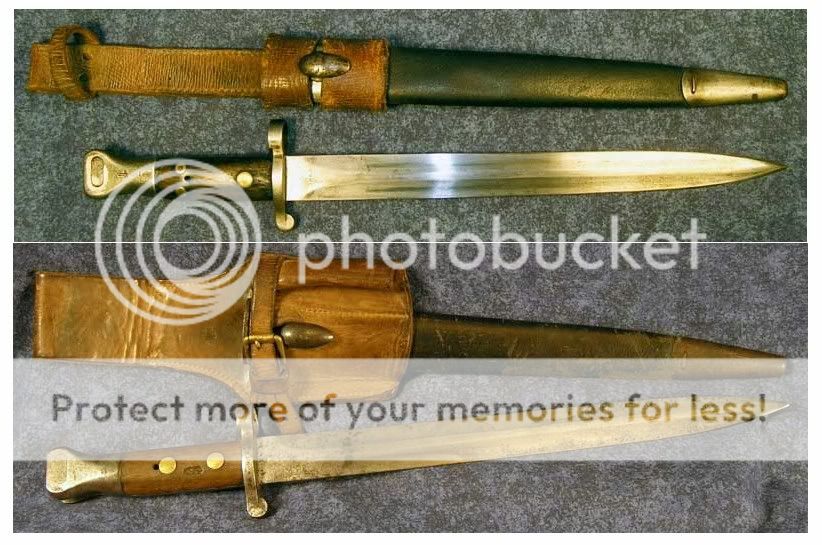
Bayonet for these was the Pattern 1888, a very nice double-edged blade about a foot long, inch and a quarter wide and with a low ridge down the middle. It fixed to the rifle by an extension forward from the front barrelband/nosecap into a recess in the pommel of the critter. Top of the pommel rubbed very nicely against the bottom of the barrel. Crossguard was extended about 3/4 inch below the blade and extended upward to provide a mounting-ring for around the barrel. They tended to be quite a close fit.

Sliding one of these on and off a few hundred times would definitely give apoplexy to a purist. It would also tend to wear on the bluing on the barrel... a lot.

Can somebody kindly post a photo of a Pattern 1888 bayonet? Either type, 2 rivets or 3?

I have always thought that these and the related Pattern 1903 are the most beautiful bayonets of the late 19th/early 20th Centuries. Just pure CLASS!

And it IS rather a pity about Injah.... and Pakistan.... and the Soudan.... Burmah also, y'know.... Thibet.... Afghanistan (does that sound familiar, somehow?)......

Ah, yes, the Good Old Days. "We civilised 'em with the Martin-'Enery an' we KEPT 'em civilised with the Maxim Gun!"

And you STILL have one of the prettiest flags on CGN!
 
Last edited:
Almost forgot to thank you Canuckians for five of my Long lee's from John Denner

Just reminded of a story about milarm. Leftist reporter asked one of the salesmen what was the most destructive military rifle they had on sale. (expecting a SLR or an AK) The salesman turned around , reached onto the rack and pulled out a SNIDER!
Got to agree, .577 Minie balls are nasty! They don't break bones, they SHATTER THEM
 
..... Can somebody kindly post a photo of a Pattern 1888 bayonet? Either type, 2 rivets or 3? ....!

Both types -
P1888_Type1andType2.jpg
 
Back
Top Bottom