1905 Ross

Polar_Hunter

Regular
EE Expired
Rating - 100%
18   0   0
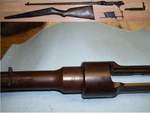
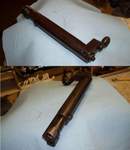
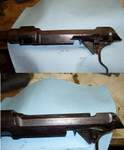
I acquired this today. Going to do my best to restore it. As the photos show it has seen a lot of abuse. I scrubbed the bore and I think that it will still make a shooter so the work will start as soon as we get some warmer weather. I intend to rust blue the barrel, action and trigger guard. Not sure how to go about fixing the stock, I have some wood worker friends that may be able to help. Unlikely that I will be able to find an original stock that is in better shape.

 
TIRIAQ is right, of course.

There are lots of Bubba Special 1905s out there, made out of ex-military rifles, but NONE of them have that ".303 ROSS" marking. That appeared only on REAL Factory Sporters.

What's wrong with the Stock, apart from its shape? That's the shape that was popular back then, it works okay and it is very distinctive today, really makes the old rifle stand out.

Be very careful working on that original stock. They were made of the finest Walnut which could be obtained anywhere in the world. Many were made of Italian, Turkish and Rumanian Walnuts which are obtainable today only through rare-woods importers. Check your stock out with a good Furniture maker, a Musical Instrument maker or a proper Stockmaker before doing anything too drastic. Many times, these will want only a very careful cleaning, motor oil removed from the interior of the wood, the wood resaturated with Linseed oil of the right types and brought back to the colour and lustre which it had 105 years ago.

BTW, these original factory Sporters were a tad on the expensive side. Generally, they sold for a couple of MONTHS' wages. They were the best rifles in the world..... and they shot like it.

You take the cake so far for Lucky Dude of the Year on this forum.
 
smellie, the stock is cracked in several places, I'll post photos later today.
Two parts are missing from the action, the bolt keeper (the spring and the push rod are still in the stock) and the mag spring. I'll advertise on the EE for originals. If that doesn't work I should be able to machine a reproduction bolt keeper from photos.
 
After looking at the pics I'd say that stock can be repaired without too much trouble.

Gotta go push snow yet again (tractor is warming up as we speak) if you need some tips on stock repair and another member doesn't post a detailed post about repairing stock cracks id be willing to do so, just a little short on time.

Steve.
 
Find original Ross sporter parts will be next to impossible. Be extremely expensive if you do find any too.
Like Tinman says, that stock is easily repaired with one of the needle style epoxy applicators and some clamps. Needs cleaning first though. Use the same products and techniques used on fine furniture.
The steel doesn't look in terrible shape. Clean it before you do anything else too.
 
Here's an example of a repair I've done.

This stock was on my friend Nic's P14 rifle that he had. It was broken quite badly right through the left side of the stock and up through the rear section where the action screw is.

The crack was about a 1/8" apart which made the stock fit terrible.

Anyhow here's a pic of the damage.

F14BCC78-D4DF-4417-A1E8-3D7E38058619-782-000001217EF2AFD4_zpsf347c4b9.jpg


3918C02F-65F0-4BC9-919B-309BD78BDA96-782-0000012196A965CA_zpsb63caaae.jpg


My first step before I do anything is to look over the damage and decide what my best course or action is going to be and also how/where I'm going to clamp the crack once I glue it.

Second step is to clean the oil from the wood with brake clean. I usually use a full can over a day or so and keep spraying it in til I feel that the stock is clean.

Next I let the stock dry over night.

Next step is to mix up epoxy which will be used to glue the stock back together. If you are concerned about the epoxy showing then mix in some fine sawdust to the mixture. The sawdust will take stain and therefore will help in hiding the epoxy.

Then I use a suitable applicator (based on the size of the crack, can be your finger, a Popsicle stick whatever works) to get the glue in the crack.

Once the epoxy is in the crack good I clamp it.

5526DB1C-C30E-46CB-BDE7-14288EFE45A3-782-000001221085BF60_zps2a5fdb73.jpg


In the last pic you'll notice that the epoxy is smeared all over the stock around the crack. That's no big deal cause once the epoxy starts to cure (about 3-5 mins with the stuff I use) I simply roll it off with my fingers which takes care of it, the key is you have to do that BEFORE it gets too dry!!

Then it looks like this.
3BBCB7FF-CB8D-4A0C-B175-75BD41D91D0C-782-000001225BA22C0F_zps0ef8f675.jpg


Next step in a really bad crack such as this one is to reinforce the damage. In this repair I used 2 screws which I hid under the action and bolt release so it would be invisible. I drill holes then put epoxy on the screws and gentally screw them in. I let them dry and then cut off the heads. Then I use a dremel to smooth the heads flush with the wood.

6122FD8D-E8A1-4FDC-85B1-17C4D6456E36-782-000001230EC28272_zpsecc99c42.jpg


Here's the finished project after some light sanding with 600-1000 grit, staining and a good amount of linseed oil.

07C8CC3D-3005-47EE-8CEF-D1665616EBC2-782-000001227217A5A5_zps7b34de7d.jpg


Hope that helped!!

 
If you make screw holes that end up being exposed there's 2 ways I've dealt with them.

The first is to plug the holes with wooden dowels made out of the same material as the stock is made from. If you can't find suitable dowels then you can stain them to match.

The second is to simply use brass screws and cut them flush and sand them to be smooth. It gives the repair and oldtimey kind of look and suits antique rifles nicely.
 
As far as possible, I avoid the use of external dowels or screws. Much prefer to keep reinforcements internal. Often it is possible to rout a little channel and embed a little grooved/threaded rod in it.
 
There are two screws in the for-end of the stock already. When I remove them I'll have to do something cosmetic. Finding wood close to the same color may be difficult but it would look the best.
 
This rifle should have a serial # on the barrel, over the chamber, just above the stock line on the left side.

The serial # can usually be found on the stock as well.
 
A trick for matching-up wood colour on repairs is to get a Dremel and rout a channel under the barrel, then fill that with Acra-Glas and let it set. You collect the DUST you routed out and store it carefully.

You do this AFTER you have cleaned the wood thoroughly, removed all old oil, dirt and so forth. NOW you are ready for gluing.

When it comes time to match-up the repairs with the original wood, you add this dust to the Acra-Glas you are using to glue the break.

You now have repairs that will stain down to a perfect match for the rest of the wood.

Niggling, but well worth the effort.
 
A trick for matching-up wood colour on repairs is to get a Dremel and rout a channel under the barrel, then fill that with Acra-Glas and let it set. You collect the DUST you routed out and store it carefully.

You do this AFTER you have cleaned the wood thoroughly, removed all old oil, dirt and so forth. NOW you are ready for gluing.

When it comes time to match-up the repairs with the original wood, you add this dust to the Acra-Glas you are using to glue the break.

You now have repairs that will stain down to a perfect match for the rest of the wood.

Niggling, but well worth the effort.

What a great idea! Thanks smellie ;)

 
I have patched holes by inletting pieces of wood. Try to get as close a grain and colour match as possible. I keep odds and ends of scrapped stocks around for that purpose.
 
There are tools made for the task. It's called a Wood Plug Cutter. I have three different styles and you can get it at most hardware stores. Get the matching dowel drill and you're done. You can cut pieces from the Inside of the stock (where it's thick enough - then, you plug the hole with a new plug to keep the stock some strenght) or behind the buttplate.

Here's what it look like;
http://www.bing.com/images/search?q...3BD370E7B465C799770498249DA9EF462&FORM=IQFRBA
 
Rather than using round patches, I prefer rounded cornered diamonds, ovals, triangles, etc. Round and square patches don't blend as well. I cut out the recess, then carefully fit the patch to fit. Carefully dress the patch down to flush, smooth it. Done very carefully it is not necessary to refinish the whole area.
 
I agree Tiriaq, it makes a better fit - when it's well done. The problem is that it needs some skills to get it done right and not everyone has the experience to do so. But I think you will agree with me, for the average (or the rushed) amateur, it's much easier to just insert a well fitted round plug...
 
Back
Top Bottom