If you shoot a .44 magnum for a while, you won't notice the recoil from your .45 auto. Or you could adapt a better technique to control the bit of recoil that the .45 Auto does generate. To repeat the advice from BCRider, place your hand as high on the grip as possible. The closer your grip is to the center-line of the bore, the less muzzle flip the pistol have. Next time you're at the range, load the pistol with a single round and fire it with you hand as low on the grip as you can manage. The pistol will try to rotate out of your grip. Now reload, place the pistol in your hand so the web between your thumb and trigger finger is tight to the tang or the beaver-tail. When you shoot this time, you'll find its much more controllable; you might not even be aware of any muzzle flip.
With your shooting hand placed high on the grip, place the fleshy part of your support hand against the grip panel, in the space between the thumb and the fingertips of your shooting hand. Keep the thumb of your shooting hand on top of the safety, and run the thumb of your support hand along the side of the frame. I used to overlap my thumbs when shooting the 1911, but keeping the thumb of the support hand forward, significantly diminishes the amount of lateral movement.
Trigger press is the most critical part of making a shot with a handgun. You can have a great sight picture, intense focus on the front sight, your grip can be high and firm, your natural point of aim can be perfect, and your breathing can be well controlled, but if you lean on that trigger the shot will go wide. Between your focus on the front sight and your attention to the trigger break, you shouldn't even notice the gun recoil.
The first pad of your trigger finger engages the face of the trigger, there should be a bit of space between your finger and the side of the pistol, which insures you don't pull it off target as you press. And that's right, everyone, since triggers were put on firearms, has said squeeze the trigger. If you offer your finger to a baby, he will squeeze it, and squeeze it surprisingly hard, and he does it by squeezing with his entire hand. If you use your entire hand to squeeze the trigger, your pistol sights will swing off target before the shot breaks. You want to press the trigger, and train yourself so that the only part of your hand that moves is your trigger finger. The best way to train to do this by dry firing at home. Aim at a convenient spot on the wall, a light switch, a picture, whatever. Once the sights are aligned, shift your focus to the front sight and press the trigger. When the shot breaks, what does the front sight cover? What the front sight covers is what the bullet would have hit. Live fire doesn't demonstrate this nearly as well, or show you how to correct it.
The front sight is placed in the notch of the rear sight, so the top of both front and rear sight are even, and so there is equal space on either side of the blade. The front site is placed on the center of the target, then you shift your focus to the front sight allowing the rear sight and target to blur out of focus, leaving the front sight in clear and crisp in your vision. If your front sight is serrated, you should be able to clearly see those serrations, if it has a colored insert, you should be able to clearly see the seam between the insert and the sight blade.
Now add pressure to the trigger. If you see your front sight swing off target, maintain pressure on the trigger, and wait for the front sight to come back on target, then increase the pressure until the gun fires. When the gun fires, or when the hammer drops on an empty chamber if dry firing, it should surprise, but not startle you. You know the gun will fire, but you won't know precisely when it will fire. Over time and with practice, the time it takes to fire can be greatly reduced, but if you anticipate the shot you won't be able to make a good hit. Now this is important. Once the hammer falls and the gun fires, keep the trigger held back. Breath. Now, slowly release pressure on the trigger until you feel it reset. If dry firing, it won't of course, and you'll either have to rack the slide, or manually #### the hammer. The key though is not to break contact with the trigger between shots. This will prevent you from slapping the trigger in your rush to find it and make that fast follow up shot.
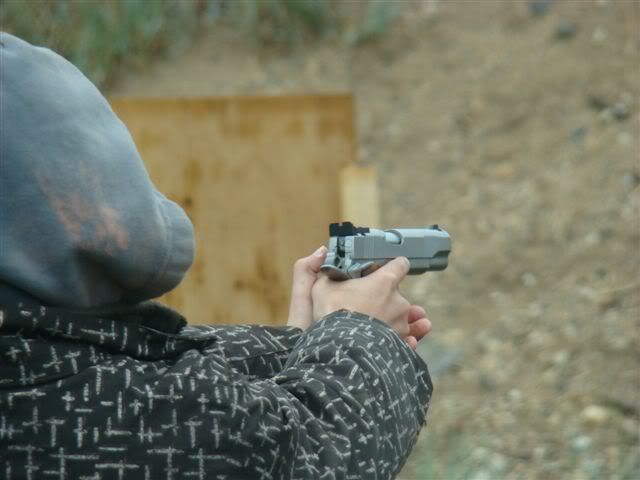
My grandson at 13 shooting my 1911 with factory 230 gr ball. Note the overlapped thumbs, which I have subsequently moved away from.
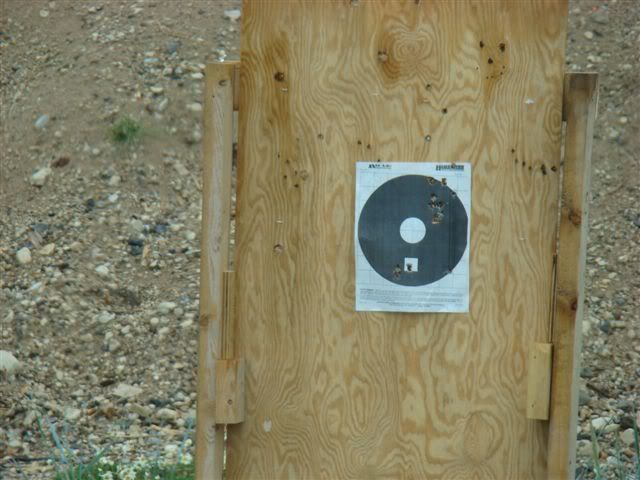
A couple of 10 yard groups, the kid's at the top, mine at the bottom.