












































You are using an out of date browser. It may not display this or other websites correctly.
You should upgrade or use an alternative browser.
You should upgrade or use an alternative browser.
...
- Thread starter jiffx2781
- Start date

What does this do that my BCG doesn't do?
Just had to go and crack this can wide open didn’t ya


I looked at the Glock 17 factory 10 round mags tonight at Brownells and they won't ship those to Canada.
Maybe it's something specific to Glock if they are willing to ship other brands of 10 round mags.
Glock must not allow Brownells to bypass the Canadian dealer. I bought 10 round colt magazines before. I noticed there's a few other brands they won't ship

I always marvel at how some guys will spend a sh!tpile of $$$ to save a gram or two. I do appreciate the goal as my Rifle is a bloody boat anchor, but I really have to question if swapping any part other than the barrel is worth the weight saving if the price goes up dramatically.
*Sigh*. It's not about saving weight for the purposes of the rifle as a whole being lighter (Though that's a good side benefit). It's about saving reciprocating mass in the action. A lightweight bolt carrier, combined with a tuned buffer system, tuned gas system, tuned ammunition, and a good muzzle brake results in dramatically reduced recoil. It's a competition thing. Imagine shooting a match where speed is everything with a 300 Win Mag, and a .22LR. Less recoil = faster.

Blastattack
CGN Ultra frequent flyer
- Location
- Winnipeg MB
Yeah, it is worth it. The brownells BCG almost saves 1/2 a lb. That's big on a 6lb rifle.
Eh... no. The Brownells Ti BCG weighs in at 7.9 oz., while regular AR15/M16 BCG weighs in at about 11.5 oz. so that's a savings of almost 1/4lb, not 1/2 lb. However, their Lightweight Steel BCG is only $100 USD (~135 CAD) after the sale and HAA code, and only weighs 8.2 oz. I have ordered one of those, and a Brownells 9mm BCG... and some other stuff too...
Another way to save some weight is pop the weights out of the buffer. A rifle buffer weighs in at about 5.15 oz. loaded, and about 1.5 oz. empty.

redshooter
CGN Ultra frequent flyer
- Location
- Central Ontario
*Sigh*. It's not about saving weight for the purposes of the rifle as a whole being lighter (Though that's a good side benefit). It's about saving reciprocating mass in the action. A lightweight bolt carrier, combined with a tuned buffer system, tuned gas system, tuned ammunition, and a good muzzle brake results in dramatically reduced recoil. It's a competition thing. Imagine shooting a match where speed is everything with a 300 Win Mag, and a .22LR. Less recoil = faster.
I still say it's nuts, but if you are a hard core competitor I have to concede your point.
I still say it's nuts, but if you are a hard core competitor I have to concede your point.
"tuned ammunition" would not be full power 1000m, “M855”. The recoil system is designed to work together. Most competitors want heavier barrels and or upward ports to control recoil.i.e. keep a quick sight re-acquisition as a feature of the weapon. The lighter the weapon the heavier the recoil given a certain load(mass). Shot downrange.
Eh... no. The Brownells Ti BCG weighs in at 7.9 oz., while regular AR15/M16 BCG weighs in at about 11.5 oz. so that's a savings of almost 1/4lb, not 1/2 lb. However, their Lightweight Steel BCG is only $100 USD (~135 CAD) after the sale and HAA code, and only weighs 8.2 oz. I have ordered one of those, and a Brownells 9mm BCG... and some other stuff too...
If the Titanium is too pricey for the weight saving, then get the steel. If you're not building a lightweight rifle it's not for you. But it all adds up, especially when you're not starting with the lightest to begin with.
Another way to save some weight is pop the weights out of the buffer. A rifle buffer weighs in at about 5.15 oz. loaded, and about 1.5 oz. empty.
And the stock. And the barrel. And the hand guard. And the ... ...
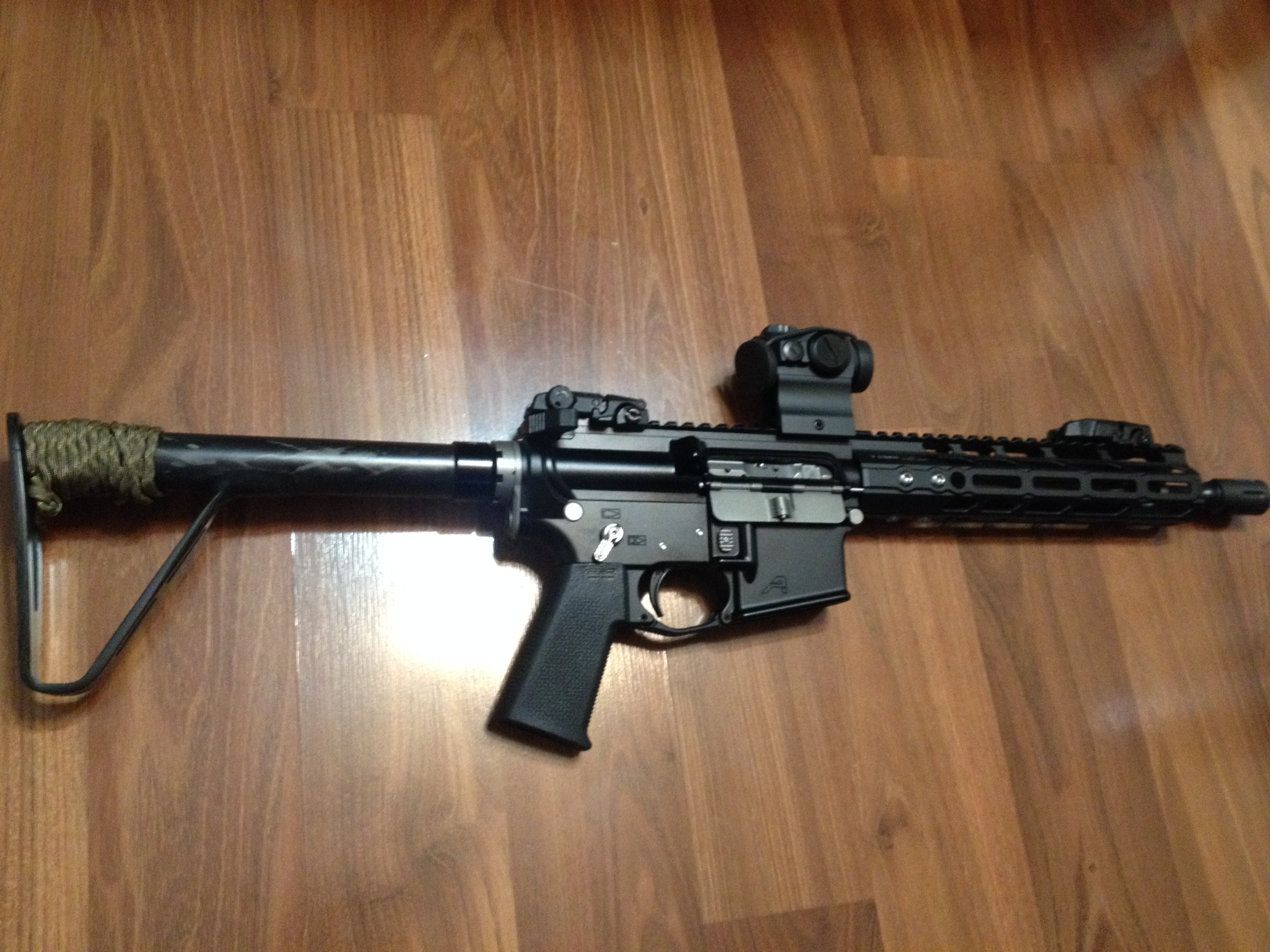
Then you get a 3.5lb [4lb with optic/buis] rifle with plenty of "exotic" materials.
(BCG is 5.9oz, 2a Titanium)
I looked at the Glock 17 factory 10 round mags tonight at Brownells and they won't ship those to Canada.
Maybe it's something specific to Glock if they are willing to ship other brands of 10 round mags.
Just got my shipping notice and the Pmags are good to go.
Blastattack
CGN Ultra frequent flyer
- Location
- Winnipeg MB
If the Titanium is too pricey for the weight saving, then get the steel. If you're not building a lightweight rifle it's not for you. But it all adds up, especially when you're not starting with the lightest to begin with.
And the stock. And the barrel. And the hand guard. And the ... ...
Then you get a 3.5lb [4lb with optic/buis] rifle with plenty of "exotic" materials.
It's quite hard to justify spending any amount of money to save 0.3oz. However that 2A Armory Ti BCG is quite impressive at a hair under 6oz. Not impressive enough for me to justify the price, but cool nonetheless.
Getting lightweight components for the bolt system, stock, barrel, and handguard are the only worthwhile places to spend money on. Those fancy Ti pins and screws look pretty but they're far more effective at parting you with your money than actually achieving anything.

It's quite hard to justify spending any amount of money to save 0.3oz. However that 2A Armory Ti BCG is quite impressive at a hair under 6oz. Not impressive enough for me to justify the price, but cool nonetheless.
Multiple parts at part of an ounce save an 1/8 - 1/4 lb. When dealing with LIGHT parts, this adds up over a rifle. If you're not building a lightweight rifle, none of it will be viable (including the brownells steel vs Ti). Grab an SW MP, swap out a few parts and call it a day.
Getting lightweight components for the bolt system, stock, barrel, and handguard are the only worthwhile places to spend money on. Those fancy Ti pins and screws look pretty but they're far more effective at parting you with your money than actually achieving anything.
If you're dropping 3k to build a light weight rifle, another $300 in Titanium/aluminium to reduce the mass further is a prudent choice. Grams add up to ounces, ounces to pounds. Period. And it's a relative minor increase in cost over something like a DD Mk18 and pounds lighter. Dropping the money to only scrimp on the last few hundred would be a waste, even if not readily noticeable. If you've spent money on a LIGHT barrel, stock, BCG, hand guard [go check those prices.] you're going to spend $300 to save 2 oz on the ancillaries.
If you're deciding between $100 on a BCG, then no. But "light" is a different animal and is not cheap.
Last edited:
it's quite hard to justify spending any amount of money to save 0.3oz. However that 2a armory ti bcg is quite impressive at a hair under 6oz. Not impressive enough for me to justify the price, but cool nonetheless.
Getting lightweight components for the bolt system, stock, barrel, and handguard are the most cost effective places to spend money on. Those fancy ti pins and screws look pretty but they're far more effective at parting you with your money than actually achieving anything.
^^^^^^^^^^^
this

spend 400$ on a BCG but still running a rifle tube and aluminum lower........
Rifle ? Uh what ? It's carbine length, and it's the lightest stock/buffer tube on the market (though I could've saved .6oz on it by going open but it catches gear too easily.).
And the weight savings on the upper/lower is 2.6oz for $1000+ set of 2055 upper/lower receivers without going plastic. 5.8oz 2055 upper from v7 (Last one in Canada was $550+) vs 6.5 oz aluminum Aero ($99). Similar numbers with the lower. $800 extra for 2.6oz isn't close to worth it. The 2a balios has a bit less weight savings, but still $750ish more.
But you can be snide and continue to tell me where I went wrong.
Last edited:
With a titanium carrier you are really only moving the weight further rearward in the rifle, you need to increase the weight of the buffer to compensate for the weight you removed from the carrier.
Some add an adjustable gas block, but in a big bore ar, even with it on the lowest setting you will find that it is not enough in most cases. An adjustable gas block is meant for fine tuning once you are close with the carrier and buffer weight for your caliber.
Some add an adjustable gas block, but in a big bore ar, even with it on the lowest setting you will find that it is not enough in most cases. An adjustable gas block is meant for fine tuning once you are close with the carrier and buffer weight for your caliber.
Blastattack
CGN Ultra frequent flyer
- Location
- Winnipeg MB
With a titanium carrier you are really only moving the weight further rearward in the rifle, you need to increase the weight of the buffer to compensate for the weight you removed from the carrier.
Some add an adjustable gas block, but in a big bore ar, even with it on the lowest setting you will find that it is not enough in most cases. An adjustable gas block is meant for fine tuning once you are close with the carrier and buffer weight for your caliber.
I couldn't disagree with this more. You don't reduce carrier weight to just turn around and add it to the buffer. That's ridiculous. You reduce the weight of all the moving components to reduce the impact of the bolt and buffer reaching the end of travel, and you use the adjustable gas block to give you just enough gas to move those components and not a smidge more.
The only reason that all that mass is there is to reduce the rate of fire in a fully automatic firearm and make a firearm that is very tolerant of a wide variety of ammunition and environmental conditions. An M16 that ran 1200+ RPM would not be a terribly effective or useful firearm, nor would it be terribly tolerant of various conditions. However, in a lightweight/race gun, you don't care about any of that. You're not firing full auto (because firstly it's entirely useless in 90%+ of situations, and also not legal) and the firearm does not need to tolerate a wide variety of conditions, only the exact conditions that you are immediately facing. You run that gas block 1-2 settings above failure, and you get a firearm with no recoil, fast follow up shots, and absolutely no jump, drift or kick in any direction. The thing just stays put.
I couldn't disagree with this more. You don't reduce carrier weight to just turn around and add it to the buffer. That's ridiculous. You reduce the weight of all the moving components to reduce the impact of the bolt and buffer reaching the end of travel, and you use the adjustable gas block to give you just enough gas to move those components and not a smidge more.
The only reason that all that mass is there is to reduce the rate of fire in a fully automatic firearm and make a firearm that is very tolerant of a wide variety of ammunition and environmental conditions. An M16 that ran 1200+ RPM would not be a terribly effective or useful firearm, nor would it be terribly tolerant of various conditions. However, in a lightweight/race gun, you don't care about any of that. You're not firing full auto (because firstly it's entirely useless in 90%+ of situations, and also not legal) and the firearm does not need to tolerate a wide variety of conditions, only the exact conditions that you are immediately facing. You run that gas block 1-2 settings above failure, and you get a firearm with no recoil, fast follow up shots, and absolutely no jump, drift or kick in any direction. The thing just stays put.
Agree. Keep in mind that playing around with all these components will affect reliability. Imagine a 30 degree day where you fire off three mags rapid fire. Now in Canada we are talking ...15 rounds. Then a new round is chambered and allowed to cook in the chamber for a minute or so before its discharged. Now think of the same load fired in a cold chamber at -30.
Its fun to talk about saving weight and exotic metals. Sometimes it amounts to other unforeseen problems.






















