













































The late 19th century was a rough time in Europe’s large cities. London, Paris, Berlin, Madrid – and the hundreds of industrial cities all over Europe - were bursting at the seams with people flocking to the factories in hopes of making a decent living. Life in the country was no picnic in those days; most farmers did not own their land, but were tenants and peasants working their lord’s land, surrendering most of their yearly harvest for the right to farm the land. Many a young man was tempted by the factory owners’ promises of good money and a life of luxury in the city. The industrial revolution spawned a new and profitable career: the “head hunter”, agents of the factory owners whose job it was to ensure a constant supply of workers to man the machinery and churn out product… Reality was quite a different story, though: although they could usually find work in the city (as long as they were strong and healthy), these country folks were not used to having to buy their food and pay rent. They soon realized that their meager earnings in the factories barely covered their expenses, and if they had a family to support, everyone, including the children, had to work very hard to make ends meet. They usually lived in squalid conditions, crowded into dirty, disease-ridden slums where cholera and tuberculosis were rampant. The factories of 19th century Europe were dangerous places: machinery lacked safety devices, soot, smoke, and acrid chemicals made people sick, and work place accidents crippled thousands, making them incapable of working. Without the support of the state (there was no welfare, no unemployment insurance and no medical plans) their only chance of survival was to turn to begging or crime. The slums of the poor were ruled by organized gangs of thugs and hoodlums who controlled prostitution, petty criminals such as pick-pockets and shoplifters, and arranged for the fencing of stolen goods. Drugs were not as big a thing as they are today, mostly because they were not widely known and not controlled by the state. Opium dens were common, liquor and tobacco were readily available, making it unnecessary for gangs to control their sale and use. The gangs were known by many names: Paris had the “Apaches”, a notoriously violent gang of thugs preying not only on the good citizens of Paris, but on the poor and destitute – as well as each other. Turf wars were common, and street fights were a daily occurrence. Weapons were usually crude, often home-made: knives, daggers, clubs and sharpened belt buckles for the “common” thugs, and those who could afford it would carry a gun, brass knuckles, or perhaps one of the “specialty” street gang weapons, a combination of gun, knife and brass knuckles. These guns are known by collectors today as “Apaches”, named after the Paris gang.
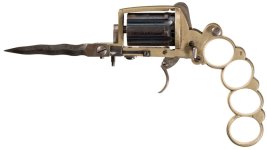
This Dolne "Apache" sold at auction for almost US$5000
In London, Glasgow, Liverpool and Manchester (and other cities of the UK) gang activity was similar: London had the “Forty Thieves”, an all-female gang of shoplifters, and the “Elephant and Castle” gang, a well-organized group of criminals who were known to dress well, and live like aristocrats. Manchester had the “Scuttles”, violent, mostly juvenile street fighters who attacked anyone they felt like having a scrap with…
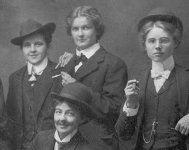
Members of the "Forty Thieves", also known as the "Forty Elephants", an all-female gang of criminals who terrorized South London for 200 years.
It comes as no surprise that there was a huge market for weapons of self-defense. Every gentleman, and many a lady, carried a pocket gun, often exquisitely engraved, inlaid with gold and silver; more of a fashion statement than a serious deterrent. The best and most famous makers all marketed pistols and revolvers aimed at the paranoid and scared citizens of the towns and cities, in Europe as well as America: Colt, Remington, Smith and Wesson among many others in the USA, Chamelot et Delvigne, Adams, Tranter, Lefaucheux, and Collette, just to name a few European makers. But, there was another tier of gun makers, less well known (they surely wished to remain anonymous) the ones who marketed their products specifically to the gangsters of Europe. Although a thug could use any knife, dagger or gun to ply his trade, a certain, much more effective type of weapon soon developed, specifically intended for the street fight: the knife pistol. The example shown here is such a gun: a large-caliber (15mm) six-shot revolver with a second barrel underneath the main barrel, loaded with a 9mm grape shot shell. This massive gun also has a folding knife blade attached to the bottom as a further means of getting into the “thick of it” with confidence. This type of weapon was not intended for a peaceful, law-abiding citizen, nor a police man or a soldier. Its only customer would be one with nasty business on his mind…
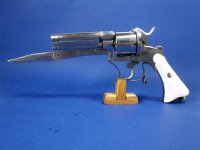 The gun is a 15mm pin fire revolver, with a 9mm smooth bore second barrel. It is well made although it lacks all identifying marks (probably for good reason) except a strange shape stamped on the face of the cylinder. The ivory grips and tips on the extractor would suggest that this was not the gun of a common criminal, but someone with clout, money, and status in the underworld. It was most likely owned by a gangster “lieutenant” or crime boss in a 19th century European city…
19th century society was outraged over the proliferation of gangs and their open warfare. There are numerous accounts of innocent citizens being caught in the cross-fire of warring gangs, of upper-class ladies and gents being robbed at knife or gun point in the streets, and of open thievery and unabashed criminality in broad daylight. The result was, of course, that the public felt a need to arm itself in an attempt to protect life and property. Pocket pistols of all varieties from pepperboxes and single-shot derringers to revolvers, palm pistols and muff pistols flooded the market and found eager buyers. The design, manufacture and distribution of personal weaponry was a huge business. From the plain and practical to the dainty and extravagant fashion “accessoire”, the choices were only limited by the buyer’s budget and personal taste. Today, these often rare and unusual weapons are a treasure trove for antique collectors and historians…
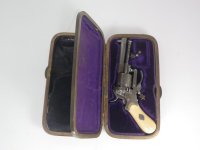
A tiny, 5mm revolver hidden inside a cigar case

A "Chicago Firearms" Palm Pistol, ca. 1890
This Dolne "Apache" sold at auction for almost US$5000
In London, Glasgow, Liverpool and Manchester (and other cities of the UK) gang activity was similar: London had the “Forty Thieves”, an all-female gang of shoplifters, and the “Elephant and Castle” gang, a well-organized group of criminals who were known to dress well, and live like aristocrats. Manchester had the “Scuttles”, violent, mostly juvenile street fighters who attacked anyone they felt like having a scrap with…
Members of the "Forty Thieves", also known as the "Forty Elephants", an all-female gang of criminals who terrorized South London for 200 years.
It comes as no surprise that there was a huge market for weapons of self-defense. Every gentleman, and many a lady, carried a pocket gun, often exquisitely engraved, inlaid with gold and silver; more of a fashion statement than a serious deterrent. The best and most famous makers all marketed pistols and revolvers aimed at the paranoid and scared citizens of the towns and cities, in Europe as well as America: Colt, Remington, Smith and Wesson among many others in the USA, Chamelot et Delvigne, Adams, Tranter, Lefaucheux, and Collette, just to name a few European makers. But, there was another tier of gun makers, less well known (they surely wished to remain anonymous) the ones who marketed their products specifically to the gangsters of Europe. Although a thug could use any knife, dagger or gun to ply his trade, a certain, much more effective type of weapon soon developed, specifically intended for the street fight: the knife pistol. The example shown here is such a gun: a large-caliber (15mm) six-shot revolver with a second barrel underneath the main barrel, loaded with a 9mm grape shot shell. This massive gun also has a folding knife blade attached to the bottom as a further means of getting into the “thick of it” with confidence. This type of weapon was not intended for a peaceful, law-abiding citizen, nor a police man or a soldier. Its only customer would be one with nasty business on his mind…
19th century society was outraged over the proliferation of gangs and their open warfare. There are numerous accounts of innocent citizens being caught in the cross-fire of warring gangs, of upper-class ladies and gents being robbed at knife or gun point in the streets, and of open thievery and unabashed criminality in broad daylight. The result was, of course, that the public felt a need to arm itself in an attempt to protect life and property. Pocket pistols of all varieties from pepperboxes and single-shot derringers to revolvers, palm pistols and muff pistols flooded the market and found eager buyers. The design, manufacture and distribution of personal weaponry was a huge business. From the plain and practical to the dainty and extravagant fashion “accessoire”, the choices were only limited by the buyer’s budget and personal taste. Today, these often rare and unusual weapons are a treasure trove for antique collectors and historians…
A tiny, 5mm revolver hidden inside a cigar case
A "Chicago Firearms" Palm Pistol, ca. 1890























