11.19 Ammunition - General
(1) Except where DND-provided ammunition is used by Cadets (see para (3)), competitorsupplied
ammunition must be used in all DCRA fullbore competitions, including team events.
(2) Unless a competitor has made prior written arrangements with the DCRA, the latter does
not undertake to have ammunition available for resale to competitors, either directly or through
an on-site or off-site supplier.
(3) Where ammunition is issued to competitors -
(a) If DND-issued ammunition is used (ie, by Cadets), it may not be modified in any
way, and all unused rounds and expended cases must be turned in to the original issuer.
(b) Where DCRA-issued ammunition is used for special matches, it may not be
modified in any way, and all unused rounds and expended cases must be turned in to the
RO or ARO.
(4) Handloaded ammunition may be employed, but no handloading is permitted in DNDowned
buildings.
(5) All applicable federal and provincial ammunition storage regulations must be adhered to.
Ammunition may not be stored in DND trailers or DND tents; however, a limited number of
secure separate lockers may be available (see DCRA Office). Provided that no firearm is also
present, ammunition may be locked in the trunk of a car.
(6) Competitors will be held responsible under Rule 26.03(7) for ensuring that each round of
their ammunition is absolutely safe to use in whatever rifle, weather and temperature it is being
fired. Any competitor loaning or otherwise supplying ammunition to others will share the
recipients' responsibility in this connection.
(7) Competitors will be held responsible for ensuring that if their ammunition is fired
upwards from the firing point at an angle of 5 degrees or less from the horizontal, the bullet will
fall within the danger area defined by the approved safety template for the range in use. See also
Rule 26.03 (7).
(8) Although competitors still retain their responsibility under para (7) above, all types of
permissible TR, TR-O and BP ammunition are considered acceptable within the safety template
from every firing point at Connaught Range and Primary Training Centre without requiring
further evidence or testing. NOTE: Non-TR ammunition used in ISSF and "F" Class events must
comply with Rule 11.21 (3), (4) and (5), in addition to para (7) above.
(9) Lubrication may be applied to bullets.
R11/9
11.19 (10) A competitor must submit his ammunition for inspection and testing whenever required.
ROs, AROs and Equipment Scrutineers may check at any time the ammunition any competitor is
using and, in particular, the RO may take for subsequent critical examination both a fired case
and one of the rounds a competitor is about to fire.
(11) No dispensation will be given if the quarantining of any of a competitor's ammunition
leaves him with insufficient rounds to complete his score. Competitors must, therefore, always
bring sufficient rounds to the firing point to allow for the situation described in para (10) above.
(12) The use or possession on the firing point of any ammunition other than that permitted for
the applicable event SHALL RENDER THE INDIVIDUAL OR TEAM CONCERNED LIABLE
TO DISCIPLINARY ACTION. See Rule 26.02(6).
(13) Once a competitor has taken his position on the firing point, under no circumstances will
any allowance or time extension be made for a defective cartridge (see Rule 11.03). Hangfires
and misfires are provided for under Rule 16.02 (9). CAUTION: Ammunition should not be
loaded in such a way that the bullet jams into the lands of the barrel when the bolt is closed. If
the bolt then has to be re-opened before such a round is fired (eg, for a ceasefire), the bullet might
stick in the barrel, spilling powder into the chamber and action. This might lead to either of the
following:
(a) Competitors might be tempted to fire (or leave the bolt closed on) such a round
after the order is given to cease firing. SUCH BEHAVIOUR CONSTITUTES
DANGEROUS CONDUCT AND WILL BE DEALT WITH ACCORDINGLY.
(b) Alternatively, no extra time is allowable for a competitor to clear up any powder
that may have been spilt into his rifle (see Rules 11.03 and 16.02(7)).
(14) As a condition of entering the CFRC, every competitor agrees that any of his rounds
which misfire, or show evidence of overpressure (eg, a blowback, case failure, or pierced primer,
etc) may be quarantined by the organizers. He also agrees that, if so requested, he will turn over
all such items to the RO for subsequent detailed examination(s) in conjunction with the
competitor.
11.20 Ammunition - TR, TR-O and ISSF Competitions
(1) Subject to Rule 11.19 and the remainder of this Rule, all TR/TR-O ammunition must be
of 7.62mm NATO/.308 Winchester or 5.56mm NATO/.223 Remington calibre and must not
exceed the maximum, applicable SAAMI or CIP chamber specifications. Cases of either calibre
that have been "improved" in any way are explicitly prohibited for use in TR competitions.
(2) The bullet weight for 5.56mm NATO/.223 Remington TR ammunition is unrestricted.
The maximum permitted bullet weight for 7.62mm NATO/.308 Winchester TR ammunition is
156 grains.
(3) Note also that the Program Booklet for the Canadian Fullbore Rifle Championships
specifies certain additional Conditions governing the ammunition to be used in TR events. For
information, these Conditions are currently as follows (but see Rule 1.06(2)):
11.20 a) The use of either 5.56mm NATO/.223 Remington or 7.62mm NATO/.308
Winchester ammunition is permitted in international, inter-club or interprovincial
team events .
(4) ISSF competitors may use TR ammunition to the foregoing specifications. If they do not,
their ammunition must comply with Rule 11.21.
11.21 Ammunition - 'F' Class
(NOTE: ISSF competitors employing non-TR ammunition must also comply with all provisions of this
Rule).
(1) Subject to Rule 11.19 and the remainder of this Rule, any ammunition may be used in 'F'
Class competitions that fits within the military safety template for the range being used. A
maximum calibre of 8mm applies at Connaught Range and Primary Training Centre. The
maximum calibre limits for events held at other venues may differ, and must be determined and
promulgated in advance by the organizers of those events.
(2) Provided they are safe to use (see Rule 11.19 (5), other cartridges may be "improved" or
modified within the foregoing ballistic limits.
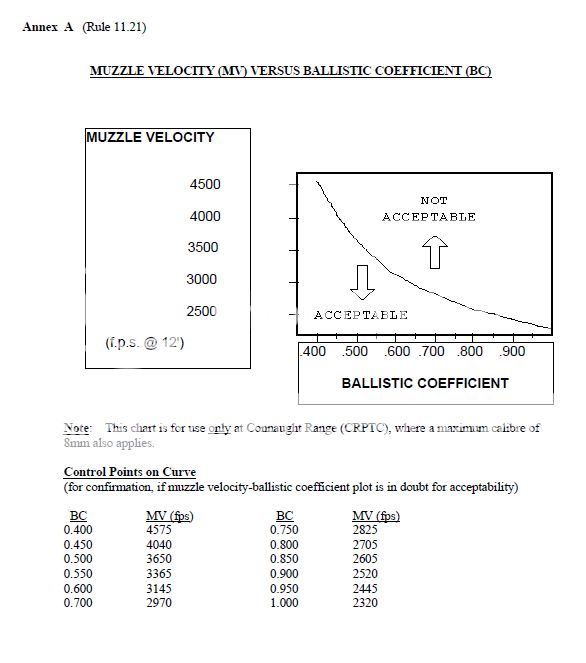
(3) For competitions at Connaught Range and Primary Training Centre (CRPTC), the
maximum DCRA-acceptable combinations of bullet Ballistic Coefficient (BC) and Muzzle
Velocity (MV) are shown in the graph at Annex AA" at the end of this Rule. The curve consists
of straight-line segments between specified control points which reflect an appropriate safety
factor.
CAUTIONS:
(a) Compliance with this graph does not relieve competitors from their
responsibilities under Rules 11.04 (1) and 11.19 (6) and (7).
(b) The graph must NOT be used to determine acceptable combinations of BC and
MV for shooting at facilities other than CRPTC (the safety templates may differ).
(c) For the graph to be safely applied at CRPTC, "F" Class shooting (also ISSF
shooting with non-TR ammunition) must NOT take place any further down-range than
the 300 yard firing point on Burke ("A") Range or the 700m firing point on Letson ("C")
Range, although any firing point may be used on MacDowell ("D") Range. Individuals
shooting non-TR/BP ammunition from
CRPTC firing points any further down-range assume complete personal responsibility
under Rule 11.19 (7). (NOTE: under Rule 11.19 (8), TR and BP shooting are considered
safe from all firing points at CRPTC, as are "F" Class and ISSF shooting with
ammunition to TR specifications).
(d) The DCRA expressly makes no representation that any point on this graph will
produce safe firearm pressures.
11.21 (4) For purposes of para (3) above, competitors will be required upon entering the CFRC to
show written evidence of their bullets' BC in the form of an original brochure or letter from the
bullet manufacturer, or a photocopy of a page from the bullet manufacturer's reloading manual. If
the manufacturer quotes more than one value for a bullet's BC, the mathematical average will be
used. If satisfactory BC evidence is not furnished, the DCRA may pull and weigh one of the
competitor's bullets, and then arbitrarily assign a BC of such value as it considers appropriate
(normally at least 1.1 times the highest value published by any manufacturer for a Very Low
Drag (VLD) bullet of the same weight).
(5) In situations that the DCRA considers doubtful or borderline (eg: cartridges employing
heavy VLD bullets, or a large-capacity case for the calibre), competitors may also be required to
submit their rifles and up to 5 rounds of ammunition to a test of muzzle velocity in a DCRA
facility (see also Rules 11.19 (11) and 16.19). NB: this testing may be required before the
competitor is allowed to shoot in the matches. If such testing finds the MV to be "unacceptable"
for the bullet employed (as determined by the graph at Appendix "A" to this Rule), the competitor
will not be permitted to shoot any further until his ammunition is modified (or substituted) and
successfully retested. The results of all DCRA MV tests are considered final and may not be
appealed.
(6) It will be the competitor's responsibility to clear doubtful cartridges with the DCRA well
in advance of the event. However, Rule 11.19(5) still APPLIES
 I'm not the DCRA ballistics police, I just know where to look...
It's all about safety templates and how far your round can travel...
You just have to be safe and use your head.
And if primers are a popping, you should pull
yourself off the line!