.223, are these cratered primers ?

Tak

Regular
EE Expired
Rating - 100%
7   0   0
So went to the range yesterday to try my first .223 reloads.

Rifle is a Marlin XL7 VH 1:9 twist

Data was 53 grn VMAX
Varget Powder
COL 2.315
CCI Small rifle Primers

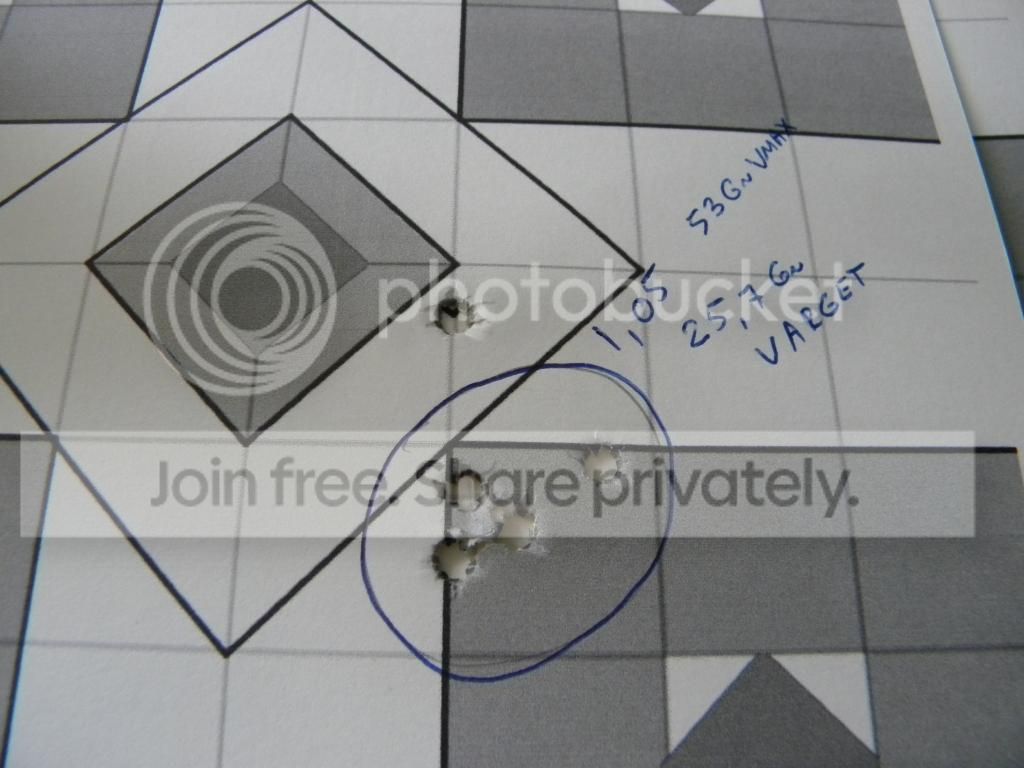
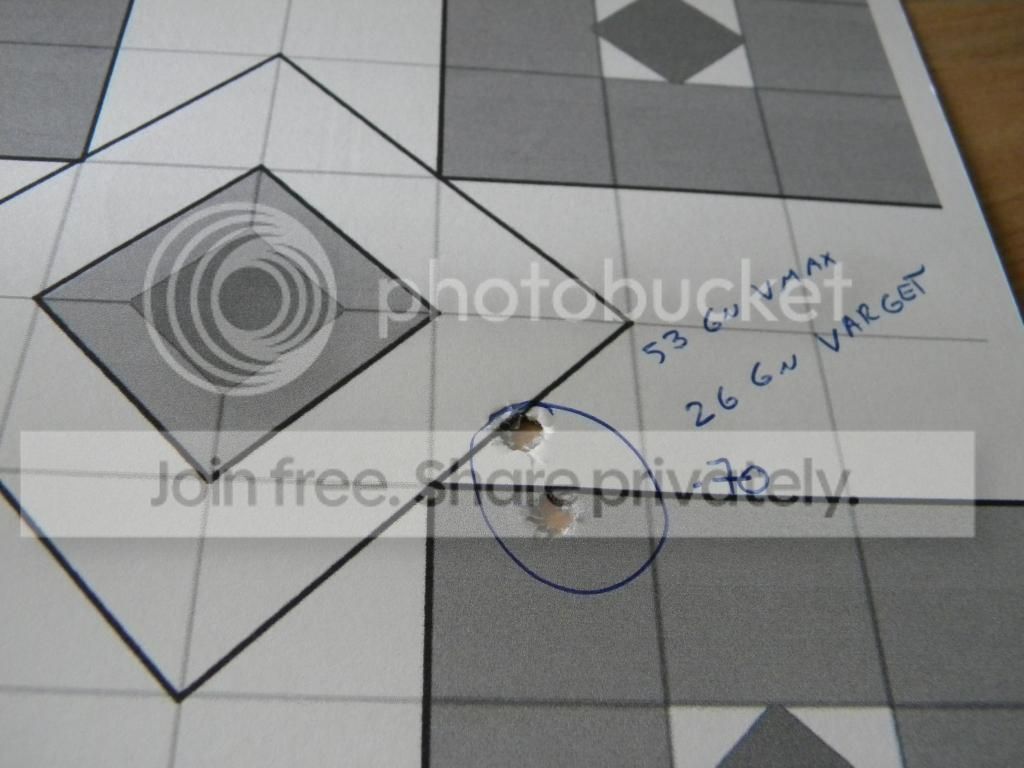
5 Groups of 5 as such :

#1 : 24.5 grn
#2 : 24.9 grn
#3 : 25.3 grn
#4 : 25.7 grn
#5 : 26.0 grn (Max recommended or close to max recommended depending on source)

Groups #2, 4 and 5 were the most promising, with #4 probably the best conclusive.

#2 :
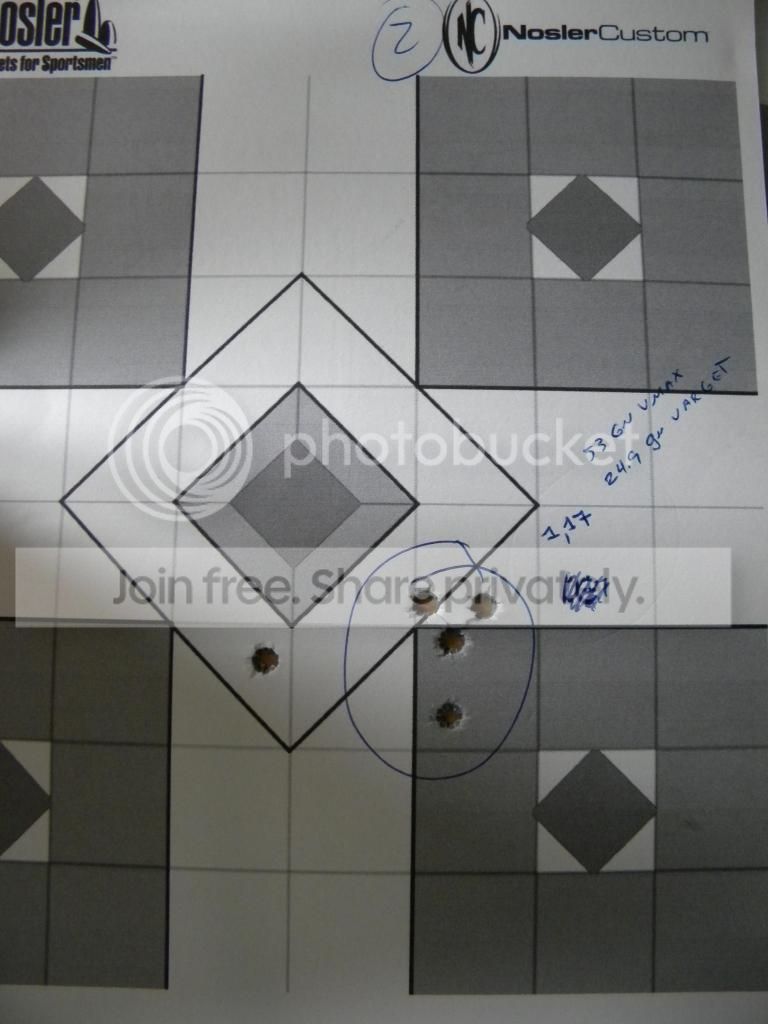
DSCN6041.jpg


#4
DSCN6039.jpg


#5
DSCN6040.jpg


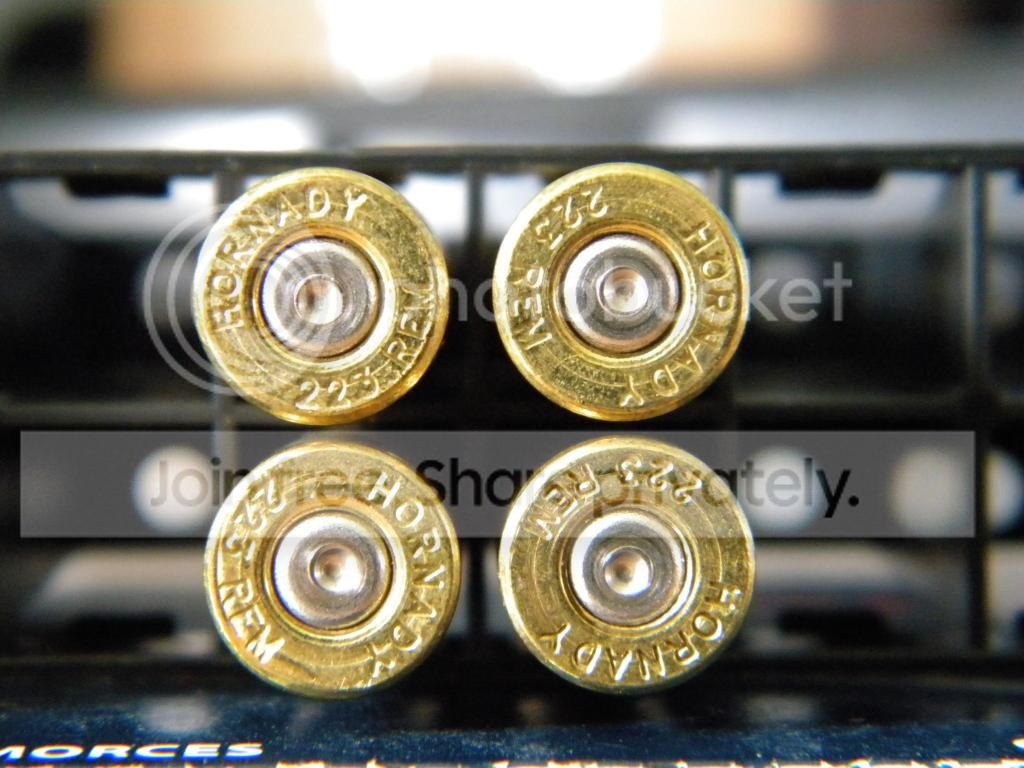
Now I don't even consider group 5 a group realy, the reason why there are only 2 shots out of 5 is because the 3 others would not chamber smoothly. Ive been loading about .015 from the lands, and out of the 25 shots rounds reloaded, 5 would not chamber smoothly. I'm gessing its probably bullet inconsistency because I was checking the COL every 5 rounds or so and it was always very close. However I might be closer to the lands than I thought. Any how, I'm guessing I'm fairly close on most of the bullets so I was checking for pressure signs and those primers seemed a bit more cratered then the factory loads I shot. Not flattened though, and I should add that the first group produced pretty much the same primer as the fifth. Should I be concerned at all? I'm gonna seat a little deeper next time just so I don't get those unchamberable rounds like .005 deeper. And we will see so that should make it a bit easyer pressure wise.

Factory load primers :
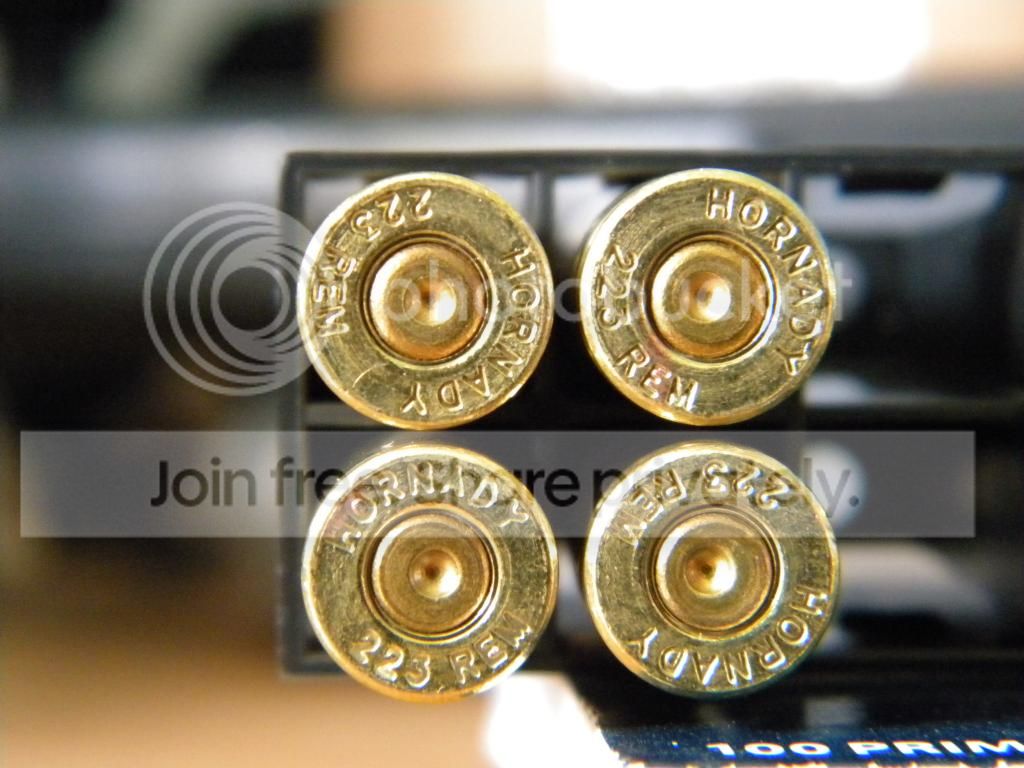
DSCN6037.jpg


Reloaded rounds :
DSCN6036.jpg


Oh and quick other question : I had one dud that didn't go, pin struck the primer but nothing happened (factory) is it safe to deprime it with the decaping pin or should I just throw it in the dud bin ?

Thanks for the imput

Cheers

JP
 
Oh and quick other question : I had one dud that didn't go, pin struck the primer but nothing happened (factory) is it safe to deprime it with the decaping pin or should I just throw it in the dud bin ?

perfectly safe
 
If you're planning on getting your bullets seated at .015" off the lands, I wouldn't count on the overall length to measure that.... There is substantial variation in the bullet tip shape. To get a consistent seating measurement, you need to use a bullet comparator type gage. This measures the length to the land diameter...
If you left your seating die at the same adjustment for all of your test loads, I think you might be a bit closer than the .015"....

As a test. I once measured the same 25 rounds of 30-06, measuring both the OAL and the comparator length. The OAL lengths were all over the map (so to speak), and the comparator lengths ended up with a standard deviation of .001"....

I agree; group #4 looks promising.
I would consider your reloads pretty close to maximum, going by the looks of the primers. Were the reloads from group #5?

Stan
 
;)The primers you used to reload were thinner or softer than your factory loads and flowed around the firing pin, as stated above your primers showed less pressure signs than the factory ammunition.

On a AR15 you should only use primers that have cups .025 in thickness to prevent slam fires and you can see below the cups have different thicknesses and also hardness variations. I would switch brands of primer if you plan to load hotter.


On a AR 15 the center of the primer can also let go at higher pressures with thinner and softer primers, and remember some small rifle primers are made for cartridges that have lower chamber pressures. As an example you would never use a Remington 6 1/2 primer in a AR15 because it is thinner and softer than the Remington 7 1/2 primer.(the 6 1/2 is made for the 30 carbine and 22 Hornet) Below on the left the primer anvil is protruding from where the center of the primer ruptured and blew out and these cases were not loaded over pressure.


Do not be alarmed by these photos, on a over gassed AR15 there can still be pressure in the barrel when the bolt starts moving to the rear and tight fitting thick hard primers are a must. On a bolt action you still need to match the primer to the chamber pressure of the cartridge you are shooting and if you switch primers and shoot the same load you will not see the primer flow around the firing pin.

Oh and quick other question : I had one dud that didn't go, pin struck the primer but nothing happened (factory) is it safe to deprime it with the decaping pin or should I just throw it in the dud bin ?

Thanks for the imput

Cheers

JP

Wear safety glasses and "SLOWLY" push the primer out in your press, I use a Lee universal de-priming die, it is wide open on the inside and and "IF" a primer did go off it is not confined in a restricted area. Note, no live primers have ever gone off in more than 40 years of reloading while removing a live one so just be safe and work "slowly".
 
Last edited:
Ill check out the comparator gauge, in the mean time ill just sit .005 deeper and see if i can get good results while tweeking the powder loads. Group 5 was close to max at 26 grn varget but the primers shown did not belong to any perticular group they where pretty much all like that so i guess they are just softer. Thanks for all the good info guys, Im reassured so I can keep working on these :)

Bidgedp are you suggesting i use the 450 for te 223
? I use 400 now

cheers!
 
So after taking more measurement I've noticed that the COL sometimes varies by as much as .005 (when measured from the tip, just like you guys said) So I guess that means the seater doesn't contact the tip of the bullet but in fact pushes down somewhere on the ogive. Does that mean that if I use the bullet comparator gauge ill have to readjust the seating die every time it varies to much (ie end up obtaining different values with the same seating die setting0 ? Or does the seater seat from the ogive, in which case it means they should all be at the same distance from the lands any ways ?

Thanks, JP
 
So after taking more measurement I've noticed that the COL sometimes varies by as much as .005 (when measured from the tip, just like you guys said) So I guess that means the seater doesn't contact the tip of the bullet but in fact pushes down somewhere on the ogive. Does that mean that if I use the bullet comparator gauge ill have to readjust the seating die every time it varies to much (ie end up obtaining different values with the same seating die setting0 ? Or does the seater seat from the ogive, in which case it means they should all be at the same distance from the lands any ways ?

Thanks, JP
If using a bullet comparator they will all measure the same distance from the lands.
Mine usually vary +-0.0005 when measuring on the ogive.
 
Measuring off bullet tips will give you wild variations as bullet oal varies quite a bit even with match bullets. Your seating die should be seating at or around the ogive. Pull the seating plug and set a couple different bullets in it, so long as they don't wobble around on their tips you should be fine. The plug should make contact around the diameter of where it touches the bullet. As for being difficult to chamber, I'm assuming you reloaded once fired hornady brass? Was it neck sized or FL? Trimmed after sizing? Crimped or not? They could need the shoulders pushed back a little or trimming. Or have they been reloaded several times?
 
Bidgedp are you suggesting i use the 450 for te 223
? I use 400 now

cheers!

Tak

The diameter of the firing pin hole in your bolt face is "LARGER" than the diameter of your firing pin. This allows softer primers to "flow" around the firing pin and into the bolt face and this is what you are seeing. Many newer rifles are like this and its caused by the manufactures taking shortcut to reduce manufacturing costs.

My new Remington 700 does the same thing, look at the photo below and you will see the bolt face has a tapered bevel at the firing pin hole in the bolt face. My fired primers will flow into this bevel and look just like your primers. I was very disgusted with this "new" Remington 700, their quality control and manufacturing shortcuts to reduce costs. None of my older Remington 700s were made this way and they had a smooth milled bolt face and a tight fitting firing pin.


This same problem has been discussed at Accurateshooter.com and many Remington and Savage owners have the bolt face re-bushed with a smaller diameter hole in the bolt face.

Again, this is a comedic defect and the firearms manufactures do not see this as a problem. "BUT" as soon as you say reloaded ammunition the firearms manufactures will turn a death ear to your problem.

You have four choices.

1. Don't worry about it and do nothing.
2. Switch to thicker and harder primers.
3. Contact the manufacture and see if they will fix the problem.
4. Send the rifle to a gunsmith and have the bolt face drilled out and have a threaded bushing installed with a "SMALLER" diameter firing pin hole.

NOTE: At Accurateshooter.com "some" of the competitive shooters were shooting hotter loads so many had the problem repaired rather than risk a ruptured primer. Other shooters just switched to harder thicker primers to solve the problem. Primer softness and chamber pressure cause the problem so your loads will determine the severity of the primer flow defect.

If you look closely below at your photo and the arrow you will see a small ridge where the factory loaded primer just started to flow into the firing pin hole in the bolt face. Your reloads have a softer and thinner primer, I would switch to thicker primers and see what happens.

 
Last edited:
I would suspect the rounds that you were unable to chamber need to have the shoulders bumped back a few thou....


You know what that might actually be it! I was partial sizing ! Didn't even think about that part... gotta have a look at that !

Bigedp: Thanks a lot I'll try it on my next batch, but in other words, with normal loads, it is just a cosmetic thing, no safety concerns right?

Thanks, JP
 
Measuring off bullet tips will give you wild variations as bullet oal varies quite a bit even with match bullets. Your seating die should be seating at or around the ogive. Pull the seating plug and set a couple different bullets in it, so long as they don't wobble around on their tips you should be fine. The plug should make contact around the diameter of where it touches the bullet. As for being difficult to chamber, I'm assuming you reloaded once fired hornady brass? Was it neck sized or FL? Trimmed after sizing? Crimped or not? They could need the shoulders pushed back a little or trimming. Or have they been reloaded several times?

Fired once, partial neck sizing slightly bumping the shoulder back. Trimming was good though, so if the seating die seats around the ogive, it means that in theory, the ogive should be at the same lenght from the lands for every round regardless of the COL. In other words, if I were to measure these rounds with a bullet comparator, they would all give the same measurement Correct ?
 
bigedp51: Thanks a lot I'll try it on my next batch, but in other words, with normal loads, it is just a cosmetic thing, no safety concerns right?

Thanks, JP

Tac, many people are having the same problem, below is a post from Accurateshooter.com, as you can see in his photos his primers are flowing into the firing pin hole in the bolt face and the pressures are below max. It is nothing more than manufacturing shortcut to save money, in the past gun makers took pride in their workmanship. Today its the bottom line and company profits are all that matters. :mad:

Topic: Pressure Sign on Tight Bore
http://forum.accurateshooter.com/index.php?topic=3820312.0
 
Back
Top Bottom