223Rem Ladder - gurus needed

308BAR

CGN Ultra frequent flyer
Rating - 100%
100   0   0
Hey gurus need some help with deciphering my ladder test.

Using Hodgon Data and other resources I put together some loads for the 75gn Amaxes and 80gn VLDs. My range only goes out to 200m bottom line, unable to test it out further to see have the verticle of the loads are.

80gn VLD, 23.8gn-25.0C Varget in 0.3gn increments 0.015 into lands, virgin Lapua brass. FPS range from 2681-2795 fps respectively. Which doesn't seem like much gain in speed should there be more gain? Trouble finding these nodes so to say. Shot two sighters using the lowest load and worked from lowest to highest load, highest to lowest load, lowest to Highest load total for three shots.

Can't figure out where to start testing for accuracy.
P=24.7gn
P1050085.jpg


75gn Amaxes, 23.8gn-25.0C Varget in 0.3gn increments, 0.3gn increments, at lands, FPS range from 2611-2827 fps respectively. Shot two sighters using the lowest load and worked from lowest to highest load, highest to lowest load, lowest to Highest load total for three shots. 24.4gn seem to produce the tightest verticle.

P1050084.jpg


Where should start testing again? Next step? Thoughts and any help is appreciated.

Thanks in advance. Cheers.
 
Last edited:
I thought 0.2gr increments were sufficient for small loads, maybe you blew through all your nodes... I could learn something from this thread though so I'll be paying attention.
 
I would have shot at 5 separate targets (for each bullet weight and load) and checked the groups.
 
I'm sure there is a node in there :) I am finding it hard to decipher as your key does not appear to match the targets. I would try again going up in 1/10th of a grain increments and fire one shot per charge. Make enough rounds to do the ladder test a couple of times for confirmation.
Or I would load 5 rounds of each charge going up 2/10ths and shoot for groups on separate targets.

For what its worth your 80 grainers 24.1 looked pretty flat for 200 yards. Was the wind blowing to the left of the target?

I think you might get more consistant results once your brass is fire formed to your chamber or at least resized.
 
You are using single, small number groups, to play around with minute powder charge changes. Maybe on Tuesday, with the sun shining, you have it figured out.
But on Thursday, with the sun behind a cloud and the wife made the morning coffee stronger, you can't duplicate what happened on Tuesday.
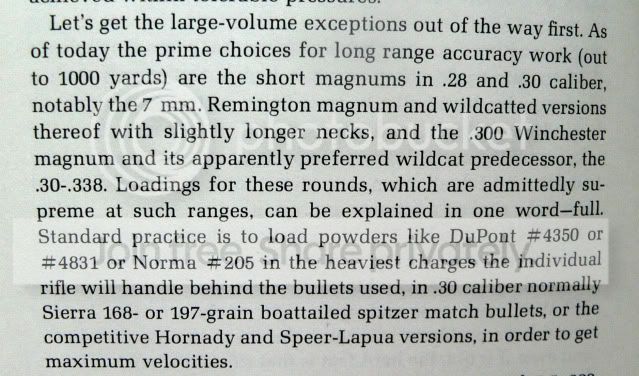
For reloading, I much prefer the method used by world class precision shooters.
Possibly the best ever in this class was Warren Page. Here are a couple of copies from his book, "The Accurate Rifle," regarding loading.
load001.jpg

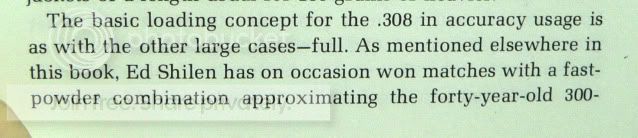
Then this, while talking about the 308.
load003.jpg


Of course, the rifles have to be properly bedded. In a nutshell, Warren Page sums it up like this.
Extremely heavy, stiff barrels are free floated.
Normal barrels are bedded with enough pressure at the front of the stock to take care of, as he puts it, the barrel vibrations.
 
You never say if you were seeing pressure signs with the 75gr Amax @ 25.0gr or you just arbitrarily stopped. In my rifle I never saw pressure until north of 26.0gr (compressed), I found my node with this bullet/powder combo at 25.7gr. Of course your rifle may vary (work up slowly).
 
Yes, 300 meters is better than 200 meters, but you should get some clue at 200. I'm having trouble picking out which hole is which so can't offer you an opinion on where a node may be.

I see you were loading to touch the lands. I think that is the poorest possible place. At least for the ladder test I would do a few groups to see if a 0.010 jam works better than a 0.010" jump, and go with which ever is better for the ladder. The problem with at the lands, is that once you introduce seating depth error, bullet bearing surface variation, and bullet ogive to seating cone variation, you will have a mixed bag of jam and jump actuals, and they may be jammed and jumped up to 0.010". Stay away from the no mans land area until you find the node, and then fine tune it with seating depth.

What I like to do is shoot three shots per load, calculate average elevation for each group (ignore the horizontal), and plot them on a graph vs load and also vs velocity. I'm not looking for the smallest group, but for flat spots where load and velocity goes up, but POI elevation does not. That defines the node. See some examples below for three different bullets. They were done at 300 meters. My conclusion is that a velocity of 3420 or so is a node for them all.

LadderGrains.jpg

LadderVel.jpg
 
You never say if you were seeing pressure signs with the 75gr Amax @ 25.0gr or you just arbitrarily stopped. In my rifle I never saw pressure until north of 26.0gr (compressed), I found my node with this bullet/powder combo at 25.7gr. Of course your rifle may vary (work up slowly).

I stopped only based on max load data on the hodgon load data site. I'm looking for everyones experience your info is quite informative.
 
Yes, 300 meters is better than 200 meters, but you should get some clue at 200. I'm having trouble picking out which hole is which so can't offer you an opinion on where a node may be.

I see you were loading to touch the lands. I think that is the poorest possible place. At least for the ladder test I would do a few groups to see if a 0.010 jam works better than a 0.010" jump, and go with which ever is better for the ladder. The problem with at the lands, is that once you introduce seating depth error, bullet bearing surface variation, and bullet ogive to seating cone variation, you will have a mixed bag of jam and jump actuals, and they may be jammed and jumped up to 0.010". Stay away from the no mans land area until you find the node, and then fine tune it with seating depth.

What I like to do is shoot three shots per load, calculate average elevation for each group (ignore the horizontal), and plot them on a graph vs load and also vs velocity. I'm not looking for the smallest group, but for flat spots where load and velocity goes up, but POI elevation does not. That defines the node. See some examples below for three different bullets. They were done at 300 meters. My conclusion is that a velocity of 3420 or so is a node for them all.

Thanks, I'll either jam or jump the bullets. I'll try to post up better photos and colour coding for the holes.

Thanks to all you gurus.
IMG_2100.jpg

IMG_2099.jpg
 
Last edited:
Got lots of article on load tuning that will help you.

Go up in 0.2gr increments to find the nodes. Then go around the node in 0.1gr increments. Yes, it will show a change in 0.1gr IF your scale is up to the task.

Shoot at separate targets 2 or 3 rds to start. At 200yds, it will be very obvious which loads work

For the 80gr Amx, just off the lands is great.

Jerry

PS what rifle and optics are you using? Have you properly bedded the action?
 
I'll try to post up better photos and colour coding for the holes.

OK, I can pick them out now. However, there is a lot of spread for each load. Your only hope is to put a horizontal line accross the target lower than all holes. Then measure vertical only from that line to each hole center for each load group. Average that measurement for each load group. Last plot that average vs the load. You then may see a trend. Again what you are looking for is a flat spot where load goes up but average POI does not go up in elevation. As it is now, there is too much overlap to see a trend without doing the averaging and plotting it on a graph. Once you see a possible flat spot area of interest, then try doing it again with 0.2 grain increments in the narrower range.

I find it easier to shoot separate targets so you don't mix up the bullets from one load group to another.
 
To my novice eyes it seems on the first photo it's green and in the second photo it's red. That is at least where you should focus on. Keep in mind i'm basing this on excactly zero experience doing this.
 
Got lots of article on load tuning that will help you.

Go up in 0.2gr increments to find the nodes. Then go around the node in 0.1gr increments. Yes, it will show a change in 0.1gr IF your scale is up to the task.

Shoot at separate targets 2 or 3 rds to start. At 200yds, it will be very obvious which loads work

For the 80gr Amx, just off the lands is great.

Jerry

PS what rifle and optics are you using? Have you properly bedded the action?

Savage with shilen SSM barrel, just a Tasco Varmint scope (but works and tracks very well) waiting on my Sightron S3 arrive, action has been bedded supporting the barrel nut in a B&C stock barrel is free floated.
 
Shooting at multiple targets like RonAKA suggests is a great idea. You can mark the bullets in sequence with a jiffy marker (completely colour them), red, green, blue, no colour, red, green,..etc. Shoot four at each target the colour will rub off on the paper. When you are done you can simply mark on the target which holes correspond to which load and then continue with the same target.

edit...Mea Culpa, I couldn't see your targets on the confuser i was using so didn't realize you had colour coded your bullets, my apologies, but man.. there sure is an awefull lot of holes on those pieces of paper, very easy to mix up the shots.

I use benchmark powder, not because it's better, but simply because the range between min and max loads for the 223 is greater than for varget. I my mind, it makes the load less sensitive to small errors in powder metering and makes it easier to find the sweet spot as a 0.1gr change is not as large a %change.
 
Last edited:
Dear lord, I printed one of those and connected the dots and couldn't make out an object, animal, stick figure, nothing.
KDX and H4831 I think have it.
We found a load for my dad's old 308NM using one full grain + - at a time from
a load that gave a decent group.
Five shot groups on five different targets with five different loads.
Good sunny windless day.
Had help doing this from an old long time friend reloader.
 
Back
Top Bottom