












































You are using an out of date browser. It may not display this or other websites correctly.
You should upgrade or use an alternative browser.
You should upgrade or use an alternative browser.
275gr 35 Whelen info
- Thread starter WhelanLad
- Start date


Wouldnt Read about it but pretty Spewin...
I cant get the Patch an Rod to Spin with the rifling..
One patch it slides straight and two barely fits...
So FFS im still unsure of the Twist Rate.
While Im here, doesnt anyon have some Numbers for Energy of the 275 @ 2200 say and the 250 @ 2500 say?
I cant get the Patch an Rod to Spin with the rifling..
One patch it slides straight and two barely fits...
So FFS im still unsure of the Twist Rate.
While Im here, doesnt anyon have some Numbers for Energy of the 275 @ 2200 say and the 250 @ 2500 say?

- Location
- In the shadows of the Rockies
Wouldnt Read about it but pretty Spewin...
I cant get the Patch an Rod to Spin with the rifling..
One patch it slides straight and two barely fits...
So FFS im still unsure of the Twist Rate.
While Im here, doesnt anyon have some Numbers for Energy of the 275 @ 2200 say and the 250 @ 2500 say?
Here you go -
http://www.handloads.com/calc/index.html


- Location
- Somewhere on the Hudson Bay Coast
JBM's output is 2.792 stability #s with a 12 twist..... doesn't mean much to me?
or 1.571 with a 16 twist..
The scale used by Bryan Litz suggests that anything under 1.0 is unstable, and 1.4 is generally the minimum for real world stability to be appreciated under a variety of conditions. For example, best case stability occurs in warm humid conditions, at high altitude. Worst case stability occurs in dry, arctic cold conditions, at, or below, sea level, so a bullet that is stable in an equatorial mountain range, in the wet season, might not work so well on the winter sea ice in the Canadian arctic.
There are things you can look for to indicate how stable your bullet is, the most obvious being whether the bullet holes in your target are round, slightly elongated, or keyholes. If you were to recover bullets from game, or test medium, examine both the expanded portion of the bullet, and the base of the bullet. If the expanded portion of the bullet is sharply angled, rather than at right angles to the shank of the bullet, it suggests that the bullet was in precession (yaw), and that the rotational velocity of the bullet was insufficient to correct it. All bullets precess at impact, but if stable they recover quickly. For this reason, long bullets fired from fast twist barrels penetrate more deeply than if fired from slow or standard twist barrels. Another indicator is if the base of the bullet is squashed, like it was hit with a hammer. This seldom occurs with expanding bullets, since their center of gravity moves forward in a dramatic manner, as the bullet expands. Squashed bases did occur frequently with long, heavy, tapered solids of the Kynoch style. These bullets were only marginally stable due to their modest rotational velocity, and long length, which didn't shorten after impact, since there was no expansion, and the base heavy, tapered, bullet wants to swap ends once it encounters a denser than air medium. This is the reason that successful modern solids are short in length, have parallel sides, and hemispherical or flat noses.
- Location
- In the shadows of the Rockies
Slammer you have helped me very well.
It looks like i wouldnt be much better or worser off keepin a 250gr , if anything proberly more versatile ! Distance / less drop etc...

I prefer the 310gr especially in my custom .350 Remington Magnum SI (Slamfire Improved
 ) which is built on a long action. Magazine length doesn't restrict cartridge OAL like it does in a short action for which this round was originally developed.
 Bullets can be seated without taking up case capacity so that more powder can be used. It has a 24" length 1:12 twist McGowen Precision barrel. Sub MOA accuracy.
Reloder17 seems to be the best powder. I can safely drive the 310gr bullet at 2530 fps MV, and a 250gr bullet at 2750 fps MV. Better downrange energy with the 310gr.

Woodleigh 310gr RN SN
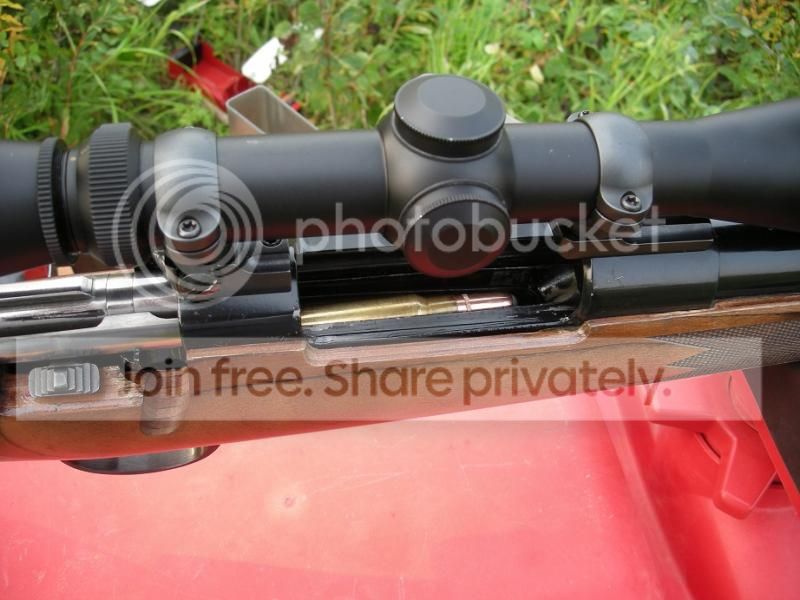
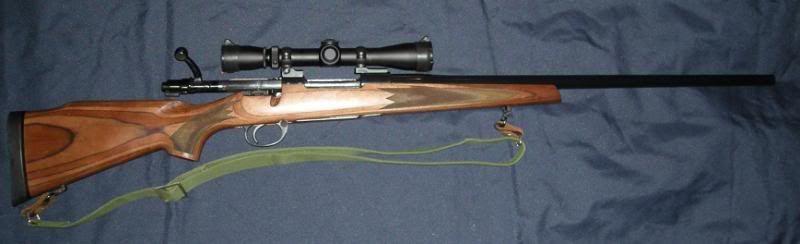
Remington 798 .350 RM with Leupold VX-2 Ultralight 3-9x33mm scope
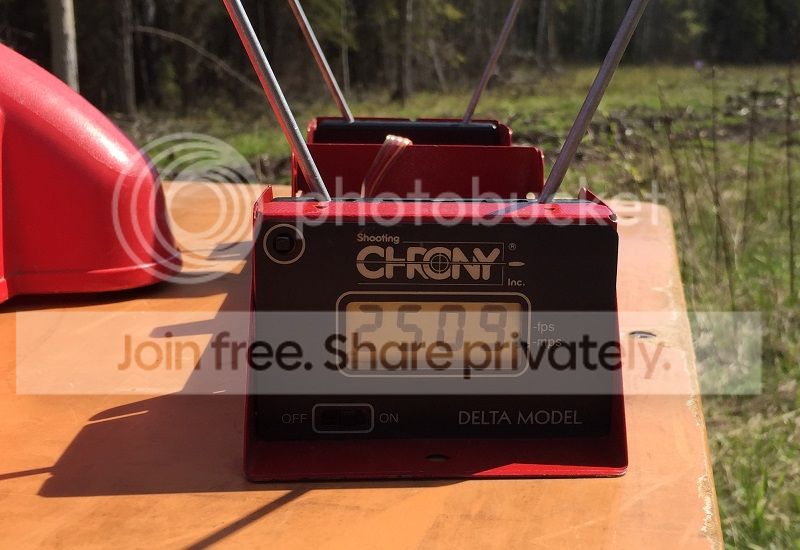
310gr chronograph reading
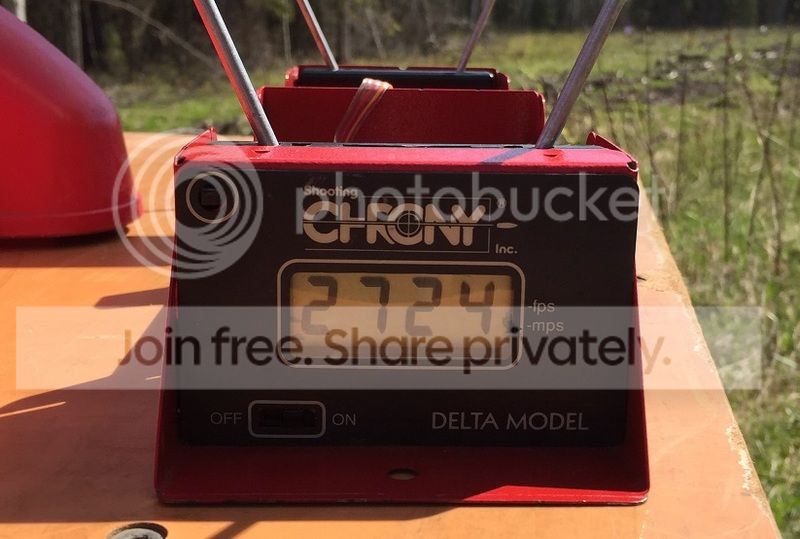
250gr Hornady SP chronograph reading

310gr .350 RM SI ballistics

250gr .350 RM SI ballistics





















