I wouldn't expect low pressure with factory ammunition.
Yes it is common in cartridges that will be fired in rifles that may be in excess of 100 years old.
The backed out primers in the 30-30 is quite common as was mentioned due to low pressures.













































I wouldn't expect low pressure with factory ammunition.
Yes it is common in cartridges that will be fired in rifles that may be in excess of 100 years old.
The backed out primers in the 30-30 is quite common as was mentioned due to low pressures.
Excellent tutorial. Mine measured 0.065" so headspace is not my problem.Measure the case rim thickness and the amount the primer is protruding and this will be your actual headspace.
The primers backing out is normal, the 30-30 max chamber pressure of 43,000 psi is not great enough to push the case back against the bolt face.
The primers on my Winchester 94 30-30 and my sons Marlin 30-30 back out all the time, and the amount they back out is your head clearance.headspace
Below depending on your rim thickness on average the primers can back out .007 to .009 maximum. If you have a vernier caliper you can measure your primer protrusion and rim thickness to get your rifles actual headspace reading.

With lower chamber pressure like starting at the suggested start load or reduced loads any cartridge will have backed out primers. And the amount the primer backs out is your head clearance. And with a resized case with .002 shoulder bump you would have approximately .002 head clearance.
Below is the cheap bastards headspace gauge with rimmed cartridges.
1. Take a new or full length resized case with the primer removed and measure from the case mouth to the base of the case and write it down.
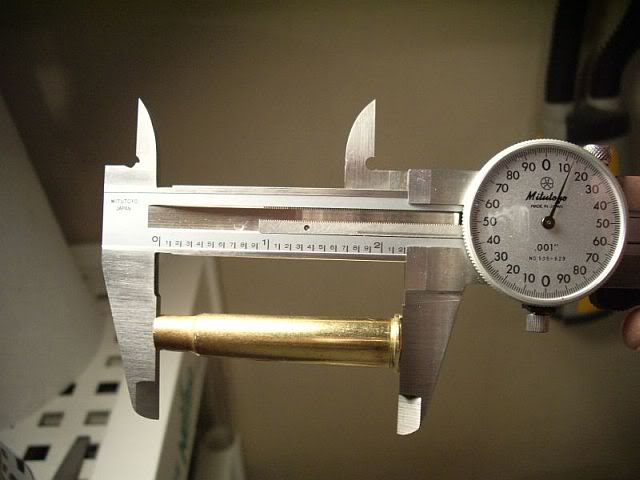
2. Now take a fired spent primer and using your fingers just start the primer into the primer pocket.
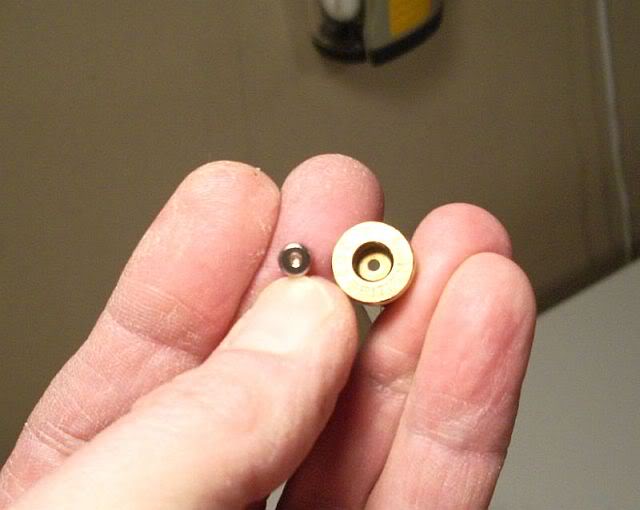
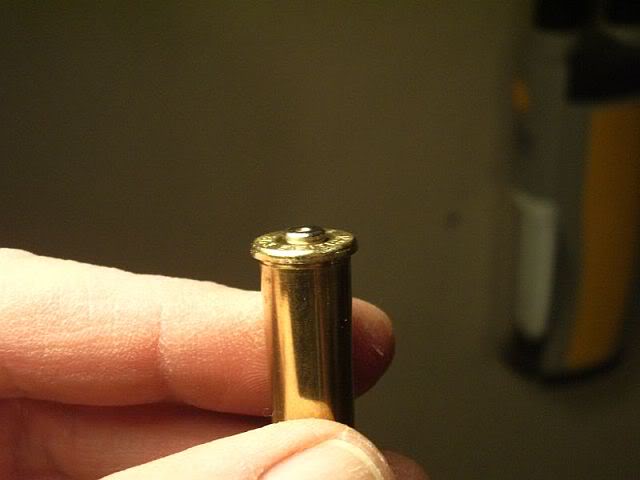
3. Now chamber the case and slowly close the bolt and let the bolt face seat the primer.
4. Remove the case and measure again from the case mouth to the base of the "primer" and write it down.
5. Now subtract the first case measurement from the second and this is your head clearance and the amount the primer is protruding.
6 Now measure your rim thickness and add it to your head clearance and this in your rifles actual headspace. And the max field gauge 30-30 Win headspace is .070.
NOTE, if the rifle is over .070 you should get a gunsmith to set the barrel back to GO and NO-GO headspace limits to be safe.
30-30 factory ammo is not loaded conservatively it's loaded to industry specIt could be excess headspace, but it could also be a sign of low pressure or a combination of the two. Sometimes, at low pressures, there isn't enough rearward thrust to push the case head against the bolt face, but the primer gets pushed out until the bolt face stops it.
.30-30 factory ammo tends to be loaded pretty conservatively and it isn't unusual to see primers backing out to some extent.
High pressure from "Detonation" could be your culprit in this case .on very low 30-30 loads (
Ummm, OK, but it's the "locking blocks" in fully engaged position that will determing headspace. I'm guessing, from your post, that the trigger guard portion of the lever was bent? not allowing the blocks to fully engage?My first center fire rifle was a win 30-30
first range visit primers were backing out
took it to a gunsmith with fired cases in hand
at that point in my life I knew 0 about guns
he took one look at it and said leaver is bent ... left it with him ... he fixed it
He re-bent the leaver / heat treated it ?????
still have rifle
I'm beginning to think that was the cause. I later shot some heavier 4064 loads to max +.5grains without any issue.High pressure from "Detonation" could be your culprit in this case .
30 gr is well within the min/max range so I question hte detonation theory, but more testing will proveBlew a primer on very low 30-30 loads (30gr/H335) with 150gr RN bullet.
All of the above. Winchester quality control (wait for the flack) changed throughout the years as technology advanced.bearhunter, while we're on it, in a old Marlin or Win , would the worn bolt be the culprit or can a worn lever also allow excessive headspace?
Can a lever be modified to take up space? realizing the Win has more linkage parts that can also be worn

METALLURGY has to be looked here if your dates are correct and not a replica stamp or such.I’ve got a Winchester 1894 in 30-30 that was manufactured in 1895 and rebarreled at some point, the date stamp on the barrel is 1946.
I finally got around to shooting it for the first time a couple days ago. After firing 4 rounds I picked up a case to inspect it and found the primers were pushed halfway out of the pocket. I was shooting federal 170 gr factory ammunition.
What could cause this? Fwiw, I measured the shoulder of the fired case and compared it to the shoulder of a loaded round and found the shoulder has moved forward .024” on the fires cases. As the 30-30 headspaces on the rim, this couldn’t be the issue, right?
I didn't note any difference.30 gr is well within the min/max range so I question hte detonation theory, but more testing will prove
tough to recall I bet, but did the one bad shot sound or feel different than the others?