












































300 Short mag or Similar, POI please

WhelanLad

CGN Ultra frequent flyer
Rating - 0%
0   0   0
Location
Australia AU
Hey guys, bit of a broad question here for those of you with a 300WSM or similar velocity class... 300wm, 7,325 wsm, etc

Where is YOUR rifle shooting at 100Ms?

I realise everyones hunting grounds/ situations are different from one person to another, an the needs of the rifles often vary.
An aslong as your rifle is 1inch to 2.5inches at 100m, your in with a good chance..... I just spent the arvo at a shootin alley up in the bush shootin my 300wsm an had one of my better outcomes with this rifle to date, an am now right into it!

Just wanted to Ask an find out where the POI are for you guys?

Any pointers would be good.

Cheers
WL
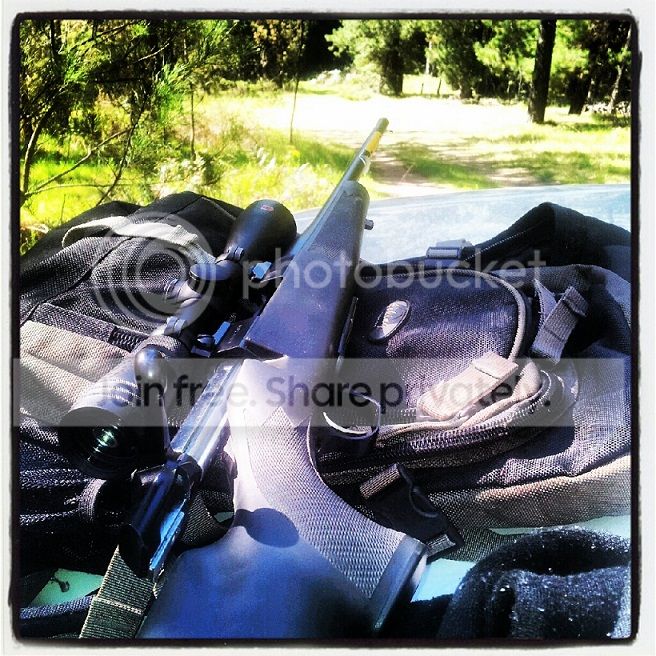
IMG_20121007_162530_zpsc05065a3.jpg
 
Everyone has different ideas but for me I sight in for 2.5" high at 100m which allows for no holdover to 300m for my 300WM. I do shoot at 100m,200m and 300m to make sure of the bullet drop but so far this has worked well for me.
 
Everyone has different ideas but for me I sight in for 2.5" high at 100m which allows for no holdover to 300m for my 300WM. I do shoot at 100m,200m and 300m to make sure of the bullet drop but so far this has worked well for me.

Yeah for sure, everyone has different ideas, i just wanted to get everyones ideas in the one place an take a few notes.
Thanks for givin your rifles poi!

Hopefully some other fellows add theirs.

Cheers
WL
 
If you are going to us the gun past 300m then you should zero it at 200m so you can dial up for 400 or 500m or more.
If you have a BDC scope then you have to zero it at 100m or 200m.
If your just shootin out to 300m then a 2.5" high at 100m will put you in an 8" kill zone between 100 and 300 but just remember if you go to 350m you need 5" to 7" more elevation.
 
If your cartridge drives it's bullet faster than 3000 fps, you could probably get away with a 250 yard zero if you intend to reach way out there. The problem is though that as the average hunter prepares for that long range shot, the result is often a short range miss, and by internet standards I'm well below average. So I sight my moderate and high velocity rifles for 200 yards, and my .30/30 and .458 are sighted to hit point of aim at 150. Keep your zero within the limits of the range at which you realistically expect to shoot. Once you've done that, verify your zero at that range, and determine the hold off for both shorter and longer ranges. I've found that it is counter-intuitive to hold low at close range, and easier to hold high at long range and for wind. So my advice is to keep your zero distance so that the maximum ordinate (if you like cool terms) is about 2" rather than attempting to maximize the point blank range on a larger target. You never know when you might want to shoot at a smaller target then the one with a 16" kill zone.
 
I test and sight in for dead on at 200 meters. This gives me about 3 " high at 100. I also use a Conquest BDC scope with the V600 reticle. This way I can shoot to the hash marks out to 600. In my 300 SAUM using 150 TTSX bullets the scope is pretty close with all the hash marks. I can hit 4 liter milk jugs with 1 shot at all the ranges. It is a great setup with a laser rangefinder. However, you have to be cautious at close range. Steve
 
If your cartridge drives it's bullet faster than 3000 fps, you could probably get away with a 250 yard zero if you intend to reach way out there. The problem is though that as the average hunter prepares for that long range shot, the result is often a short range miss, and by internet standards I'm well below average. So I sight my moderate and high velocity rifles for 200 yards, and my .30/30 and .458 are sighted to hit point of aim at 150. Keep your zero within the limits of the range at which you realistically expect to shoot. Once you've done that, verify your zero at that range, and determine the hold off for both shorter and longer ranges. I've found that it is counter-intuitive to hold low at close range, and easier to hold high at long range and for wind. So my advice is to keep your zero distance so that the maximum ordinate (if you like cool terms) is about 2" rather than attempting to maximize the point blank range on a larger target. You never know when you might want to shoot at a smaller target then the one with a 16" kill zone.

This has helped 100%, An funnily enough i was thinkin within the whole 9 yards of what you covered!
Thank you bud!

FWIW- the scope is a Redfield with the ballistic reticle, which has hold over points roughly for calibres in the 3000fps range, for 200-300-400 an 500! So there is no real use having it sighted real high at 100 for a max PBR, plus the idea is to shoot a long way but rarely happens so i think what you have said is very true!

im on lunch break but will chip back in soon.

WL
 
. However, you have to be cautious at close range. Steve

Due to the POI being high at closer ranges?

I found this was something in the back of my mind the whole time i was hunting with it sighted high... an may have been the reason a Fallow stag took off after a shoulder shot which at 100ms would be a High shoulder shot :/ but none the less its sittin pretty now !
 
Yes, you have have to be cautious and aim lower at theclose ranges. Besides the heart is low on these animals. Fire a few shots at 75 and 100 to see where they hit.
Steve
 
The bullet will be "low" for only about 25 yards, and it will be no more than about 1.5" low (or whatever the height of the scope over the bore) at the very start of that distance and rising. For any other distance the bullet will be high until it reaches the "zero" range; from then on it will be lower.

There is no need to worry about closer shots being low on any target the size of big game animals if the rifle is zeroed at 200.
 
On any rifle with decent velocity and wearing a scope without any range finding accoutrements, I have always sighted +3" at 100.
This give a MPBR of anywhere from 300 to 360+, depending on chambering and load.

One needs to be aware of the mid-range trajectory, which, in some chamberings will be +4" or slightly more.

This will not cause a miss on any big game animal when the shot is in the heart-lung area.
If one is trying for neck or head shots [I do not think they should be anyway]then it becomes a problem.

With B&C reticules, I sight for bang on at 100, then use the other stadia for longer shots.

One must shoot his rifle and load to determine where that bullet is at various ranges.

Regards, Eagleye
 
Cheers for the replies to this thread, i forgot about it,

Rezeroed the rifle at a range finded 100ms and it was dead on at 100 for some reason, I adjusted 1.5 inch high which gives me around a 200-230 M zero an still hold dead on at 300ms, Which is about as far as i want to shoot for now, without further practise at 250+

happy days
 
This has helped 100%, An funnily enough i was thinkin within the whole 9 yards of what you covered!
Thank you bud!

FWIW- the scope is a Redfield with the ballistic reticle, which has hold over points roughly for calibres in the 3000fps range, for 200-300-400 an 500! So there is no real use having it sighted real high at 100 for a max PBR, plus the idea is to shoot a long way but rarely happens so i think what you have said is very true!

im on lunch break but will chip back in soon.

WL

I am new at the longer range stuff, but this is what I have been doing. Check the MOA change for each mark on the reticle - I have the Leupold B&C which comes with the info in the owner's manual. Then look at a realistic figure for BC of the bullet you are using. Bryan Litz has lots of good info published. Then consider your muzzle velocity - measured as opposed to claimed. You can then sight your rifle in as per calculations from a ballistics calculator. Once you have done that, you need to place targets out at the ranges that correspond to the marks on the reticle and confirm that your shots are going where they need to go. You may need to make some small adjustments to your initial sight in range. For example the B&C reticle is designed for 200 yard main cross hair, then 300, 400, 450 and 500. Depending on the load I may need to sight in at 190, 200, 205 etc. in order to have the other marks on at the appropriate ranges.

Keep in mind that there is an extremely important step involved in the process: actual testing in the field!
 
My approach is simple. I handload and chonograph my loads. By luck or design, in all of my hunting rifles, loads are running at right around 3000 fps, give or take 50. I also happen to use bullets from .277 to .308 that have similar ballistic coefficients, say .450, give or take. Given this, I sight all rifles at about 2.25 " high at 100m, which means a 230ish yard zero and really similar point-blank ranges. I can switch hunting rifles at a whim. The only thing I need to ensure is that I match the rifle to the ammo, and the ammo to the game. Everything else is a no-brainer. Sight alignment and point of impact at all practical hunting ranges is same-same. I include my .300 WSM in this approach. The only practical difference between it and my .270 Win is that I'm spitting out 180g bullets, not 130.
 
Back
Top Bottom






















