












































303 Brit Hollow Point MilSurp Ammo

Ganderite

CGN Ultra frequent flyer
Rating - 99.7%
355   1   0
This round was made around 1900.

The problem with sealed packs of ammo is you can't see what is inside. I just found out that the 303 ammo issued around the turn of the century was hollow point. This includes the ammo made in Canada.

Soon after, I am guessing around 1902ish, the switch was made to FMJ and the existing ammo was pulled and the bullets replaced. I doubt much of the original HP ammo is left.
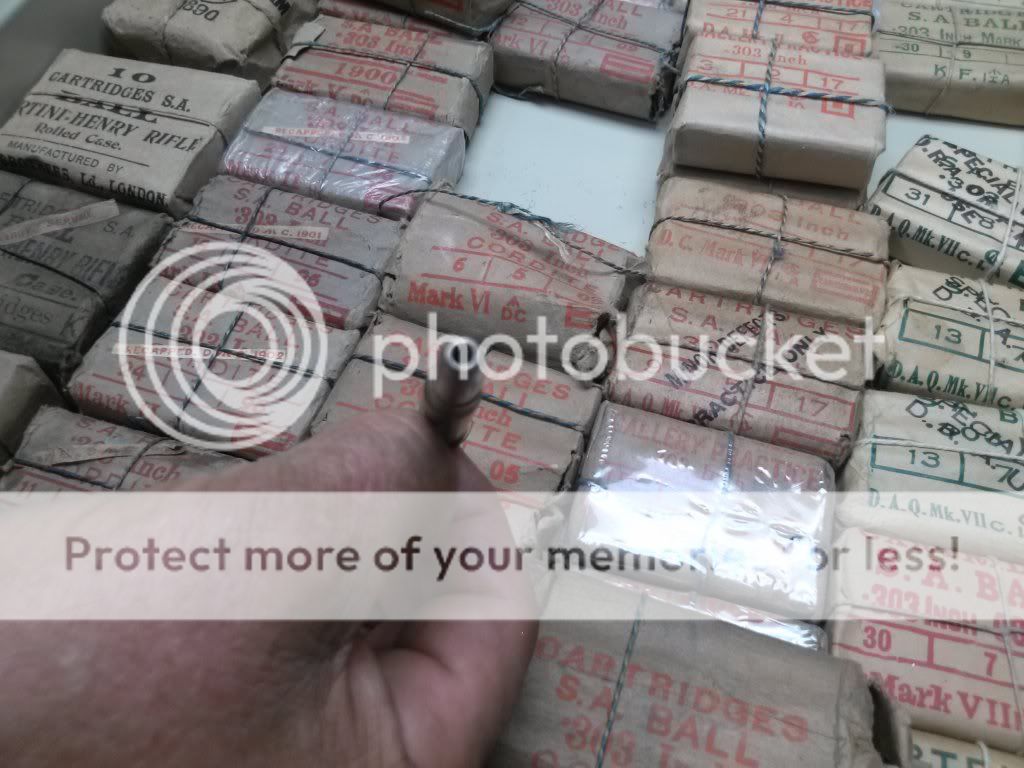
hp303.jpg
 
I am told that the Dum Dum hollow point worked well and became the standard 303 for a period of time. The collection includes Canadian made hollow point.

If you look at the overstamp, you can see that the hollow points were pulled and FMJ was installed.
 
I heard somewhere that military ball was used for military applications back then in place of any expanding round. The philosophy being that ball projectile passes through (potentially less lethal) than expanding which...well, we know what a hollow point .303 could do.

Could all be BS, I don't know. Same deal with serrated Bayonets of the same time period...Geneva? another earlier "Convention of Countries"?
 
.303 ammo:

Cartridge, Small Arm, Calibre .303" (in full or abbreviated) will be on any package. There is also a LOT of other information but you have to know how to read it.

Mark I: compressed Black powder, small Boxer primer, 215 RNFMJ bullet
Mark II: same but marked II

Cordite ammunition was headstamped C on the brass and the packets were marked, ammo being termed "Cordite Mark whatever"

Cordite Mark I: 215 RNFMJ
Cordite Mark II: 215 RNFMJ
Cordite Mark III: 215 RNSP EXTREME RARITY: only a few known to exist: never issued
Cordite Mark IV: 215 RNHP
Cordite Mark V: 215 RNHP
Cordite Mark VI: 215 RMFMJ: this was a post-Hague Convention reversion to the Mark II standard
Cordite Mark VII: 174-grain tripartite spitzer FMJ, impact-unstable
Cordite Mark VIII: 174-grain spitzer FMJBT with a Rebated tail

TYPE Z AMMUNITION used extruded IMR-type powders. Marked as VIIz, VIIIz, 7z, 8z.

SPECIALS also were marked on the Cartridge Case and on the Packets:
UP TO 1927, markings were:
VIIG tracer
VIIW: AP
VIIB: Buckingham Incendiary
VIIP: early AP
There were several others also: Pomeroy Incendiaries, Gallery rounds and the super-baddie: Q: PROOF rounds.
In Canadian, also GP-B: Galery Practice, Ball: 115-grain RN lead bullet

STARTING 1927:
VII only: Ball
GII, GIII, GIV, GV: all Tracers
BI, BII, BIII, BIV, BVI, BVII, B4z, B6z, B7z: all Incendiaries There was no V or 5. BIV is very special: APIT for ME-109 tanks.
WII: AP

This is only fragmentary; there are others.

BEST REFERENCE is Peter Labbett and Percy Meade's book, CALIBRE .303". It is utterly exhaustive, refers to all 3600 known variants!

Hope this helps.
.
 
Last edited:
Development on the hollowpoint series began at Dum Dum in India, hence the name we still use.

First were the Dum Dum Mark II Special: C Mark II with the nose filed off.
C Mark III was a standardised version of this one.
C Mark IV was a deep hollowpoint
C Mark 5 was a deep hollowpoint, slight variation
They worked VERY well.

The entire Dum Dum series was banned by the Hague Convention, which was convened specifically for the purpose of banning "inhumane" weapons. These included the Dum Dum bullets and any and all explosive projectiles under 1 pound in weight. A 1-pound projectile comes in nicely at 37mm, which is why this has become a standard AA and light-artillery bore.

Following the Hague Convention, Britain "saved face" by announcing that they had a BETTER cartridge, the Cordite Mark VI..... which was ACTUALLY a reversion to the Cordite Mark II standard which they had declared obsolete. Then they got down to work and came up, in 1910, with the Mark VII IMPACT-UNSTABLE projectile, which remained the standard for Ball ammunition until the end of the .303 era. The Ball Mark 8 was an extended-range round intended for the Vickers MMG and generally was packed belted.

Hope this helps.
.
 
Last edited:
I had heard about Dum Dum making an expanding bullet. I had never heard that a deep hollow point (like the one in the picture) had been adopted into general use and was made by all the factories.

My grandfather went to Africa in the Boer War. We have a picture of him holding what I assume is a Long Lee. Was his ammo HP??
 
Hague Convention was binding only upon the troops of a "civilised signatory Power" when fighting against the troops of another "civilised signatory Power".

All bets were OFF when it came to anchoring Fuzzy Wuzzy, Pathans and assorted other folks who resented becoming a part of the Empire on Which the Sun Never Sets.

World opinion was another matter, and Britain had been roundly pounded in the world press for their "barbaric" ammunition. The "world" (meaning French, German and American) press was vehemently anti-British and would have LOVED a chance to castigate "the world's bullies" by catching them using hollowpoint ammo against Whites. That was a point also at that time; it was assumed that Whites were civilised, whereas the modern international Marxist-Leninist press assumes that we are the scum of the earth, good for nothing but oppressing the downtrodden masses.

I very much doubt that the hollowpoints would have been used in the Boer War in any official capacity, but it is possible that a few rounds were carried there by inidivduals.

Officially, the hollowpoint ammunition all was downgraded and used for practice; it shot beautifully. The last stocks were used up for machine-gun training in the Great War, along with the world's only remaining supply of SAA Ball, .450" Gardner and Gatling, shot off by the RFC in old brass-jacket Maxims.

Interesting enough, CANADA manufactured all 3 types of Dum Dum bullet. You can sometimes find C Mark IV and C Mark V for a few bucks a shot, but the Cordite Mark III was long believed not to have been made here until I reported a Blank round with the C Mark III headstamp to Peter Labbett, who expressed surprise that it had been made here. It is one of the Great Rarities anywhere. I have never seen an unmolested round of British or Canadian manufacture: just a single casing converted to Blank, headstamp DAC C III cancelled.

I have only a very few rounds which I am quite certain came out of the Boer War... and they are C Mark II: 215-grain RNFMJ.

That would be a very good question for a thread over at milsurps dot com: lots of experts there, including a few from SA.

It's been 115 years: perhaps time to get to the bottom of it.
.
 
I was hoping Smellie would chime in here and explain all this. Some of the old ammo wrappers have labels to the effect that that ammo is not to be used on white troops.

History linked to hardware is fascinating.
 
@ Ganderite:

If you check the description on the packet label, likely you will find the description is for "C Mark V" or "C Mark IV": both 215-grain hollowpoints with about 2060 ft/sec MV.

Can you post a photo of the label? It would be GREATLY appreciated.

Thanks.
.
 
Back
Top Bottom






















