303 Brit with Cast Bullets

Ganderite

CGN Ultra frequent flyer
Rating - 99.7%
355   1   0
I tried shooting a CQB match with a #4 once. It did not work very well. I used cast bullets, to reduce the recoil and cost (don't need much power to punch paper at 25 yards). The bullets had a flat tip and would not feed reliably.

I ordered some new cast bullets with a round point. They weigh about 203 gr with the gas check. Today I did a bit of load development. They ran perfectly from the magazine.

The powder used was 12.5 to 15 gr of Unique. I wanted to use 2400, but could not find it in my magazine.

It appears that 12.5 is the best load. I tested at 50 yards, off a sandbag. The rifle is a #4T with the issue 4X scope.

I am pleased (shocked) with the performance. I did not think a 4X post scope could shoot so well.

Noise was soft. Velocity ran from 1250 fps to 1575 fps, depending on the powder charge. Recoil was nil.
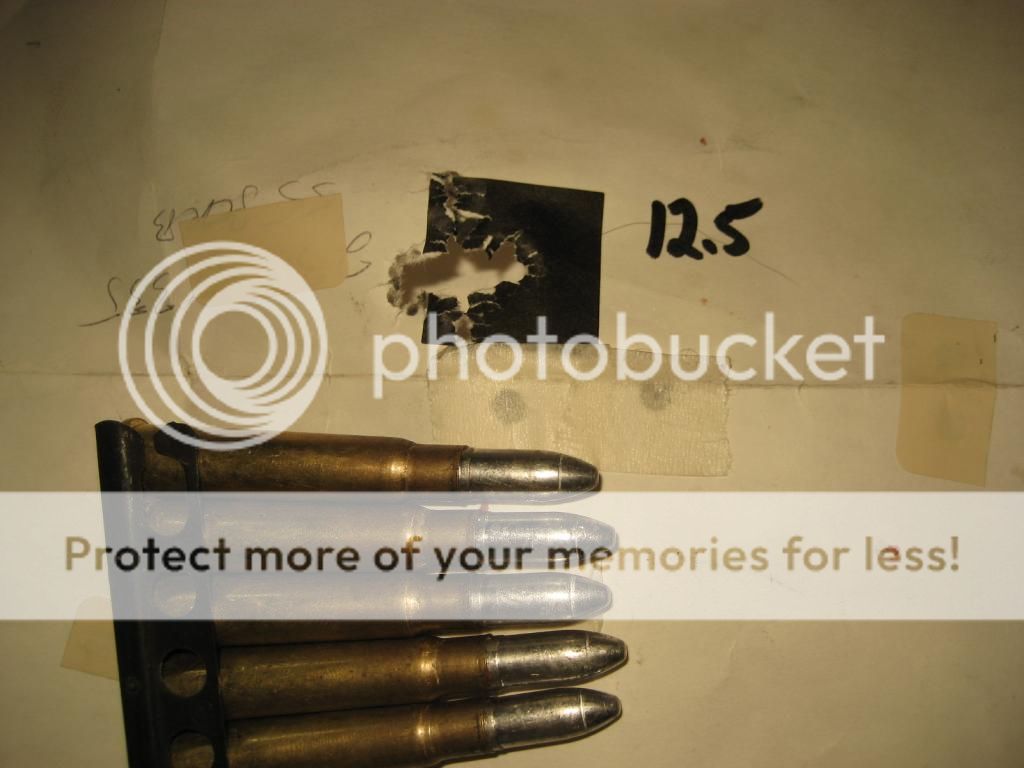
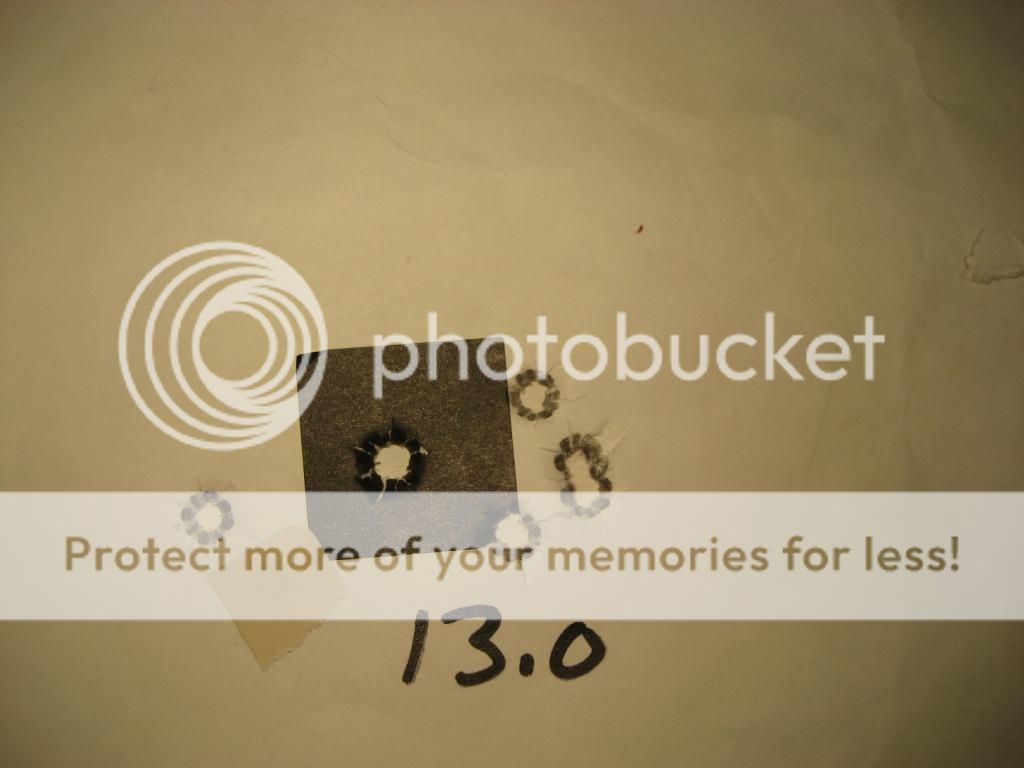
IMG_0373.jpg

IMG_0378.jpg

IMG_0375.jpg

IMG_0376.jpg

IMG_0377.jpg


The ammo looks dirty because it was once fired brass that was almost full length sized to fit this rifle. I left the sizing lube on the cases so the brass would set back onto the bolt face and fire form without stretching. The brass will then be segregated for this rifle.
 
Last edited:
I never got a chance to buy Unique so I shoot 303 with Trail Boss under NOE 200Gr.

Shot it today with loads 10.5 to 11Gr and 11 looks like a winner-2 inch, 10 shot group.Somehow I have to make a pix of that and post it.

I tried Red Dot and 2400 before and it didn't quite work.That was before I noticed 2 groove barrel just hates any WW alloy or softer ( other rifles don't care).

I had to add scrap solder (thx to sloppy plumber on job site :) ) and now things work out nicely.
 
I just started this cast game of the .303. I've been trying the 5744 at about 21 gr. out of a sportered Ross, a Parker Hale # 4 and a Ruger #1.
It's a Lyman bullet that goes 206 gr lubed and gas checked.
My groups were not as impressive though!
 
Did you use inner filler with your Unique?

I tried shooting a CQB match with a #4 once. It did not work very well. I used cast bullets, to reduce the recoil and cost (don't need much power to punch paper at 25 yards). The bullets had a flat tip and would not feed reliably.

I ordered some new cast bullets with a round point. They weigh about 203 gr with the gas check. Today I did a bit of load development. They ran perfectly from the magazine.

The powder used was 12.5 to 15 gr of Unique. I wanted to use 2400, but could not find it in my magazine.

It appears that 12.5 is the best load. I tested at 50 yards, off a sandbag. The rifle is a #4T with the issue 4X scope.

I am pleased (shocked) with the performance. I did not think a 4X post scope could shoot so well.

Noise was soft. Velocity ran from 1250 fps to 1575 fps, depending on the powder charge. Recoil was nil.

IMG_0373.jpg

IMG_0378.jpg

IMG_0375.jpg

IMG_0376.jpg

IMG_0377.jpg


The ammo looks dirty because it was once fired brass that was almost full length sized to fit this rifle. I left the sizing lube on the cases so the brass would set back onto the bolt face and fire form without stretching. The brass will then be segregated for this rifle.

Did you need to use any filler? Looks like a fun experiment.
 
Even factory ammo in my longbranch I get the occasional casing with thin brass or even a small split a cm up from the rim, I just buy my occasional ammo as I don't shoot mine regular, I wouldn't dare reload it personally, With the loose bore for contamination the brass expands and contracts a lot imho, at least in mine
 
Even factory ammo in my longbranch I get the occasional casing with thin brass or even a small split a cm up from the rim, I just buy my occasional ammo as I don't shoot mine regular, I wouldn't dare reload it personally, With the loose bore for contamination the brass expands and contracts a lot imho, at least in mine

Yes. The problem you describe is well understood when ammo is shot in a Lee Enfield.

The solution is two-part. For the initial shot, stop the case from going all the way into the chamber. keep it hard against the bolt face. The O-ring or pony tail tie around the case at the rim is the solution with full power ammo.

With mild ammo, I just lube the case, so it won't stick to the chamber wall and stretch. That is why I left the sizing lube on the cases. When I sized them, I sized he once fired brass just enough to make sure it would all chamber. I tried to not set the shoulder back.

This brass now fits the chamber of this rifle.

The second part of the solution is to keep the brass segregated and neck sized only in the future.
 
Its funny that you mention that, it seems to always be the first case that splits and the rest are fine.

At least I know it will fire with a stick or rock in the chamber with the round :p

8)
 
I never did get into casting my own but have done lots of reloading, including 303 Brit. I have been thinking about trying some cast bullets in my Ross 1905 factory sporter and my No4 MkII. Just wondering where you purchased the cast bullets?
 
.
The .303 works very well with an appropriate cast bullet, in both two or four groove barrels. I generally try the old C.E. Harris load of 13 grains of Red Dot with about a 180 to 215 grain bullet. Back when I was a lot younger and not a lot of money, I use cast bullets for target shooting out to 300 yards, and even played around out to 600 yards. You had to experiment a bit with sight settings and I found out I was using about a 600 yard setting for the 300 yard targets.

If you are not using a filler such as daycron, then you can get more consistency in your groups by raising the muzzle of the rifle so that the powder falls back against the rear of the case. Sometimes Magnum primers can help as the have more "spark" and expand the flame out inside the case better. Small charges lay on the bottom of the cartridge case, and if you use a powder that is a bit harder to ignite, the flame from the primer can pass right over the powder charge and delayed ignition occurs.

Also, people attempt to drive cast bullets too fast. I have found that a 1600 to 1900 feet per second range tends to give the most accuracy. Another thing is bullet shape. People look at a spritzer pointed cast bullet and tend to think that they can drive it faster, similar to a jacketed bullet----in most cases, ---WRONG thinking. An example of this is the 169 grain Lyman pointed bullet for the 30-06. This is the "Squibb" design and was intended for Gallery practice indoors and up to 100 yard ranges. Try driving them at over 1800 and they go all over the place, BUT--reduce the velocity to 1600-1650 fps, and you will find 25 yard groups will hover around the one inch mark and two inch 100 yard groups are fairly easy to obtain. I bought a Hensley and Gibbs mould a long time ago in this design, (which is very similar to the 172 grain Springfield military bullet,) but specified a .316 diameter. It is a double cavity mould and both bullets are within 1/2 grain weight of each other.

As SMELLIE knows, every once in a while Nostalgia gets a grip on the Soul, and one of the old .303 SMLE, Lee-Enfield or Ross target rifles get taken out to the Gopher fields along with an ice cream bucket full of cast bullet loads, and the fun begins. Since the Prairie Gophers are small targets, usually shot at under 100 yards or within .22 rimfire range, these days do get interesting.

On the other hand, I have successfully driven cast bullets at 2700 fps, or full power loadings. However, these have been paper patched, (paper Jacketed) bullets. I have even used these on Deer with good results. Thus, you can use a cast bullet designed for the .30-06 in the .303 if you use a paper jacket, at a high velocity, with no leading of the barrel. The original 1899 Swiss 30 calibre bullet and Military loading used a paper jacket, the famous Sharps and other Buffalo Rifles used paper jackets, the famous target shooters of the late 1800s used paper jackets. You can even use cast bullets that have grease grooves in them for paper jacketed bullets.

Anyone interested in using paper jacketed bullets will find that the book by Paul Matthews, (The Paper Jacketed Bullet) will give a lot of information. It was out of print, but has been reprinted so should be available. Any Gun Shop or good book store should be able to get one for you. WOLFE Publishing prints them.
 
I never did get into casting my own but have done lots of reloading, including 303 Brit. I have been thinking about trying some cast bullets in my Ross 1905 factory sporter and my No4 MkII. Just wondering where you purchased the cast bullets?

I got these from R and R Bullets, Kingston, Ontario area 613 320-0155

Bullets are heavy, so for a source closer to you, try the Bullet Barn

http://www.thebulletbarn.com/

I have purchased from both places with excellent results.

I use several thousand cast pistol bullets a month in a pistol. They are cheap and accurate. Except for the extra smoke from the bullet lubricant, they are a perfect substitute for jacketed bullets.

I used to cast my own rifle bullets, but have not done any in 30 years. Somewhere around here I have a box of molds.

I found the long heavy round nose rifle bullets worked quite well, whereas the lighter, pointy bullets did not. My 303 bullet was a Lee of around 200 gr, as I recall.

I also found that the best powder was 10 to 15 gr of shotgun powder.

It is standard practice to size the bullet (part of the lubing process) to about 1 or 2 thou bigger than groove diameter.

The problem with 303 Lee Enfields is that the diameters are hard to measure (odd number of grooves) and they vary a lot from rifle to rifle. I ordered .314 in the hopes that is bigger than most of my barrels.

As you can see, with a bit of load development, you can make a rifle shoot well. This would be the perfect load for training a youngster. Accurate, with no kick and much reduced noise.

I used to go to the gravel pit with a bucket of cast ammo and practice my offhand shooting. I would try shooting off both shoulders, both standing and sitting. Cost was close to zero compared to shooting jacketed ammo.

BTW: Both "Mold" and "Mould" are correct. American vs. British spelling.
 
I really want to get into casting. I think it would be a great way to get my wife into shooting the more powerful rifles as well as a nice cheap way for us to shoot her Carcanos and my 303s. I also really want to shoot my M-10 Ross without causing a bunch of wear on it as it's almost a perfect example.
 
I have never shot cast bullets in my Ross. It appears to have very shallow rifling, so the mild load with shotgun powder might be a good place to start.

I am sure others can share actual experience with the Ross.
 
I have never shot cast bullets in my Ross. It appears to have very shallow rifling, so the mild load with shotgun powder might be a good place to start.

I am sure others can share actual experience with the Ross.
I found my 1910 was spraying them at 25 gr 0f AA5744 . At 21 gr the group tightened up a lot. I'm using the same bullet as Ganderite it appears, from RR Bullets. The bullet appeared to be tipping at 25 gr, reducing to 21 gr mostly eliminated that.
Alas I gave my last 3/4 lb of Unique to a friend in need before I took up shooting cast in rifles.
 
I got these from R and R Bullets, Kingston, Ontario area 613 320-0155

Bullets are heavy, so for a source closer to you, try the Bullet Barn

http://www.thebulletbarn.com/

I have purchased from both places with excellent results.

I use several thousand cast pistol bullets a month in a pistol. They are cheap and accurate. Except for the extra smoke from the bullet lubricant, they are a perfect substitute for jacketed bullets.

I used to cast my own rifle bullets, but have not done any in 30 years. Somewhere around here I have a box of molds.

I found the long heavy round nose rifle bullets worked quite well, whereas the lighter, pointy bullets did not. My 303 bullet was a Lee of around 200 gr, as I recall.

I also found that the best powder was 10 to 15 gr of shotgun powder.

It is standard practice to size the bullet (part of the lubing process) to about 1 or 2 thou bigger than groove diameter.
Thanks Ganderite.
I checked out the link you sent. Prices are quite reasonable as compared to jacketed bullets and they have a 200 grain RN bullet available for the 303. I see these bullets are ready to load and shoot. They come complete with gas check and already lubricated.
 
Last edited:
Thanks Ganderite.
I checked out the link you sent. Prices are quite reasonable as compared to jacketed bullets and they have a 200 grain RN bullet available for the 303. Would these bullets be ready to load and shoot or would I have to lube them before reloading?

They are great bullets, I just got some from him, pre-lubed and gas checked.

A real easy guy to deal with.
 
They are great bullets, I just got some from him, pre-lubed and gas checked.

A real easy guy to deal with.

I just edited my post after re-visiting the web link. You beat me to it.
Having the bullets ready to load (lubed and gas checked) is a bonus.
Thanks for letting me know about your dealings with the Bullet barn. Good hear positive feedback.
 
.
The .303 works very well with an appropriate cast bullet, in both two or four groove barrels. I generally try the old c.e. Harris load of 13 grains of red dot with about a 180 to 215 grain bullet. Back when i was a lot younger and not a lot of money, i use cast bullets for target shooting out to 300 yards, and even played around out to 600 yards. You had to experiment a bit with sight settings and i found out i was using about a 600 yard setting for the 300 yard targets.

If you are not using a filler such as daycron, then you can get more consistency in your groups by raising the muzzle of the rifle so that the powder falls back against the rear of the case. Sometimes magnum primers can help as the have more "spark" and expand the flame out inside the case better. Small charges lay on the bottom of the cartridge case, and if you use a powder that is a bit harder to ignite, the flame from the primer can pass right over the powder charge and delayed ignition occurs.

Also, people attempt to drive cast bullets too fast. I have found that a 1600 to 1900 feet per second range tends to give the most accuracy. Another thing is bullet shape. People look at a spritzer pointed cast bullet and tend to think that they can drive it faster, similar to a jacketed bullet----in most cases, ---wrong thinking. An example of this is the 169 grain lyman pointed bullet for the 30-06. This is the "squibb" design and was intended for gallery practice indoors and up to 100 yard ranges. Try driving them at over 1800 and they go all over the place, but--reduce the velocity to 1600-1650 fps, and you will find 25 yard groups will hover around the one inch mark and two inch 100 yard groups are fairly easy to obtain. I bought a hensley and gibbs mould a long time ago in this design, (which is very similar to the 172 grain springfield military bullet,) but specified a .316 diameter. It is a double cavity mould and both bullets are within 1/2 grain weight of each other.

As smellie knows, every once in a while nostalgia gets a grip on the soul, and one of the old .303 smle, lee-enfield or ross target rifles get taken out to the gopher fields along with an ice cream bucket full of cast bullet loads, and the fun begins. Since the prairie gophers are small targets, usually shot at under 100 yards or within .22 rimfire range, these days do get interesting.

On the other hand, i have successfully driven cast bullets at 2700 fps, or full power loadings. However, these have been paper patched, (paper jacketed) bullets. I have even used these on deer with good results. Thus, you can use a cast bullet designed for the .30-06 in the .303 if you use a paper jacket, at a high velocity, with no leading of the barrel. The original 1899 swiss 30 calibre bullet and military loading used a paper jacket, the famous sharps and other buffalo rifles used paper jackets, the famous target shooters of the late 1800s used paper jackets. You can even use cast bullets that have grease grooves in them for paper jacketed bullets.

Anyone interested in using paper jacketed bullets will find that the book by paul matthews, (the paper jacketed bullet) will give a lot of information. It was out of print, but has been reprinted so should be available. Any gun shop or good book store should be able to get one for you. Wolfe publishing prints them.

110% AAA+++

...i cast and paper patch for .303 and 7.62 x 39 in a 185 grain lee w WW and a sundry small amounts of Unique...and yes, load DOWN...1,300 - 1,600 fps...lee custom sizers made for me in .312, .313, and .314...what a freakin' hoot to shoot!

...and i cast and paper patch for my .45-70...405 + 500 grain lee dies...same speed...same powder...does the job and you can trim the waste from around the hole with a pocket knife...and believe me, that bullet's long gone some other place than in that carcass...kinda' like trying to stop a freight car...

MUST BE METICULOUS TO NOT DOUBLE-CHARGE USING UNIQUE!!!

...paul matthews books are a must-read...must be a manitoba thing? :)
 
Last edited:
Back
Top Bottom