.303 British Reloading Issue

maple leaf

CGN frequent flyer
Rating - 100%
64   0   0
Location
SW Ontario
Like most right now, I'm trying to get some reloading done and have hit a snag. I have cleaned, deprimed, resized and reprimed (CCI primers) 100 pieces of .303 British brass for use in my Lee Enfield. I loaded 20 rounds with 42 grains of H414 powder and Hornaday 303 Cal (.312) 150 GR SP Interlock (#3120) bullets. I check the overall specs before and after with a digital caliper. Everything went smoothly.

I am using a Lee 303 British hand loader to resize the brass and do all the reload functions. It's slow, but I have nothing but time right now.

I ran out of those Hornaday bullets, so switched over to Sierra 303 cal (.311) 180 GR Spitzer bullets and Speer Hot-Cor 303 cal (.311) 150 GR HCSP bullets that I had on hand.

When ever I go to seat these bullets into the case head, the case head becomes deformed (see picture). Any recomendations for a new reloader on how to fix this (without having to buy a multi stage reloader and new dies)?

Cheers
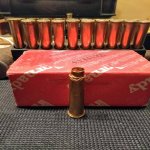
IMG_20200426_161319653~2.jpg
 

Attachments

  • IMG_20200426_161319653~2.jpg
    IMG_20200426_161319653~2.jpg
    101.1 KB · Views: 303
My first thought is that your case necks are not chamfered on the inside edge? Or perhaps the case mouths are even turned inward a bit - from a dull case length trimmer? I presume that the "hand loader" that you refer to is the Lee Loader, which neck sizes only - I have used it to load many hundreds, if not thousands, of 308 Win loads without having the issue that you show, but inside case chamfer was part of my loading sequence as long as I can remember.

Another, albeit less likely issue - have you actually measured the diameter of your bullets to confirm they truly are what it said on the package? The outside diameter of a 303 British case neck is something like .338", so you would get similar to your picture trying to seat 8mm (.323") bullets?

Third - the inside of the case neck in your picture looks shiny - you describe cleaning and prepping your brass. They often have dents in the case mouth - not perfectly round - from handling - what might be catching on your bullet base - why people with normal press and dies would run the expander ball into new cases, to make sure they are "round".
 
Last edited:
A comment about the load that you chose - 42 grains of H414 - I believe it is identical powder to W760. I looked in Speer #14, Hornady 9th, Hogdgon on-line and Load-data on-line and could find no reference to that powder with 150 grain bullets. I did find it (760 powder) with 42.0 grains as Start Load on Hogdgon on-line, using Sierra 180 grain bullets. I would find it surprising if the same powder charge can be used with two different bullet weights? It might be totally suitable - I just could not find any mention of it in published material.
 
I've had same issue with .375 H&H and .32-40, both somewhat similar case shape so I suspect it's an inherent risk. Not every case though. I blame the friction or grab of the bullet on the case as it's being seated. Was using bench and hand presses so I wouldn't be too quick to blame the Lee Loader.

What kind of brass? I tried using military brass to reload for .308, checking chamber fit after resize and before bullet seating and still had issues closing the action when going to fire. I believe it was because the military brass is thicker and caused the neck to expand too much once the bullet was seated. Only in one rifle, which may have just had a tight chamber.

Can you fire form some cases in the rifle then de-prime, clean and reload with out touching the neck until putting final crimp on?

It may be that the bullets are just slightly too large to seat properly.
 
Last edited:
I agree with Potashminer. Did you chamfer the case neck? I use https://www.amazon.ca/Lee-Precision...ywords=lee+chamfer+tool&qid=1590073568&sr=8-2 with my press.

Also, as said, verify the projectile diameter. Before you start reloading, do the projectiles slide easily into the case? They should - the Lee "pound and load" neck sizes only so if the projectile is tight before you neck size, something is wrong with the projectile size.
 
A comment about the load that you chose - 42 grains of H414 - I believe it is identical powder to W760. I looked in Speer #14, Hornady 9th, Hogdgon on-line and Load-data on-line and could find no reference to that powder with 150 grain bullets. I did find it (760 powder) with 42.0 grains as Start Load on Hogdgon on-line, using Sierra 180 grain bullets. I would find it surprising if the same powder charge can be used with two different bullet weights? It might be totally suitable - I just could not find any mention of it in published material.

First rule of reloading is NOT to substitute powder or powder data. Those two powders are not the same.
If it’s not listed..don’t use it. There is too many kitchen reloader already..keep those bad reloading practice for oneself but don’t tell other to do that.
 
I think you will find that H414 and W760 come out of the same spout in the same plant - some going into Hogdgon H414 bottle; some going into Winchester 760 bottle. They are unusual - the only exactly identical powders that I know of.
 
First rule of reloading is NOT to substitute powder or powder data. Those two powders are not the same.
If it’s not listed..don’t use it. There is too many kitchen reloader already..keep those bad reloading practice for oneself but don’t tell other to do that.

Hodgdon website shows identical data for both of these powders (H414 and W760) in 303 BR with 180 gr bullets.
 
The lee loader does not have a expander like a press mounted sizing die to size the "inside" of the case neck. So any factory bullet crimping of the case mouth can spring back and make the case mouth smaller. As stated above you will need a deburring tool and possibly the Lee hand held case trimmer. I would recommend the VLD inside deburring tool with its steeper angle to ease seating.

Look at the images at the link below, you may have a tool at home that does the same thing.

Chamfer/Deburring Tool
https://www.amazon.ca/s?k=reloading+chamfer+tool&ref=nb_sb_noss
 
Since your issue is likely addressed I have serious doubts about 414 being suitable for a 150 in the .303. It is a very slow powder. I recall it only working well with the old heavy 215 RN bullets.
 
Last edited:
The Lyman reloading manual lists H414 with 150 grain bullets. And if he is using a Lee Loader he is also using a scoop to measure the powder. And the Lee loader instructions also list H414 for a 150 grain bullet. The OP is using the instructions with his Lee Loader and the recommended powder for scoop use.

The issue is not the powder he is using, the issue is the Lee loader does not come with a deburring tool.
 
Yes I know, you and others addressed it so I commented on his powder. I didn't say it won't work it is just far from ideal based on my own experience with it. It is the best powder I have found for 215 grain bullets though.
 
Yes I know, you and others addressed it so I commented on his powder. I didn't say it won't work it is just far from ideal based on my own experience with it. It is the best powder I have found for 215 grain bullets though.

The problem is the Lee Loader only comes with one scoop and the load data even lists H450 for the 150 grain bullet. The lee load data wants to keep the reloader safe by using the slower burning powders. And until the OP buys some type of scale to weigh accurate charges he is stuck with his single scoop and Lee load data.

The OPs next question here will be "Why do my fired cases have so much black soot on the outside of them."

Powders listed below with the Lee .303 British loading data and the scoop that comes with the loader.
Reloader15 39.6 grains
Accurate 2015BR 38.3 grains
Accurate 2700 40.9
H414 42.4
H450 42.9

The OPs real problem is not having a deburring tool.

trimming-case-length.jpg
 
The Lyman reloading manual lists H414 with 150 grain bullets. And if he is using a Lee Loader he is also using a scoop to measure the powder. And the Lee loader instructions also list H414 for a 150 grain bullet. The OP is using the instructions with his Lee Loader and the recommended powder for scoop use.

The issue is not the powder he is using, the issue is the Lee loader does not come with a deburring tool.

I agree that the powder discussion was a sidetrack/hijack.

What's really interesting to me is that the OP said that the interlocks seated fine with a listed diameter of .312 but the Sierras and Speers with a listed diameter of .311 are causing issues. If deburring was the only issue, then it would seem strange to me that a smaller bullet would cause problems. I wonder if the radius on the bottom edge of the the Sierra/Speer bullets is sharper than on the interlocks, possibly making it more difficult for them to seat straight. I've never used a Lee Handloader, though, so I'm not sure if this could cause the problem or not. It would be interesting to know if the case is deformed evenly all the way around or if the deformation is worse on one side than the other.
 
If you look at the OPs top photo and the second case from the left it looks like it is bulged more at the base. I'm wondering if the cases are tilted and not lined up properly with the neck of the lee die. With the Lee loader the die body is much larger than case body diameter and the case neck may not be aligned properly. On top of this the inside of the case neck has not been deburred and tapered for good bullet seating.

I have Lee Loaders for almost every caliber I have as backups, but I have not actually reloaded with a Lee Loader since 1973, Meaning I'm a little rusty and I have been using my Rockchucker press since 1973.

But I'm also wondering if the Lee loader was adjusted down in length for the .311 bullets and not allowing the neck to expand.

It might be the time for a upgrade and have the OP build up his pecs. :d

Reloading Without a Bench
https://www.gunsamerica.com/digest/reloading-without-a-bench/

a-compact-reloading-kit.jpg
 
Last edited:
But I'm also wondering if the Lee loader was adjusted down in length for the .311 bullets and not allowing the neck to expand.

This still doesn't explain why the .312s seated fine but the .311s are causing issues (unless I'm totally misunderstanding you, which is always a possibility).
 
This still doesn't explain why the .312s seated fine but the .311s are causing issues (unless I'm totally misunderstanding you, which is always a possibility).

I'm wondering if the Lee loaders die body was adjusted shorter and does not allow the case neck to expand during seating.
And I do not think a bullet .001 smaller in diameter would be causing the issue.
 
I'm retired with nothing to do and all day to do it, so I broke out my Lee loader. The cases had been deburred and and I had no problem seating the Hornady .312 bullet on the left or the Sierra .311 bullet on the right. I am more confused now than before getting out my Lee Loader and brushing off all the dust. And when you drop the bullet in the Lee die it centers the neck in the die. And I seated bullets using a short section of 2x4 and using both hands to push down and tapping with a plastic hammer and both methods work fine.

I checked both cases for bullet runout and the Hornady bullet had .009 and the Sierra bullet had .007. And using my Rockchucker press the runout would be .002 or less.

7ZA2B1m.jpg
 
Last edited:
I may be all wet on this, but the samples of the Sierra 150, and the Hornady 150 I have here have different shaped bases.
The Sierra has a sharper base, while the Hornady is more rounded.

So, to my way of thinking, it may not be the diameter of the bullet that is causing the trouble, but, rather, the shape of the base.
A better chamfer, or a slight flare of the mouth of the case may solve the problem, if this is the issue.
Dave.
 
Based upon my own experiences with Speer bullets I believe Eagleye has identified what is probably the main issue with the OP's problem with crushed case necks.
I have on hand a couple boxes of Speer 180 303 cal. bullets and they have a much sharper base compared to other 303 cal bullets I have on hand such as Hornady and Winchester brands for instance. I always make sure to give the case mouth an extra couple of twists with my case chamfer tool to help seat these bullets, I haven't actually crushed any case necks using the Speer bullets but did experience somewhat more effort when seating them without some extra case mouth chamfering.
 
Back
Top Bottom