












































You are using an out of date browser. It may not display this or other websites correctly.
You should upgrade or use an alternative browser.
You should upgrade or use an alternative browser.
.303 bullets
- Thread starter turbo250
- Start date


A while back I had a bunch of Sierra 155 Palma .308 bullets collecting dust that I had won at a shoot but no .308 target rifle to shoot them in. I decided one day to try them in my #4 MK II .303 which had a really good bore. I changed the neck expander in my .303 dies from .311 to .308 and proceeded to work up a load. In my rifle they shot very well but like I said my bore was in very good condition. May be worth a try if the shortage continues.

- Location
- Northern ON
I've been having a hard time finding them too. I guess it's just one more side of the general ammunition shortage.

Hornady (and possibly other manufacturers?) have "temporarily suspended" certain "unpopular" bullets to fill orders for their more popular lines (.224, .308, 6.8mm, etc.). No word on if or when they will bring back production. .303 are on the list as well as most 8mm, a good number of 7mm, several 6.5mm, and some others.
My P14 eats almost exclusively cast. Like Yukidaruma mine will shoot .308 bullets just fine as well. Probably getting some reduced velocity due to gas blow-by but they still shoot accurately. It may be worth a shot (pun intended) to try it in your rifle; just need to swap the expander as mentioned. Worst case scenario they tumble and keyhole and you know it doesn't work in your rifle. Use load data for the same weight bullet and seat to the cannalure (or just fill the case neck if you're worried about tension). You could also give the light 125gr .310" bullets a try. They are meant for the 7.62x39 but can work. There is even load data available for bullets that light. If you're looking for hunting bullets though they probably wont work since most are either FMJ or fragmenting varmint bullets.
My P14 eats almost exclusively cast. Like Yukidaruma mine will shoot .308 bullets just fine as well. Probably getting some reduced velocity due to gas blow-by but they still shoot accurately. It may be worth a shot (pun intended) to try it in your rifle; just need to swap the expander as mentioned. Worst case scenario they tumble and keyhole and you know it doesn't work in your rifle. Use load data for the same weight bullet and seat to the cannalure (or just fill the case neck if you're worried about tension). You could also give the light 125gr .310" bullets a try. They are meant for the 7.62x39 but can work. There is even load data available for bullets that light. If you're looking for hunting bullets though they probably wont work since most are either FMJ or fragmenting varmint bullets.
Last edited:
I was getting the idea that there was a shortage of .303 to bad. Thanks for the advice. Seems there is no shortage of cast bullets. LUTNIT what are you loading for cast? I was reading on it and it sounds like I should slug my barrel first to get an accurate size is this really necessary?

TargetAcquired
CGN Ultra frequent flyer
- Location
- S. Ontario
Slug your barrel, but unless it is really shot out, the Bullet Barn's gas checked .313 projectiles are great. 2 or 3 weights I think, and I've been having a lot of fun with the 200gn round nose. I don't crony, but based on the load data I'm using, I'm in the high 1900 low 2000fps range, and have accuracy I'm happy with at 300+ yards.
I'm using an aluminum clone of the Lyman 314299 mould with pure wheel weights and water dropping them to add a little more hardness. They drop .315" (wheel weights increase in size when water dropped) and are a touch over 200gr. I put on .308 gas checks and size them to .314". I tumble lube with Lee liquid alox; it's messy but it works for me. I'm probably only in the 1200-1600fps range with mine as I'm cheap with the powder but I have pushed them closer to 2000fps. Currently I'm using mostly H4198 and SR-4759 (discontinued) but do use some Unique for really light 50yd loads.
It isn't necessary to slug your bore but you have to be lucky for it to work without knowing your actual bore/groove diameter. With my Mosin Nagant I just got lucky. I tried .311" gas checked bullets since that's what I had on hand for other rifles and they worked great. Still haven't slugged it as it shoots great and I don't see a point. I also had a Lee Enfield I tried to get cast bullets to work in without slugging it and it just tumbled and/or leaded badly. After slugging it I found out it was .315" which explains why my .311" and even .314" wouldn't work past ~700fps.
There are various videos on YouTube about how to slug a bore. Found this one which is informative: https://www.youtube.com/watch?v=ErFaJlUVs1Y
One issue I have is he uses a caliper to measure the slug. Calipers should be assumed to have a tolerance of +/- .002" on the reading it shows. Many are better, a few are worse, but I still don't like trusting a caliper for any tolerance of .002" or less. A cheap micrometer will do the trick and can be bought for $20-40. The one I keep at my reloading bench was around $30 from Lee Valley and can measure to .0001" but I'm sure the tolerance on that is at least +/- .0002".
If you don't want to buy a box of lead balls you can cut open a 00 buck shotshell. 00 buck pellets should be .330" and if it's a cheap shell it shouldn't be extra hard or copper plated.
You want a cast bullet .001" to .002" over your groove diameter but I often go .003" and have gone as high as .004" and it works with a medium hardness alloy (my bullets are probably around 12-16bhn).
There is a velocity limit with cast bullets and it's common to use powders with a faster than normal burn rate for the cartridge in question. For .303 British I use a lot of H4198.
It could also be a good starting point to use the Hodgdon reduced recoil data. They say you can use any data with H4895 (might also include IMR4895 but I forget) and reduce the starting load to 60% of what's listed (multiply the starting load by 0.6) and it's a safe, lower velocity, reduced recoil load. From there you can work up to the normal max watching for barrel leading or erratic accuracy. You are pretty much guaranteed to have leading or accuracy issues before reaching max pressure. The upper limit of normal cast bullets with gas checks is 1700-2200fps. There are ways to go higher but things can get weird (like zinc bullets instead of lead).
You may also want a neck flaring die (Lee makes a cheap one that works from .20 to .50 cal) to add a touch of flare to start the bullet easier and prevent the case mouth from shaving your bullets.
In summary:
-slug your bore and find cast bullets 1-2 thou bigger
-find reduced velocity/recoil load data to use as a starting point (the Lyman Cast Bullet Handbook has loads of data)
-load the ammo as normal except flare the neck before seating the bullet
It isn't necessary to slug your bore but you have to be lucky for it to work without knowing your actual bore/groove diameter. With my Mosin Nagant I just got lucky. I tried .311" gas checked bullets since that's what I had on hand for other rifles and they worked great. Still haven't slugged it as it shoots great and I don't see a point. I also had a Lee Enfield I tried to get cast bullets to work in without slugging it and it just tumbled and/or leaded badly. After slugging it I found out it was .315" which explains why my .311" and even .314" wouldn't work past ~700fps.
There are various videos on YouTube about how to slug a bore. Found this one which is informative: https://www.youtube.com/watch?v=ErFaJlUVs1Y
One issue I have is he uses a caliper to measure the slug. Calipers should be assumed to have a tolerance of +/- .002" on the reading it shows. Many are better, a few are worse, but I still don't like trusting a caliper for any tolerance of .002" or less. A cheap micrometer will do the trick and can be bought for $20-40. The one I keep at my reloading bench was around $30 from Lee Valley and can measure to .0001" but I'm sure the tolerance on that is at least +/- .0002".
If you don't want to buy a box of lead balls you can cut open a 00 buck shotshell. 00 buck pellets should be .330" and if it's a cheap shell it shouldn't be extra hard or copper plated.
You want a cast bullet .001" to .002" over your groove diameter but I often go .003" and have gone as high as .004" and it works with a medium hardness alloy (my bullets are probably around 12-16bhn).
There is a velocity limit with cast bullets and it's common to use powders with a faster than normal burn rate for the cartridge in question. For .303 British I use a lot of H4198.
It could also be a good starting point to use the Hodgdon reduced recoil data. They say you can use any data with H4895 (might also include IMR4895 but I forget) and reduce the starting load to 60% of what's listed (multiply the starting load by 0.6) and it's a safe, lower velocity, reduced recoil load. From there you can work up to the normal max watching for barrel leading or erratic accuracy. You are pretty much guaranteed to have leading or accuracy issues before reaching max pressure. The upper limit of normal cast bullets with gas checks is 1700-2200fps. There are ways to go higher but things can get weird (like zinc bullets instead of lead).
You may also want a neck flaring die (Lee makes a cheap one that works from .20 to .50 cal) to add a touch of flare to start the bullet easier and prevent the case mouth from shaving your bullets.
In summary:
-slug your bore and find cast bullets 1-2 thou bigger
-find reduced velocity/recoil load data to use as a starting point (the Lyman Cast Bullet Handbook has loads of data)
-load the ammo as normal except flare the neck before seating the bullet
Last edited:

Hotwheels81
CGN Ultra frequent flyer
- Location
- South of GP
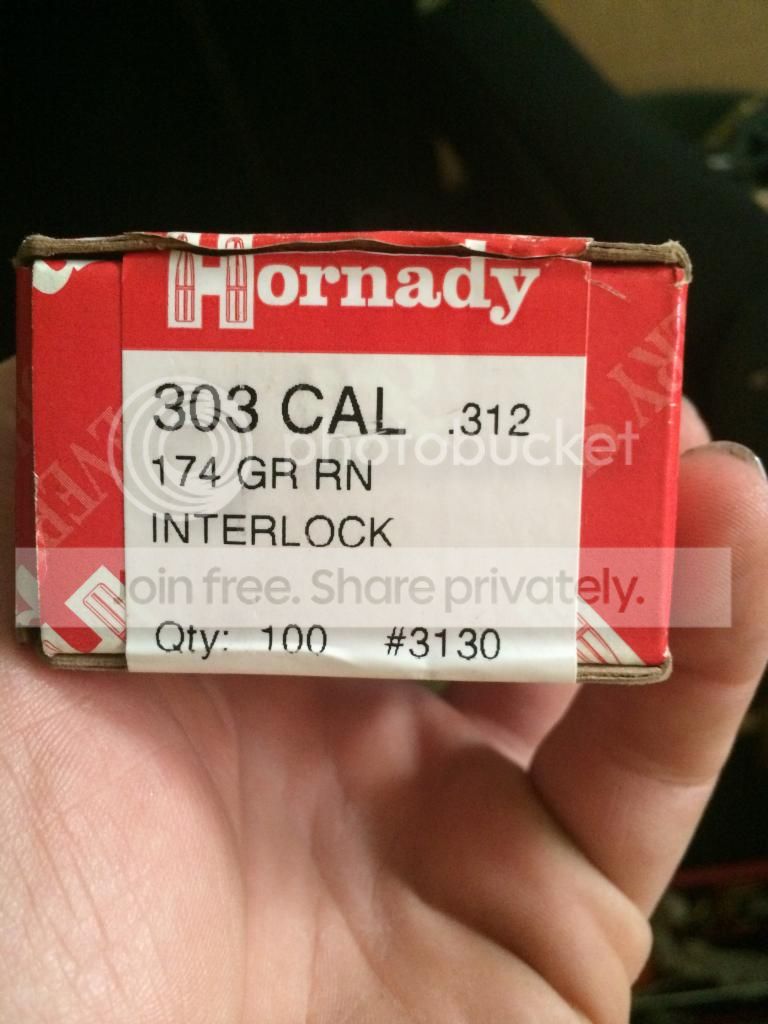
Saving this partial box for a VERY rainy day... Till then it's x39 projectiles and some factory fodder I have in the locker

mudgunner49
CGN Ultra frequent flyer
I'm down to my last couple hundred of the old Remington 215gr RNSP - sure wish someone other than Woodleigh (crazy expensive) would come out with this one again...
lowridersvt
CGN Regular
- Location
- Niagara Falls ont
I have been using pulled 7.62x54 bullets work great . Get a spam can pull the bullet then work up a load using the provided powder

Email mystic precision. I ordered 500 PRVI .303 bullets from him. No guaranteed delivery date but he was kind enough to take my money for them.
Keep us updated on how long it takes to actually get them. What sorta bullets did you order? Price?
I have been using pulled 7.62x54 bullets work great . Get a spam can pull the bullet then work up a load using the provided powder
Sir, I like your thinking.
Keep us updated on how long it takes to actually get them. What sorta bullets did you order? Price?
PRVI 150grain .311's I believe. Don't remember the price off hand, but not unreasonable. I also ordered 400 cast from rusty wood a second ago. Let the hoarding begin!
I have been using pulled 7.62x54 bullets work great . Get a spam can pull the bullet then work up a load using the provided powder
How much do you reduce the surplus powder charge before working back up for the .303?
How much do you reduce the surplus powder charge before working back up for the .303?
Also very interested in this...
lowridersvt
CGN Regular
- Location
- Niagara Falls ont
I reduced it by 10% made for a nice shooting load not overly accurate but ok for plinking





















