.303 Lee Enfield Accuracy Problems....

angrygopher

Regular
EE Expired
Rating - 100%
4   0   0
Is there a resource for diagnosing the source of accuracy issues with the No. 5 Mk 1 Lee Enfield? I shot groups using an optic on a properly torqued based and rings. @ 25 yards I had good a couple of good shots and then wild "flyers". By flyer, I mean 3 or 4 inches off... at 25 yards. This makes me believe there's a mechanical issue with the rifle. I've tried tightening the "king" bolt but I'm sure I'm missing something important. The rifling looks good, however, the free-bore is crazy long, in the neighbourhood of a 1/4".
 
the wandering zero of the #5 was an ongoing issue. Never heard of a reliable fix for it but I'm not a great student of it.
 
The first place to start looking is the ways (bedding) Google the proper method for disassembling the rifle.

Some of them shoot very well, when they are in excellent condition inside and out and they are properly bedded

I haven't been lucky enough to come across one yet that doesn't change point of impact when the barrel gets hot. Still, they will usually hold into six inches or less at 100 yards.

Space your shots and allow a bit of cooling time between rounds.

Remember, these rifles weren't designed for match accuracy.
 
The bore looks fine, I'm entirely unsure as to how to determine the condition of a crown with a flash hider attached.

It's probably well protected if it always had a flash suppressor on it. A friend had one with a rough looking bore, and after a couple of shots the bullets would tumble.
 
I have two #5s both shoot dead on as long as your shoulder can handle the kick, they kick like a mule and after a few shots I believe it is more of a flinch problem than the wandering 0, the wandering 0 is a total myth, started more for political issues than mechanical problems with the rifle because at the time that the #5 came out the army was really looking for a semi automatic not another bolt gun and needed an excuse to get rid of the #5. There is another post on the #5 a little farther down the page.
 
Bedding is a bit of a mystic art when it comes to all Lee Enfields, I bet it’s mostly that. You could try treating it with a serious BLO regimen. A lot of the stocks on these rifles are dried out and shrunk.

You could try PM’ing Riflechair, he went through a stock oiling exercise with a No 5 quite recently with some good results.
 
Bedding is a bit of a mystic art when it comes to all Lee Enfields, I bet it’s mostly that. You could try treating it with a serious BLO regimen. A lot of the stocks on these rifles are dried out and shrunk.

You could try PM’ing Riflechair, he went through a stock oiling exercise with a No 5 quite recently with some good results.

Yup, the stocks do shrink after sitting for decades without having applications of BLO. That's one of the reasons they were floated in cosmoline for long term storage.

One of the main bedding failures is crushing the recoil shoulder of the ways when a fore end is not properly removed, by pulling it DOWN AT THE REAR. Most people grab the barrel and the fore end tip and spread them apart at that point. Instant damage to the ways, resulting in inaccuracy.

Another issue is to lose the King Screw spacer and over tighten the screw to take up the slack. This also crushes the ways.

xsniper, If you have 2 No5 rifles that shoot really well, you're a lucky man. Dead on can mean a lot of things to different people. Shooting 3-4 inch groups, offhand, to point of aim is good. Sometimes better from a bench rest. I agree, shooting No5 rifles from a bench is absolute torture.
 
Pay attention to Bearhunter's post - the Lee Enfield No. 1, No. 4 and No.5 have an action and barrel bedding system that is different from most, and prying the barrel out of the stock as if dismantling a Cooey single shot shotgun is a certain way to damage the Lee Enfield stock's draws. Go up to milsurp site and read Peter Laidler's articles about bedding and repairs to the Lee Enfield stocks. Might want to research how Bisley shooters had "tuning" work done on their Lee Enfields to secure the action in the stock and bed their barrels - starts from proper military bedding and pressures, then builds on that - the "tuning" was not a short cut to avoid the initial military style set-up. And, remember the standards being used for those rifles - the very best military Lee Enfields, the "T" sniper rifles that were "tuned" by Holland and Holland, "Accuracy tests for the No. 4 sniper rifle involved placing 7 out of 7 shots within a 5 inch diameter at 200 yards & 6 out of 7 shots into a 10 inch diameter at 400 yards.” So, the very best, were expected to deliver 2.5 MOA at 400 yards for 6 out of 7 shots...
 
I think bedding is a path to pursue. I put the target away for a few days and then looked at it again. The flyers are wildly left or right on good holds. I’m going to disassemble the gun in the new year and try and find the problem.
 
I was having trouble getting consistent groups with my No. 5 until i switched from a bench rest and sandbags to utilizing the sling, wrapping it around my forward arm like.

Accuracy rose greatly. Never from a bench rest again.
 
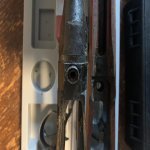
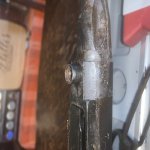
It's too darn cold to be outside today, so I disassembled the old girl. The ledge fo the recess that the king screw bushing sits in looks to be damaged/dented. I'm wondering if the bushing was butted up against but not seated in the recess. IMG_1094.jpg

IMG_1096.jpg

The rifle also needs a thorough cleaning.
 

Attachments

  • IMG_1094.jpg
    IMG_1094.jpg
    56 KB · Views: 66
  • IMG_1096.jpg
    IMG_1096.jpg
    59.4 KB · Views: 64
Last edited:
Back
Top Bottom