303 RN bullet seating issue

RichardSlinger

CGN Regular
Rating - 100%
122   0   0
Location
Calgary
I all
I bough 200 180gr Speer RN bullets for my 303 last week.
I loaded about 5 rounds now but in each case the bullets are not seating straight in the case.
I have loaded hundreds of spitzer bullets with this die set and never had an issue with the spitzers.
This has never happened to me, I'm using Lee dies.

Has anyone ever come across this issue?
 
Interesting conundrum. I've only loaded spitzer bullets with a Lee Classic Loader for my 303, so I can't help you.... But my guess would be the stem on the bullet seater isn't wide enough (or the dimpled part is too deep) to center the round nose?

What if you just barely started to seat the bullet, then check it for straightness, then finish seating it?
 
Don't fully tighten the bullet seating stem. Leave it a little free floating so it will self align with the round nose. Failing that, find a round nose seating stem or have one made.
 
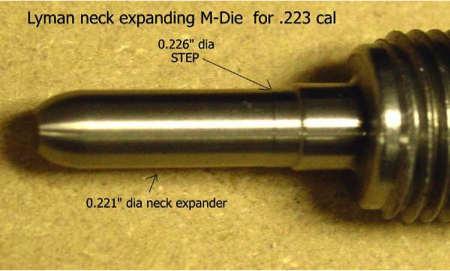
Buy a Lyman type M expander die, the "steps" in the expander will help seat the bullet straight. This Lyman expander die was used with case bullets and now more reloaders are using it with jacketed bullets.

Lyman Neck Expanding "M-Inchdie (Arg Mauser, 303 British) (7.65-mm)
https://www.amazon.com/Lyman-Expanding-M-Inchdie-British-7-65-mm/dp/B006N7474E

Lyman Neck Expander M Die 31 Caliber Long
https://www.midwayusa.com/product/199295/lyman-neck-expander-m-die-31-caliber-long

I use them with my .223/5.56, .308 and .30-06 to seat the bullets straight and in-line to reduce neck runout.
Below you can see a .224 bullet will start straight into the case mouth when expanded to .226 and not tilt when seated.

Many pistol type dies now have a stepped expander since the Lyman patent expired.

ohIUcpd.png


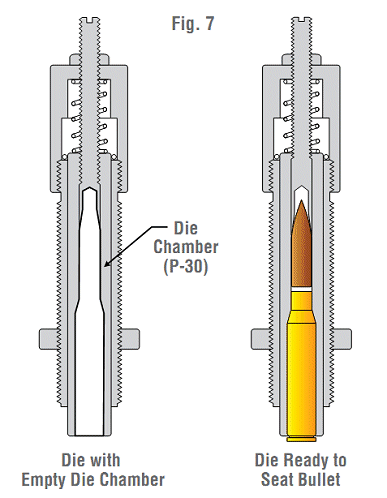
Another thing that works is Redding and Forster benchrest seating dies, the sliding sleeve holds the bullet in perfect alignment with the case neck and the bullet can not tilt.

MomXeUI.gif
 
Make sure the shell holder is free of any debris. Years ago, I had the same issue, only to discover that a single kernel of powder had lodged in the recess of the shell holder...
 
Thanks guys, looks like I'm going to have to find a round nose seating stem or a neck expander die.

Forster Bench Rest Seater Die 303 British
http://www.midwayusa.com/product/201900/forster-bench-rest-seater-die-303-british

German Salazar at the "Riflemans Journal' website did a seating die test below of 5 seating dies and the Redding benchrest seating die came in first place.
(Forster benchrest seating die same as Redding die but much cheaper);)

I have the Forster benchrest sizing and seating dies for most of my rifles. If I do not have the Forster seater die I use the Lyman expander dies and standard RCBS seating dies.

Reloading: Seating Die Runout
Seating Die Induced Runout - A Comparison
by Germán A. Salazar

#1 - Redding Competition Seating Die (sliding sleeve type, threaded die) The Redding, which I expected to finish high, did what I thought couldn't be done - it produced rounds with an average runout that was less than the average case neck runout of the brass used. In none of the ten rounds loaded did the Redding increase the runout; it either held exactly the same or it decreased. The Redding, with an Average Runout Change of -0.0003" is the winner. The negative sign, of course, indicates a reduction in runout. However, it's important to note that we're using a mathematical calculation that gives a result that is smaller than the precision with which we can measure runout, so take the numbers as what they are - smaller than we can reliably guarantee and more of a ranking indicator than an exact measure of probable runout results. This applies to all the dies.

#2 - Wilson (chamber type, for arbor press) I expected the Wilson to come out on top, given it's long-standing reputation as the best seating die and its near universal use in Benchrest shooting. It didn't quite work out that way, but the Wilson was very good, with only three rounds increasing runout and an equal number decreasing, the remainder were zero-change. Wilson Average Runout Change: +0.00015".

#3 - RCBS Standard Die (standard threaded die) I expected the RCBS to be dead last, maybe by a big margin; was I ever wrong! I was really surprised, quite pleasantly, by the RCBS die's performance. Three runout increases, an equal number of decreases and four zero-change made for a very creditable score. RCBS Average Runout Change: +0.00025".

#4 - Vickerman and Hornady (tie) (both partial sliding sleeve, neck only, threaded dies) These dies share a lot in common, being of universal use for a given caliber, in this case, .30 caliber. You can seat bullets in anything from a .300 Savage to a .300 Winchester Magnum with these dies as they just capture the neck of the case in order
to align it with the bullet. However, as your Economics professor taught you, there is no free lunch. That universality of application reduces precision, though certainly not to a level that would render them useless. With more increases in runout than decreases, the Hornady lost ground. The Vickerman had a lot of zero-change rounds, but increased 0.002" on a couple and that really hurt it's average performance. So, the Hornady and Vickerman with an Average Runout Change of +0.0006", bring up the rear - very much to my surprise. These are very useful dies, however and let's keep some perspective, with an ARC of about half a thousandth, I wouldn't be concerned about using them for Highpower match loading.


Bottom line, with round nose bullets the Lyman type M die or the Forster benchrest seating die will greatly reduce neck runout from tipping bullets during seating.
 
loaded the same bullets yesterday 50 rounds, RCBS dies, they call for a number 7 shell holder, shell casing was to lose in it for my liking, so I used a number 4 shell holder from 300wm ,It held the shell case tighter and had no problems , I rotate the casing going up the bullet sitting die to help center the bullet.
 
I wrote Lee and got this response I think that it's sitting too high on the ogive.

It could be that the round nose bullet is not working well with the bullet seating plug in the die. It is most likely sitting too high on the ogive of the bullet and not allowing it to seat consistently. Another cause could be that the the round nose bullet has a square tail and is having difficulties entering the case when being seated. It is recommended that the inside case neck be chamfered 1/4 to 1/2 the case wall thickness of the neck. This will allow the bullet to sit square on the neck when going into the die and then allow it to enter the case more easily.

If the chamfering takes care of the issue, good. If not you may need a custom bullet seating plug to correct the issue.
 
I had read of a possible solution. You need to start with a straightly seated bullet of the type you are loading. Put release agent on the bullet. Mix up some epoxy and set a dab on the bullet's tip. Run that cartridge up into your seating die. Turn down the seating stem until it makes contact with the bullet. Let it sit overnight. You've created a perfect inside of the seating stem that matches your bullet. I have never needed to do this yet, but have some flat nose cast bullets (.367 and .459) that might benefit from the idea.
 
Back
Top Bottom