













































Munkey1973
CGN frequent flyer
- Location
- Regina, SK
I am building my first 308 F T/R rifle (first ever 308 for that matter). Custom barrel from Krieger should hopefully be here next month and my gunsmith is asking me about reamers.
I got a minimum SAAMI spec reamer picked out that has a very short freebore … might be too short. So if need be, the throat will be reamed further using a throat reamer.
In the meantime, I'm currently trying to create a dummy round based on my desired seating depth.
The projectile that I will be using by the way, is the new Sierra 200 MK (#2231) with some Lapua 308 Palma Brass.
Looking at two methods for creating this dummy round:
(1) Erik Cortina's Method https://www.youtube.com/watch?v=U9XpnpgJd0A&list=PLJm6jq3qGs_r_0FXPLnC2gnaSI5STs1oc&t=0s&index=3 A technique that is generally applicable to any cartridge/component combination...Lining up the bottom bearing surface with the intersection of the neck and shoulder..... I had to sacrifice some a bullet and brass, but this method makes sense to me...with a cut-a-way I can see what is going on inside of the case. The visibility on the work bench (versus the video) worked better than expected.
(2) Sierra's Load Data https://sierrabulletsblog.com/2018/01/31/sierra-bullets-load-data-for-2018-new-matchking-bullets/…. Very specific to the projectile I intend to use. On their site they recommend a COAL = 3.150. Well hey, it is what the manufacturer recommends after all and one should think they kinda know what is best practice for their product.
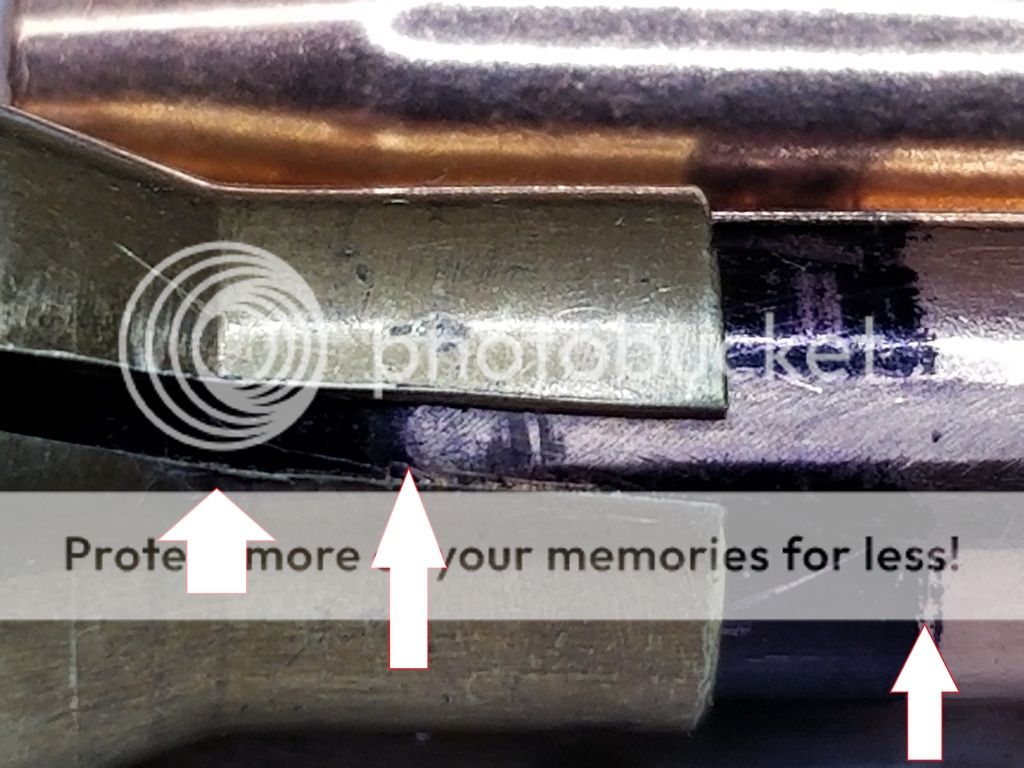
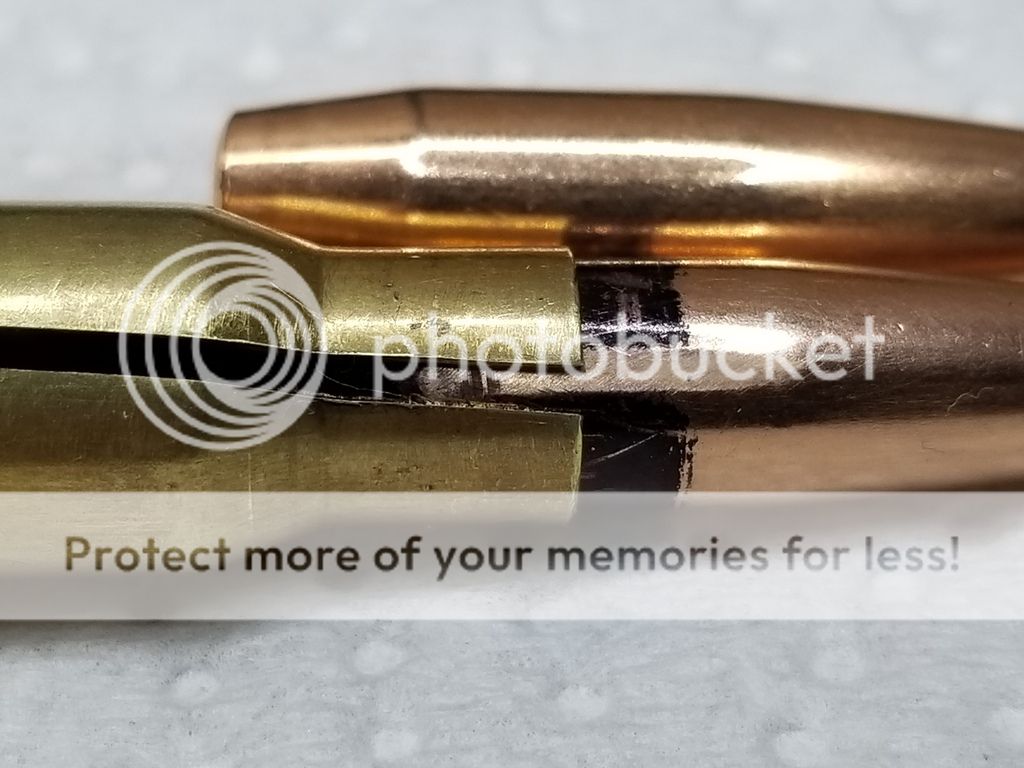
The pictures below show the end result of Sierra's method...remember this when looking at pictures.
With Sierra's Load Data, the bottom boat tail is inline with the body/shoulder intersection (as noticeable in the 2nd picture). I should have flexibility on how much powder I wish to use. However, the bullet seems way too far out to me. The bearing surface length is almost half way up the case neck! (as displayed in the arrow gaps in the 1st picture) Might be previously misguided, but I think that it is paving a road to poor run-out and potential doughnuts (regardless that my outer case necks will definitely be turned anyways)?
The Cortina Method guarantees (damn near) that the entire Bearing Surface Length of the bullet with be in contact with 100% the case neck of the brass. Which thereby eliminates my fears of bad run-out and future doughnuts from using Sierra's Load Data (at least in my mind). But these new Sierra 200's have a very long boat tail. Although I did not take a picture of the Cortina Method end result... imagine that the first 2 arrows on the left will overlap each other and the black marks on the bullet were covered up the case..... the bullet will displace a lot of volume from the case. So I am concerned that I will get a weak powder charge that is insufficient for F class shooting.
Option 1 Cortina Method PROS: save my brass, achieve low run out... CONS: run the risk of a competing with sub-sonic projectile that an electronic target can't register at the 1,000 yard shooting line ?
Option 2 Sierra's Load Data PROS: flexibility with powder charge CONS: get banana cartridges & have to invest a inside neck reamer next season ?
Option 3 ... split the difference... Move the middle arrow half the way to the left arrow ?
I got a minimum SAAMI spec reamer picked out that has a very short freebore … might be too short. So if need be, the throat will be reamed further using a throat reamer.
In the meantime, I'm currently trying to create a dummy round based on my desired seating depth.
The projectile that I will be using by the way, is the new Sierra 200 MK (#2231) with some Lapua 308 Palma Brass.
Looking at two methods for creating this dummy round:
(1) Erik Cortina's Method https://www.youtube.com/watch?v=U9XpnpgJd0A&list=PLJm6jq3qGs_r_0FXPLnC2gnaSI5STs1oc&t=0s&index=3 A technique that is generally applicable to any cartridge/component combination...Lining up the bottom bearing surface with the intersection of the neck and shoulder..... I had to sacrifice some a bullet and brass, but this method makes sense to me...with a cut-a-way I can see what is going on inside of the case. The visibility on the work bench (versus the video) worked better than expected.
(2) Sierra's Load Data https://sierrabulletsblog.com/2018/01/31/sierra-bullets-load-data-for-2018-new-matchking-bullets/…. Very specific to the projectile I intend to use. On their site they recommend a COAL = 3.150. Well hey, it is what the manufacturer recommends after all and one should think they kinda know what is best practice for their product.
The pictures below show the end result of Sierra's method...remember this when looking at pictures.
With Sierra's Load Data, the bottom boat tail is inline with the body/shoulder intersection (as noticeable in the 2nd picture). I should have flexibility on how much powder I wish to use. However, the bullet seems way too far out to me. The bearing surface length is almost half way up the case neck! (as displayed in the arrow gaps in the 1st picture) Might be previously misguided, but I think that it is paving a road to poor run-out and potential doughnuts (regardless that my outer case necks will definitely be turned anyways)?
The Cortina Method guarantees (damn near) that the entire Bearing Surface Length of the bullet with be in contact with 100% the case neck of the brass. Which thereby eliminates my fears of bad run-out and future doughnuts from using Sierra's Load Data (at least in my mind). But these new Sierra 200's have a very long boat tail. Although I did not take a picture of the Cortina Method end result... imagine that the first 2 arrows on the left will overlap each other and the black marks on the bullet were covered up the case..... the bullet will displace a lot of volume from the case. So I am concerned that I will get a weak powder charge that is insufficient for F class shooting.
Option 1 Cortina Method PROS: save my brass, achieve low run out... CONS: run the risk of a competing with sub-sonic projectile that an electronic target can't register at the 1,000 yard shooting line ?
Option 2 Sierra's Load Data PROS: flexibility with powder charge CONS: get banana cartridges & have to invest a inside neck reamer next season ?
Option 3 ... split the difference... Move the middle arrow half the way to the left arrow ?






















