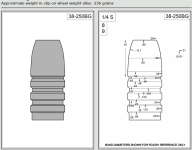
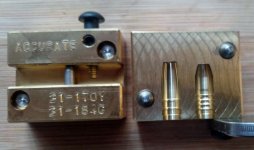
38-55 bullet fitting

Tim249

Member
Rating - 100%
11   0   0
Location
Lindsay, Ontario
I have a 1905 Model 94 in 38-55. I bought some lead bullets for loading, and I put a .377 in the muzzle and it too easily slid in and out when I tilted the barrel down, so obviously .377 is too small.

I tried another set of lead bullets from a different seller and they're much tighter, I had to get my cleaning rod to tap it back out when trying it in the muzzle. Seemed like the second batch was a better size for my bore. I pressed one of the larger bullets into a casing and set the length to try cycling it, although once the lead is pressed into the brass, the "bullet" has a lot of wiggle room in the muzzle. Am I just an idiot and the 38-55 being a tapered round isn't ideal for the bullet muzzle test? Obviously that lead bullet didn't shrink, am I just being thrown off by the taper?

I know someone will say to slug my bore, but I'm not set up for that.
 
You can slug your bore. It’s not the perfect wy to fit cast bullets but it works most of the time. Get a soft lead fishing weight bigger than the bore. Pound it in the muzzle carefully with something like a soft faced hammer. Once it’s flush with the crown you’re going to need a long dowel that fits in the barrel. I like to cut it into lengths as the short pieces are much easier to work with and harder to break. Carefully pound the lead weight all the way through the barrel but catch it with a rag or paper towels in the chamber so it doesn’t get damaged. Measure it with a micrometer at its widest points. Add 1-2 thousandths of an inch to that number and that’s the size of bullet you should start with. Although 38-55 can be trickery to load for. Often the throat is smaller than the bore and a bullet sized to the bore won’t chamber. A pound cast can help diagnose that. They were designed for pure lead bullets and black powder. The black powder caused the soft lead to “bump up” sealing the bore. Hopefully you don’t have that problem.
 
although once the lead is pressed into the brass, the "bullet" has a lot of wiggle room in the muzzle.
thats a bit confusing. Simply seating a bullet in a case should have no influence on the diameter of the lead
It may be the newer bullet you tried has more taper to it or may have reduced front bands, compared to the rear bands

smokeless is fine to use if the barrel is made for it, which your should be, it should be marked
smokeless will give a bullet enough upset to expand and seal, easy
 
I've recently loaded a few boxes of 38-55 using cast bullets that's marked on the bullet box sized to .377. After reading this thread I pulled out my 38-55 rifle, an 1894 Winchester, made in 1899.

The bore is remarkable; shiny, strong rifling no corrosion with clean undamaged muzzle. Using one of the cast bullets I pressed it into the muzzle nose first. The tapered front section entered but hit the rifling. I pressed it in and pushed the bullet back out with a flexible cleaning rod. It was easy to see where the bullet contacted the rifling, the marks were deep.

I remember reading there was inconsistency in bore size with the early 1894 in 38-55. Some folks were using bullets sized to .379. It appears it's a hit and miss with the early guns.
 
Last edited:
I cast my own bullets sized to 0.379. Largest sizer I have. 50% wheel weights and flashing. Gives a softer bullet that slugs up I the bore. Winchester 1905 and savage 99 1908 so older rifles with larger bores. A lot of store bought cast bullets are to hard and don’t slug up sealing the bore. I use both black powder and smokeless powder with good results. The tapered nose section should go into the muzzle up to the drive bands on the body. Use the base. If it goes in with some force you have a good chance of them working well.
 
I would bet that the biggest,softest cast bullet that you can chamber will give you best results.
Black powder will help bump up the bullet to fit the barrel.
That's what I would do. I had a 38-56 that would not chamber a bullet that was groove diameter. I bought a 0.381" mold from Buffalo Arms and cast them in 20:1 and it shot well enough with BP. I doubt you'd be able to do it with smokeless though.
 
I have a 1905 Model 94 in 38-55. I bought some lead bullets for loading, and I put a .377 in the muzzle and it too easily slid in and out when I tilted the barrel down, so obviously .377 is too small.
I have a Model 1895 manufactured in 1898. It is chambered in 30 U.S. The bore looks very good, but with 30 caliber bullets the groups it could produce were about 8 MOA. After exhausting just about every combination of jacked bullets and powders, I bought an ingot of cerrosafe and made a chamber cast which also provided me with the lede, ball seat, and first inch and a half of rifling.

It turned out that the bore dimensions are closer to being .303 caliber than .30 caliber. Something similar could possibly the same for your rifle as well. As somebody has probably mentioned already, barrel and chamber dimensions from that time period can vary greatly.

Regardless, particularly with cast or swaged lead bullets, the most important dimensions are those of the ball seat/lede at the front of the chamber. They are always going to be larger than those of the rifled barrel in front of them. Regardless of how much larger, when the bullet gets pushed into the rifling when fired, it will swage down to your barrel dimensions just fine.

The closer your seated bullets are to the ball seat/lede where the bullet sits after being chambered, the better the likelihood of the bullet obdurating upon firing to prevent burning gases jetting past the sides of the bullet until obduration does start. Which in turn means less likelihood of gas cutting, leading, fouling, and less loss of grouping ability due to bullet damage from those gases on firing.

Making a cerrosafe cast is actually pretty simple. It is a good one-time investment in a rifle you want to use cast bullets in.

The slightly more expensive - but enjoyable - part is to then take the known dimensions for your rifle, go to Accurate Moulds, pick the bullet profile you want to use, specify whatever changes to that dimension you want the mould cut at, and get a mould that drops bullets that drop at a precise fit. You can get two or three different designs cut to your specifications in just one mould block for a nominal extra charge.

If you're going to powder coat versus being a traditionalist and mess around with the full black powder/grease lube thing, specify Tom cutting you major dimensions -.0015" to account for the thickness of the powder coating.

5-zzzzzzzzzzzzzzzzzzzzzzzz1.PNG

5_____ Capture3.JPG
 
The old 38/55s were around .380 bore. I have read that many tried the newer 38/55 factory loads in old guns and assumed the bore was toast due to poor accuracy. Happened to friend of mine with an old 94 38/55. Pretty sure the newer Winchester factory loads had .375 bullets identical to the then new 375 Winchester.
I scrounged my friend a box of old Dominion 38/55 and the old 94 shot fine.
 
I have a 1905 Model 94 in 38-55. I bought some lead bullets for loading, and I put a .377 in the muzzle and it too easily slid in and out when I tilted the barrel down, so obviously .377 is too small.

I tried another set of lead bullets from a different seller and they're much tighter, I had to get my cleaning rod to tap it back out when trying it in the muzzle. Seemed like the second batch was a better size for my bore. I pressed one of the larger bullets into a casing and set the length to try cycling it, although once the lead is pressed into the brass, the "bullet" has a lot of wiggle room in the muzzle. Am I just an idiot and the 38-55 being a tapered round isn't ideal for the bullet muzzle test? Obviously that lead bullet didn't shrink, am I just being thrown off by the taper?

I know someone will say to slug my bore, but I'm not set up for that.
I've always done 379/380 cast, but the only way to know for sure what'll work for you is to slug the barrel, which is very easy to do. The other issue you could run into with a 380 bullet is the chamber dimensions. If the profile of the bullet you're using doesn't taper enough at the front, I've heard of people having trouble locking the action into battery.

38-55 can be a challenge to load for, but once you've got it dialed in, it's a great cartridge, especially in a vintage rifle like yours.
 
The old 38/55s were around .380 bore. I have read that many tried the newer 38/55 factory loads in old guns and assumed the bore was toast due to poor accuracy. Happened to friend of mine with an old 94 38/55. Pretty sure the newer Winchester factory loads had .375 bullets identical to the then new 375 Winchester.
I scrounged my friend a box of old Dominion 38/55 and the old 94 shot fine.
The Winchester white box 0.377 shot 5” groups with my 94. Tried the Dominionand groups went 2” or under. Shot that stuff of and started loading cast and never fired another factory bullet out of my 94’s.
 
So you guys would use pyrodex or a similar black powder replacement instead of a smokeless powder?
I wouldn't use pyrodex. Pyrodex= rust
If you can't get a large enough diameter bullet to fit your bore. Black powder will bump up a soft lead bullet to fit your barrel.
You are much better off finding a cast bullet that fits your gun than trying to bump up undersized bullets.
Everyone on this thread is giving you good information
 
I would slug the bore with a .390 lead round ball and a 5/16" brass rod to tap it through. I have had several original cartridge guns whose bore was dramatically oversize

cheers mooncoon
 
Proper bullet. Minimum of 0.379 with softer lead. I did borrow a 0.381 sizer but didn’t find any improvement in accuracy. With black powder I found amount of powder compression and primer used improved stuff. I switched to pistol primers which made my loads more consistent. 3f Goex.
I do have a smokeless load made up using IMR 4198. I use that load in straightened 30-30 cases with the bullet seated out. I also use those rounds in my 375 Winchester. They are max for 38-55 and above minimum for 375. 30-30 cases are shorter than 38-55 or 375. If it’s loaded in a 30-30 cases I know it can be safely used in 375 and -38-55. It is short for 38-55 but works well. My lead bullets are 255 gr and 335 gr lubed with SPG. RIFLE PRIMERS are used with that load.
 
What do you use if not pyrodex?

Everybody at our Club winter blackpowder shoots is using Triple7. I use the 3F granulation as it meters better in my loading equipment.

Except the fellow who acquired many pounds of American Pioneer and is using that propellant. He does well with it in his .30-30 and .303 British.

Many were using BlackHorn209 before it got prohibitively expensive. I thought my 38/55 loads with it were a bit snappier and certainly more consistent.
.
 
If you really want.to shoot your 38-55 without any hassle use a .379 dia lead bullet and 48 to 55gr of
Swiss 1.5g and don't look back
It will work fine for you and it will bump up any lead bullet
Synthetic black powder is hit and miss
With the real blackpowder there's no miss
That rifle was made for it.
Smokeless powder " WILL NOT" bump up a lead bullet unless you are using a fast burning pistol powder and its "NOT RECOMMENDED "
Shoot black and shoot straight and enjoy 😉
 
What do you use if not pyrodex?
Use Unique IMO.
I've played this game with a sewer pipe bore in a 94 38-55.
The bore is abysmal. Patina and function are awesome.
Out of box that bullet must be like a drunk staggering down a hallway... bouncing from one side to the other.
I use the Lee .379 255 gr bullet with PL.
I didn't shoot one perfect ( mark this day on your calendar... on CGN everyone always shoots boiler rooms that result in DRT)... thank God it went parallel (kinda) to me.
Came out of a draw at a goodly distance.
I had to flip the ladder up and used about 300 for a setting. It turned out to be 275 ish paces.
It put that Spoon & Crockpot down quite nicely.
Your loaded rounds will likely be one trick ponies in that 'They will really shine in your rifle / carbine only'.
Good luck with it.
 
Back
Top Bottom