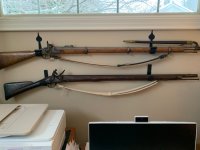
In 2014 I purchased a third model Brown Bess from a dealer in Connecticut. He acquired it from "an old & well-established California collection of India Pattern/3rd Mdl. Brown Bess muskets whose owner acquired it on the east coast in the 1980's". David Gibbins article (see below) indicates that the musket came from Canada.
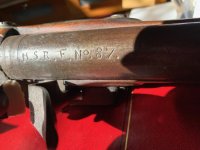
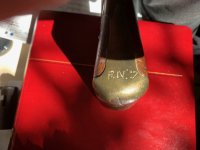
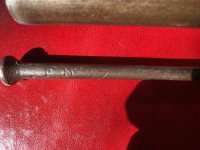
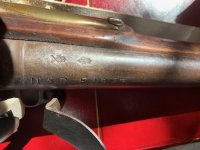
The weapon is regimentally marked "M.S.R. F. No. 87" on the barrel, "F No. 87" on the ramrod and "F. N : :7" on the upper butt plate. Presumably this translates M.S.R. regiment (de Meuron Swiss Regiment?), Company F, rack number 87). At full strength a De Meuron company had a strength of 112.
This gun is mentioned in the article by David Gibbins regarding other Brown Bess guns similarly marked and their potential use by the de Meuron Swiss Regiment serving with British forces in Canada during the War of 1812, most notably in the battle of Plattsburg in September of 1814. See: https://davidgibbins.com/journal/20...rs-date-stamped-msr-de-meurons-swiss-regiment.
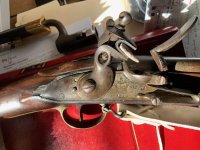
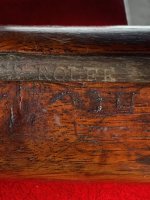
Interestingly, although the lock plate has the typical typical Tower, Royal, and broad arrow acceptance markings, the ramrod channel is stamped with the name "W. Rolfe" possibly William J. Rolfe, a gunsmith of Birmingham who was active from 1807-1817 and who had contracts with both the British Board of Ordinance and the North West Company. Weapons of his manufacture are typically stamped with "Rolfe" on the lock plate.
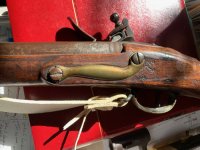
It looks to me that the lock was possibly replaced on the musket due to pretty extensive damage to the stock in the upper rear area of the lock plate. Possibly a rather crude field repair of a broken lock.
I haven't disassembled the weapon due to my fear of damaging a 200+ year old weapon.
Any comments or opinions regarding possible use of the weapon with the de Meuron regiment or the potential lock replacement would be welcome.
I have added photographs of the musket in a separate post a few entries below.
The weapon is regimentally marked "M.S.R. F. No. 87" on the barrel, "F No. 87" on the ramrod and "F. N : :7" on the upper butt plate. Presumably this translates M.S.R. regiment (de Meuron Swiss Regiment?), Company F, rack number 87). At full strength a De Meuron company had a strength of 112.
This gun is mentioned in the article by David Gibbins regarding other Brown Bess guns similarly marked and their potential use by the de Meuron Swiss Regiment serving with British forces in Canada during the War of 1812, most notably in the battle of Plattsburg in September of 1814. See: https://davidgibbins.com/journal/20...rs-date-stamped-msr-de-meurons-swiss-regiment.
Interestingly, although the lock plate has the typical typical Tower, Royal, and broad arrow acceptance markings, the ramrod channel is stamped with the name "W. Rolfe" possibly William J. Rolfe, a gunsmith of Birmingham who was active from 1807-1817 and who had contracts with both the British Board of Ordinance and the North West Company. Weapons of his manufacture are typically stamped with "Rolfe" on the lock plate.
It looks to me that the lock was possibly replaced on the musket due to pretty extensive damage to the stock in the upper rear area of the lock plate. Possibly a rather crude field repair of a broken lock.
I haven't disassembled the weapon due to my fear of damaging a 200+ year old weapon.
Any comments or opinions regarding possible use of the weapon with the de Meuron regiment or the potential lock replacement would be welcome.
I have added photographs of the musket in a separate post a few entries below.
Last edited: