












































410 - why?

Hate the .410. Sold mine, dont regret it. Its got nothing to do with poor shooting technique or my skills, and everything to with poor amounts of pellets that dont hold a group. Maybe my gun was a dud (Cooey 840) but mine could not reliably pattern any shell that I considered suitable for grouse at any distance further then 12 paces.

Shells are also ludicrously expensive.
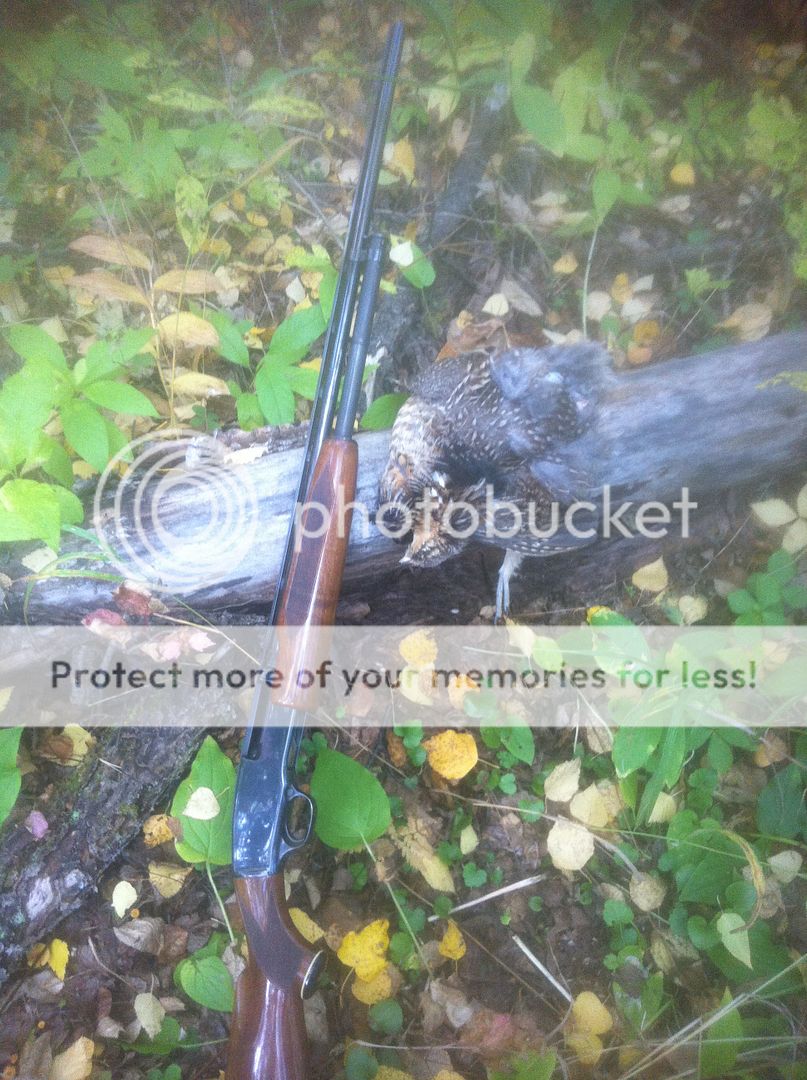
 
Ya I have done it…
Bad habits are formed from low recoil light guns.
With a 410 this year I would have likely taken very few birds.
IMG_3362.jpg
 
I believe it has more to do with the type of "hunters" that are now taking up the sport. When I started hunting at age 12, families hunted together and a youngster was taught firearms safety and how to hunt at a young age by his/her father, uncle or grandfather. Today, there are more and more people getting into hunting at older ages with no background in firearms safety, and nobody to teach them, other than the PAL course which teaches them very little. The result is that we have people running around committing unsafe acts, because they don't know any better, and because of today;s society, many of them just don't care.
What the heck is all this bashing argueing to do with the .410 bore shotgun?
 
I just finished my fourth season with the 16 ga. What I have found with my shooting style is I am now taking shots that I would have automatically passed up after many seasons of using a 410 ( and why is the 410 the only shotgun that is easy to find in 2 1/2 inch, defies logic in a shell that already is pretty light in the shot department?). I was often hunting without a dog during my 410 years which is a whole different game as well. In answering the OP's original question, well I can't. It is a calibre, not a gauge, it has a very low shot count but costs more instead of less for shells. It is light and very low recoil but so does the 28 which has more bang for the buck. Anyone care to comment on how the 410 came to be?
 
I just finished my fourth season with the 16 ga. What I have found with my shooting style is I am now taking shots that I would have automatically passed up after many seasons of using a 410 ( and why is the 410 the only shotgun that is easy to find in 2 1/2 inch, defies logic in a shell that already is pretty light in the shot department?). I was often hunting without a dog during my 410 years which is a whole different game as well. In answering the OP's original question, well I can't. It is a calibre, not a gauge, it has a very low shot count but costs more instead of less for shells. It is light and very low recoil but so does the 28 which has more bang for the buck. Anyone care to comment on how the 410 came to be?

It was created in the early 1900's as a self defense round.... Back then cane guns were common and that is what it was designed for....
 
The thread was already off topic when I posted the post that you quoted. Why not ask the posters that took the thread off of topic?

That was me.

I felt I was doing the public a favor by reiterating the fact that shooting a solid, high speed, projectile skyward with no backstop was unwise. From there it went sideways, and then I clicked "ignore". It's better now.

Sorry about that.

For the record, I love my (daughter's) .410.

GGG
 
Interesting question. Wikipedia says this:

Using this method a .410 bore would be equivalent to a hypothetical 67-gauge

We both learned our one thing for today.....

-J.

Except it's incorrect info..... Gauge is actually determined by how many round lead balls of the bore diameter it takes to make up a pound..... in the case of the .410, this makes it a 32 gauge......
 
Except it's incorrect info..... Gauge is actually determined by how many round lead balls of the bore diameter it takes to make up a pound..... in the case of the .410, this makes it a 32 gauge......

Not according to Chuck hawk

www.chuckhawks.com/410bore.htm

" If the .410 had been named in the traditional fashion, by the number of lead balls .41 inch in diameter needed to make one pound, it would be about a 67-68 gauge. Many years ago it was also called the 36 gauge, and I have seen a picture of an old box of Remington shells marked "(36 GA.) .410-2 1/2 IN. (12 MM)." However, the "36 Gauge" designation was very inaccurate, as a true 36 gauge gun would actually have a .506 inch bore diameter"
 
Not according to Chuck hawk

www.chuckhawks.com/410bore.htm

" If the .410 had been named in the traditional fashion, by the number of lead balls .41 inch in diameter needed to make one pound, it would be about a 67-68 gauge. Many years ago it was also called the 36 gauge, and I have seen a picture of an old box of Remington shells marked "(36 GA.) .410-2 1/2 IN. (12 MM)." However, the "36 Gauge" designation was very inaccurate, as a true 36 gauge gun would actually have a .506 inch bore diameter"

Incorrect..... but I will do my due diligence and research and come back and eat crow if I have to...... lol
 
Not according to Chuck hawk

www.chuckhawks.com/410bore.htm

" If the .410 had been named in the traditional fashion, by the number of lead balls .41 inch in diameter needed to make one pound, it would be about a 67-68 gauge. Many years ago it was also called the 36 gauge, and I have seen a picture of an old box of Remington shells marked "(36 GA.) .410-2 1/2 IN. (12 MM)." However, the "36 Gauge" designation was very inaccurate, as a true 36 gauge gun would actually have a .506 inch bore diameter"

Well.... I'll be damned..... It's a good thing I am good at math so that I can prove myself wrong..... lol..... lots of different numbers being thrown around the web, but you were right Galt......

Well.... crow is best eaten warm I suppose.... :)

Here is the calculation for gauge..... you just have to put .410 in where the N is.......

12a61f5ba48189aabb944ec5cccaae2db316570b
 
Well.... I'll be damned..... It's a good thing I am good at math so that I can prove myself wrong..... lol..... lots of different numbers being thrown around the web, but you were right Galt......

Well.... crow is best eaten warm I suppose.... :)

Here is the calculation for gauge..... you just have to put .410 in where the N is.......

12a61f5ba48189aabb944ec5cccaae2db316570b

I love my 410 for grouse but for crow it may be a bit light...
 
My Dad bought me a.410 a couple of years before I could get a hunting licence. I got quite a bit of practice shooting sneaking up on crows on the farm so that by the time I got a licence at 15 I had a bit of unofficial practice. I shot lots of partridge/grouse as well as a few pheasants and ducks. However you had to pick and choose your shots, which is a good idea in any case.
 
Back
Top Bottom






















