Look carefully under a strong light ( bore scope works great) for lead deposits in the corners of the grooves, they are hard to see. Another thing to try, weigh 10 bullets to check for consistency. Cast bullets can have voids resulting in varying weights and off centre balance. Also, if your gun is an older Marlin with the Microgroove fifling they frequently don't perform well with cast lead bullets.













































You are using an out of date browser. It may not display this or other websites correctly.
You should upgrade or use an alternative browser.
You should upgrade or use an alternative browser.
45-70 won't group
- Thread starter jdschwass
- Start date

Hey Ashcroft, I appreciate the info. I used a bore scope to try and see as best I could in the bore for any remaining lead. Honestly, it could be smoother looking, but it doesnt look like there is anything in the corners. Do you have any tips for doing better? I have heard soaking in windex can help because of the ammonia... but I didnt go that far. Lead is a beeotch to get out... I have experience that before on other guns, but mostly pistols with fast powders and soft lead.
I have checked my .22 cal bullets for weight differences, because that makes a big difference... I didnt think the bigger bullet would be as sensitive, but I should measure them anyways... one more factor to rule out.
I have checked my .22 cal bullets for weight differences, because that makes a big difference... I didnt think the bigger bullet would be as sensitive, but I should measure them anyways... one more factor to rule out.
The weight difference in a 400 gr bullet isn't as important as where a void is, if badly off centre it can cause instabilty. Ammonia can work but it's nasty stuff, must be used outdoors. Used to be a product called WipeOut that worked well on my revolvers. Also, the bore should be sparkling clean before using lead, it will attach to copper fouling easily.

nowarningshot
CGN Ultra frequent flyer
Not sure what the top speed for non gas checked cast bullets, but your definitely speeding. Have you slugged your bore? Best size is 1-2 thousands over. What do the bullets drop, one can manipulate the size somewhat with your lead mix and hardness. Still sounds like sizing would be a good idea, the cheapest option is the the lee sizers. Believe those are up to about $30. The price of factory 45-70 starts at about $50/box, so since your cost of cast is next to nothing, a $30 sizer is cheap.

Not sure what the top speed for non gas checked cast bullets, but your definitely speeding. Have you slugged your bore? Best size is 1-2 thousands over. What do the bullets drop, one can manipulate the size somewhat with your lead mix and hardness. Still sounds like sizing would be a good idea, the cheapest option is the the lee sizers. Believe those are up to about $30. The price of factory 45-70 starts at about $50/box, so since your cost of cast is next to nothing, a $30 sizer is cheap.
Totally agree. With any cast load in any firearm the first thing I do is slug the bore to see what I am working with. If you dont you are just guessing and dont have a true picture of what is going on. Takes about 10 minutes of work and then you will know your exact diameter you need to be working with. Most Lee molds will drop 1 thou under what is specified so if your barrel is .458 and you are running .457 bullets then Houston we have a problem.
I know I slugged the bore in the past, but I cant find the measurement in my notes. That's why I dont size the bullets, just as dropped. I'll check it again for sure. At the mid range charge I am using I dont think I should be seeing any leading. Great feedback though, thankyou all.

Brutus
CGN Ultra frequent flyer
Each gun if different.
my Marlin shoots best with IMR3031.
glad you cleaned your gun.
do try jacketed bullets as well.
What he said here. For 45-70 medium to high power loads in your Marlin I use mostly just two powders.
IMR3031 and Reloader 7.
Both can be accurate powders without the recoil of stout IMR handload powders starting with "4".
I am assuming with you quest for velocity with IMR4198 you are leading up that barrel a bit too fast.
Haha, I like the quest for velocity... in fact, I chose my load for accuracy not for speed, but i think you are correct about the over speed. A can of 3031 is on my shopping list. I'm going to do another cleaning for good measure, slug the bore and then start fresh on my loads. I like this gun too much to be angry with it. I'll get her dialed in sooner or later
Brutus
CGN Ultra frequent flyer
Haha, I like the quest for velocity... in fact, I chose my load for accuracy not for speed, but i think you are correct about the over speed. A can of 3031 is on my shopping list. I'm going to do another cleaning for good measure, slug the bore and then start fresh on my loads. I like this gun too much to be angry with it. I'll get her dialed in sooner or later
I think your plan is very wise sir.
It's very hard to become disappointed with 3031 and the 45-70.
Cheers
Heyall,
I am experiencing some great frustration here, and decided it’s finally time to reach out. I’ll try and be as detailed as possible.
A couple years ago I purchased a Marlin lever action in 45-70. (new) I casted a pile of bullets from the Lee 405 gr mold, which I then tumble lubed with Lee Liquid Alox. I did not size the bullets.
I did some ladder testing with 4198, and settled on a load around 46gr, which was getting me about 1.5 inch groups at 50 yards off the seat of a snowmobile. Good enough for me.
I then loaded up a full box of 50 rounds of that load.
About 6 months ago I was out at the range and I found that the shots were walking on me, and realized that my scope was sliding through the rings. After mitigating the scope issue, I loaded up another box of 50 rounds.
I was out shooting over the last couple weeks, and I cannot get this thing to group. I am seeing flyers all over the place, the best groups I can get ignoring the flyers is about 2 or 3 inches at 50 yards of a bench rest.
I guess my questions are… what kind of accuracy should I expect from this rifle? What could be causing this erratic shooting? Is there a different load that I should be trying?
This gun is primarily my bear hunting rifle, so shots between 50 and 150 yards would my useful range, which currently I cannot trust to make.
The only other thought I had was to buy some bullets and eliminate the casting from the equation, but I find it hard to believe I would see groups like this because of tiny variations in bullet weight.
Thanks for any advice.
> Your load was shooting 1 1/2" @ 50 yards: Now your groups are much larger. Something changed.
- Certainly a good cleaning, to rule that out. I had an -06 that required a phenomenal cleaning session. It does not take much lead to make things go south.
I've dabbled in casting, not for 45-70, but did a fair bit of testing in a 38-55. Bullet size is a factor, anything smaller than groove size is not ideal. As you approach groove size things improve. Ideal is in the at least groove or 0.001 over. In my 38-55 the largest bullet that was usable was app 0.001 under groove. This seemed close enough for sustainable accuracy. I used a gas checked bullet for the most part, but a plain base LEE worked as well. I have used LLA (LEE Liquid Alox) but for my 38-55 I sized and lubed with a 4500. I've used LLA in a 7x57, it worked OK, but eventually I bought the sizing dies and lubed them conventionally.
LEE molds tend to drop near to advertised size. your mold should be dropping a 0.457" bullet. This may be a bit on the small size. Bullet alloy also plays a part. Sometimes your alloy may age soften. This doesn't happen very often, but it can. You bullet, the 457-405-F is not a tumble lube design, hand lubing may make it work better. If your bore is significantly larger than 457, you may have to fool with bullet alloy.
There are improved versions of tumble lube, there seems to be a good following for 45 45 10. Depending on your groove dia. and bullet dia. (both should be measured) painting (powder coating or Hi-Tech) may work best.
Recently I've begun to buy coated bullets from Xmetal, and they work surprisingly well. They are coated with a formulated coating manufactured by Hi-Tech. You can get almost the same results using cheap Princess Auto (Harbor Freight) powder coating, from what I've seen and read online.
The advantage of coated bullets is that they are fairly forgiving, size and alloy become less of a factor.
I've made some assumptions, one is that Marlin groove dia. is usually large, as is the bore. IOW the rifling is shallow. It seems like their Ballard style rifling is just microgroove with fewer grooves. It doesn't take much fouling to make things go south. I suspect that the edge of the rifling is leaded, very hard to see without a bore camera. Also very hard to clean.
Without personal experience, I suspect that you may be on the edge, nearing the bullets limitation with your load. Shooting off the seat of a snowmobile suggests that you may have initially tested in winter. That load may be hotter in warm weather. You may want to back down or even changer powders. In the 38-55 I got 4198 to work, but also got good results with 5744 and 3031 as well. I used SR4759 as well, but it is not an easy powder to find, and not in current production IIRC. I'd try loading to trap door data first, see how things go and progress from there.
I checked the data in Lyman 50 and for a Lyman 405 gr bullet sized @ 458 their max load with IMR-4198 is 40.5 gr for a velocity of 1717 fps. Interestingly the accuracy load is with 32 gr of 5744 for a velocity of 1434 fps. Ruger #1/#3 data goes to 44.5 gr of IMR-4198, max for 1881 fps. Below is a picture from Lyman 50, 45-70 data for the 1895 Marlin.
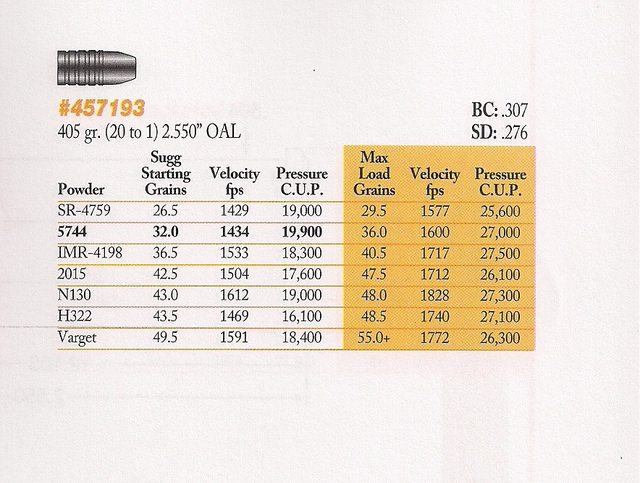
Lyman data suggested that they used a 20-1 alloy, with a BHN of app 10. For the Trap Door they listed Lyman #2, with a BHN of app 15. Interesting! Higher pressure and velocity, with a softer alloy. If you are using COWW you'd be in the middle.
Shooting cast can be a journey down the rabbit hole, it can also be very satisfying when things work out.

You mentioned a scope early on.. have you tried swapping that out to see if it makes a difference? A 45-70 puts a beating on everything it touches, having a scope go south wouldn't surprise me.
If that's ok, I'd clean the sh*t out of the bore and try a box of jacketed bullets to see what happens.
My Beretta came with a warning not to shoot jacketed bullets if cast had been used until the bore was thoroughly cleaned and free of lead.
If that's ok, I'd clean the sh*t out of the bore and try a box of jacketed bullets to see what happens.
My Beretta came with a warning not to shoot jacketed bullets if cast had been used until the bore was thoroughly cleaned and free of lead.

Heyall, first off, I have to apologize because I mixed up some loads in my head, and my original post was incorrect. During my initial ladder testing when I got my Marlin, I performed ladder testing with IMR4198 from 36 to 40 grains in one grain increments. (I did not load 46 grains). This was performed with a 405 gr. cast bullet. The data I used was from the Lyman 49th, which should be right in spec for a plain based cast bullet. The best accuracy I got during this testing was with 38gr of powder, so I should be in the middle of the road for pressure.
Sincere apologies for the incorrect data
,
This is why we always check any data we get off a forum before using. Maybe also go back and edit the first post so someone doesn't use it by mistake.

Mount Sweetness
CGN Ultra frequent flyer
- Location
- Southern Ontario
Is it a decent scope?
Scope could be pooched
Scope could be pooched

- Location
- The Conservative part of Ontario
I suspect you had decent groups right off because your bore was free of lead. As it leaded up the groups faded.
Once you have removed the existing lead your groups will tighten once again. Slowing down to 1300 to 1400fps will cut back on the leading with a plain base bullet. firing the occasional jacketed round will help too.
If you need more speed you'll want a new mold and some gas checks.
If you do some research, and like to play, paper patching is another option.
Once you have removed the existing lead your groups will tighten once again. Slowing down to 1300 to 1400fps will cut back on the leading with a plain base bullet. firing the occasional jacketed round will help too.
If you need more speed you'll want a new mold and some gas checks.
If you do some research, and like to play, paper patching is another option.

I shot 420 gr cast gas checked bullets in front of H322 at 1985 fps out of my 95G rifle into 1.5 " or less at 100 yards . RJ
Most of the Remington rifles will take larger bullets, either .459" or .460". Undersize cast bullets tend to foul more and be less accurate. The .460" bullets have helped accuracy in some micro-groove barrels but the catch is that most but not all of the rem lever guns will chamber the .460" bullet cleanly.
Last edited:





















