45 ACP Questions

oneskilledshooter

Regular
EE Expired
Rating - 100%
7   0   0
First off thanks to all the regulars here that help out us new guys to get started. Reading on this forum has helped me out A TON!!!

I have loaded up a bunch of 45 ACP using 200 grain semi wad cutters. I have had feed issues in my stock government 1911 that I may have actually fixed by tightening down the crimp dye on my dillon square deal all the way. It was almost all the way down as it was. The crimp still doesn't look quite right: there appears to be a very slight outward taper now??? New to reloading and this has me a little confused...

In any event I loaded the last of the SWC that I had and when I went to buy more cast bullets I discovered that I can buy 200 grain round nose flat point bullets so I grabbed a box of those as I don't know if I will be able to ever get the SWC to feed reliably. I loaded the SWC to the specified 1.235 in the lyman book and the fact that they feed but don't always allow the pistol's slide to go all the way forwards (it is JUST out of battery) leads me to believe that I am dealing with a crimp issue and not one of over all length.... Am I correct in this assumption? I know most guys load longer than 1.235, but I don't know that going longer will help me here.

I spent some time working up a load for accuracy using Titegroup and found that 5.0 grains was optimal. (starting load in the lyman book is 4.8, max is 5.4).

1. There is no data that I can find for the round nose flat point, so can I just go by the SWC data?
2. Would you say that I would need to do accuracy testing again for these round nose flat points, or would you expect that I would just find that the same 5.0 grains of titegroup will yield the same results?
3. Do you think that my feed issue relates to over all length, crimp, or the pistol itself?
 
To answer your questions:

1. Yes, 200 grain SWC data will be fine for RNFPs.
2. 5.0 grains of Titegroup will probably work fine, but you will have to do accuracy testing with the different bullet type to determine optimum accuracy.
3. Never mind the book OAL. You likely have the bullets seated too far out. Loaded rounds should drop freely into the chamber of your barrel, such that the back of the case is flush with the barrel hood. I think you may even be overcrimping if the case mouths taper outward. You only need to taper crimp a little more than enough to remove the flare left by the powder die; crimp diameter should be around .468"-.471".
 
"...get the SWC to feed reliably..." It's not just the crimp. Your pistol has to be set up to feed SWC's reliably. Extend the feed ramp half way up the sides of the chamber. Just chamfering it a wee bit.
Like tjhaile says, you load for the bullet weight. Not the shape or who made it.
 
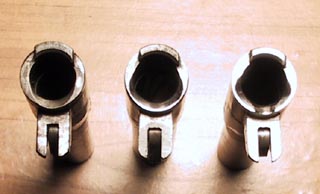
If your barrel feed ramp looks like the one in the middle or on the right, it is already correct for SWCs.

barrel.jpg


Most 1911s produced in the last couple decades have had "throated" barrels from the factory. Guns with the narrow "GI" feed ramp seen on the left sometimes require modification in order to function properly with SWCs.
 
Thanks for all the tips.

I may have been too long winded in my first post.

SWC always feed perfectly, but the pistol does not go in to battery (slide does not always come all the way forwards) every time. A firm palm strike to the back of the slide usually does it, but sometimes I have to smack it pretty hard.

tjhaile - that's a great pic that you posted of different barrels - mine would be the old guy on the left. I can see how this would improve feeding from the magazine, but I am scratching my head how it could help the problem that I describe.

Thanks for posting the crimp spec as well - I had it right until I went screwing with the crimp dye thinking that was my issue. I have some over crimped at .460 - .463 that I am going to pull and reload as they may not be safe with that much crimp.

I am thinking that the most likely cause is that they are too short and I am confused how you say they could be "too far out" ie too long? I removed the barrel to ensure that they are not too long by doing the drop test and they look good. I will re re re-check that! I showed them to a pretty experienced guy at the club who had a similar issue when loading as short as I was and he fixed the problem by going a little longer. I have also found by searching forums that many people have corrected feeding issues by going longer - I have read guys having success with anything from 1.180 through to what I believe the max of 1.280 to be.

Also while we are on the topic of correct over all length - do you guys have a method of determining best over all length for accuracy out of a pistol? I have read that most people start at the minimum and then work up in 5 or 10 thousandth increments until they get the best group? Isn't there a standard method such as a specific length short of max?

If it turns out that the real problem is with my feed ramp I will just reload the 200 grain round nose flat points that I have. I have no attachment to SWC whatsoever, but I do have the right load worked up. I prefer simply switching bullets over modifying or replacing the barrel.

Getting the basics down for reloading was easier than I thought, but the details are harder to figure out than I ever imagined! I have read the lyman book and the ABC's of reloading but they certainly don't have all the answers....
 
If rounds aren't hanging up on the feed ramp, then the barrel doesn't need to be throated. I would try a new recoil spring if the slide isn't going into battery with rounds that drop freely into the chamber.

The reason that too much OAL can cause a problem is the the bullet will end up being an interference fit with the rifling. Increasing your OAL will not help if the round is chambered but the slide does not go into battery. If your rounds are making it that far, your OAL is not too short.

I would not bother with adjusting OAL for accuracy with a pistol, as you might with a rifle. Just pick a length that fits the chamber and feeds.

I would just shoot up the overcrimped rounds. They would be safe to shoot, but the accuracy won't be the best because excessive crimping deforms the bullet.
 
Thanks for the tips!

The comment about a new recoil spring makes a lot of sense given the symptoms, but the pistol works flawlessly for factory and wolf reloads!

I understand how this could cause the slide to almost come all the way forward but I can't understand how sometimes I have to hammer the crap out of the slide really hard and repeatedly to get it to come forward? The excessive force that I have to use sometimes was leading me to believe that I had a problem with the rounds....
 
On one of the cartriges that you "hammer" in try ejecting it before firing. Sounds like OAL is too long. If you can't remove it easily then it is confirmed :)
 
"...pistol works flawlessly for factory and wolf reloads!..." 200 SWC's? But you have to smack it to close with your handloads? OAL or the crimp. The taper crimp should just be a wee bit.
 
i have also had this problem and the solution is quite simple or at least it was for me. the 1911 was designed to fire a heavy bullet and has usually quite a stiff recoil spring. you are running on the low side of that load with a fairly short oal. in my understanding (correct me if im wrong) when you bring that bullet out a little further it gives powder more time to reach desired pressure. so extending your oal may fix this issue and if not i would try to increase your powder load. thats what fixed the problem for me. as far as it was explained to me is your spring isnt actually coming back far enough to get proper momentum to load next bullet. I also use tightgroup under a 230 grn rn so it might be a powder thing i don't know. and to answer your other question how i judge my oal. i will seat my bullet at max and drop in barrel and slowly seat it further and further till it sits perfect without a crimp then bring it back a touch more in case of press run out and call it good. i dont know if it is the right way to do it but it has worked for me

i hope this helps you out
 
i have also had this problem and the solution is quite simple or at least it was for me. the 1911 was designed to fire a heavy bullet and has usually quite a stiff recoil spring. you are running on the low side of that load with a fairly short oal. in my understanding (correct me if im wrong) when you bring that bullet out a little further it gives powder more time to reach desired pressure. (1) so extending your oal may fix this issue and if not i would try to increase your powder load. thats what fixed the problem for me. as far as it was explained to me is (2) your spring isnt actually coming back far enough to get proper momentum to load next bullet. I also use tightgroup under a 230 grn rn so it might be a powder thing i don't know. (3) and to answer your other question how i judge my oal. i will seat my bullet at max and drop in barrel and slowly seat it further and further till it sits perfect without a crimp then bring it back a touch more in case of press run out and call it good. i dont know if it is the right way to do it but it has worked for me

i hope this helps you out

(1) Wrong. This will make it worse;

(2) Wrong. The purpose of the recoil spring is not to force the cartridge into the chamber when it doesn't fit;

(3) Mostly correct - in theory, at least...
 
It sounds like the throat of your chamber needs to be relieved a bit. I have had the same issue with a number of factory barrels, especially Colt manuf ones.

Fine with factory FMJ, too tight for reloads with cast projectiles...

That may help. The original GI spec barrels had a short throat that works well enough with RN ball ammo, but doesn't leave much room to work with for SWCs. The Kuhnhausen manual mentions this.
 
have you tryed the lee fact crimp die? if the bullet is seated a little off plumb you'll bulge a bit unevenly. use your barrel as a case gauge, the rds have to fall in & fall out. also check for lead buildup in the chamber. i've had the same prob, crimp of .468 is max, if you get a little heavyer the lead above the case will swell . check your loa, with some bullets[ & press stroke] you can get quite a diff, & set your seater so that loa is 1.235 max[or whatever you pick for loa], & keep your stroke even. happy crunching & unloading [ps 1.260 will work in most barrels with a drg 200 swc]
 
(1) Wrong. This will make it worse;

(2) Wrong. The purpose of the recoil spring is not to force the cartridge into the chamber when it doesn't fit;

(3) Mostly correct - in theory, at least...

he never said anything about it not fitting he can drop it in barrel freely i was not referring to forcing anything if the bullet fits freely by dropping it in barrel it is not a size problem plain and simple it could be a feed ramp problem as stated earlier but i was stating what my problem was and how i fixed it no forcing involved. also i have recently chronoed the same load and bullet at different oal and the longer oal had higher fps so by that i assume it is receiving more pressure as it is not a hot load and i can get higher fps with more powder.

Please forgive my spelling
 
Back
Top Bottom