












































You are using an out of date browser. It may not display this or other websites correctly.
You should upgrade or use an alternative browser.
You should upgrade or use an alternative browser.
450 boxer
- Thread starter gregs5190
- Start date


colt brass gets pretty thick by the time you trim it to 450 length. I have a couple examples of commercial 450 around here and they all have thinner rims then 455.
fiochi made 450 brass is probaley your best bet.
Keep in mind that there is VERY little room in a 450 case. expect to operate at very very low veloicity or risk too high pressure.
fiochi made 450 brass is probaley your best bet.
Keep in mind that there is VERY little room in a 450 case. expect to operate at very very low veloicity or risk too high pressure.

The unaltered rim of the .45 Colt is too thick ......
FWIW, here are two diagrams giving the case specs for all of what I call the ".455 family" of British Service revolver cartridges - for the simple reason that despite their names the .450 Adams/Boxer, .476 Enfield and .455 Webley all have the same case mouth diameter and all shoot a .455" bullet! The illustrations are from Dowell's "The Webley Story" -
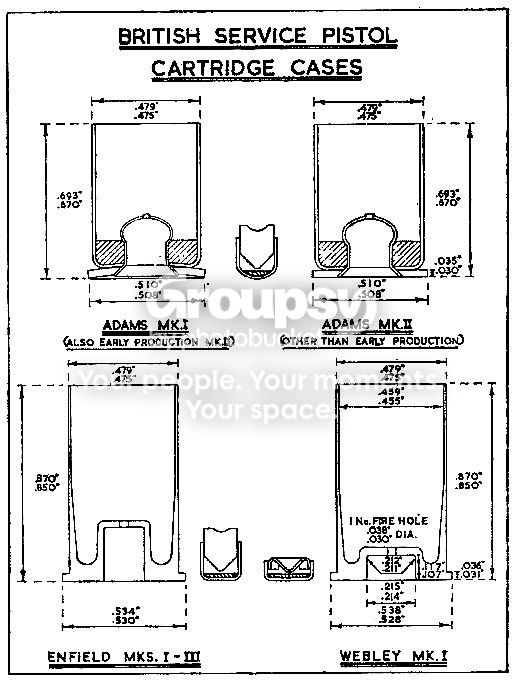
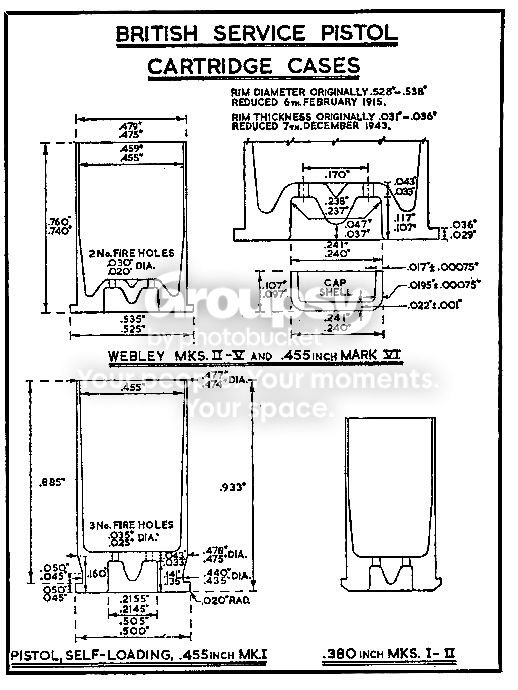
FWIW, here are two diagrams giving the case specs for all of what I call the ".455 family" of British Service revolver cartridges - for the simple reason that despite their names the .450 Adams/Boxer, .476 Enfield and .455 Webley all have the same case mouth diameter and all shoot a .455" bullet! The illustrations are from Dowell's "The Webley Story" -
Interesting that rim thickness was reduced in both 1915 and 1943. War measure to save material?
Actually rim diameter was decreased in 1915 (but only by .003") and rim thickness in 1943 (and then it was only the minimum acceptable thickness which was reduced by .002", from 0.031" to 0.029", while the maximum remained at 0.036"). In neither case would such a minuscule change result in any significant material conservation, to my mind .... especially considering the re-tooling by the ammunition manufacturers which would likely have been necessary in 1915.
Rather, I suspect that, in 1915 at least, there was an intentional change in rim diameter to accommodate the many "non-standard" revolvers that Britain had to acquire to meet the massive wartime demand for arms which Webley was simply unable to meet. Britain contracted with Colt for 100,000 "New Service" revolvers, with Smith & Wesson for 40,000 "Hand Ejector" (a.k.a. "New Century") revolvers, and with Orbea & Co. in Spain (which then syndicated with two other manufacturers for the job) for 30,000 revolvers of a pattern which was essentially a copy of of the Smith & Wesson ".44 Double Action" model of the 1880's, dubbed the "Pistol, Old Pattern" by the War Department. All of these "Foreign Objects" (also W.D. terminology) were to be chambered for the .455 service cartridge.
The problem with that, I suspect, was that none of the cylinders on these revolver designs could properly accommodate the fairly wide rim diameter of the .455 cartridge - the Colt was designed for the .45 Colt cartridge, but it had a notoriously narrow rim (virtually non-existent in fact) and the other two designs were designed as .44 caliber revolvers. When chambered for the .455, I think that the rims could fail to consistently clear each other in a fully loaded cylinder, and that the slight reduction in rim diameter was aimed at resolving that problem.
To be honest, I'm not really sure why the 1943 change would have been made. Keep in mind that in late 1920's, the .455 revolver had been supplanted by the .380 Enfield as the primary-issue British handgun, but that .455 revolvers were still in service and many more were pressed back into service for the war. Since the 1943 change was really an expansion of the acceptable range of rim thickness, rather than a true "reduction" of rim thickness as implied in the note in the diagram, I suspect the change in specifications simply had more to do with accommodating ammunition manufacturers not normally contracting with the War Department - i.e. relaxing standards a bit. (Increased thickness would not be acceptable, of course, because that would risk binding up revolvers with very close tolerances, but slightly thinner rims would not present any serious problem.)
Last edited:






















