45acp Crimp or no crimp

Good points, will have to consider that when I start reloading 45acp. May have to setup two sets of dies/toolheads - one with taper crimp for my 1911's and one with a roll crimp for my S&W 625 where the cartridge head-spaces off of the moon-clip. Was talking to another wheel-gunner who had experienced 45acp rounds coming apart in his 625. I think he said he switched to roll crimping.

- What he said. This is a no-brainer; all cartridges headspace. They all locate their correct depth in the chamber somehow - this is what "headspace" means. Rimmed cartridges are easy - they rest on their rims at the chamber mouth; bottlenecked rifle cartridges usually (not always) headspace on their shoulder (the "not always"? - .303 British and 7.62x54R are rimmed bottlenecks that headspace on the rim; the "R" in 7.62x54R means "rim").

- And what happens if they headspace wrong? As in say, a roll crimp on a cartridge that's supposed to headspace on the case mouth? There will be nothing stopping the cartridge from falling too far into the chamber, and then the firing pin will not even reach the primer, or will just shove the cartridge forward instead of denting it; gun go 'click' instead of 'boom'. Interestingly, an older friend was recently complaining that his .45 ACP was misfiring his handloads something dreadful - on discussion, it turned-out that he was roll-crimping them. I offered to mount-up my spare cylinder and shoot 'em off in the Webley with moon clips, to help him salvage the brass; ain't I a helpful soul? :redface:

Finding-out how the cartridge you're reloading is supposed to headspace, is one of those "little things" you must learn before you try to reload that cartridge. And for cartridges that headspace on the case mouth, you should also look-up your case dimensions to see what diameter the finished cartridge should be, and mike a couple of your reloaded cartridges across the case mouth to see if they're too small; there's a bit of wiggle-room in case you're loading-up some +P's and need a firmer crimp, but not much.
 
Taper crimp for .45 auto. Don't need a lot, just to assist chambering and function and to prevent bullet setback on some 1911's that hammer the bullet into the chamber.

^^ ditto ^^

I check in 3 ways:

1) First off, gotta pass the "plunk" test.
2) Measure, push against table, re-measure.
3) Measure, chamber round with good "power-stroke" of slide, re-measure.

Once it passes all three, the crimp is measured and set for that load.


Thanks as well for the pic! I like to see it in the flesh - as it were.

Im going to have to buy a taper crimp die then! I have everything to start reloading for my new 1911 (and first time for handguns) but all I have is the Lee 3 die set.... weird that they have a 3 die set and the 4 die.

I have / use both types (3 and 4 die sets).
The 3 die incorporates the seating and crimping die into one, while the 4 die does it in separate steps.
May really come down to personal preference.. but I run the 3 die in 9mm and 4 die in .40 / .45 and have no complaints either way.

:cheers:
 
Last edited:
Thanks as well for the pic! I like to see it in the flesh - as it were.

Im going to have to buy a taper crimp die then! I have everything to start reloading for my new 1911 (and first time for handguns) but all I have is the Lee 3 die set.... weird that they have a 3 die set and the 4 die.

The 3 die set includes the correct taper crimp die. It is part of your seater die.

Take one of your existing loaded rounds and back out the seater stem a few revs. Install the loaded round on the shell holder and push the ram up as far as it will go. Then screw the seater/crimp die down until you feel it hit the loaded round. That should be the crimper hitting the case mouth. Turn it in another quarter turn and lock it into place.

With the seating stem still backed out, try crimping several more loaded rounds and see how much crimp you are adding. If you need more crimp, screw the die in another quarter turn.

Once you have the crimp you like, screw the seater down until it hits the crimped bullet. Die is now set to seat and crimp in one action.

The crimp will vary slightly with the length of the cases.
 
Good points, will have to consider that when I start reloading 45acp. May have to setup two sets of dies/toolheads - one with taper crimp for my 1911's and one with a roll crimp for my S&W 625 where the cartridge head-spaces off of the moon-clip. Was talking to another wheel-gunner who had experienced 45acp rounds coming apart in his 625. I think he said he switched to roll crimping.

Your option would be to use .45 Auto Rim for the 625.
 
Your option would be to use .45 Auto Rim for the 625.

Man, I learn new stuff on this forum almost every day! Thanks for the suggestion, a quick search of the web shows very promising results for accuracy using SWC's loaded in .45AR. Will stick with 45acp RN ammo and moon clips in the 625 if I ever use it for IPSC, but great to have options for improved accuracy.
 
There's no doubt that if you're using the 625 competitively, you'll reload a whole lot faster with moon clips. I was shooting PP with my Webley (it broke yesterday :( ); a spare 'shaved' cylinder with .45 ACP and moon clips was the only way I could reload fast enough to compete. I had no problems with the rounds coming apart, but I load so soft for the Webley that I suppose I wouldn't; 3.5 gr Trail Boss, a 230gr lead TC and ~625 f/s.
 
I just found this thread and wanted to share what I experienced:

I loaded some dummy rounds with newly bought Campro 45 230 RN FCP, OAL set to my 1911 chamber length with a light crimp using a lee FCD.
After cycling the rounds thru my 1911 I noticed some serious setback.

I wasn’t sure what was causing the setback maybe too much flare, not enough neck tension or bullet swaging after running the loaded round thru the FCD carbide ring
So last night I decided to run a quick test.
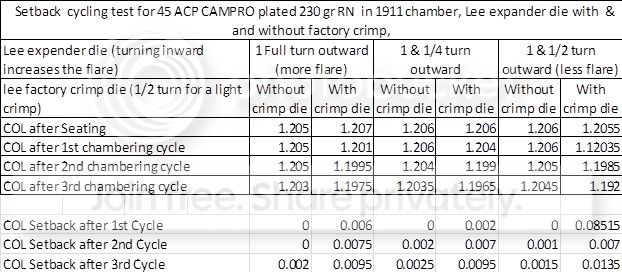
I loaded 6 dummy rounds with 3 different flair settings, each pair would have a FCD & non- FCD crimped round.

Once loaded I would cycle each single round 3 times in the 1911 and measure COL

COL_TEST_zpsr6fppwh2.jpg


Results from this quick test are pretty clear:

Running the post sizing lee factory crimp die will swage the campro bullet then neck tension decrease will cause the setback.
next test I might try to crimp using the bullet seating die or I will knock out the carbide ring from the FCD or better just not crimp at all.
 
Excellent testing methodology Gilbear :) What OD is your crimp die set to? I've found that too much crimp actually causes less neck tension because the bullet swages down, while the brass casing springs back a little.

I just found this thread and wanted to share what I experienced:

I loaded some dummy rounds with newly bought Campro 45 230 RN FCP, OAL set to my 1911 chamber length with a light crimp using a lee FCD.
After cycling the rounds thru my 1911 I noticed some serious setback.

I wasn’t sure what was causing the setback maybe too much flare, not enough neck tension or bullet swaging after running the loaded round thru the FCD carbide ring
So last night I decided to run a quick test.
I loaded 6 dummy rounds with 3 different flair settings, each pair would have a FCD & non- FCD crimped round.

Once loaded I would cycle each single round 3 times in the 1911 and measure COL

COL_TEST_zpsr6fppwh2.jpg


Results from this quick test are pretty clear:

Running the post sizing lee factory crimp die will swage the campro bullet then neck tension decrease will cause the setback.
next test I might try to crimp using the bullet seating die or I will knock out the carbide ring from the FCD or better just not crimp at all.
 
Just a soupcon of taper crimp. Almost undetectable just like my bell. The less you do the longer the brass lasts.
 
Back
Top Bottom