.45ACP not feeding properly???

rubberdown

CGN frequent flyer
Rating - 100%
15   0   0
Location
Ontario
I have been reloading for my .45acp for a little while now, I did about 200 rounds the first time reloading and only had a couple FTFeed rounds but they were nickle coated cases so I assumed the case was the possible issue. I just loaded another 600+ rounds over the holidays and fired off 100 rounds today. About 15 rounds would not load all the way into the chamber when the action cycled. the info below is my bullet type, load, powder and over all length,

Bullet - 230 GR. LRN
Powder - Winchester 231
C.O.L. - 1.200"
Grains - 4.3

What I notice on my reloads compared to the factory Wolf rounds and others reloads from members at the club is that my length is a lot shorter than everyone elses, and therefore the case almost creates a sharp step where it is crimped on the bullet. So is it okay to increase my overall length to allow the bullet to be seated just deep enough to leave some of the bullets larger diameter just above the edge of the case? This will change my pressure wont it, making it less than if I keep the OAL at 1.200"? And if thats the case, will it be enough to worry about, or should not worry about it at all, or would it be wise to increase the powder weight a little bit to account for the lower pressure?

Before I get to worked up, I will be stripping the gun down for a really good cleaning and try it out again on Thursday just to rule out a dirty gun as the issue, its had about 400 to 500 rounds through it since I cleaned it really good last time. And its a Remington 1911 R1 Stainless if that might matter.
 
Seating the bullet further out will - rule of thumb, no guarantees - lower chamber pressure. That's not a problem, safety-wise. Provided that the bullets are tight, you can seat them out until a) they no longer fit through the magazine or b) the bullets start running into the rifling, making it impossible for the slide to go home.

Semi-educated guesses...

Have you checked case lengths for the ones that would not feed?

Second, you mentioned a crimp. Keeping in mind that the .45 ACP headspaces on the front of the case, a crimp that is great for revolvers will cause problems with the .45.

Third, I had an S&W 9mm once with feeding problems. Put a polishing head on the Dremel and made the feed ramp shine. Worked fine after that.

Fourthly, are you sure you screwed the sizing die all the way down and then 1/4 turn more with the ram lowered?

Just some thoughts.
 
Are you using mixed brass, seperate the brass, as this can effect how much its crimped. I once mixed S&B and FED brass, all the SB would feed but all the FED would FTF.
 
COL looks good. I load mine to 1.250. Do they manually feed correctly? 4.3 grains seems a little weak no?

This was the starting grains and I like that it isnt a massive recoil round.

Are you using mixed brass, seperate the brass, as this can effect how much its crimped. I once mixed S&B and FED brass, all the SB would feed but all the FED would FTF.

I'll look into that next trip out to the range, its all once fired brass for a forum sponsor and yes, its all mixed brass.
 
Usually I would suspect OAL. For your particular bullet 1.20-1.25" is fairly normal, and at 1.20" I think that's probably fine.
The other problem may be that when you bell the case with the expander die, then seat the bullet you may not be putting enough of a taper crimp on the round to take the belling out and let it chamber. Or are just belling more than needed before seating bullet.

I would try taking the barrel out of your pistol and dropping the rounds in the lone barrel to see if they drop in easy, also Wilson makes Case gauges that perfom the same job for each calibre.
 
Seating the bullet further out will - rule of thumb, no guarantees - lower chamber pressure. That's not a problem, safety-wise. Provided that the bullets are tight, you can seat them out until a) they no longer fit through the magazine or b) the bullets start running into the rifling, making it impossible for the slide to go home.

Semi-educated guesses...

Have you checked case lengths for the ones that would not feed? No

Second, you mentioned a crimp. Keeping in mind that the .45 ACP headspaces on the front of the case, a crimp that is great for revolvers will cause problems with the .45. I'll post some pics when I get a chance of the rounds I loaded, you tell me what you think please

Third, I had an S&W 9mm once with feeding problems. Put a polishing head on the Dremel and made the feed ramp shine. Worked fine after that. I'll look into that as well.

Fourthly, are you sure you screwed the sizing die all the way down and then 1/4 turn more with the ram lowered? I set it up exactly as the instructions told me to

Just some thoughts.

My answers in red ;)
 
I had a similar situation years ago with my 45. Turns out it was not enough crimp.
Sucks that I found it during a match, but after I sent the rest of the ammo through my factory crimp die, all was good.

(E) :cool:
 
#8 x2 , check the crimp , .468 +/- , @ the very top of the brass . seat the bullet @least to the ogive , aka the fat part of the bullet should be @ the case mouth or further out . it's too long if the bullet won't fit in the mag or it seats into the rifling . too long will not cause any pressure probs .
 
You are loading lead rn boolits! Are they covered in lube? I mean are they just lubed in the lube groove or are they completely covered in liquid alox ( LEE Mule snot )If your lad boolits are cast from a very soft alloy, it is not a problem as far as the pressure generated by the 45 acp. But the softer the alloy is it can become "sticky" when it is trying to run up the feed ramp.If there is lube on the noses it can slow things down enough to stop the slide from going home and putting the pistol into battery! I assume the Remington does not have a ramped BBL wilson/nowlin cut? Try and check to be certain that the nose of your slugs are clean and load up 7 dummy rounds to use as proving loads. Be sure the ramp is clean and shiny, then load a mag with dummy rounds ( no primers ) and when doing any of these tests I make it a policy to not even have a loaded round in the room where it is being done!! Check for operation , then head to the range. Also have you chamber checked your loaded rounds? Take the barrel completely out of your pstol and use it as a go / no go guage. Your rounds should drop right in flush with the hood on the breech end of the bbl. If not you have other issues to be addressed. Ps, also forgot to ask what diameter your cast boolits were sized to? Generaly for 45 acp I size mine to .452" but you should realy slug your gun's bore to see what it wants and size to 1-2 thou over bore diameter.
 
Last edited:
COL looks good. I load mine to 1.250. Do they manually feed correctly? 4.3 grains seems a little weak no?

Not a weak load for LEAD RN bullets at that OAL.

I would try to lengthen that OAL a wee bit.

Pulled Directly from the Speer #14 manual:

LRN:
COAL tested: 1.270"
231: Start 5.1gr / Maximum 5.6gr.

I would lengthen your OAL, and try a bit more powder. I've noticed the 231 burns cleaner when it's a touch closer to the Maximum charge. ( I won't say how much.. )

Lee's Modern Reloading 2nd Ed...
Says to load a 230gr LRN, Win231 with 4.3gr Starting and 5.3gr MAX @1.200" OAL. So I'm assuming you went off that data chart?

I would start by not seating as deep, and then adding more powder until you get your desired results.
 
I got my data from the on-line Winchester reloading data site, same as what you posted above me Soulfly.

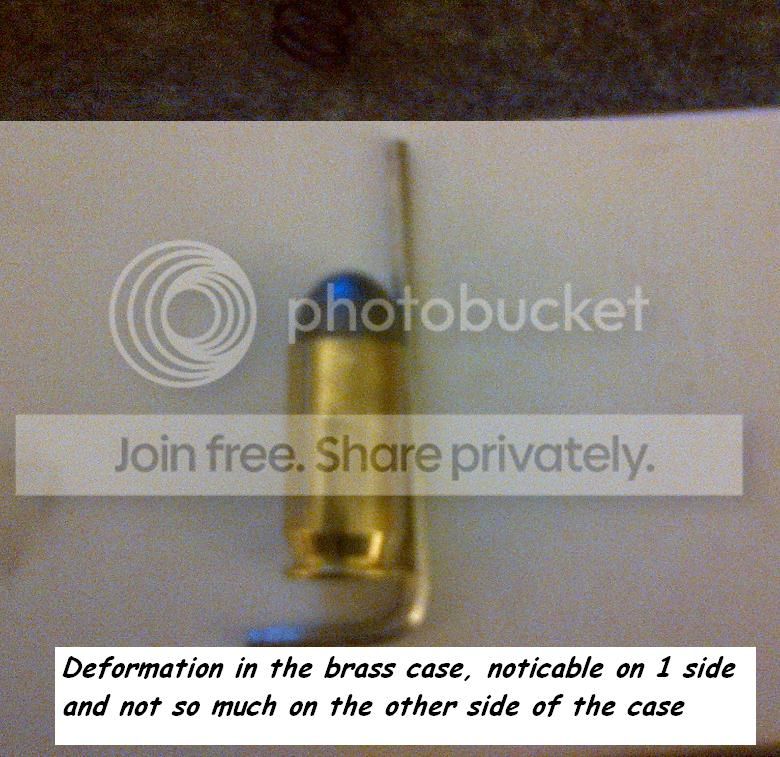
Heres a picture of one of the reloads, you can see the deformation on the brass case, its not noticable all the way around the case,

45-1.jpg


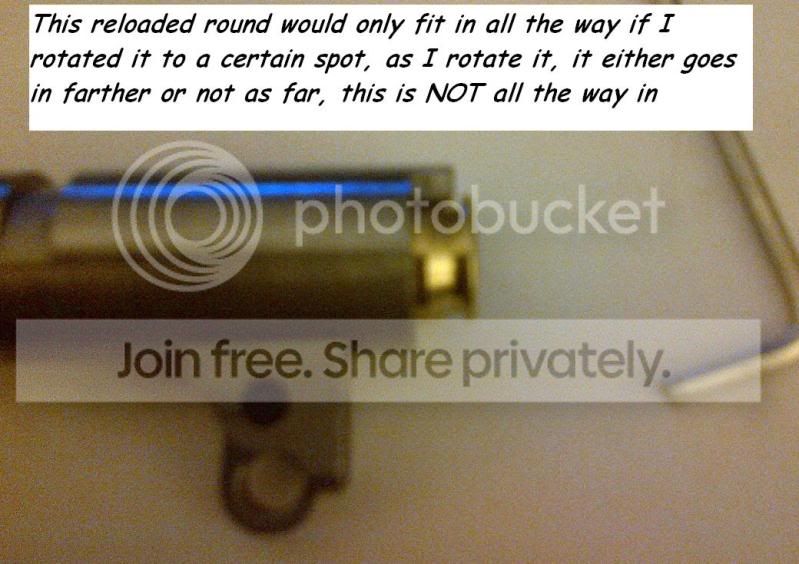
Here is the same bullet placed in the barrel, it doesnt drop all the way in unless I rotate it around and find a sweet spot, this was not the sweet spot,

45-2.jpg


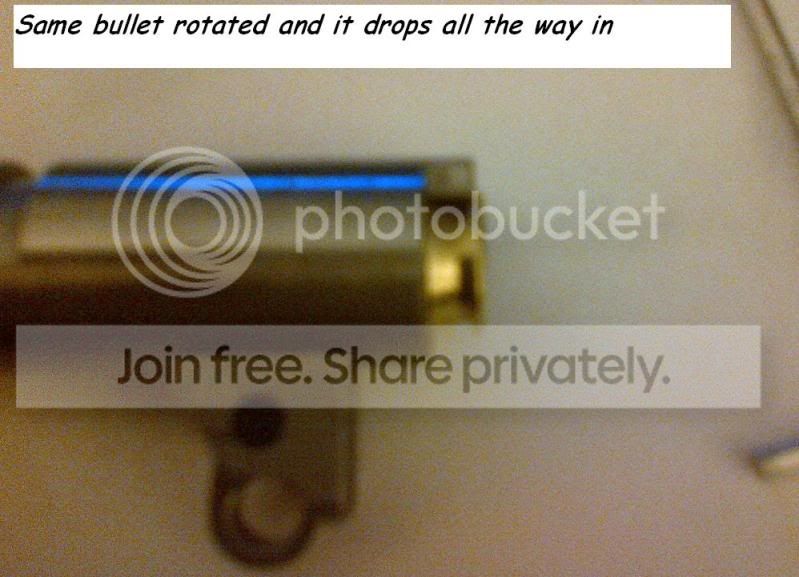
And here it is seated all the way rotated until it drops in all the way, rotating it is very stiff unless I pull the round out a little bit,

45-3.jpg


And lastly, I took a factory loaded FMJ RN Federal bullet and it drops right in to full depth and can easily be rotated around while at full depth with NO resistance at all.
 
Sorry, pics are very crap quality but you can see everything needed to be seen. These tests and pics where taken right after a full cleaning of the gun.
 
Is it possible that the deformation is caused by me not making sure the bullet is sitting perfectly in line with the case when doing the seating and crimping stage of the reload? Like, if its sitting on a bit of an angle, would this be the cause of this?

The lube on my bullets is a thick red wax, is it possible that the wax is to thick on the bullets?
 
Are your boolits a square flat base? Or are they a bevel base? If I were you I would try and be sure that you are setting the slugs square to the case before seating! The brass will show a "bulge" whether you are loading "J" words cast or copper plated as the brass has been sized down then expanded to hold the slug! As far as cast go what diameter are your sized? .452" will "likely" be about perfect. As I had mentioned before set the slugs with purpose on top of the flared case mouth and seat. once done check to see that they are seating evenly around the body. Just had a thought!!!! What brand of dies are you using? Is there a swc seating stem as well as a rn seater? If you are trying to use the swc on a rn boolit it may be causing the slug to rock to one side rather than pushing it evenly down.
 
Even looking at your second picture , that is not "all the way in" either. With an auto loader you want the cartridge to drop in like you were buying it drinks all night and land with a solid "thunk" when it headspaces on the case mouth. And that should be flush with the barrel hood.
 
I'm using a Lee Pro 1000 progressive, pretty sure the part that sets the depth has a concave face on it to try and center the bullet somewhat. The guy I buy them from says he sizes them to .452, I could go out and measure one tomorrow morning to double check.

The factory Federal bullet was like the loose girl I bought drinks for all night long LOL, the reloads with the bulge in the brass are not slutty bullets at all hahaha.

Yes these lead bullets have a small bevel on the flat inside end of them.
 
Unless you're seating it only 1 or 2 thou, the bullet will self-center that deep in the case. If it's going to screw the pooch, it'll do it early and crush the mouth of the case.
The wax is waaaayyyy softer than either the bullet or the case. No problem there.
My bet is still on the crimp. You could probably seat a little less deep, but apply more final crimp.
You have a FCD on the press, right?

(E) :cool:
 
Not a weak load for LEAD RN bullets at that OAL.

I would try to lengthen that OAL a wee bit.

Pulled Directly from the Speer #14 manual:

LRN:
COAL tested: 1.270"
231: Start 5.1gr / Maximum 5.6gr.

I would lengthen your OAL, and try a bit more powder. I've noticed the 231 burns cleaner when it's a touch closer to the Maximum charge. ( I won't say how much.. )

Lee's Modern Reloading 2nd Ed...
Says to load a 230gr LRN, Win231 with 4.3gr Starting and 5.3gr MAX @1.200" OAL. So I'm assuming you went off that data chart?

I would start by not seating as deep, and then adding more powder until you get your desired results.

I agree with this. I started at 4.6gr of WIN231 during load development and settled on 5.4gr of WIN231 with COAL of 1.260"..
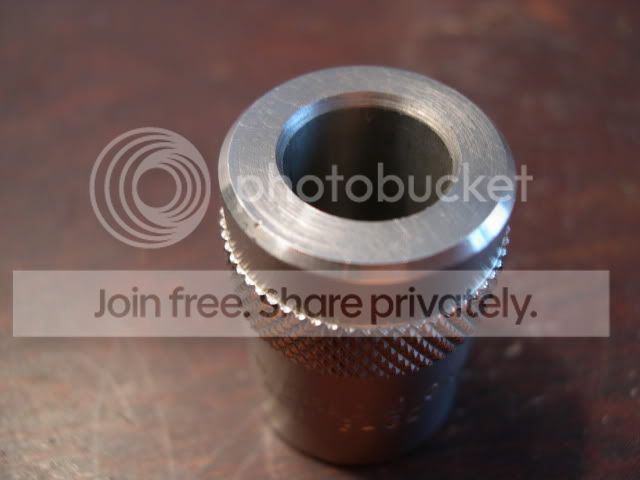
Get one of these case gage. Very useful IMHO.
DSCN4092.jpg
 
Back
Top Bottom