.5 Vickers - I wish I had a few of those too.. . .

fat tony

CGN Ultra frequent flyer
Rating - 100%
111   0   0
http://www.quarry.nildram.co.uk/Vickers.html

The story of the Vickers gun is well known. It originated in the first successful self-powered machine gun, the Maxim of 1884, which had become the standard machine gun of the British Army by 1891 and was adopted (under various names) by many other armies. A modified version with a more compact mechanism was adopted by the British Army early in the 20th Century as the Vickers-Maxim but later simply became known as the Vickers. It was available for various rifle cartridges (up to .45 inch or 11.5 mm) but in British service was overwhelmingly used in .303 inch (7.7x56R) calibre. It fought through two world wars and remained in front-line British service until the mid-1950s.

Also well known are the big "pom-poms" in 37 mm or 40 mm. The first of these was the Maxim one-pounder (1 pdr) of the late 19th Century in 37x94R calibre, named for the weight of the shell. This was manufactured by Vickers, who went on to develop heavier versions. The first of the these was the 1½ pdr (37x123R) just before the First World War (this was experimentally fitted to the R-31 airship, in a circular top mounting), but shortly afterwards this was replaced by the 2 pdr (40x158R) which became the standard naval AA gun, available in single, four and eight-barrel mountings, serving until after the Second World War.

In between these were the .5 inch machine guns, which are much less well known. This account is intended to describe the various experimental and service weapons and their ammunition, developed mainly in the interwar period, some of which saw service but several of which did not.

It's interesting that a lot of the Vickers projects of that era are shrouded in mystery. . .
 
Last edited:
the vickers light tank mounted a vickers .5 gun, and in my opinion, the .5 vickers ammo was a better round than the browning. it was lighter to move, smaller, and could feed longer belts than the browning due to the lower weight of ammo to pull. more ammo in a tank or aircraft MG is nice, and it would make for a much lighter easier to move gun by the time aircooled guns were common
 
The Mk. VI in .303 for the AFV was no slouch either. There are reports of some having been made in Canada but no firm documented proof remains or has surfaced. The AFV Vickers also came equipped with a bipod, butt pad and cheekpiece for ground use as well.
 
South African Army had the best collection of vickers gun because they bought any model that vickers could make. All were destroyed per UN rules!!!!
 
Most if not all of the CA Vickers in Canada came out of Turkey some years ago via the UK. They had a few modifications on them, but they were the closest to the original Mk. 1 around anywhere. Converted to 8mm in Belgium and sent to Turkey, but still the closest to the Mk. I guns as originally made. There are a few .50 Vickers (less than 5) in Canada that were brought in by a western dealer many years ago but they have just disappeared into the woodwork.
If anyone knows of any parts or accessories for the AFV Vickers I'd sure like to know via PM.
 
Not so. It was the French air force that used the Vickers in 11mm Gras, and post war the US army did a lot of work on the round for air service.

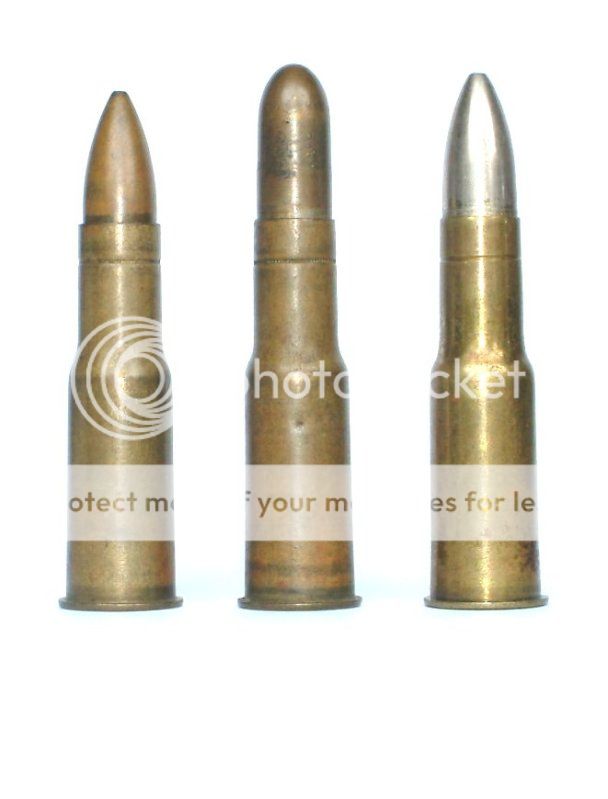
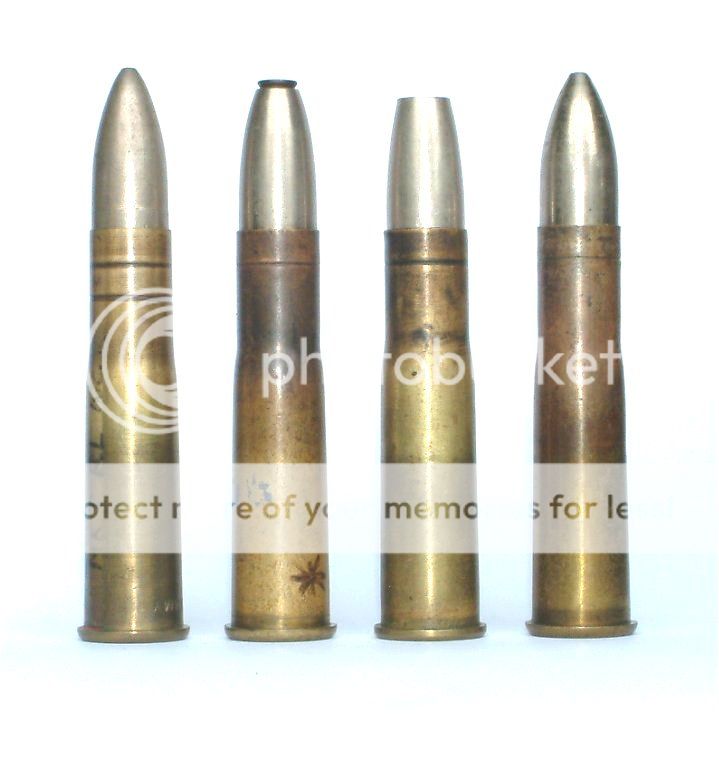
Britain initially tried the .577/.450 Martini round for air service loaded with Brock, Pomeroy and tracer bullets, but then decided that the .45 Gardner Gatling was a better round. Although a number of guns were sent to France and also used for home defence against Zeppelins and Gothas these were only experimental installations and were never widely issued.

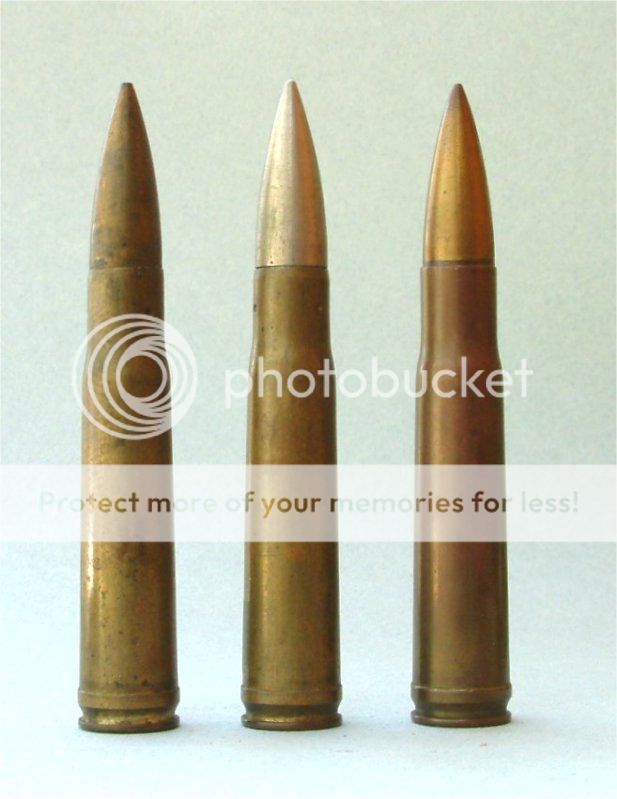
By 1917 the RFC decided that a completely new .5 cartridge was needed and instructed Eley Bros to develop the .600/.500 round. Work continued on this after the war, the belted case was redesigned as a rimless case and in 1924 it was approved as the new .5 inch Vickers round.

Martini Air service rounds
45MHcase.jpg


Gardner gatling Air Service rounds
45GGcasejpg.jpg


.600/.500 Experimental Vickers rounds
600-500A.jpg


Regards
TonyE
 
Not so. It was the French air force that used the Vickers in 11mm Gras, and post war the US army did a lot of work on the round for air service.

Britain initially tried the .577/.450 Martini round for air service loaded with Brock, Pomeroy and tracer bullets, but then decided that the .45 Gardner Gatling was a better round. Although a number of guns were sent to France and also used for home defence against Zeppelins and Gothas these were only experimental installations and were never widely issued.

By 1917 the RFC decided that a completely new .5 cartridge was needed and instructed Eley Bros to develop the .600/.500 round. Work continued on this after the war, the belted case was redesigned as a rimless case and in 1924 it was approved as the new .5 inch Vickers round.

Martini Air service rounds
45MHcase.jpg


Gardner gatling Air Service rounds
45GGcasejpg.jpg


.600/.500 Experimental Vickers rounds
600-500A.jpg


Regards
TonyE


Drop me an email you swine !!!
:)##
 
There are also some colt 3006 vickers models in Canada. They came from an israeli surplus machine gun deal through IMI. I think there was about 15 vicker's guns in total 303 and 3006.
 
Back
Top Bottom