6.5x58 Portuguese loading with RL-17 powder

diopter

CGN Ultra frequent flyer
Rating - 100%
82   0   0
Location
Montreal
Managed to try some loads with a chrono last night.
Dealing with rare old calibers with brand new powders can be interesting to find min/max levels.

Here are the results.

Rifle 1904 Verguiero ,full military configuration, mismatched bolt.
Winchester Large Rifle primers used in all loads.
Bullets appear to be Speer 140gr flat base SP, a few thousand were given to me.

String: 5
Date: 12/10/2012
Time: 11:35:28 PM
Grains: 140
Hi Vel: 2433
Low Vel: 2339
Ave Vel: 2380
Ext Spread: 94
Std Dev: 37
6.5x58P 39gr RL-17
Velocity Power Factor Ft/Lbs
2433 340.62 1839.779021
2402 336.28 1793.194716
2355 329.7 1723.706294
2372 332.08 1748.681896
2339 327.46 1700.363947


String: 6
Date: 12/10/2012
Time: 11:44:37 PM
Grains: 140
Hi Vel: 2437
Low Vel: 2398
Ave Vel: 2416
Ext Spread: 39
Std Dev: 17
6.5x58P 39.5gr RL-17
Velocity Power Factor Ft/Lbs
2402 336.28 1793.394
2411 337.54 1806.858
2437 341.18 1846.038
2433 340.62 1839.983
2398 335.72 1787.426


String: 7
Date: 12/10/2012
Time: 11:45:59 PM
Grains: 140
Hi Vel: 2455
Low Vel: 2437
Ave Vel: 2446
Ext Spread: 18
Std Dev: 6
6.5x58P 40.0gr RL-17
Velocity Power Factor Ft/Lbs
2455 343.7 1873.409
2450 343 1865.786
2446 342.44 1859.699
2437 341.18 1846.038
2446 342.44 1859.699


String: 8
Date: 12/10/2012
Time: 11:47:44 PM
Grains: 140
Hi Vel: 2496
Low Vel: 2478
Ave Vel: 2484
Ext Spread: 18
Std Dev: 8
6.5x58P 40.5gr RL-17
Velocity Power Factor Ft/Lbs
2496 349.44 1936.506
2478 346.92 1908.676
2478 346.92 1908.676
2487 348.18 1922.566

40 and 40.5grs of Reloder 17 gave pressure signs of flattened primers

Bolt is mismatched.

No accuracy tests yet
 
Last edited:
The 6.5X58 has a capacity between the 6.5X55 and the 6.5-06, so you can use 6.5X55 loads as a benchmark. There isn't much in the way of load data for Re17, but there's lots for H4350, and I have found that Re17 is close to H4350 in Burn Rate.

You don't state what firearm you're shooting it in (M1904 Portuguese Mauser?), nor the barrel length, but with that powder and that bullet, 2500 fps would be a modest upper level for MV, and correlate to about 40K psi. The "pressure sign" you're detecting isn't...............

All that having been said, I think you're about where you want to be, and thanks for sharing. I 've shot a grand total of five shots with mine, and never shared the load data - I didn't think anyone would care.
 
Supposed to be 2400±fps with a 156gr FMJ RN
I have 5 Kynoch rounds that I paid over $5.00 @
Won't be sending those downrange.
 
I only have one dwm made soft point so I am not sending that downrange either. Weird, I run into decent amounts of Krop ammo but 6.5 x 58 seems to be in the same rarity category as unicorns.
 
Guys, don't bang off those original rounds; they are scarce enough that I am still trying to find one.

For things such as this, I regard the TEXT BOOK OF SMALL ARMS - 1909 (His Majesty's Stationery Office, London) as the Oracle. The British dissected and tested everything they could get their hands on..... and did it when things were NEW and they didn't have to cope with dodgy primers and false pressure curves and squibs and all the rest, and the RESULTS are all in this incredible book. I am extremely fortunate in that I actually HAVE an original copy, so let's see what it says regarding the Portuguese rifle and ammo of that period........

Pattern: 1904

Designation: Mauser Vergueiro

Magazine System: Vertical box with movable bottom

Number of cartridges: 5

CHARGER loading

Cutoff: none

Bolt safety

Weight: 8 pounds, 13 ounces alone, 9 pounds, 9-1/2 ounces with Bayonet

Length: 4 feet alone, 4 feet, 11-1/4 inches with Bayonet

Barrel: 29.08 inches

Calibre: 6.5mm/.256 inches

Grooves: 4

Depth of Rifling Grooves: .00575"

Figure of Rifling: Concentric, with edges slightly rounded

Twist: 1 turn in 7.78 inches/ 30.76 calibres

Direction: Right

Sights: 200 metres to 2000 metres

Cartridge Length: 3.26 inches

Bullet shape: Ogival

Bullet weight: 155.3 grains

Charge: 31.8 grains

Powder type: nitroglycerine and nitrocellulose (nowadays we would call this double-based, as the Alliant series)

Muzzle velocity: 2347 ft/sec

There is no Note regarding chamber pressures, bullet jacket material nor for the value of w/d2. This is quite unusual because most other ammunition is described most thoroughly.

Hope this helps.
 
Bullet weight: 155.3 grains

Charge: 31.8 grains

Powder type: nitroglycerine and nitrocellulose (nowadays we would call this double-based, as the Alliant series)

Muzzle velocity: 2347 ft/sec

Those specs speak to a long obsolete rifle powder quite a bit faster than Re17 (or Re 15) - it was in the H4895 range. Mind you, 100 years ago that was considered quite slow.
 
Likely it was very close to RL-7, which is still available.

It is a very economical powder because of the quick burn rate and the double-base composition. I sometimes use it in .303s.

MOST military ammo is loaded with fairly quick powders because it makes for less tonnage to buy, less tonnage to store and ship and less combat load for the troopies.

With relatively large cartridges, those all become factors.

Information I gave was from the Book, exactly. That's what they were using at that time.
 
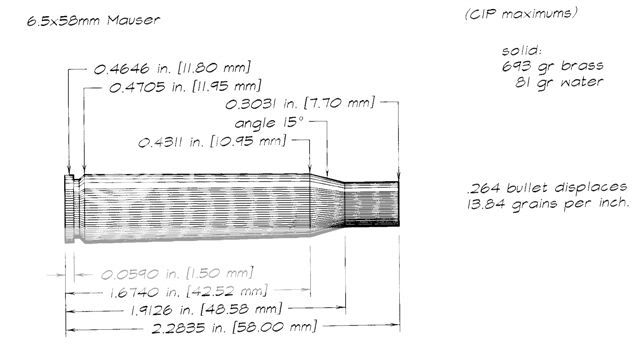
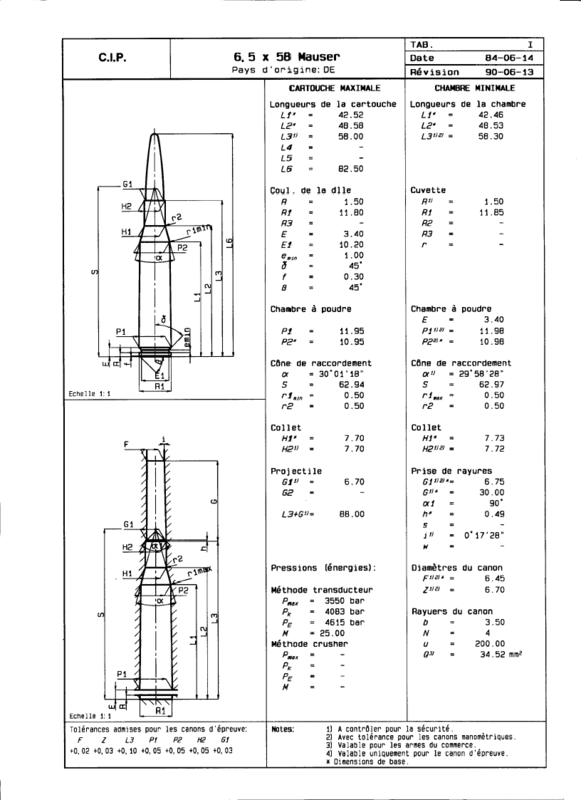
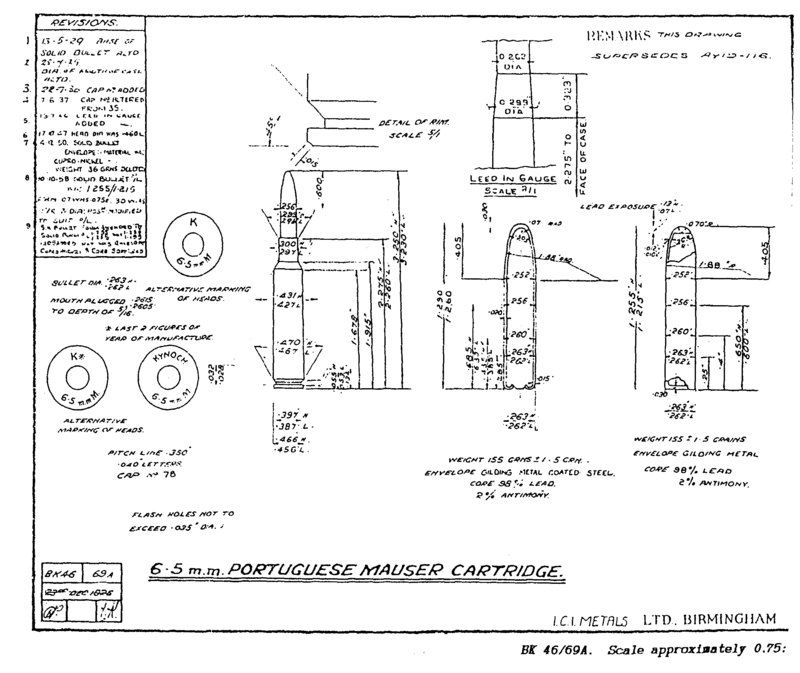
With thanks to Dave at CH4 dies:
65x5820Maus20H.jpg


65x58Mauser-1.gif


6_5x58Portuguese.gif
 
According to WHB Smith's Rifles of the World, 38 grains of the double base powder they used, produced appx 41,000 psi at 2350 fps with 156grain bullets.

He further states that commercial companies in the UK, loaded cartridges for it as well but at lower pressures.
 
There is some GREAT information here regarding this more-than-a-bit-obscure cartridge.

I wish we all were together, just so I could buy everyone a coffee and a piece of lemon pie for the effort.

This problem of the powder charge has been disturbing me somewhat. Right now, it is 5 minutes after 4 in the morning. I just fired up The Beast because I awoke from a dream in which I got a whole untampered CASE of this ammo, original stuff, German and Portuguese markings both on the wooden crate, shipping labels intact. In the dream, I opened the case..... and found BALL powder, evidently leaked from a broken old hard-brass casing, in the bottom. I KNEW that this was one number that Winchester DEFINITELY never made.... and that disturbed me enough to wake me up so I could check the chart on Page 250 of TBSA - 1909 again!

I think I need a break!

BTW, the chart still says 31.8 grains, double-based, and the rational part of my mind (if indeed I actually have one) makes suggestions about a high-nitroglycerine flake powder somewhat similar to the rolled Ballistite which the Italians were using (30.09 grains gave 2395 ft/sec with a 163-grain slug in a quite similar casing. Closest thing we MIGHT have today to a powder such as this would be REloder-7, although it does not use anything like as much (hot, high-pressure) nitroglycerine in its makeup. Cordite of this early period was 58% nitroglycerine, being lowered to a mere 37% in 1910 and thus saving untold millions of barrels from early trips to the steel mill......... which is why we still have in our collections rifles still fitted with the barrels with which they fought the Great War.

Something to think about the next time you put a few rounds downrange.

I think I'm gonna go back to bed now!

Hope this helps.
 
While it's interesting to determine what was originally used in the ammo 100 years ago, there's no reason why we must duplicate it. 100 years ago they used what was available, in a combination that met specific needs under specific conditions, but more commonly a compromise of components to fit general conditions. Today I can make use of a wide pallet of powders and bullets, and tailor the load for accuracy (and nothing else) under what are anything but "field" conditions - i.e. a perfectly clean rifle, on a dry day, with a low rate of fire, etc. We can, and do use different bullet weights, install higher front sights and the like (no-one wants a 300 yd zero), all things that would give an armourer fits, and end up with firearms that typically shoot better than they did when they were in use.

Aside from interest, what I find most useful about original loads is that it gives me a sanity check on pressures. If 32.0 grs of a smokeless powder produced 2350 fps with a 155 gr bullet, then diopter's load of 40.0 grs with a lighter 140 gr bullet going 2450 fps would seem to be at quite a bit lower pressure than the original, and hence not stress the firearm. If it's accurate to boot, then he can stop developing loads and simply shoot (and hence enjoy) the firearm.

I have created ammo superior to original surplus ammo on many occasions: several brands of 8X57 and 7.62X51; 30-06; 8X63; 7.62X39; and 7.62X54 come to mind, and then there's the factory stuff, usually very good, but all beatable with careful handloads. The one surplus I have not (yet) been able to one-up is 7.5X55 GP11, although I have matched it with a couple of powders and three bullet weights.
 
The Alliant powders use VERY little nitroglycerine as compared to the powders of a century ago.

The IMR type of powders use NO nitroglycerine at all, just straight granulated nitrocellulose.

Nitroglycerine is a MUCH more potent explosive than nitrocellulose. It also burns (as it does in combination with nitrocellulose) a great deal HOTTER and gives rise to HIGHER pressures and does it FASTER.

You WILL find yourself using MORE of a modern powder to get the same performance, than you would with the original powder. You also likely will be doing with with LESS heat, Less pressure and LESS damage to your rifle.

Pretty good trade-off, one would think.

In short, Andy is right.

I just BS more.
 
I have five milsurp rounds of 6.5x58 Portuguese, round nose if anyone is interested. Was just looking for info on this rather esoteric round, which led me here.
 
Back
Top Bottom