6.8 spc

woodchopper

Moderator
Moderator
Rating - 100%
78   0   0
Now I was going to post this in the black rifles section but then they tend to be unfriendly over there.


So after doing a bit of research into some old military research from prior to WW1 on what caliber is ideal there are some very interesting developments that if fully adopted at the time they were introduced would have made a big change in todays selection of military rounds

Lets start with the British in 1910 with the .276 round, rimless and the Patt'13 rifle, much like the 7mm chambering offered in the 1905 Ross.

Then there is the americans with the .276 Pederson in 1920 originally for the M1 Garand.

But both above calibers were shelved due to stockpiles of 303Brit and 30-06 and governments not wanting to have to spend money on something better.

So Post WW2 we see more development because now everyone wants self loading semi and full auto rifles, with intermediate cartridges. (7.92 Kurtz anyone) :D

so the British design the EM1 and EM2 and trial a bunch of smaller calibers but settle down to .270 and .280 then pick the 280. they had a few different cartridge sizes and shapes but
 
so the British design the EM1 and EM2 and trial a bunch of smaller calibers but settle down to .270 and .280 then pick the 280. they had a few different cartridge sizes and shapes but…

to standardize they eventually went with the US desire to have the same case head size as the 30-06. So they ended up adopting the 280/30 which is 7x44, (close to the 6.8x43 SPC)

but that didn’t last long and at the instance of the US NATO ended up with the 7.62x51, with the US adopting the M14.

Now that didn’t last long either, some sources seem to indicate that the US Airforce was the initiator of adopting the .223 and M16 but that I can’t really confirm. Sort of like someone’s good idea that really needed a little more development before it was adopted.

Now .223 was not a NATO round so a little more development and trials and we get the 5.56x45 a Belgian design slightly different from the original .223 being adopted as the NATO standard. No surprise there it fits in the M16 and none of the other rounds in the trials really had any merit better then the .223 most were actually smaller.

Now we have come full circle and we have started to discover that perhaps 5.56 may not be all that good. Surprise there were no trials conducted on it prior to it being adopted.

So lets see what’s out there that would make a good round. I vote for the 280 Enfield :D

No…. well Ok the US special forces were given the opportunity to create a better round and conducted trials on a range of calibers from 5.56 to 7.62 and really settled on the 6.8, Ok now were really coming full circle here.

As for the brass for the cartridge they took the 30Remington and necked it down, nice little cartridge not as fat as the 280 Enfield, and short enough to work with the M16 receivers.

But a little digging and the 30Remmington is actually just and improved 30-30 Winchester or 30WCF designed for black powder. Only the 30Remmington is a rimless design.

SO WHATS MY POINT :D

nothing is new in the world of cartridges
 
lol. Funny. I was just looking at a 6.8mm and thinking how much it reminded me of 7.62x39 or another 30 cal. Now 40 years later, the americans want a piston operated 30 cal gun eh? Can you say improved Kalashnikov? Fn?
 
For a very good history on the development of the .223 cartridge and the AR-15/M16, I can recommend no finer book than The History and Development of the M16 Rifle and Its Cartridge by David Hughes. And yes, it was the USAF that initiated the adoption of the M16 into US service.

As for the 6.8mm SPC, development is largely complete and it will probably only ever find a future as a sporting cartridge, although I understand that it has been tested in both Afghanistan and Iraq.

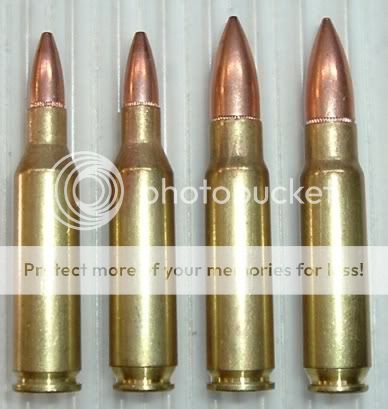
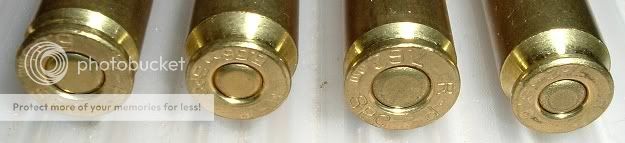
As woodchopper correctly points out, a variety of calibers were tested during the development of the SPC. Here are pictures of the 5.56 and 7.62mm. Note the rebated rims variations. There were also 6.5 and 7mm tested in both full and rebated rimmed cases. Note the different primer sizes.
68SPC006.jpg

68SPC012.jpg


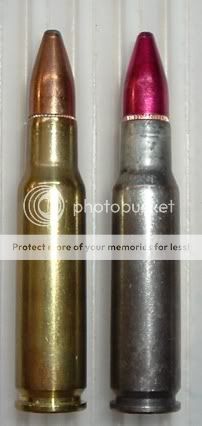
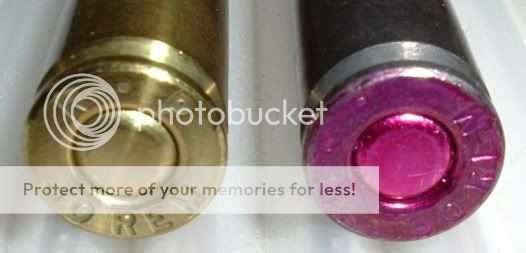
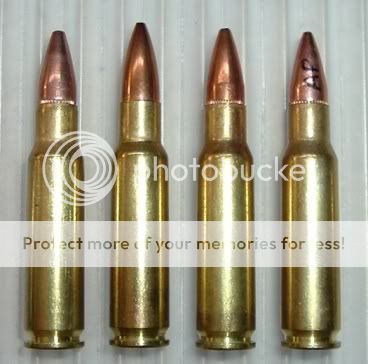
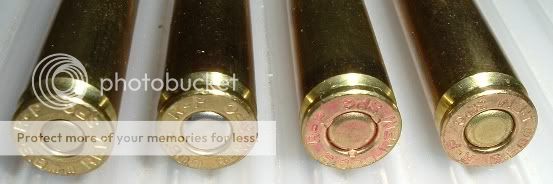
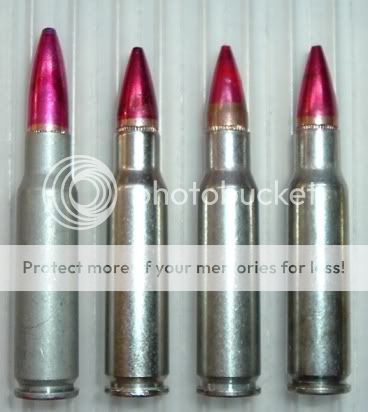
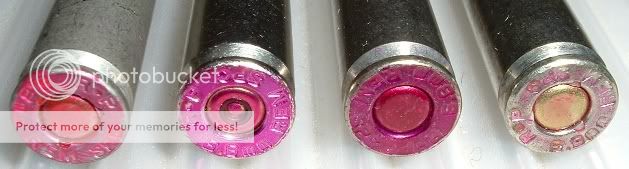
Here are some early 6.8mm rounds that still retain the .30 Remington Headstamp. The tinned case/red bullet round is a proof.
68SPC008.jpg
68SPC015.jpg


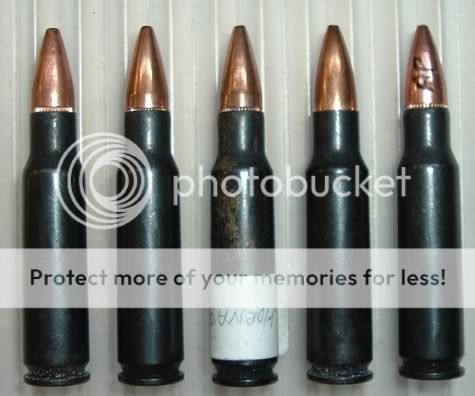
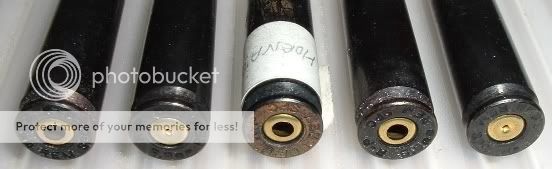
Here are some ball variations. The one on the right is an AP loading. It has no distuinguishing marks and can only be identified by a magnet attracted to the core. Note the variety of primer sizes, materials and crimping.
68SPC010.jpg
68SPC018.jpg


Here are some factory dummy loads.
68SPC007.jpg

68SPC013.jpg


Here are some proof loads. Note the electric primer. This is likely a commercial load (to me there is a very blurry line between between the military and commercial loads as the same bullets can be found in both).
68SPC009.jpg

68SPC017.jpg


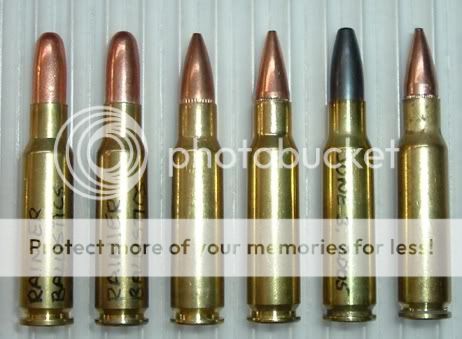
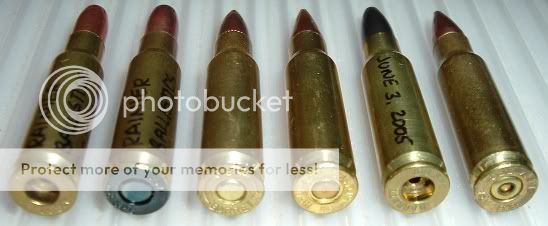
And finally, here are some commercial and aftermarket loads.
68SPC011.jpg

68SPC019.jpg


From left to right:

Rainier Ballistics subsonic - dummy and ball (SSA 6.8 SPC). SSA is Silver State Armory.
Ball loading with Sierra bullet ( - 6.8 - BARRETT)
Ball loading with Hornady bullet (HORNADY 6.8mm REM SPC)
Dummy Ball loading (X-treme Shock?) ( - 6.8 - BARRETT)
Ball loading with electric primer and Hornady bullet (R-P 6.8mm REM SPC)

Paul
 
thanks those are great pics

I remember reading about those rebated rims, they did that so that they would not have to change the bolt face on the M16 rifles just the barrels and gas port would need to be changed to run those rounds.
 
Back
Top Bottom