6mm REM primer bulging and blown out primer pocket.

ZSouthgate

New member
Rating - 0%
0   0   0
Searching for the issue with 6mm Remington loads. Newer to reloading and would like to get a few opinions.

I have 100gr Nosler Partitions paired with new Hornady brass, Federal 210 large rifle primers, a COL of 2.8, and went from 41 grains of IMR 4350 up to 43 grains which is the Max charge according to Nosler.

While testing, I noted that my primers were bulging slightly. I worked up from 41 grains of 4350 in increments of .5 grains or less, to 43 grains. All had bulged primers. When reaching 43 grains of IMR 4350, primers were still bulging to the same degree and the third round blew out the side of the primer pocket.

What might cause this? I’m seeing all kinds of things saying high pressure, too much headspace, low pressure (but I don’t know if that makes sense after the blown primer pocket).
 
I'm guessing you don't have a chronograph to see what the velocity is like?

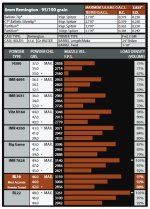
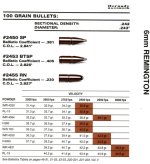
My Speer#12 also lists 43gr IMR3450 as a max load in 6mm Rem with some bullets, but only 41gr with others:
1000027830.jpg
 
This is a Remington 700.
Not resizing the new brass but I’m wondering if the shoulders aren’t being pushed a bit by the die when I’m pressing the bullets in.

I also wasn’t running these through a chronograph, I occasionally borrow one when I can.
 
Is it possibly the wrong primers. Doesn't happen often but it could be mismarked from the factory and be a 215 primer. I've had one or two defective primer pockets from the factory, a couple of them I could almost push in with my thumb. How much resistance was there to push them in the pocket. Never loaded that cartridge before but are you crushing powder when you push the bullet in.
 
The primers felt right going in, definitely couldn’t just push them in with your thumb.
Not crushing powder either, it’s far from that.
 
1) Have you checked your case capacity? [take a fired, but un-sized case with the fired primer still in place. Weigh it. Now fill that same case with water to the meniscus. Dab a piece of paper towel onto the meniscus until the convex portion of water outside the case has been removed [It doesn't take but a touch]. Now measure the case again. Filled case - unfilled case = net case capacity.
The number provided with this method is not the same as Nosler uses. Nosler uses the weight of water displaced by a bullet seated to the specified length. QL's usable case capacity [net case capacity calculated as above, minus the volume of water displaced by the bullet when seated to the specified C.O.A.L.] default is 48.8 gr. of water seated to 2.770", while Nosler shows 51.8 grs. of water. The difference of 3 grains less capacity & a slightly longer C.O.A.L. results in pressures of 71,516 psi with a C.O.A.L. of 2.800" [using an extra 3 grains of powder to offset the 3 grs. less case capacity], compared to Noslers' 51,247 psi [79% of M.A.P.], with 43 grs. of IMR4350 @ 2.770" C.O.A.L.

2) when you say "blew out the side of the primer pocket" do you mean it actually blew a piece of the brass out of the side of the cartridge case out, or simply that the gases blew by the case, which usually results in a black ring around the primer & in extreme cases results in the primer actually falling out on its own when you remove the fired case from the rifle?

3) How far off the lands are you seating your bullets? Nosler suggests a C.O.A.L. of 2.770" with a 100 gr. Partition, while you are using 2.800".

4) If for some reason you have brass with an inordinately low case capacity, combined with a short leade, the combination of the two may result in high pressure. Is it a new rifle? Is there an obscene amount of fouling or rust in the barrel? That could also cause a pressure excursion.

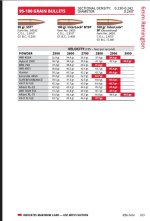
6mmRem 100 Nosler Partition.jpg
 
Hornady 11th edition does not show a load for IMR 4350. It does state that the two best powders were IMR 4064 (good luck finding any) and VIHT N-160. It also does not show the Nosler Partition as a bullet choice.
8868171B-C53E-4C56-A8F5-F04A5860074B.jpeg64F6551A-DA8C-40A3-8C49-9EC717C7E446.jpeg
 
Searching for the issue with 6mm Remington loads. Newer to reloading and would like to get a few opinions.

I have 100gr Nosler Partitions paired with new Hornady brass, Federal 210 large rifle primers, a COL of 2.8, and went from 41 grains of IMR 4350 up to 43 grains which is the Max charge according to Nosler.

While testing, I noted that my primers were bulging slightly. I worked up from 41 grains of 4350 in increments of .5 grains or less, to 43 grains. All had bulged primers. When reaching 43 grains of IMR 4350, primers were still bulging to the same degree and the third round blew out the side of the primer pocket.

What might cause this? I’m seeing all kinds of things saying high pressure, too much headspace, low pressure (but I don’t know if that makes sense after the blown primer pocket).
Can you post pictures of what you are experiencing?
What are you calling a bulged primer etc…..a photo would help explain things.
 
Double and triple check your die setup instructions.
If your over-sizing or pushing your shoulder back too much you will get too much headspace. This could mean bulging primers, aka the primers have room to push out during firing from their original seating position.
 
The only thing I can think is the gun powder. Either it is contaminated or the measurement was not accurate.
 
I don't have a lot of first hand 6mm Rem experience but I did get up to 45.9grs IMR 4350 under the 90gr Nosler Accubond in my brother in law's Ruger m77 (Wilson 1:8 barrel) with Remington brass (57.6grs h2O capacity). OAL is 2.893" which is 60 thou off lands. According to QL the net/usable h2O capacity would be 52.5grs h2O

When that rifle had its factory Ruger barrel, I did 100gr Nosler Partition over 43.0grs RL17 (3100 fps) @ 2.91" OAL. RL17 is very similar burn rate to 4350 and charge weights at max psi will be similar

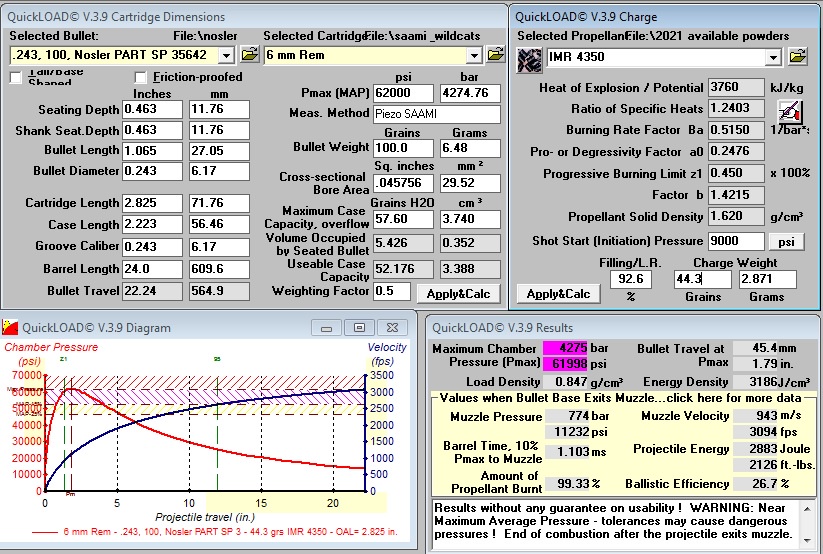
Using some default inputs in Quickload, it's suggesting 62,000 PSI would come at around 44.8grs IMR 4350 under a 100gr Nosler Partition

JPV8vj5.jpeg
 
Last edited:
You're never going to see data for a Nosler Partition in a Hornady book, or Sierra, Speer, Barnes, Berger or Swift either, for that matter. The only ones you may find data for Nosler bullets is Norma, but only with Norma powders, or Vihtavuouri, but again only with their powders, or Lyman.

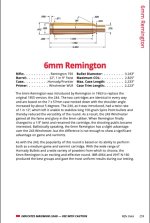
Hornady's 4th edition has data for IMR4350, but only with their 100 grain bullets, which are not the same as a Nosler Partition. Different length, construction, bearing length.

6mmRem 100 IMR4350.jpg
 
When the primer bulges or the side of primer pocket blows out, it's created by OVER PRESSURE.
Although the Nosler manual does say 43.0* it is MAX.
Max loads are not something that will work along with Nosler Partitions in all rifles.
Somewhere I've read when using N Partitions reduce powder charge by 10%, the bullet does not squeeze down as easy as cup&core when entering the lands, creating higher pressures.
Back off the charge until these signs are gone, and check velocity. Hunting loads do not have to be at max velocity, they should be reasonably accurate though.
 
Searching for the issue with 6mm Remington loads. Newer to reloading and would like to get a few opinions.

I have 100gr Nosler Partitions paired with new Hornady brass, Federal 210 large rifle primers, a COL of 2.8, and went from 41 grains of IMR 4350 up to 43 grains which is the Max charge according to Nosler.

While testing, I noted that my primers were bulging slightly. I worked up from 41 grains of 4350 in increments of .5 grains or less, to 43 grains. All had bulged primers. When reaching 43 grains of IMR 4350, primers were still bulging to the same degree and the third round blew out the side of the primer pocket.

What might cause this? I’m seeing all kinds of things saying high pressure, too much headspace, low pressure (but I don’t know if that makes sense after the blown primer pocket).
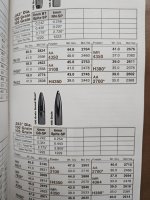
This is a typical mistake many people make... That's the maximum in the rifle they tested, NOT your rifle.

You need to start lower and as you work higher and monitor the pressure signs, stop when you get stiff bolt opening... that load is too hot. Back up.
Primers are a poor indicator of pressure except when they fail... that is a bad primer or overload. Stiffer bolt lift after firing is the best indicator when to reduce the load.
 
Back
Top Bottom