












































You are using an out of date browser. It may not display this or other websites correctly.
You should upgrade or use an alternative browser.
You should upgrade or use an alternative browser.
6th Annual Upper Canada Double Gun Classic - Take Two!
- Thread starter canvasback
- Start date

Bill, a friend has a bar in wood Purdey 20 gauge. Those are very nearly the Ne Plus Ultra of the shotgun world. Just beautiful.
Perhaps the absolute ultimate is a Purdey hammer ejector---they come on the market from time to time but are on the pricey side. Then, there is a Purdey flintlock which is incredibly rare.

Bar-in-wood guns are pure class.
Pure class indeed !
Beautiful gun in remarkable condition
Thanks for sharing CowTownBill and bridging that gap, I can only imagine the great guns in collections across our country
Hey Canvasback does this one make you nervous?? It sure might give one of your Dalys a real run for their money as Best-In-Show !!!

Still waiting for a Purdey pinfire. The only one I’ve come across, many years ago in the UK, was a $12,000 rifle, too rich for me. Maybe one will show up (reasonably priced) at the Classic for-sale table? I’m ever the optimist.
Still waiting for a Purdey pinfire. The only one I’ve come across, many years ago in the UK, was a $12,000 rifle, too rich for me. Maybe one will show up (reasonably priced) at the Classic for-sale table? I’m ever the optimist.
I have never seen a Purdey pin fire and would love to see one.
Pure class indeed !
Beautiful gun in remarkable condition
Thanks for sharing CowTownBill and bridging that gap, I can only imagine the great guns in collections across our country
Hey Canvasback does this one make you nervous?? It sure might give one of your Dalys a real run for their money as Best-In-Show !!!
Michael I’ve seen way too many amazing guns in the last two years to have any misplaced confidence about who is winning the GOTY. If the event hadn’t been cancelled in spring 2020, I might have had a chance. Now, it’s anyones game.
Thought I would share a couple of piocs of my Purdey bar-in wood hammer gun.
It is cased in a vintage Purdey oak and leather case, but the case is not original to the gun. The gun and case were reportedly sold in the 1950's by Purdey to a wonderful gentleman in Nova Scotia. Because the case was not original to the gun, the original trade label was cut from the case leaving an ugly empty spot which I covered with a replica label. A wonderful friend was in London in the 70's and volunteered to make a visit to Purdey's to purchase a cleaning rod, snap caps and oil bottle to fit the case. I had given my friend detailed measurements to ensure every thing would fit properly. The gentleman behind the Purdey counter gave a frown and told my friend, that all Purdey accessories fit all Purdey cases. The ultra conservative Purdey establishment don't make changes easily.
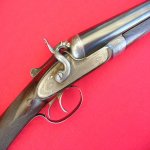
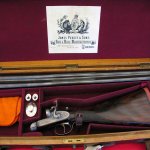
It is cased in a vintage Purdey oak and leather case, but the case is not original to the gun. The gun and case were reportedly sold in the 1950's by Purdey to a wonderful gentleman in Nova Scotia. Because the case was not original to the gun, the original trade label was cut from the case leaving an ugly empty spot which I covered with a replica label. A wonderful friend was in London in the 70's and volunteered to make a visit to Purdey's to purchase a cleaning rod, snap caps and oil bottle to fit the case. I had given my friend detailed measurements to ensure every thing would fit properly. The gentleman behind the Purdey counter gave a frown and told my friend, that all Purdey accessories fit all Purdey cases. The ultra conservative Purdey establishment don't make changes easily.
Attachments


I have never seen a Purdey pin fire and would love to see one.
It would take a ridiculously wealthy person to set aside a usable Purdey and buy another, more up-to-date one. I've seen several conversions to C-F, which made economic sense. The double rifle I was offered was complete in every sense, tools, bullet moulds, original case etc., but way out of my range. But you never know what's just around the corner, one of the many pleasures of collecting.
Thought I would share a couple of piocs of my Purdey bar-in wood hammer gun.
It is cased in a vintage Purdey oak and leather case, but the case is not original to the gun. The gun and case were reportedly sold in the 1950's by Purdey to a wonderful gentleman in Nova Scotia. Because the case was not original to the gun, the original trade label was cut from the case leaving an ugly empty spot which I covered with a replica label. A wonderful friend was in London in the 70's and volunteered to make a visit to Purdey's to purchase a cleaning rod, snap caps and oil bottle to fit the case. I had given my friend detailed measurements to ensure every thing would fit properly. The gentleman behind the Purdey counter gave a frown and told my friend, that all Purdey accessories fit all Purdey cases. The ultra conservative Purdey establishment don't make changes easily.
A profoundly beautiful gun. Just too new-fangled for my tastes!

Bar-in-wood guns are pure class.
Totally agree!

Thought I would share a couple of piocs of my Purdey bar-in wood hammer gun.
It is cased in a vintage Purdey oak and leather case, but the case is not original to the gun. The gun and case were reportedly sold in the 1950's by Purdey to a wonderful gentleman in Nova Scotia. Because the case was not original to the gun, the original trade label was cut from the case leaving an ugly empty spot which I covered with a replica label. A wonderful friend was in London in the 70's and volunteered to make a visit to Purdey's to purchase a cleaning rod, snap caps and oil bottle to fit the case. I had given my friend detailed measurements to ensure every thing would fit properly. The gentleman behind the Purdey counter gave a frown and told my friend, that all Purdey accessories fit all Purdey cases. The ultra conservative Purdey establishment don't make changes easily.
View attachment 580112
View attachment 580113
A few pictures I took at Purdey's back in 2018(?) Details of your Purdey bar-in-wood would be in one of the record books in the gun room.


Thanks for the Purdey establishment pics. I do indeed have a letter from Purdey regarding my Purdey shotgun. I got it years ago when Purdey provided such information free of charge. They even gave me the title 'Esq" after my name. How formal, indeed.
Looking at those ledgers brings back my curiosity of total production from the big names
From my research into the 1860s, the big names (Boss, Purdey, Holland etc.) might sell 80-90 guns a year, smaller makers much less. Guns with proprietary patents would be a small fraction of these. I can't say for later years, when true factory production developed, at least for second- and third-grade guns. Webley & Scott in Birmingham developed the capacity in the 1860s to produce about 2000 sporting guns a year, many of which were sold under others' names.
Looking at those ledgers brings back my curiosity of total production from the big names
Brybenn, I looked up Purdey numbers 1884-1983, as outlined in Richard Beaumont's book. He looked at the number of years it took for each 1000 guns in the numbering system, covering all shotguns, rifles, pistols etc. combined, instead of annual production numbers. Purdey had qualities ranging as Best, B, C, D, and E Quality. It could take 6 years to make 1000 (1885-1891), or 5 years (1921-1926, 1930-1935), or 4 years (1903-1907, 1926-1930), or at the most, 3 years (1891-1894, 1894-1897, 1897-1900, 1900-1903, 1907-1911, 1911-1914), not counting the war years. After WWII, production was very limited, where it took 15 years to make 1000 (1947-1962), or 12 years (1962-1974), then 9 years (1974-1983).
In the same time period, Boss & Co. were making about 40-70 a year (all types) until the 1900s, then slightly over 100 a year. After WWII production was very slow, about 200 guns total in 6 years, 160 guns total in the period 1956-1960, 130 guns in the period 1961-1965, only 50 guns in the period 1981-1985, some 90 guns in the period 1991-1995, and 70 guns total in the 4 years 1996-2000.
I would guess Holland & Holland numbers would be similar to Purdey's, or slightly more, as Holland perhaps had a wider range of both shotguns and rifles.
In the early breech-loading years, a maker would be lucky to sell 10 in a year, never mind 100!
So, when we shall gaze upon these beauties at the 6th Annual Double Gun Classic, it is worth remembering their interesting pedigree.
Breaking News......
Just confirmed that Mike Bohm of Between Seasons, an on line book seller focused on guns, hunting, fishing and the outdoor life, will be attending with an inventory of books that should appeal to us. More info to follow.
Just confirmed that Mike Bohm of Between Seasons, an on line book seller focused on guns, hunting, fishing and the outdoor life, will be attending with an inventory of books that should appeal to us. More info to follow.
Breaking News......
Just confirmed that Mike Bohm of Between Seasons, an on line book seller focused on guns, hunting, fishing and the outdoor life, will be attending with an inventory of books that should appeal to us. More info to follow.
Cool! I picked up some copies of the DoubleGunJournal from Mike last summer.
For one thing I know that he had a copy of TheGreenerStory which I coveted....





















