7.5mm 1882 Ordnance

gord1986

Regular
Rating - 100%
23   0   0
Location
Calgary
Lately I've been researching late 1800's service revolvers of various European countries and have become quite intrigued by the 7.5mm 1882 Ordnance Revolver.

From what I gather this revolver was highly regarded and was used into the early-mid 20th century. Which is quite impressive given the massive improvements in small arms in that period.

My only question regarding this firearm/ammunition is - It seems grossly grossly under-powered as a man stopping round. Why would the Swiss adopt such a pea-shooter as their standard issued side arm? Would this round even drop an enemy soldier, even with multiple hits? I am aware that during that time period an officers side arm was more of a symbol of rank and respect then it was actually intended to be used in combat, but why wouldn't they issue a revolver with a little more power behind it?

It just seems to me that a 100gr bullet travelling at 700 FPS would be less effective then a .22LR, and it barely travels faster then a pellet gun. It seems like it would be utterly ineffective as a man-stopper?

 
gord... reload. I do. I push 100 grain bullets in the 965-1050 fps range. The revolver is over-built and as refined as a Swiss watch. It's also incredibly accurate. The military cartridges were loaded with BP and are anemic... I have a few boxes of those as well. Do some research here, there are numerous posts on the Swiss 1882 and members reloading experiences. There's a reason you rarely seem them for sale on EE.
 
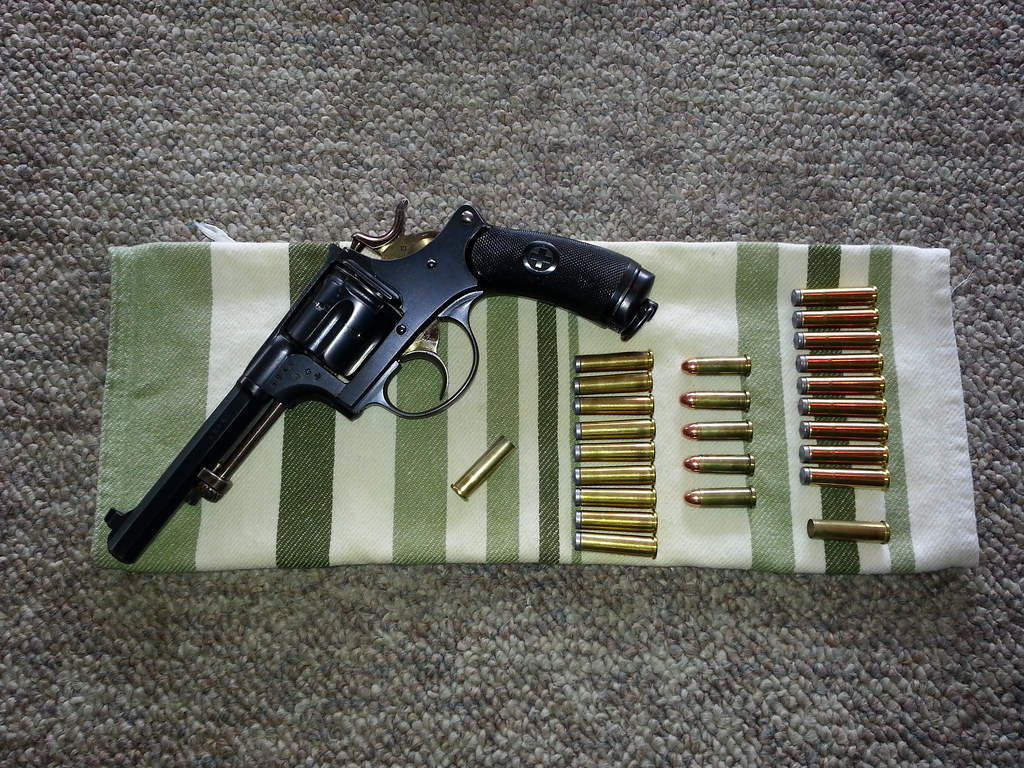
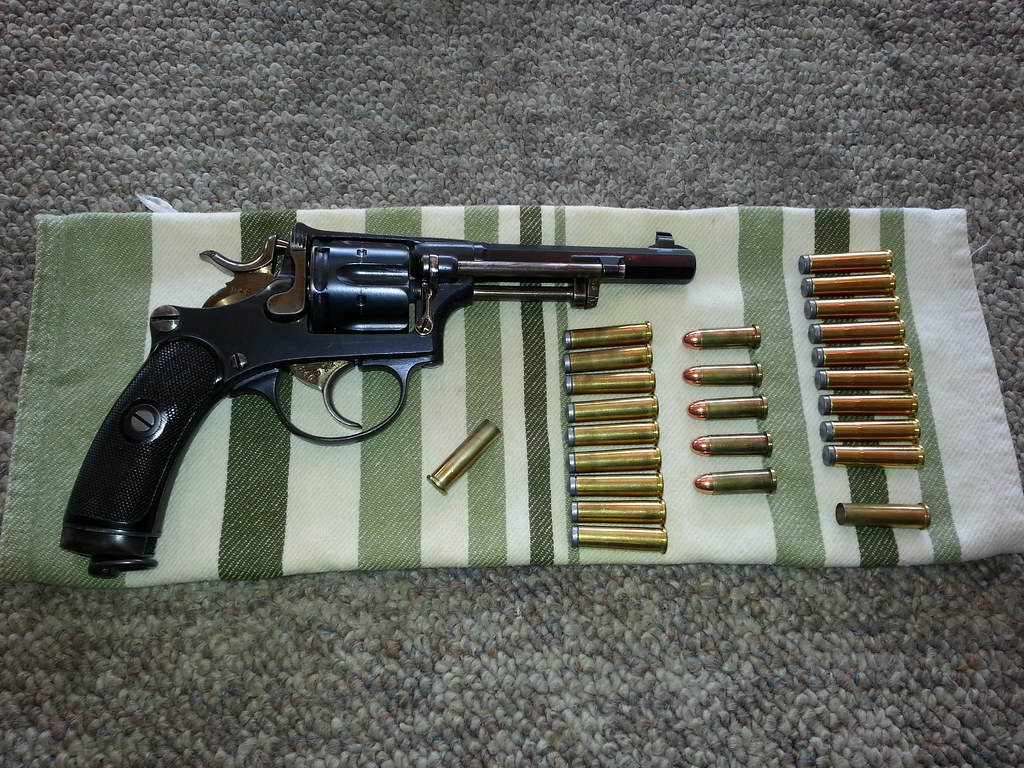
These reloads (except the 5 in the middle) utilize uncut, reformed 32-20 brass with deep seated waxed lead wadcutters and are in the optimal range in terms of accuracy and power, utilizing 3.3 grains of Trail Boss.

20324932151_1bd567a1e8_b.jpg

20324941411_e9d0b95906_b.jpg
 
Lately I've been researching late 1800's service revolvers of various European countries and have become quite intrigued by the 7.5mm 1882 Ordnance Revolver.

From what I gather this revolver was highly regarded and was used into the early-mid 20th century. Which is quite impressive given the massive improvements in small arms in that period.

My only question regarding this firearm/ammunition is - It seems grossly grossly under-powered as a man stopping round. Why would the Swiss adopt such a pea-shooter as their standard issued side arm? Would this round even drop an enemy soldier, even with multiple hits? I am aware that during that time period an officers side arm was more of a symbol of rank and respect then it was actually intended to be used in combat, but why wouldn't they issue a revolver with a little more power behind it?

It just seems to me that a 100gr bullet travelling at 700 FPS would be less effective then a .22LR, and it barely travels faster then a pellet gun. It seems like it would be utterly ineffective as a man-stopper?

Swiss doctrine at the time was peaceful coexistence with all neighbors, so using 1882 in acual combat was not really contemplated. So ammo and firearm was tailored towards accuracy and ease as well as cheapness of manufacture. In any event accuracy is always better than anything else in firearm use, so if Swiss would have had to go to war, they would have just stepped up with smokless load for 7.5 ordnance.
Since war is just practice for swiss, 1882 revolver was accurate and reliable for its purpose and cartridge loadedfor this revolver reflects this doctrine.
For our purposes we in the same boat as swiss target shooters, so loading this ammo with similar components can produce stunning accuracy.
I load for both my m1882 and m1929 and the most accurate load is where bullets travel aroun 700 to 800fps.
Paper targets are the only things that these revolvers are ment to shoot.
 
For those in the know, the antiques are beautifully finished and certainly not cheap to manufacture. When the Lugers became the new status symbol, finishing on the 1882's began to slide a bit, and the model 1929 certainly shows manufacturing shortcuts... but nice shooters though. I find optimal accuracy for my 1882 to be in the 820 to 865 fps range or 2.9 to 3.1 grains of Trail Boss.
 
The 5 reloads in the middle utilize 72 grain FMJs (32 ACP bullets) over 3.1 grains of Trail Boss inside trimmed 32-20 brass and scream at 1120 fps... I use them to "clean the lead" out of the bore. :) Not anemic! :)
 
depends on a lot of factors: top strap variant, condition, use/abuse... but I tend to keep my loads in the ~865-900 fps range for plinking and target work. As noted above, I will occasionally pop a few more spirited loads. I don't risk squib loads. According to a few published sources, the latter 1882's are factory tested at ~26,000 psi... so I don't worry.
 
depends on a lot of factors: top strap variant, condition, use/abuse... but I tend to keep my loads in the ~865-900 fps range for plinking and target work. As noted above, I will occasionally pop a few more spirited loads. I don't risk squib loads. According to a few published sources, the latter 1882's are factory tested at ~26,000 psi... so I don't worry.

900 FPS seems a little better then the 700 FPS of the original BP round.

Out of curiosity, how did the Swiss find the manstopping power of these rounds to be?
 
900 FPS seems a little better then the 700 FPS of the original BP round.

Out of curiosity, how did the Swiss find the manstopping power of these rounds to be?

It wasn't really a concern for them... At best the revolvers became a second line weapon after the 1900 Lugers entered the system and sort of remained there until the M49s came into use.
They were good enough for the staff and supply officers that carried them and also sufficient for arming the Landsturm and Landwehr. Funny to think that the 7.5mm Swiss Ordinance round they use was the last ever adopted black powder military cartridge and saw use into the 1950's...

One must also remember that the 1882s are merely an upgrade over the older 1878s by bringing a jacketed bullet and 100fps increase and were not something radically new like the Lugers. Man stopping was more concerning for colonial powers who couldn't expect "gentlemanly" warfare from their foes.
 
900 FPS seems a little better then the 700 FPS of the original BP round.

Out of curiosity, how did the Swiss find the manstopping power of these rounds to be?

Police for years were using the 32 S&W Long (32 Colt New Police) in their service revolvers, and that is similar in power to the BP 7,5 Swiss loads. I would say that the Swiss found it sufficient for their needs as well.

Reloading is key to getting the most out of these finely made revolvers. I wouldn't be too hung up on "man stopping power". If a 100 grain lead wadcutter going 900-1000 fps (~200 ft/lbs of muzzle energy) doesn't have the ability to incapacitate a would be attacker, you are doing something terribly wrong and you better have strong legs to high tail it. :)
 
There was never any combat reports from the Swiss Army on the lack of stopping power of this cartridge.
 
It wasn't really a concern for them... At best the revolvers became a second line weapon after the 1900 Lugers entered the system and sort of remained there until the M49s came into use.
They were good enough for the staff and supply officers that carried them and also sufficient for arming the Landsturm and Landwehr. Funny to think that the 7.5mm Swiss Ordinance round they use was the last ever adopted black powder military cartridge and saw use into the 1950's...

As far as I can tell .303 would have been the last black powder military cartridge ever adopted, and even then I am sure someone could still dig up another round adopted later.

The whole reason for keeping the 1882s had everything to do with cost. It was roughly a third the cost to make a 1882 over a Luger. Give the Lugers to the Infantry officers and those expected to be in combat, and the 1882s to those they felt were likely to never use it.

For those in the know, the antiques are beautifully finished and certainly not cheap to manufacture. When the Lugers became the new status symbol, finishing on the 1882's began to slide a bit, and the model 1929 certainly shows manufacturing shortcuts... but nice shooters though.

As mentioned reason they kept producing the 1882s and later 1929s was simply it was much cheaper to make those revolvers than to buy Lugers for everyone. Every model the Swiss adopted in the late 20s early 30s was a attempt to cheapen the cost of producing the firearms (which is fair considering they literally had their troops walking home with pretty much everything they made). M1929 Lugers and M1929 Revolver both are simplifications of the earlier models. The K31 was a cheaper design than the K11 to produce.

To the OP, as mentioned the cartridge is fairly similar to .32 S&W Long. It would also be fairly similar to .32 ACP or stronger than .25 ACP both very popular carry cartridges, and one a very popular military pistol cartridge for decades. Personally not my ideal round for 'manstopping' but all that doesn't matter if you can't hit your target in the first place.
 
Back
Top Bottom