9mm Lee Die worn out?

mb571

Regular
Rating - 100%
1   0   0
Hi Folk's
I need some help to diagnose what could be a worn out 9mm sizing die. I have loaded rifle before (.223 and 30-06) but this is my first crack at pistol ammo.
I do everything backwards, just for fun.
The kids wanted an AR something so I bought a used press and new .223 Lee Ultimate 4 die set. I then bought Weaver mounts, scope rings, scope, scope rings again for the right tube size, and then finally a Tikka T3X .223. Backwards yes, but I had ammo on hand when the new gun arrived.

Now on to 9mm. I want to bum a try of a few different 9mm's at the range to see what fits my longer hand well. I saw a used Lee 4 die 9mm set for sale on a local garage sale website. I bought them and got some odds and sods with what was probably an average price. The problem is I am suspecting the decapping/resizing die is worn a bit larger. I hope not as I tried to return them but the seller is not cooperating. Perhaps you folk can help me figure this out.

The die sized a handful of brass (Remington, Federal) such that the bullets press fit okay. When I tried to size the most common scavenged range brass (Blazer) the problems started. The bullets can be pressed into the shells by finger with no press needed. I tried various adjustments to the resizing die and bullet seat/crimp. If I add more crimp, the bullet spins in the casing of the finished round. You can also press the bullet in deeper by finger. The difference between the Blazer brass and the others I tried was the case wall thickness. So thus with the same OD as pressed by the die, results in a larger ID on the thinner brass.
So I took the Blazer brass I had resized over to a friend's house to size it in his Lee carbide die. Low and behold it sized it smaller and it will hold bullets now.
With my dies I have followed the instructions of adjusting the full length sizer down till it touches the shell holder.
Hopefully nobody says just don't use Blazer brass....my friends use it with no problem, and there is lots of it lying around for the picking.
I have fired some of the other stuff I loaded and it all worked. (got to bum a try of an Italian police surplus Beretta 92S and an older CZ75)

Can you folk think of any way to determine if the die is in fact worn? Or if I am doing something wrong? A way to prove it either way?
Thanks for any help.
Mark
 
The die will usually rust before it wears out. Most 9mm dies will outlast most 9mm pistols/barrels, so you should be good for over 100k rounds with a sizer die, even an inexpensive Lee die.

The thing with Lee however is the lack of quality control. So chances are that the die's ID was a bit outsized to begin with. It might be why the seller was getting rid of it. From what you describe it definitely looks like it, and since your friend's die seems to work fine, I would just try a new die. You could contact Lee and see if they'll exchange it, even if it's not under warranty or anything they often do. Shipping both ways might be more expensive than getting a new die though.

FYI: I reload blazer brass with my 9mm Lee carbide die and got no problem. I don't sort 9mm brass in any way. Can't see any difference between brand.
 
Send the die to lee, they'll replace it.

Having said that, i avoid blazer like the plague these days.
I know two guys who had guns kaboom cuz blazer forgot to crimp (remove the flare) from their round so bullets were getting set back in the box.

Latest phenomenon (9mm) is failure to feeds in several different pistols (G17, 1911, Cz Shadow 2). All other brands of ammo feed fine, try to run Blazer, no bueno.
 
The 4 die set must have come with a factory crimp die, yeah? More crimp from the final die doesn't solve your problem...?

I flare the hell out of my cases, and my Lee dies sort it all back out no problem. Loaded thousands of Blazer Brass cases with no problems...
 
If you are using range pickup brass you do not know how many times the cases were fired. The more times the case is reloaded the harder the brass becomes and "springs back" more after sizing.

Many competitive shooters use range pickup brass and use a Lee under size die that sizes the case diameter .002 to .003 smaller in diameter than a standard die.

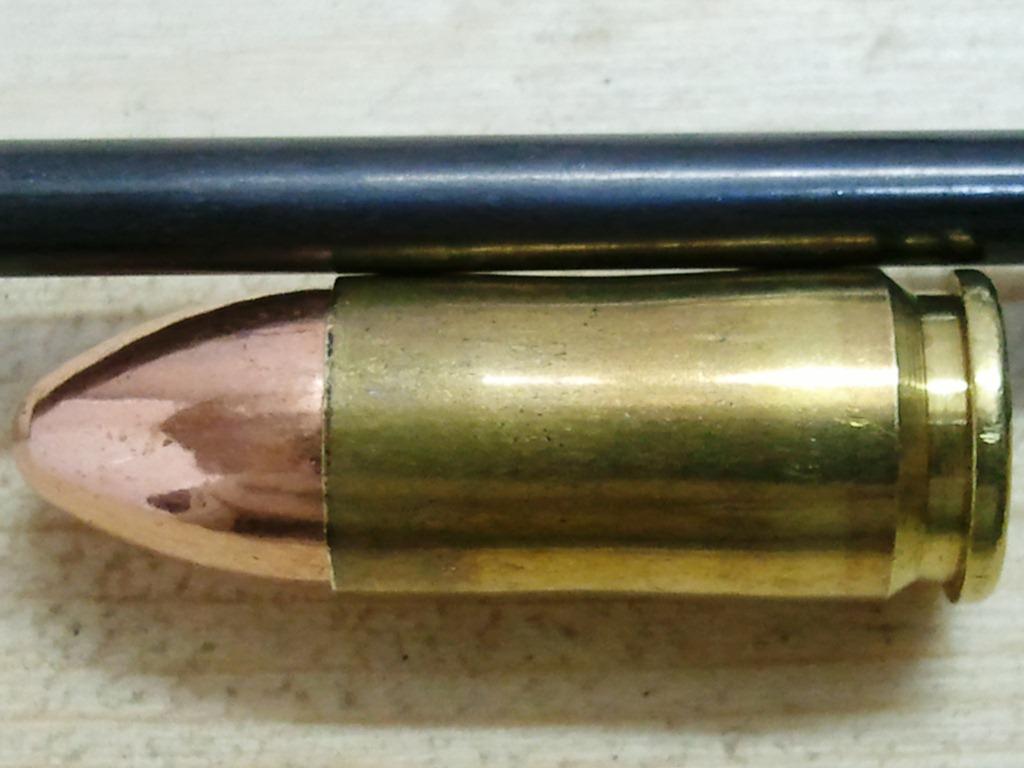
Below is a reloaded 9mm cartridge with a straight edge laying on the case showing that the case is wasp waisted. Meaning the case was sized small enough after expanding and spring back the the case has plenty of bullet grip.

If the case is smaller behind the bullet (wasp waisted) and you can see where the base of the bullet stops inside the case you have good bullet grip.

MfcwIQB.jpg


Bottom line, your die might be on the large size of specifications, the problem cases may be on the thin side, or you may have a brass spring back problem.

I buy bulk once fired military 9mm brass and also pick up brass at the range and size them with a lee under size die. And expand the cases with a Lyman type "M" die and not over expand the case mouth. I also have a standard Lee carbide die set if the undersize die is not needed.

Lee U Carbide Undersized Sizing Die
https://ads.midwayusa.com/product/386755/lee-u-carbide-undersized-sizing-die?

Lee U Carbide Undersized Sizing Dies are great for reloaders looking for ultimate feeding reliability in their handgun. These dies undersize brass between .002" and .003" smaller than other Lee Carbide Sizing dies. Ammunition with undersized brass cases will chamber each and every time it is loaded out of a magazine giving reliable chambering each time a round is stripped out of the magazine or loaded into a cylinder. Competition shooters rely on having ammunition that will feed and chamber each round of ammunition as it is stripped out of the magazine. One of the other benefits reloaders have reported when using Lee U dies is increased consistency and accuracy in loaded rounds because these dies help increase and provide more consistent neck tension on loaded bullets. The solid carbide insert inside of these dies is ground to a special contour that does not leave a belt mark on the case. These carbide dies do not require lubricant while resizing, though a little case lube will make the sizing process easier. Shellholder sold separately.

Notes:

Carbide sizing dies do not require case lube
Undersized dies size brass between .002" and .003" below specifications, so ammunition will feed in chamber in tight chambers
Undersized dies work great for bringing back case tension to hold bullets on cases that may be thinner walled
 
Last edited by a moderator:
The 4 die set must have come with a factory crimp die, yeah? More crimp from the final die doesn't solve your problem...?

I flare the hell out of my cases, and my Lee dies sort it all back out no problem. Loaded thousands of Blazer Brass cases with no problems...

The taper crimp is used to close up the flair or belling at the case mouth and streamline the mouth of the case. This taper crimp was never meant to hold the bullet in place on cases that headspace on the case mouth.

I shoot mostly plated bullets in my pistols and a heavy crimp could split the plaiting. Bullet grip is controlled by how tightly the case body is squeezing the bullet and the Lee undersized die increases bullet grip.

The undersize die compensates for thin walled cases and brass spring back with well used work hardened brass.
 
Using copper plate or FMJ on all of my pistol calibers, I don't flare; don't need to (I use Lee dies); I do for lead bullets as they will shave without it.
 
The taper crimp is used to close up the flair or belling at the case mouth and streamline the mouth of the case. This taper crimp was never meant to hold the bullet in place on cases that headspace on the case mouth.
Bullet grip is controlled by how tightly the case body is squeezing the bullet and the Lee undersized die increases bullet grip.
The undersize die compensates for thin walled cases and brass spring back with well used work hardened brass.

This is exactly what I am experiencing. I have tried to crimp with the factory crimp die and the bullet can still be spun in the brass. Even after a heavy crimp that leaves a dent in the bullet. Kinda sucks that my buddy's die (same Lee Die) does anything he picks up off the ground and this one won't.

Mark
 
Hi Folk's
I need some help to diagnose what could be a worn out 9mm sizing die. I have loaded rifle before (.223 and 30-06) but this is my first crack at pistol ammo.
I do everything backwards, just for fun.
The kids wanted an AR something so I bought a used press and new .223 Lee Ultimate 4 die set. I then bought Weaver mounts, scope rings, scope, scope rings again for the right tube size, and then finally a Tikka T3X .223. Backwards yes, but I had ammo on hand when the new gun arrived.

Now on to 9mm. I want to bum a try of a few different 9mm's at the range to see what fits my longer hand well. I saw a used Lee 4 die 9mm set for sale on a local garage sale website. I bought them and got some odds and sods with what was probably an average price. The problem is I am suspecting the decapping/resizing die is worn a bit larger. I hope not as I tried to return them but the seller is not cooperating. Perhaps you folk can help me figure this out.

The die sized a handful of brass (Remington, Federal) such that the bullets press fit okay. When I tried to size the most common scavenged range brass (Blazer) the problems started. The bullets can be pressed into the shells by finger with no press needed. I tried various adjustments to the resizing die and bullet seat/crimp. If I add more crimp, the bullet spins in the casing of the finished round. You can also press the bullet in deeper by finger. The difference between the Blazer brass and the others I tried was the case wall thickness. So thus with the same OD as pressed by the die, results in a larger ID on the thinner brass.
So I took the Blazer brass I had resized over to a friend's house to size it in his Lee carbide die. Low and behold it sized it smaller and it will hold bullets now.
With my dies I have followed the instructions of adjusting the full length sizer down till it touches the shell holder.
Hopefully nobody says just don't use Blazer brass....my friends use it with no problem, and there is lots of it lying around for the picking.
I have fired some of the other stuff I loaded and it all worked. (got to bum a try of an Italian police surplus Beretta 92S and an older CZ75)

Can you folk think of any way to determine if the die is in fact worn? Or if I am doing something wrong? A way to prove it either way?
Thanks for any help.
Mark

purchase a box of new 9mm and fire it. then try running through your press. if it works it could be possible your range pickup brass was shot from a 9mm maj handgun and is blown too far.
 
OP: what's the OD of a resized case at a few spots from the neck to the web? What bullets are you trying to seat and their OD? That would tell us more.

How far down are you pushing the bullets? Are you using a powder through expander die, and if so do you have the right one? A 38 die can seem close for some things, guys have used parts of 9mm sets for 38 S&W, you said this was an odds and ends buy so is there another die body?

Could be the Die is a little loose but I doubt worn if lube is used. Steel dies wear but that takes a lot, carbide ones can rip the insert out so there's no cure all for that. I will agree that the Blazer brass I have used is definitely thinner than Winchester or other makes.
 
The taper crimp is used to close up the flair or belling at the case mouth and streamline the mouth of the case. This taper crimp was never meant to hold the bullet in place on cases that headspace on the case mouth.

I shoot mostly plated bullets in my pistols and a heavy crimp could split the plaiting. Bullet grip is controlled by how tightly the case body is squeezing the bullet and the Lee undersized die increases bullet grip.

The undersize die compensates for thin walled cases and brass spring back with well used work hardened brass.

Good to know, thanks!
 
will try not going to the obvious, but maybe your seating die , try backing up one turn, sometimes the seating die will apply a crimp on the case and will open up the mouth
 
will try not going to the obvious, but maybe your seating die , try backing up one turn, sometimes the seating die will apply a crimp on the case and will open up the mouth

Let's not even involve talk about the seating die. I can size the Blazer brass, then I can pop the bullet in and push it too far in by hand without using a press.
 
Let's not even involve talk about the seating die. I can size the Blazer brass, then I can pop the bullet in and push it too far in by hand without using a press.

Have you measured your bullets; they may be a few thousands undersized (should be .355"). I use lee carbide dies, and when I load FMJ or Campro plated I don't use the expander die. If I load lead or polymer coated I have to or they shave the bullet.
 
Have you measured your bullets; they may be a few thousands undersized (should be .355"). I use lee carbide dies, and when I load FMJ or Campro plated I don't use the expander die. If I load lead or polymer coated I have to or they shave the bullet.

The bullets I am using are all .355 - .356"
Mark
 
The bullets I am using are all .355 - .356"
Mark

These are right on. How about the OD of your sized cases; I assume that they fit your chamber OK?

How about your brass from the size/decaping die; should be .380 OD at the mouth of the casing, and .391 just ahead of the extractor cut. Compare your sized brass to the Saami specs.

View attachment 259293
 
My Camdex processors use Lee 9mm dies. I have had the last more than 3 million cycles. I typically replace the at around a million pieces as they aren't that expensive.

Long story short, I doubt you wore out your sizing die
 
I'm thinking thin brass?

Thin brass for sure. I have measured them at .008' in some spots. But as mentioned at the beginning of this thread, my die sizes them and the bullets slips into them but when I resize them with a friend's die, it gets tighter/smaller. The crummy part is that I have to spend an hour sorting a pile of range brass and getting rid of the Blazer while my friend can run anything through his die. They are both Lee's. Lee said I could send it in and if it is found to be out of tolerance, they will replace it. This route may be cost prohibitive though if I have to ship it from Canada to the USA.
 
Back
Top Bottom