A COAL Tool - for Free!

Ganderite

CGN Ultra frequent flyer
Rating - 99.7%
355   1   0
When we load ammo, we want the bullet to be a specific distance from (or in) the rifling. This distance varies from rifle to rifle and from bullet to bullet.
COALTOOL.jpg


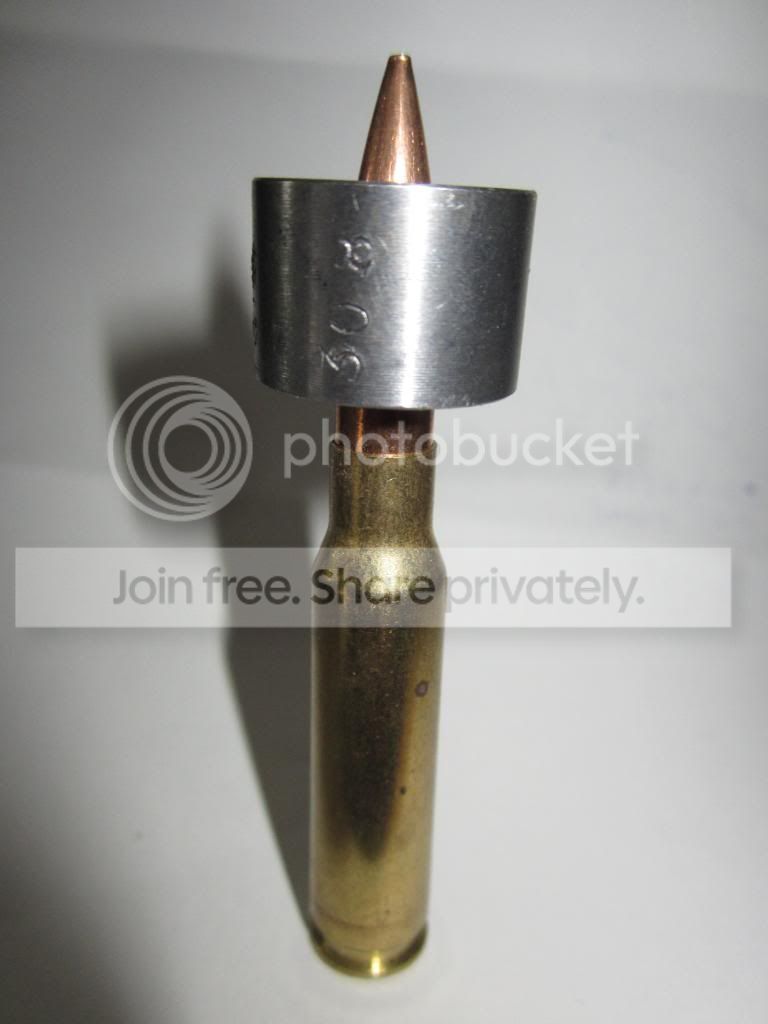
My log book ( a page for each different rifle) shows a “Hat” length. “Hat” refers to the hat I put on a loaded round that exactly touches the rifling. The hat is a piece of rifle barrel. It sits on the bullet ogive shoulder.

With the “Hat” length, I can take a new bullet and seat it long and then taking measurements, seat the bullet deeper and deeper until I reach the Hat length (measured from the top of the hat to the case base. That new bullet will now be seated to touch the rifling. If I want that bullet to be seated 30 thou off the rifling, I seat it 30 thou shorter than Hat length.

Gunsmiths routinely circumcise an inch off the muzzle of new barrels and will have lots of “Hats” available, probably free for the asking. I touch one end of the hat with a throating reamer, so it sits a little deeper.
 
That is a great idea, now to find 1/2" lengths of barrels in .223 to .458......

It's called "drill a hole in some round stock".

It doesn't have to be complicated.

If you want to make it more complicated, clean up the corner that will be nearest the case, and form a nice radius there.

If you want to be really spiffy, make the holes oversize, and form the shape of the bullet in some bedding compound or metal filled epoxy.

It just has to act as a reference point, same as the commercial gages do.


Cheers
Trev
 
Making my own tools is more satisfying, and there is no way a drill bit can make holes accurate enough to compare to actual rifling. Great ideas though.
 
The reamer used to cut the chamber can also be used to cut a throat into the hat. Exact same leade in rifle and gauge. Until the throat erodes, of course.
 
Wouldnt the "hat" have to be made from the left overs from the barrel your using ? Not some other barrel?
There are very tight tolerances on commercial barrels so the difference from one to another is well under a thousandth. A range of .2995" to .3005" for a .300" bore is probably too large but I'm just guessing. I do know that most .308" bullets I measure are .3083" to .3085" according to my (cheap) micrometer.
 
I use a barrel stub in each caliber. It has been touched with a throating reamer on one side. I don't know if this makes any difference, but the stub seem to level itself better. the object is to find the shoulder of any bullet you use. This is the part of the bullet that touches the rifling, so this is the location you want to be, say, 20 thou off the rifling.

The problem with using a COAL measurement is that the nose section of the bullet is irrelevant for chambering purposes and in the case of hollow point ammo, has a lot of variation.

As for tolerances, the nominal diameter of a 308 bullet is 0.3084", but each manufacture chooses his own diameter. I have seen them as small as 0.3065 and as fat as 0.309" I order my 308 barrels at 307" x .299"

Barrel dimensions must also take into account the groove and land widths, to accommodate the displaced material when engraved.

Barrel diameters have a similar range. I have seen new barrels as big as 0.310"

The "hat" is a quick way to take a new bullet and seat it deeper and deeper until it matches the Hat length that puts the bullet the distance you want from the rifling.

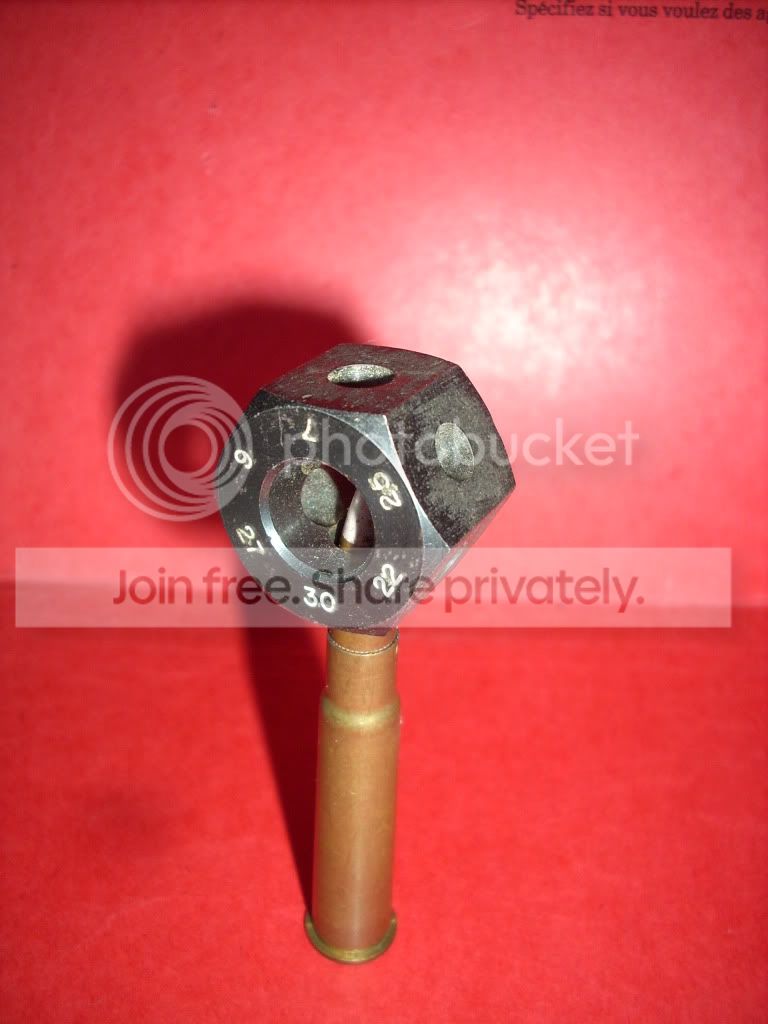
A commercial hat looks like this:

OALMULTIHAT.jpg
 
I use a barrel stub in each caliber. It has been touched with a throating reamer on one side. I don't know if this makes any difference, but the stub seem to level itself better. the object is to find the shoulder of any bullet you use. This is the part of the bullet that touches the rifling, so this is the location you want to be, say, 20 thou off the rifling.
The problem with using a COAL measurement is that the nose section of the bullet is irrelevant for chambering purposes and in the case of hollow point ammo, has a lot of variation. As for tolerances, the nominal diameter of a 308 bullet is 0.3084", but each manufacture chooses his own diameter. I have seen them as small as 0.3065 and as fat as 0.309" I order my 308 barrels at 307" x .299" Barrel dimensions must also take into account the groove and land widths, to accommodate the displaced material when engraved. Barrel diameters have a similar range. I have seen new barrels as big as 0.310"
The "hat" is a quick way to take a new bullet and seat it deeper and deeper until it matches the Hat length that puts the bullet the distance you want from the rifling.
A commercial hat looks like this:]

Is your commercial hat the same thing as Sinclairs Hex style bullet comparator? If not where do you get your commercial hats?
 
I have a hacked up 303 barrel (1916 BSA) I don't mind slicing up with the chop saw if anyone is interested. I cannot guarantee it will be cut perfectly straight you will have to file it to your liking. If interested PM me your mailing address.
 
there is no way a drill bit can make holes accurate enough to compare to actual rifling.

Who cares? You are not using the rifling to measure anything. It does not have to fit accurately until the bullet is fired. But if round is what you want, a reamer is cheap, esp if you make your own.
And the use of any particular barrel segment to measure against to set throat depth, is only valid if you are using the stub of your own barrel.

The point is to have a repeatable 'same' point of reference, so that you can get the same bullets seated to the same depth, without having to rely upon the tip of the bullet as a reference point.
I would put it to you that touching the drilled hole with a throating reamer, if you have one, will suffice. Provided that the barrel stub, or the drilled piece of stock, have the holes respectively, accurately square to the face that is being measured off of, you end up with a repeatable reference point to measure against. And only of use, if you use the same tool each time, unless you make multiples of them to interchangeable standards.

You are attributing value to something that has none (the accuracy of size of the rifling) when in fact for the tool to work correctly, it only needs to be able to be repeatable, which it can do if the hole is out of round. Getting the flat end that is used to measure off of, to be perpendicular to the axis of the bullet, seems to be the important bit, if one wishes repeatable results.

FLHTCUI, the hole of a badly started twist drill typically has one more lobe than the number of flutes. But not always.
Figure eights?Someone is doing things very poorly indeed.

Cheers
Trev
 
Great idea, thanks. As far as finding the rifling depth in a particular chamber, what's everyone's preferred method? Using a fired case with a semi-loosely seated bullet to push the bullet in, or carboning the bullet w/ a match and seating it out further and further until you see contact? I've never had success with the 2nd, but the 1st method doesn't seem like it would be the most accurate.
 
"... or carboning the bullet w/ a match and seating it out further and further until you see contact?"

Sort of. I start very long, and load successive rounds shorter and shorter until I don't see contact. I use a felt marker to blacken the bullet ogive shoulder. Once I have the seater where I want it, I re-seat all the long ones.
 
I seat the bullet excessively long in a fired and neck sized case. I close the bolt on this dummy round and the caming down of the bolt finishes the seating. Extract and measure the round with you "hat" of choice. I then use a kinetic puller and tap the bullet out a bit and repeat the above steps several times to ensure consistent readings.
 
^That is the same as what I do, I've just got varying results, almost like the bullet was being pulled back out a bit by the rifling or something. Maybe more neck tension, as I haven't really been necking it very tightly for this.
 
Back
Top Bottom