A few practical beginner questions - Lee Enfield

Martin248

CGN frequent flyer
Rating - 100%
34   0   0
Location
USA
I have a 1944 Long Branch Lee Enfield, No. 4 Mark I*, that looks to me to be in good condition, few dings in the stock, rifling looks OK. It's the only milsurp rifle I have, and probably the only one I would have, but I feel it's a part of Toronto history and I was looking for a rifle that would make a good wall hanger. So that's it. But I'm otherwise a complete beginner wrt Lee Enfield rifles, and milsurp in general. So I have a few practical questions, and please go easy on me:

1 - Where can I buy cheap .303 british? It's a buck a around. I know, "reload", but until then, is it possible to do better than a buck a round? I can only find what amount to high quality hunting rounds whereas I will be target shooting

2 - A checklist of stuff I should do to make sure the rifle is and stays in good condition? Basic care that might be different than the usual cleaning for a modern rifle? In particular, should I be soaking the stock in linseed oil? What else?

3 - Having taken it to the range just once, I can say that it shoots pretty far off the mark. Presumably in part I need to zero the rifle, at least for windage. Do I need to go buy one of those lee-enfield front site drift tools? Or is there some other way? And are there other things I should do to improve accuracy before I start trying to sight in? I am not interested in doing a massive amount of work to accurize, but I will do some basic things if there's stuff I should be doing.

In other words, just looking for some basic pointers on how to get started, what's the most important thing I should be doing, etc., being completely new to this platform and to caring for ancient wood lol.
 
Cheap 303 ammo is a thing of the past. Patrol gun shows for it but even then $0.50/round would be considered a steal.

I wouldnt worry about any special care for it. Treat it like any other rifle, it will be fine.
 
Last edited:
I don't think you need a tool to drift the front sight on a no4? I think once you get the protector off its just dove tailed in there.?
 
A punch is sufficient, to drift the sight to the left or right, and adjust windage. I went and bought a sight tool from ebay (Just search Enfield Sight Tool), for about $20. The advantage is I can make much more delicate adjustments than I can with a hammer, but that's just me.
 
Your front sight base may have a lock screw, take a look at the front of the base. If you have the lock screw you'll need either to buy or make the tool to loosen and tighten this screw. Aside from that, a punch and hammer is sufficient (although the drift tool is, as mentioned, useful if you plan on shooting a lot).

Commercial .303 ammo, a buck a round's about as good as you'll get.

Pure linseed oil, once a year, on the stock is a good idea. Very, very light coat.

Careful, Lee Enfields (and milsurps in general) can be addictive... :)
 
Be carefull on drifting the front sight over. Check to see if there is a front sight locking screw in the front end of the sight block. If so, you need a tool to loosen it. Easy to make. A buck a round is considered pretty cheap for a 303. It is readily available. "privi partizan" is the cheapest stuff out there and very good quality for the price. About $21 per box. Even if you don't reload now, save your brass. You will make freinds if you give it away at the range.
 
Front sight on the Number 4 is in a dovetail, slides sideways for 'drift' adjustment ('windage' is something else that you really do NOT want) BUT.... the Base for the actual SIGHT is SPLIT and CLAMPS the Sight element into place.

This SPLIT is controlled by a special SCREW which has what you can only call a REVERSE FILLISTER HEAD. In other words, the thing has what should be a SLOT, except that it is standing up rather than sunk INTO the Screw.

Pick out a Screwdriver with about a 3/16" shank and a buggered head. Clamp it in a Vise and saw off the Head, whatever it is. Now clamp it into the Vise again, VERTICALLY this time, and use your Saw to make a SLIT across the shank. You don't want it deep; just about an eighth of an inch will do nicely. If you are Metric, that is about 3mm.

You now have the SPECIAL TOOL for slacking off that Screw and making Front Sight Adjustment much, much quicker and easier.

Good luck!
 
Front sight on the Number 4 is in a dovetail, slides sideways for 'drift' adjustment ('windage' is something else that you really do NOT want)

Are you refering to "windage" as in the difference between the diameter of a projectile & the bore?
This is a muzzle loading/smoothbore term isn't it??
This is a legit question Smellie, not a dig at you, (i might be on the wrong page) as i had this conversation a few weeks back.
 
You are quite right.

The terms "windage" and "drift" became confused over years.

"Windage" has nothing to do with WIND; it is gas blow-by around the projectile as it passes down the bore.

"Drift" has 2 separate causes, one being crosswind (likely the source of the confusion) and the other from Coriolis force generated by air pressure on the Meplat of the Bullet.

Did a write-up on this forum a few days ago myself.

Get a grossly oversize bore..... or an old Metford barrel which has been well and truly shot-out, and you could be looking at a genuine "windage" problem in a breechloader. NOT generally found with the Number 4 unless you are loading .308 slugs into the poor thing.

I have a Johnson barrel here which you can drop a .312 slug into.... and it accelerates all the way through. Just imagine the 'windage' problems with THAT!

SHOULD have mentioned, 5thBATT, in North America the term "windage" has become almost universal when referring to sideways movement of a projectile from the line of sight. The proper term, "drift", is almost unknown. As to the proper use of "windage", that also has been almost forgotten. The situation is confusing; I am trying to get the trainwreck back onto the tracks, so to speak.
 
Federal .303 in the blue box shoots pretty much on the money for me (2$ a shot for me but hey, quality ain't cheap), and a simple screwdriver(or punch) with a mallet can allow sight adjustment.
 
Perhaps download a complete set of manuals for the Lee Enfield, which includes operating and armourer's maintenance instructions.

The manuals may be found in the Technical Articles for Milsurp Collectors and Re-loaders (click here)http://www.milsurps.com/content.php...esearch-for-milsurp-collectors-and-re-loaders


2002 No.4 (All Marks) .303 Rifle Manuals (click here)http://www.milsurps.com/showthread.php?t=3314

Complete Set includes:

- 2002 No.4 (All Marks) .303 Rifle Data Summary
- 2002 No.4 (All Marks) .303 Rifle Parts Identification List
- 2002 No.4 (All Marks) .303 Rifle Operating Instructions
- 2002 No.4 (All Marks) .303 Rifle Equipment Description
- 2002 No.4 (All Marks) .303 Rifle Maintenance Instructions


1991 No.4 (All Marks) .303 Rifle Manuals (click here)http://www.milsurps.com/showthread.php?t=3322

Complete Set includes:

- 1991 No.4 (All Marks) .303 Rifle Operating Instructions
- 1991 No.4 (All Marks) .303 Rifle Maintenance Instructions

Note: The difference between the 1991 set of No.4 Manuals and 2002 No.4 (All Marks) .303 Rifle Manuals, is that the 1991 manual contains armourer's information on how to properly "bed" the No.4 rifle, whereas the newer 2002 manual does not.

Hope this helps... :)

Regards,
Doug
 
We say 'nailing fog to a door'

tac

Can't add to much to what has been said, except to comment on the maintenance of "ancient wood" as requested. There is a fair amount of opinion and experience about that on this forum. The Army used raw linseed oil for this, applied and rubbed in with the excess wiped off. Pure tung oil works as well. As the big white rooster said to the curious little chicken, " Boy, I said that was tung oil from the nuts of the tung tree, not tongue oil boy. Now pay attention here boy so you'll know the difference".:confused:

The other type of windage that you need to know about on the MILSURPS forum is a lot of plain old hot air.:p
 
Perhaps this will help as well .. ;)

Note: Graham actually meant to say cramps .. :D

Jay Currah's Markmanship Pagehttp://www.milsurps.com/enfield.php?pg=mi.htm

Calculating Correct Front Sight Height for Zerohttp://www.milsurps.com/enfield.php?pg=ti12.htm

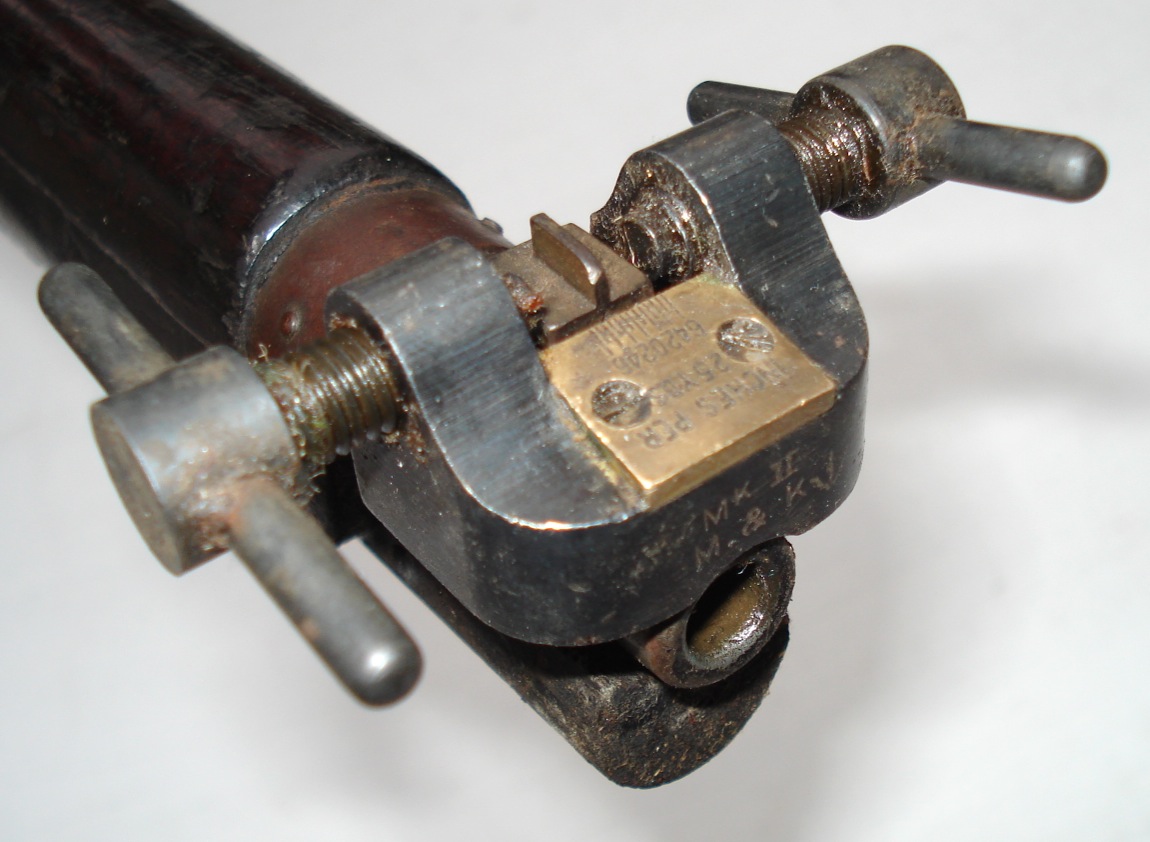
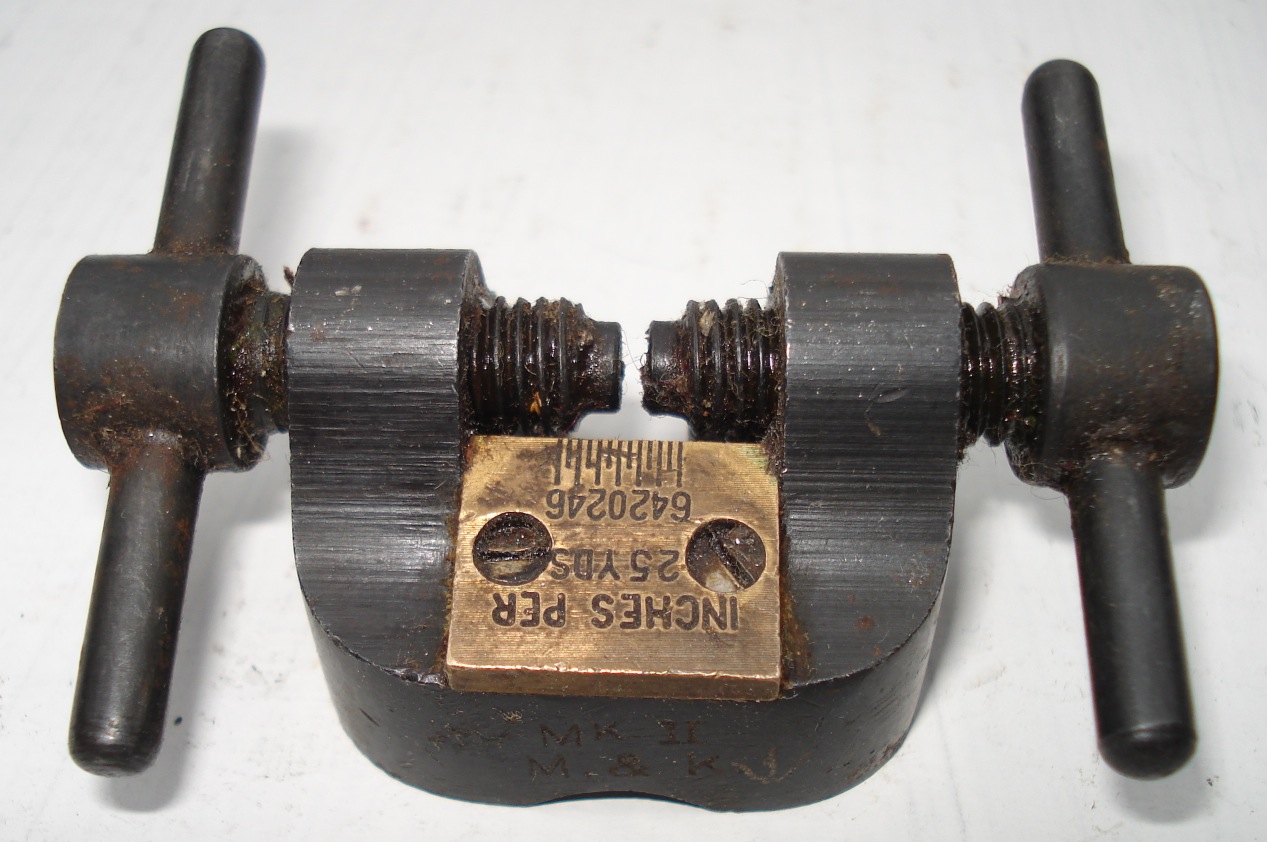
Also, with thanks to member Graeme "broadarrow303" Barber, an excellent educational research article titled “Fore Sight Adjusting Cramps” (also called Clamps), has been added to the Technical Articles for Milsurp Collectors and Re-loaders (click here)http://www.milsurps.com/content.php...esearch-for-milsurp-collectors-and-re-loaders. Essentially, these devices were designed and manufactured to facilitate the adjustment or exchange of a foresight blade as part of the “zeroing” process.

Fore Sight Adjusting Cramps (by Graeme "broadarrow303" Barber) (click here)http://www.milsurps.com/content.php...sting-Cramps-(by-Graeme-broadarrow303-Barber)

Article Extract .....

If you have collected a military firearm perhaps you too will have experienced the euphoria created by admiring it, reading about it and showing it off to others who are willing to share the passion. This is very often followed (invariably soon after acquisition) by the desire to purchase accessories, tools and any other item that was used with or for its continuance in service. Most extra items are readily available and reasonably priced and can keep the interest alive before another firearm for the collection is sourced. Most collectors acquire extras such as bayonets, slings, ammo pouches, manuals, cleaning gear, armourers tools or any other accessory they manage to lay their hands on.

While many of the extra items were issued with the firearm as part of a soldiers fighting kit there were some that were used by armourers and intended for more specialised functions. Foresight adjusting cramps are one example of such items but little seems to have been written about them. (article continues) .....


Tool No 1 Mark II fitted to a SMLE rifle (Authors collection)
(Click PIC to Enlarge)

Regards,
Doug
 
1) There's no such thing as cheap ammo for anything any more. Milsurp .303 Brit ammo is long gone and hunting ammo has never been exactly cheap.
Reloading is one way to fix it. However, you need to slug the barrel first by hammering a .308" cast bullet or suitably sized lead fishing sinker through the barrel with a 1/4" brass rod and a plastic mallet then measuring it. (You need to do it anyway. Lee-Enfield barrels can vary between .311" and .315" and still be ok. Over .315" the barrel is shot out.) Then chose a bullet or ammo that's as close to the measurement as possible. Factory ammo and bullets for reloading are .311" or .312" bullets.
A Lee Classic Loader(operated with a plastic mallet and neck sizes only) will produce decent ammo, but you need a scale. Do not use the silly scoops. They're calibrated in CC's and can vary the charge plus/minus a full grain.
2) Other than checking the headspace on any Lee-Enfield(Thousands have been assembled out of parts bins with zero QC. Not even checking the headspace to ensure the rifle is safe to shoot), there really isn't anything special you need to do except normal cleaning.
3) Windage(left/right sight adjustment. Such terms nearly all come from BP days. Musketry, for example.) is adjusted on a No. 4 by moving the front sight. Front sights get moved in the opposite direction you want the group to go. Easiest done with the sight tool, but a brass punch and a plastic mallet will do. After loosening the sight screw.
 
From whence came the term "Kentucky Windage" which unless I mis-remember refers to deliberately holding off your sight toward the direction whence cometh the wind. Not that I wish to impugn the accumen of the resident expert on matters of musketry. I do believe there is a large acceptance out there in musket-land of the idea that lateral sight adjustment is called windage as opposed to vertical sight adjustment being elevation. Of course, a lot of people call box magazines clips too.
 
From whence came the term "Kentucky Windage" which unless I mis-remember refers to deliberately holding off your sight toward the direction whence cometh the wind. Not that I wish to impugn the accumen of the resident expert on matters of musketry. I do believe there is a large acceptance out there in musket-land of the idea that lateral sight adjustment is called windage as opposed to vertical sight adjustment being elevation. Of course, a lot of people call box magazines clips too.

Exactly. Windage adjustment is commonely refered to as the horizontal adjustment, for any reason.
 
Back
Top Bottom