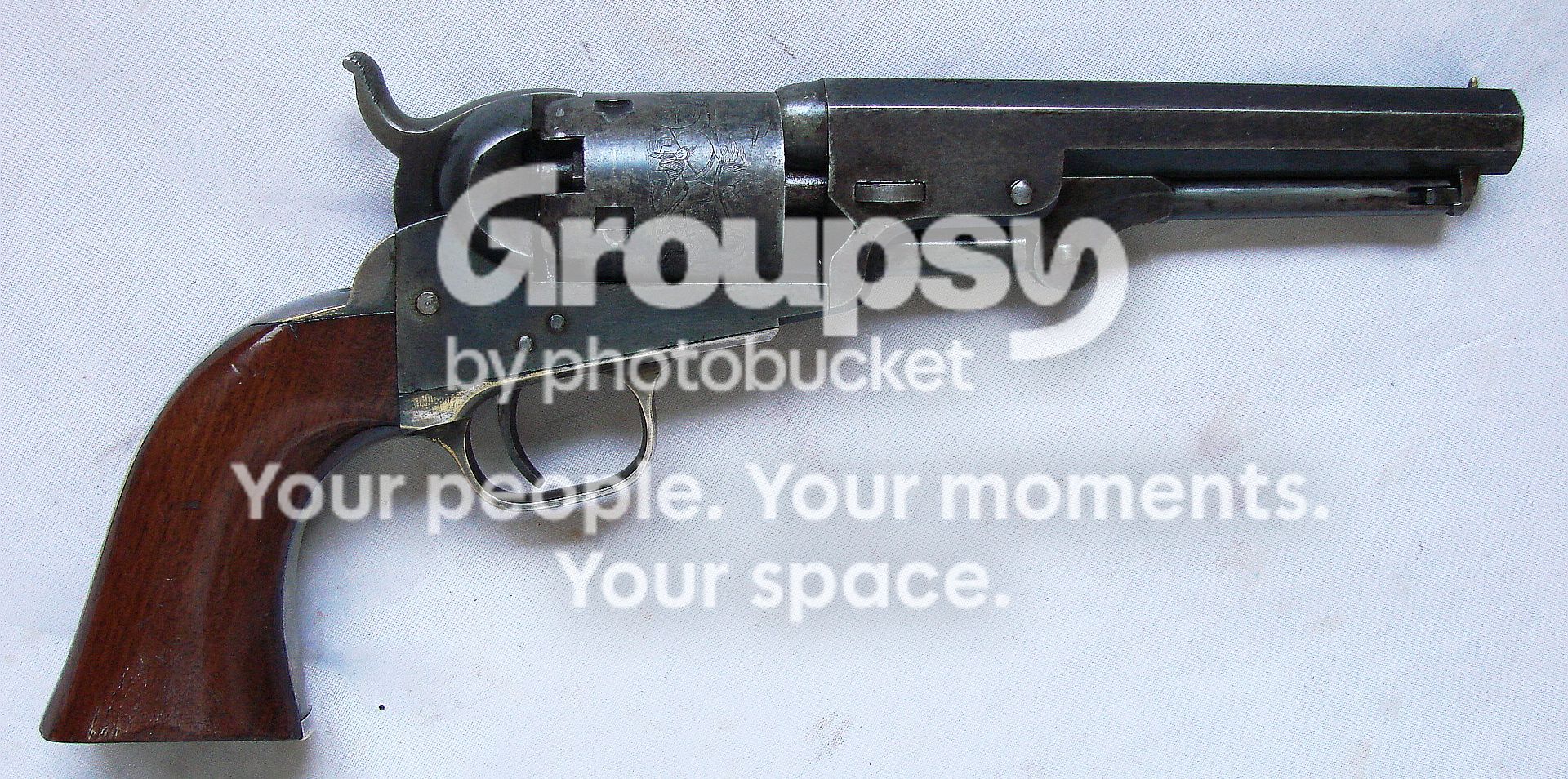
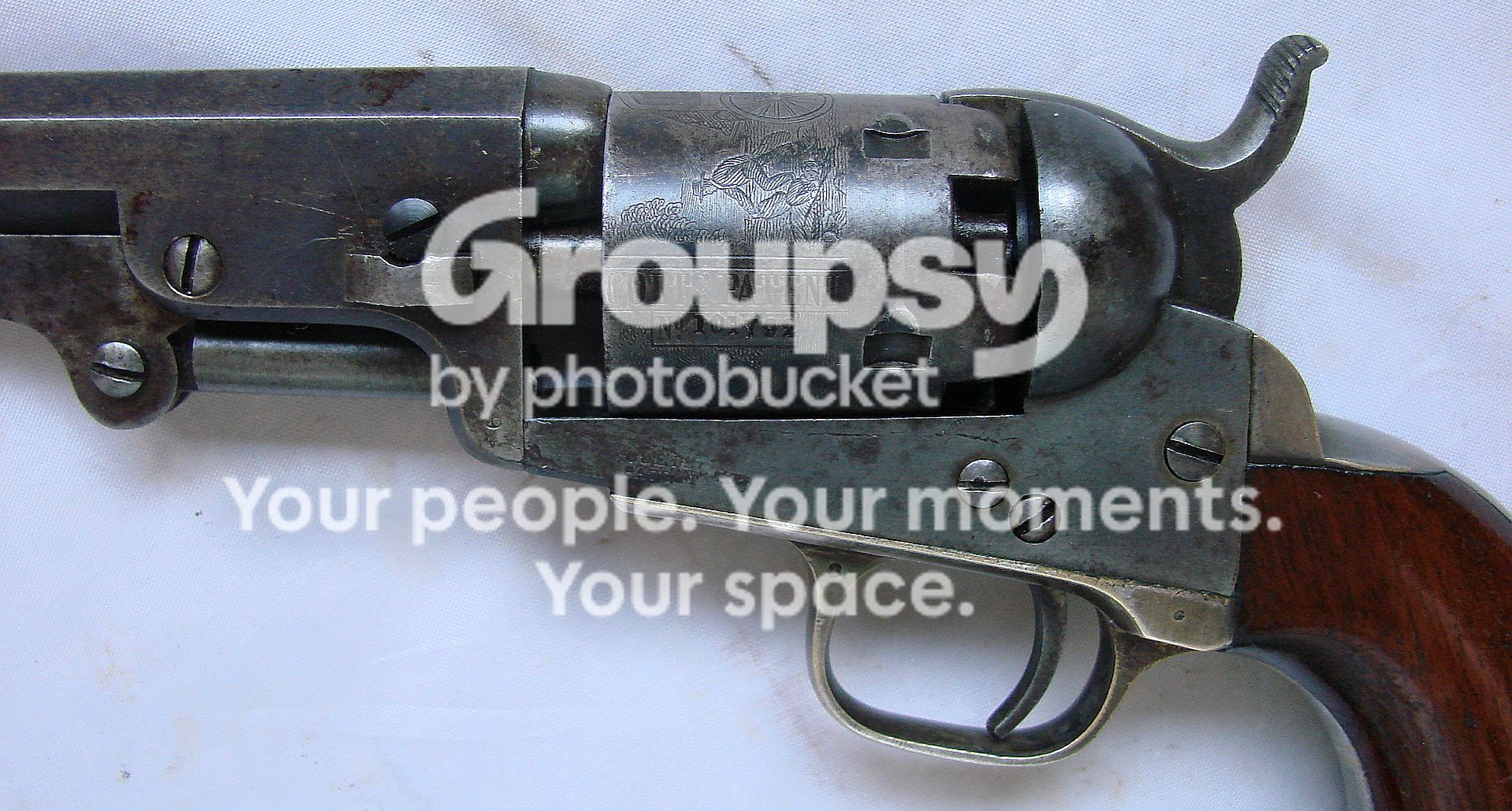
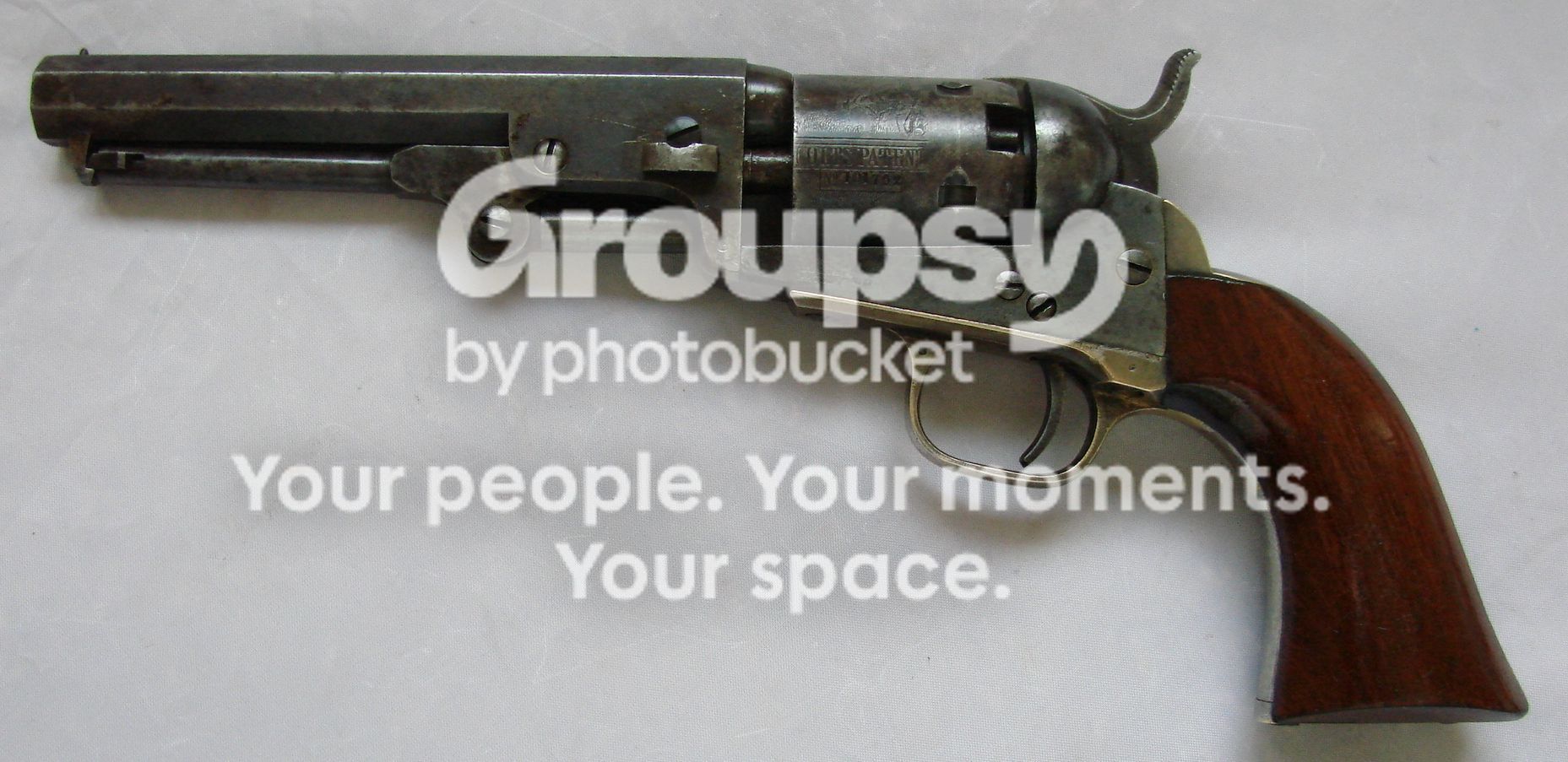
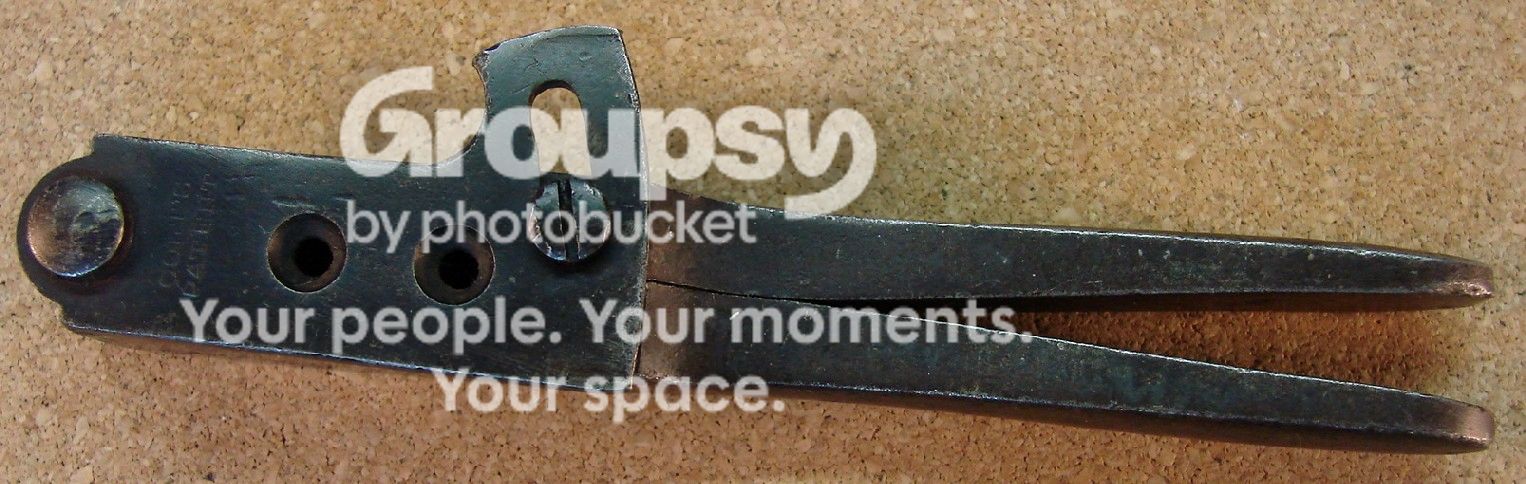
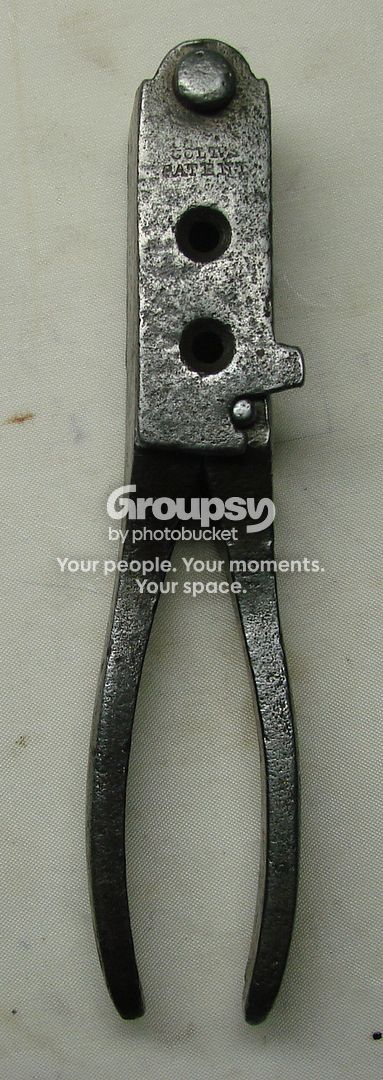
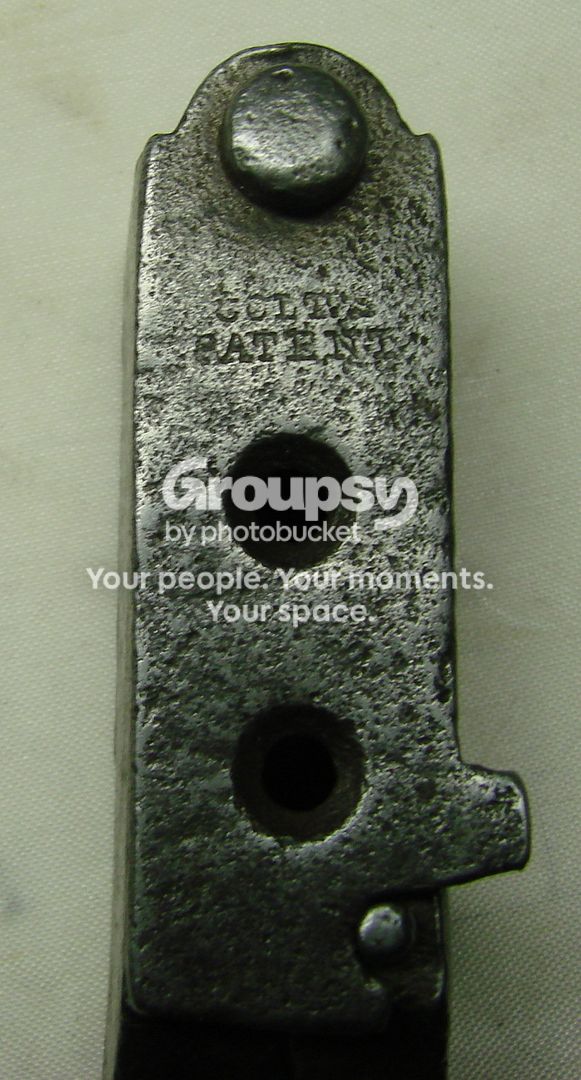
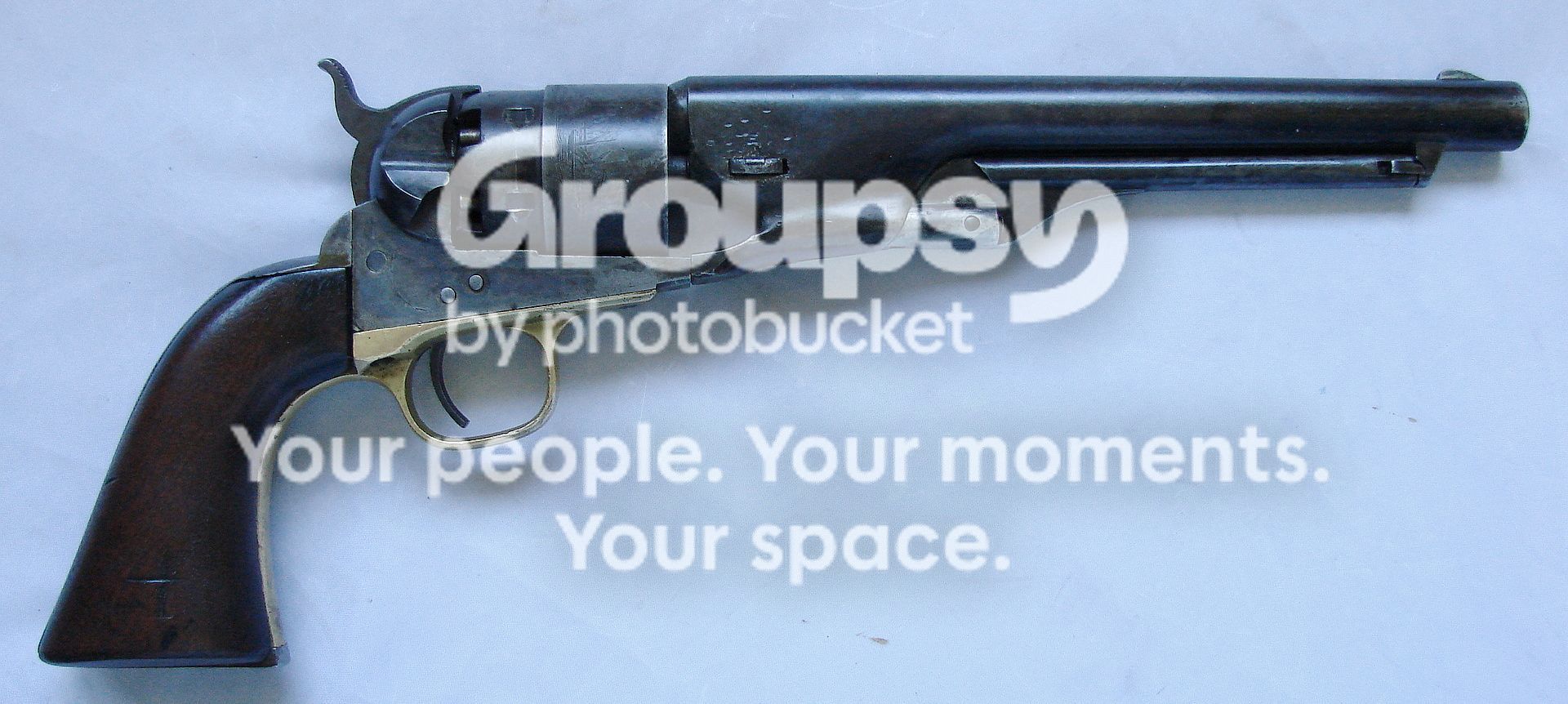
A rather nice Colt Model 1849 Pocket Revolver—with .31 cal. Colt bullet mould.

drm3m

CGN frequent flyer
Rating - 100%
13   0   0
Location
Montreal Quebec
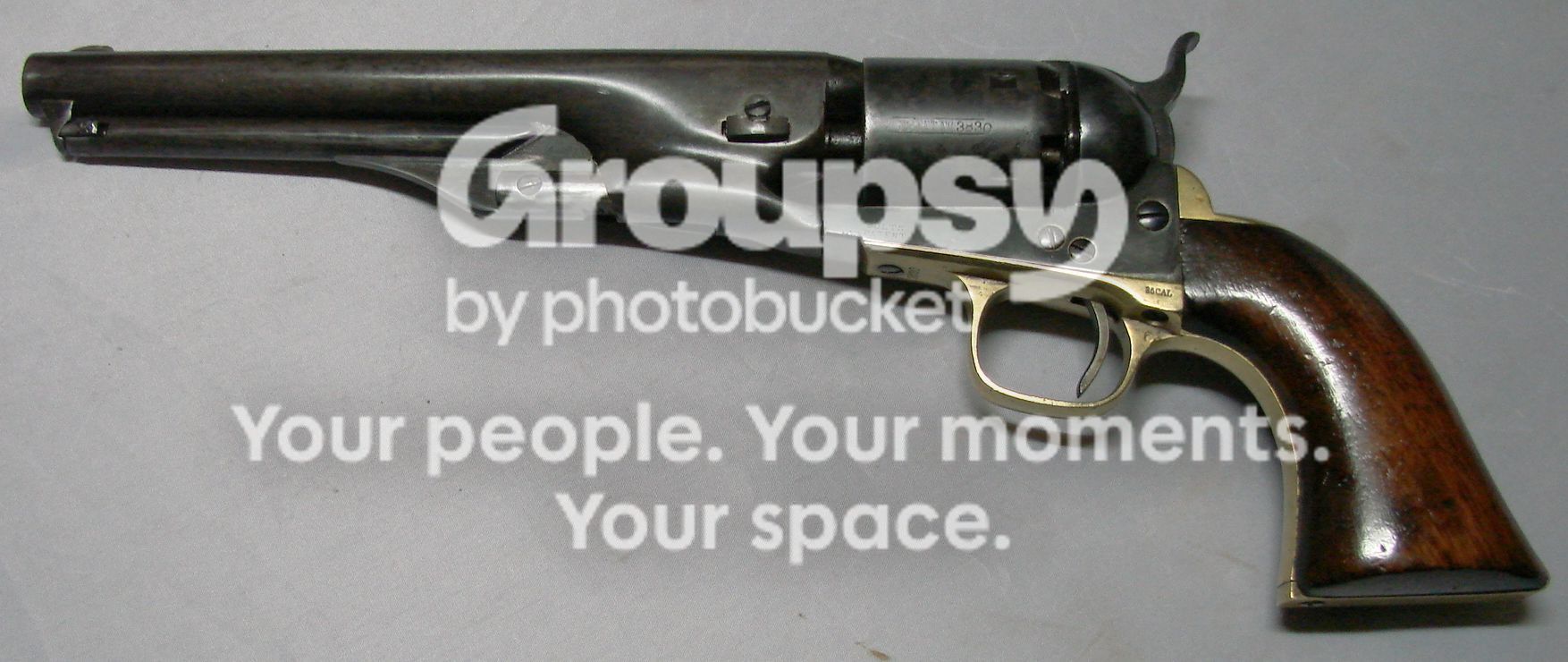
A rather nice Colt Model 1849 Pocket Revolver—with .31 cal. Colt bullet mould.

Manufactured in 1855, S/N 101792.
Superb cylinder scene, with lots of silver plating on the grip strap and trigger guard.

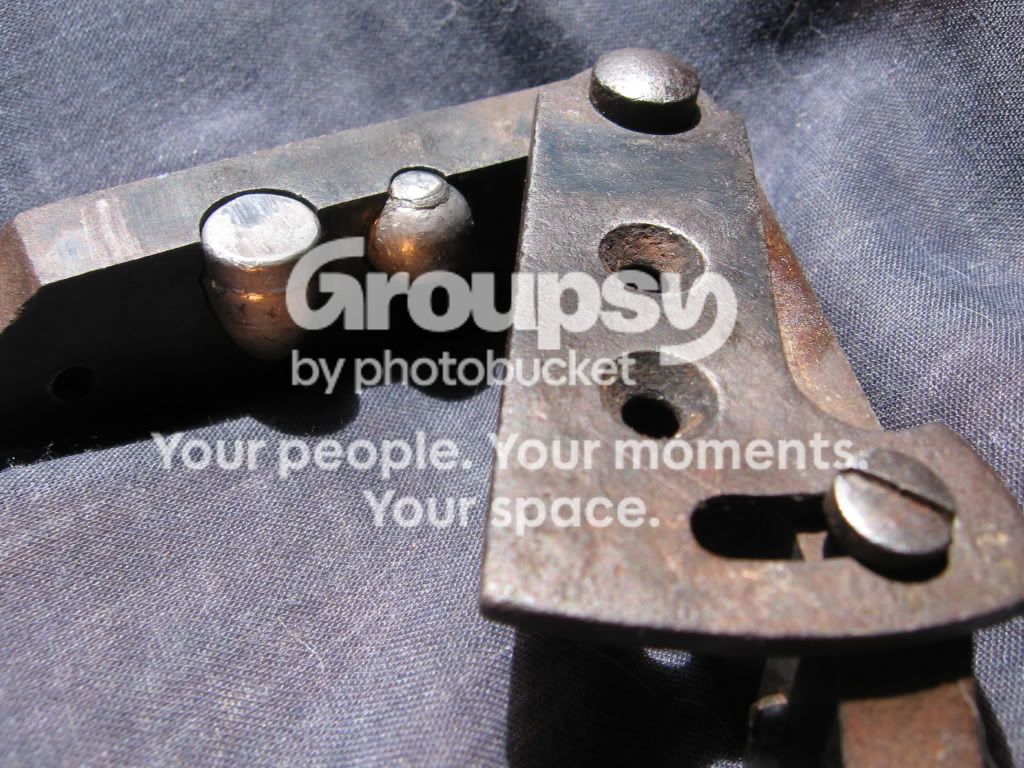
The Colt marked .31 cal. bullet mould still has plenty of finish and is well marked.

A decent example of this widely produced revolver.

David

DSC00110.jpg

DSC00109.jpg

1849ColtPocketBarrelAddressandcylinderscene008.jpg

1849ColtPocketoutsidesession010.jpg

1849ColtPocketoutsidesession017.jpg

49Colt252kbsDSC08340.jpg


224kbsfullfrontviewDSC00934.jpg

240kbsColtsPatentMarkingDSC00936.jpg

280kbs31PKtandCTMmarkingsDSC00959.jpg

176kbsbulletmoldopenpartialviewDSC00962.jpg


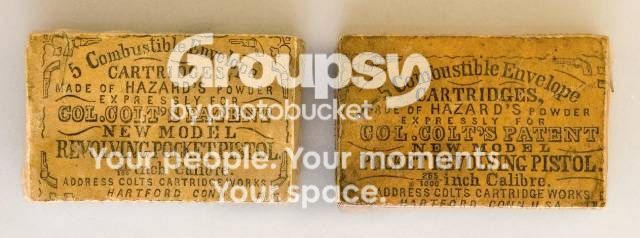
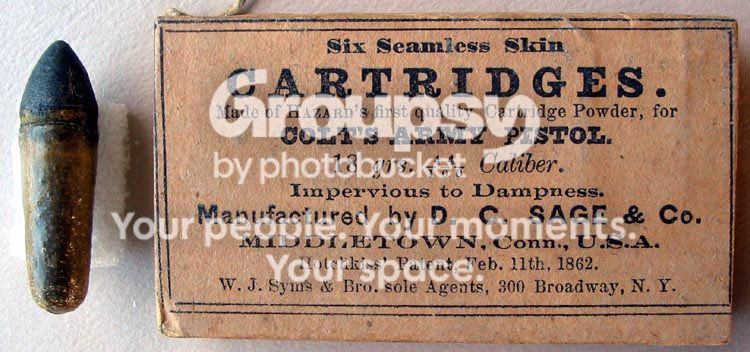
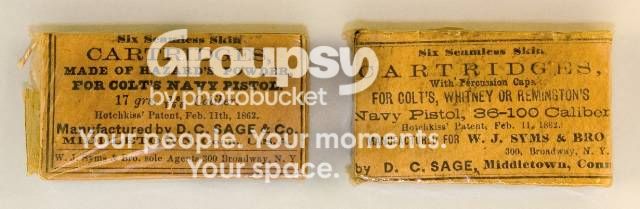
Unfortunately these cartridge packets do not belong to me.

NOTMINE23210_01.jpg
 
Last edited:
That is a very fine example of the Pocket Colt, I notice that the mould has two different size cavity's is one in .31 cal and the other .36 cal.???
 
It looks like someone reamed out the larger cavity at some point. The shape of the bullet is wrong. Also, there's some damage inside, could be from the drill catching in the edges of the mould halves.
 
mwjones and Skinny 1950.

I have not looked at this Colt mould for years.
I suspect that one cavity is for .31 cal and one for .36.

DSC01031.jpg


Unfortunately this packet of .36 cal cartridges does not belong to me.

tw1-1.jpg


This .44 cal. Colt mould is not in the same shape...but it was dual purpose.

DSC02510.jpg

DSC02509.jpg

DSC02511.jpg


This 1863 manufactured Colt Army really deserves a bullet mould in better condition.

GettysburgpurchaseJune2001.jpg


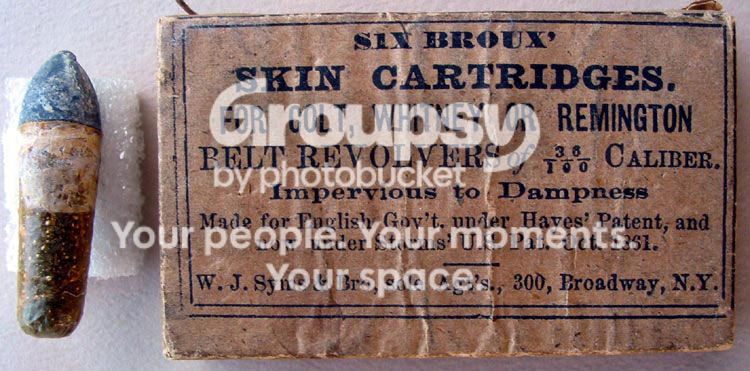
Unfortunately this packet of .44 cal cartridges does not belong to me.

tw1-3.jpg


David
 
Last edited:
For they that are interested.

C.W. skin (treated paper) cartridges.

The J&D patent (#33,393 - October 1, 1861) was issued for "an improvement in envelopes for cartridges" and the cartridges made under this patent were officially called "Johnson and Dow's Combustible and Water Proof Cartridges".

The patent calls for a cartridge case of gun-cotton, paper, cloth or other fabric or texture treated with any nitrate and an oxygenating salt to make it "highly inflammable and instantly combustible"...

The finished cartridge was dipped in collodion (also highly inflammable) to make it waterproof.

In addition to the durability of these cartridges, tests and actual field use indicated that the cartridges were easier to load, since no tearing was required and the whole cartridge was simply placed in the bore. One regimental commander later wrote that the regiment adjacent to his on the firing line had been equipped with J&D cartridges and were able to fire three shots for every two of his own regiment.

The first J&D cartridges for .58 cal rifle musket were ordered by the Federal government on March 24, 1862. Cartridges using the J&D patent were also produced by Elam O. Potter in both rifle musket and revolver calibers.

Julius Hotchkiss patented the skin cartridge, which D.C. Sage (and a few others) manufactured; again waterproof by the nature of the skin. Again the power of the percussion cap penetrates the skin and ignites the powder. Some of the .44 cal. Army packets were labelled “Waterproof Skin Cartridges.”

The patented cartridge by Doctors Doremus and Budd had a powder envelope formed by pressing the powder into molds under high tonnage, attaching them to bullets, and then dipping them into collodion, which waterproofed them, is extremely flammable and easily ignited with a percussion cap.

The combustible cartridges allowed quickness in loading, firing and being waterproof, became useful in the field. You didn’t need good teeth to tear them open and unnecessary handling.

An example;
tw1-3.jpg


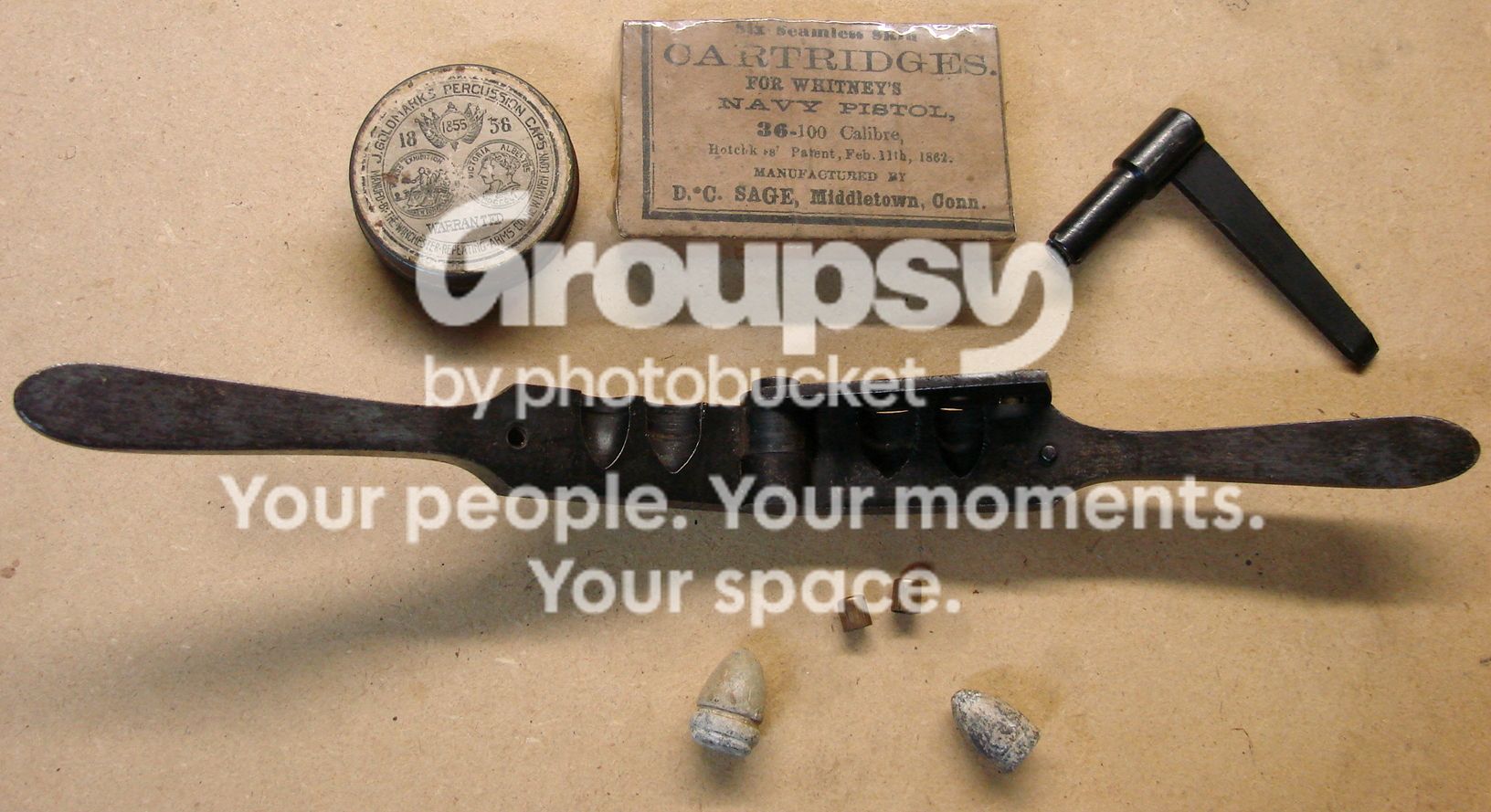
These packets of cartridges are very expensive in the U.S ($1,000 plus).....I only own the packet of .36 cal for Whitney's shown below....I bought it many years ago in Canada for $15 if I remember correctly.

CivilWarcartridgespercussioncapswithtinsandbullets.jpg


Probably a good investment back then as it goes with a '51 Navy (a martially marked gun manufactured 1857) and '62 Police (1863 manufactured.)
(Both .36 cal.)
233kbs1851ColtNavyfullleftsideoutsidesecondsession007.jpg
Model1862ColtPolice-36calDSC08330.jpg


David
 
Last edited:
It is interesting that the paper cartridges for the .44 cal Army are only 18 grains of powder, I wonder if the material (collodion etc.) added to the charge and brought the power levels up to the recommended 25 grains black powder??
Here is a picture of a 1849 Pocket Colt mould that I got from Joe Salter in the States:

1849MoldPocketColt008.jpg

1849MoldPocketColt001.jpg
 
Check out the composition of collodion.

Generally it is nitrocellulose (MNC, DNC, TNC) dissolved in alcohol/ether to make a paint-like liquid. When it dried out, it was called celluloid and it was one of the very first plastics. It also burned excellently. CONTROLLING this rate of burn resulted in Smokeless Powders.

Yes, it would add some punch to the cartridge but I rather doubt that it would be fast ENOUGH to propel the slug.

MANY old-time Black Powder cartridges were not as toadally awesome as we would like to think. The few which have survived have survived mainly in their heaviest RIFLE loads, which we cram into revolvers. The people who designed, built and used these things understood the concepts of (a) not running a machine flat-out constantly because (b) the machine will last a lot longer if it is not strained almost to "fail" with every single round.

.44-18 might sound a bit wimpy. In fact, it is why I have always been leery of running .44-40 through a gun made from the same materials, in the same factory, only a few years later. But this was, in fact, the loading used by both sides in the Civil War. Certainly, it was effective: as many men were killed in the 3 days of Gettysburg, as in the entire 11 years of the Viet-Nam War. That's powerful enough.
.
.
 
drm3m, you have a beautiful collection of pistols. Thanks for sharing those photos. Someday, I hope to own a decent Colt 1851 or 1860. In the meantime, I sure enjoy looking at them.
 
Thanks Win 38-55.

I am glad that I got these pieces years ago.

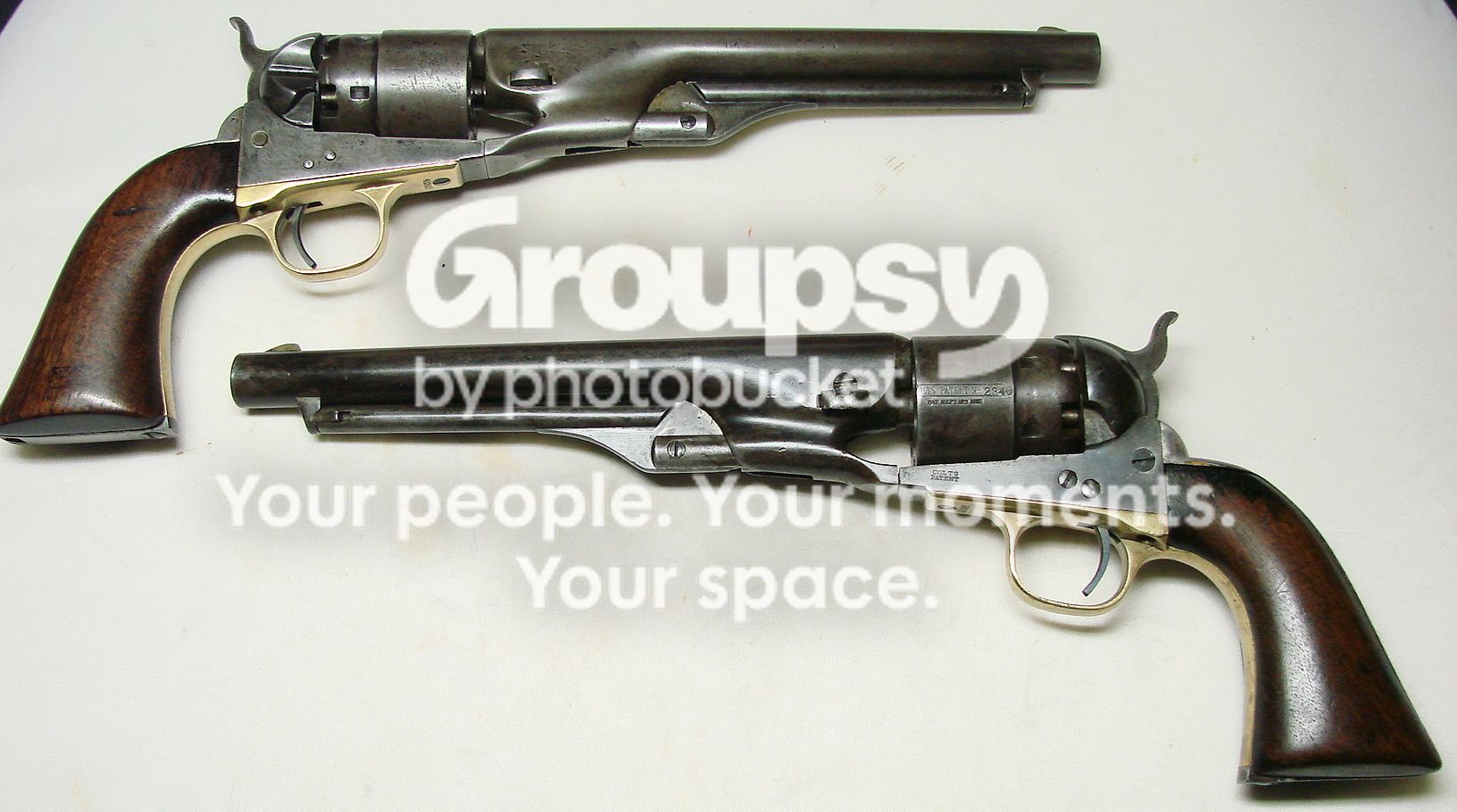
The three Colt revolvers shown below were manufactured in the first three years of the Civil War.
The '61 Navy in 1861.
The top Army in 1862---the bottom Army in 1863.

DSC08322.jpg

BothModel1860ColtArmyRevolvers.jpg


David
 
David;

I haven't said anything about these for a couple of reasons.

a. just hoping against hope that you will post ANOTHER!!!!!

b. really don't know what to say after being privileged to see such an exhibition, and

c. complete lack of green ink.

Thank you for the photos of these wonderful pieces.

g.
 
Thanks smellie and others for your comments.
I guess I fit into the category of a ‘collector’ rather than a ‘shooter’ of these old guns.

The balance of my BP collection is shown below.

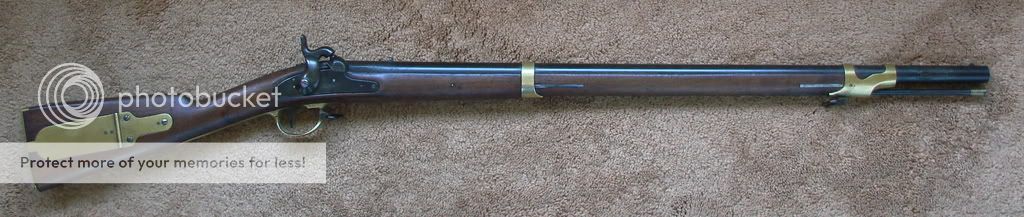
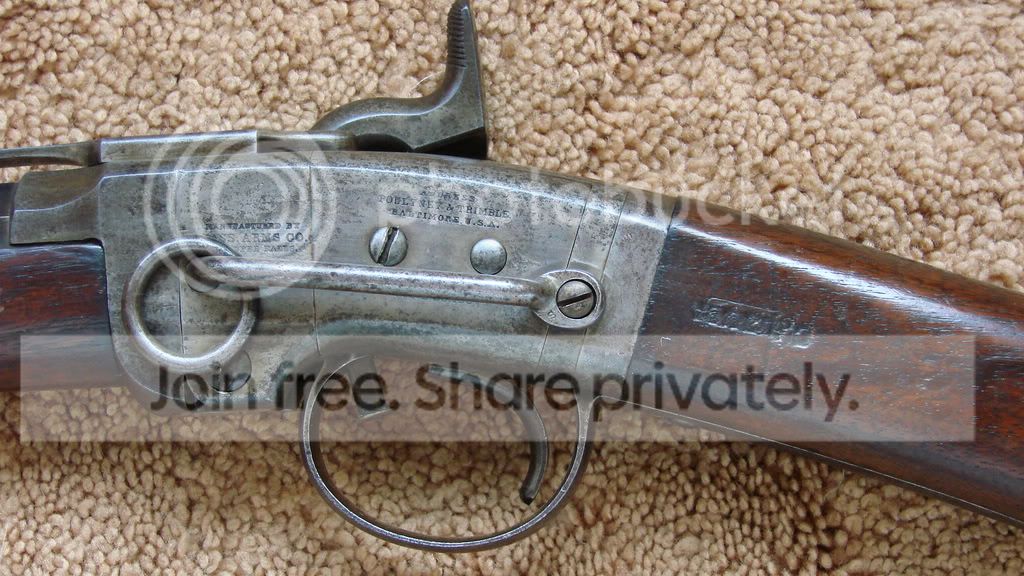
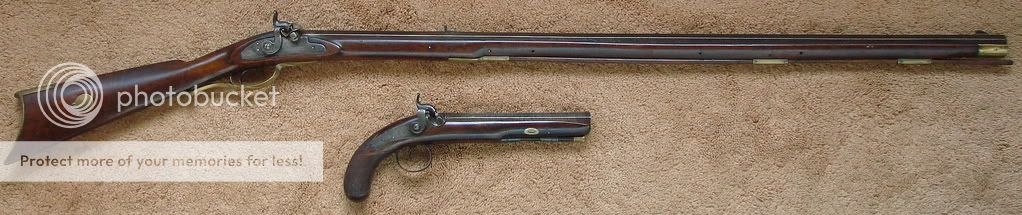
#1- U.S. Model 1841 (Mississippi rifle) - Whitney Contract-lock dated 1848-.54 cal.
DSC08740.jpg


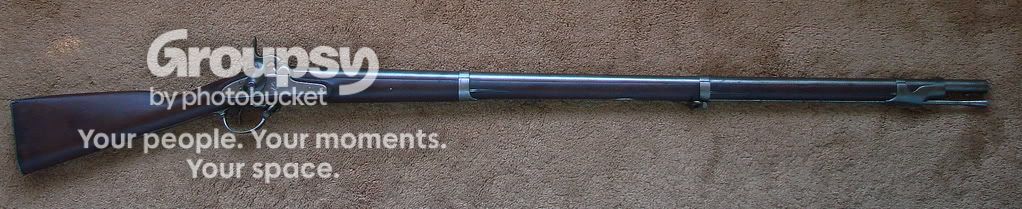
#2- Pattern 1853 Enfield Rifle Musket-lock dated 1861-.58 cal.
BestDSC08898.jpg

resizedCopyofEnfieldlockplate.jpg


The piece is not a Brit issue as it lacks the army proof house markings - even arms bought commercially for Brit service were normally reproofed at an army proof house.

24 bore on these Enfields indicates .58 cal instead of .577 cal.
ResizedCopyofEnfieldbarrelmarking.jpg

An interesting comment from an Enfield expert.
He advises that some Enfields made for the US, in 24 bore, in the early part of the war, were actually bought by the Rebels, and that might explain the bore size.

Where did this possible CS control marking come from?
ResizedCopyofEnfieldbuttplatemarkin.jpg


Brit regulations specified that all arms were to have a number not to exceed four digits engraved "and in no instance stamped or punched" on the butt plate, the ramrod, the bayonet socket, the bayonet scabbard stud, and the waist belt.

Bottom line ...this is not a Confederate Enfield.

#3-U.S Model 1861 Rifle Musket- Muir Contract-lock dated 1863-.58 cal.
DSC08918.jpg

DSC08920.jpg


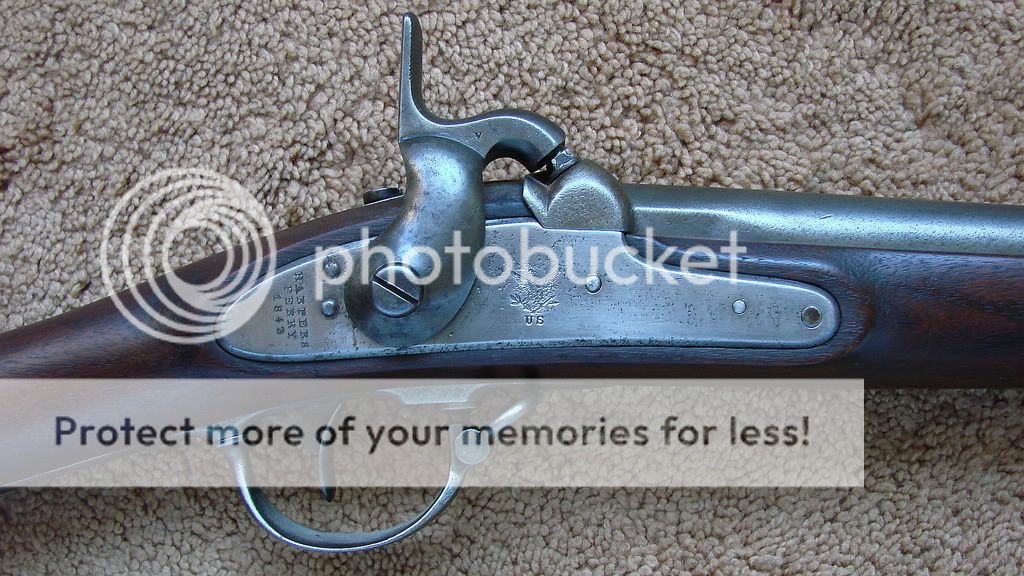
#4-U.S. Model 1842 Musket-Harpers Ferry-lock dated 1843-.69 cal smooth bore.
DSC08903.jpg

DSC08905.jpg


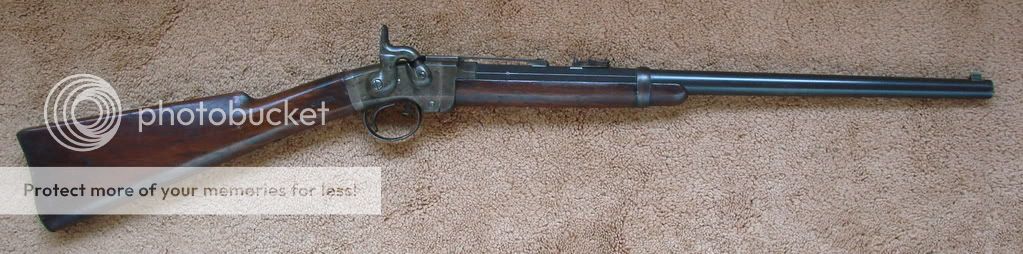
#5-Smith carbine-.50 cal.
DSC08759.jpg

DSC08764.jpg


#6-U.S. Model 1884 Springfield Trapdoor Rifle-1893 SWP acceptance cartouche.
DSC09000.jpg

DSC09022.jpg


#7 & 8 These BP guns we used to shoot back in the 60's.
DSC08943.jpg


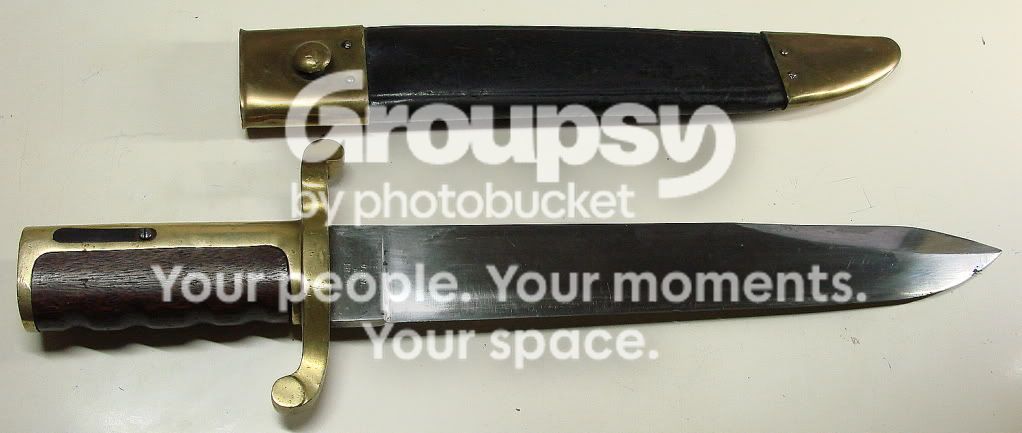
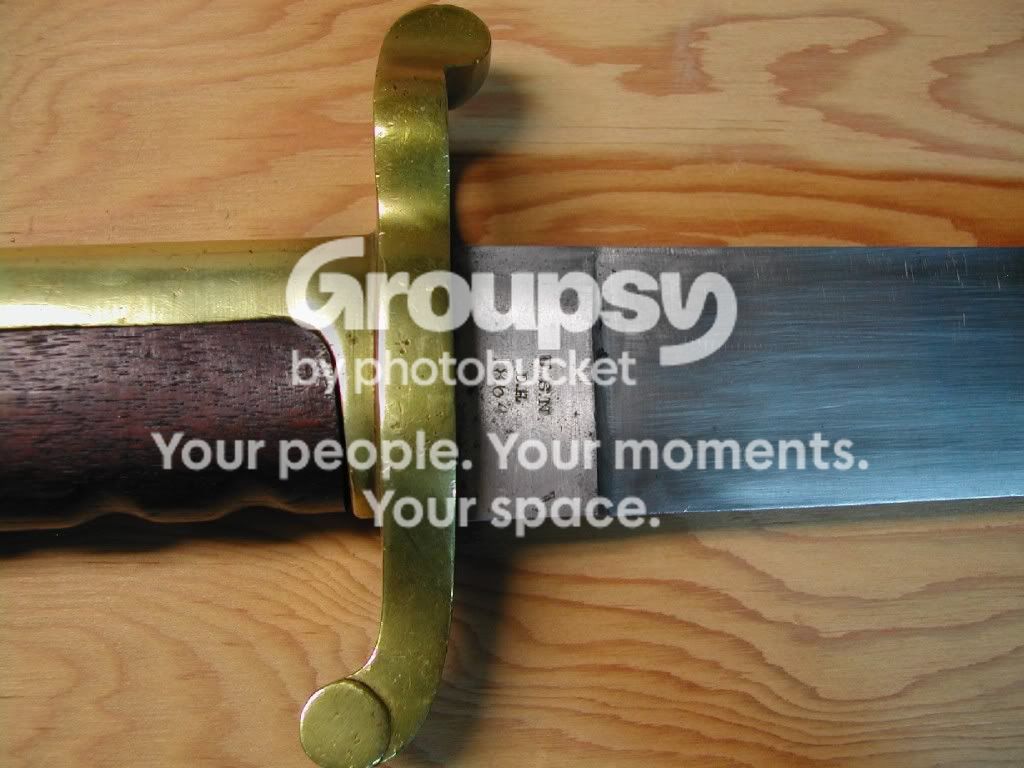
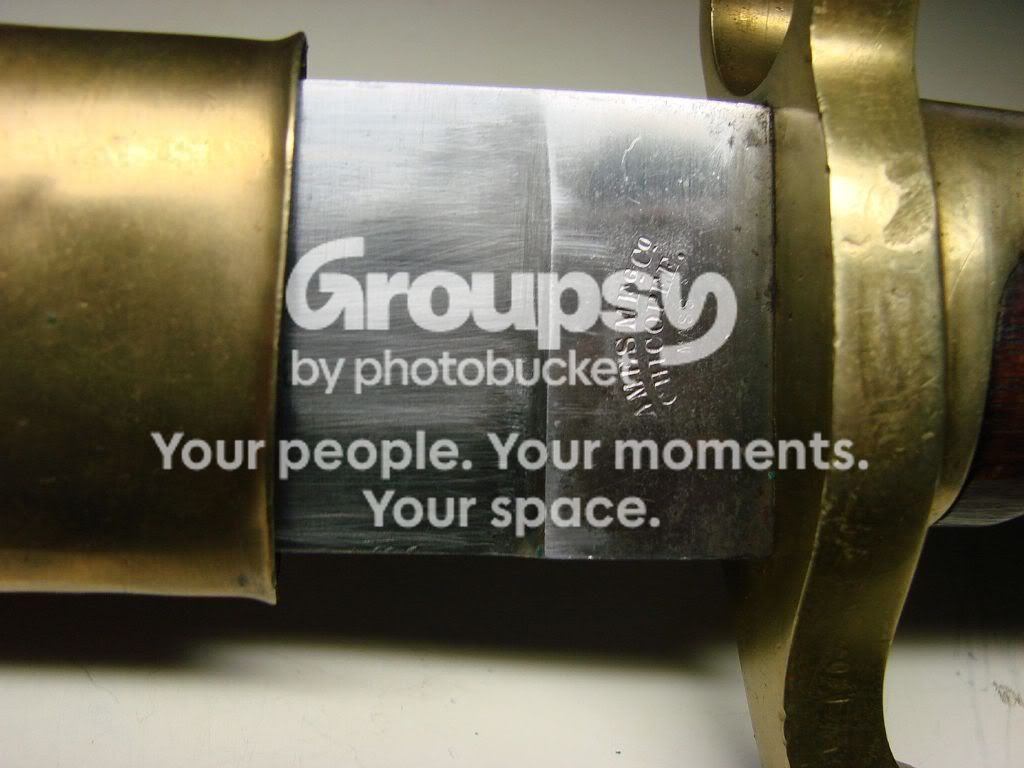
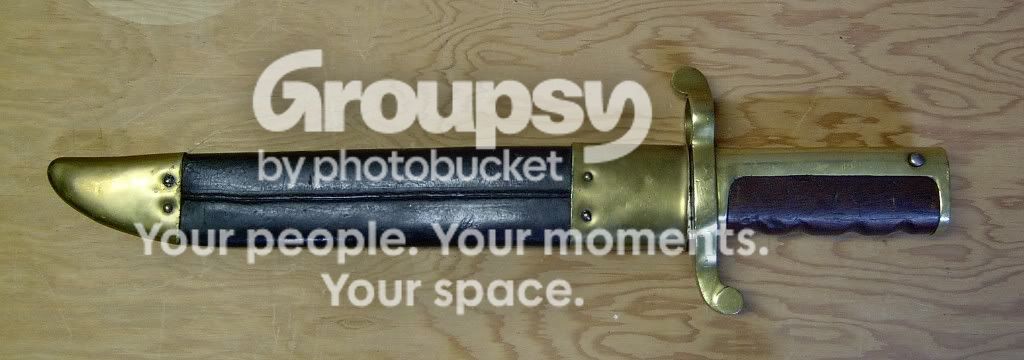
Although not a firearm, I am very pleased with this CW bayonet.
The crazy part is I don’t own the rifle that it was designed for.
Pretty hard to find these Model 1861 U.S. Navy Dahlgren bayonets in this condition.
The scabbards are usually in rough condition.
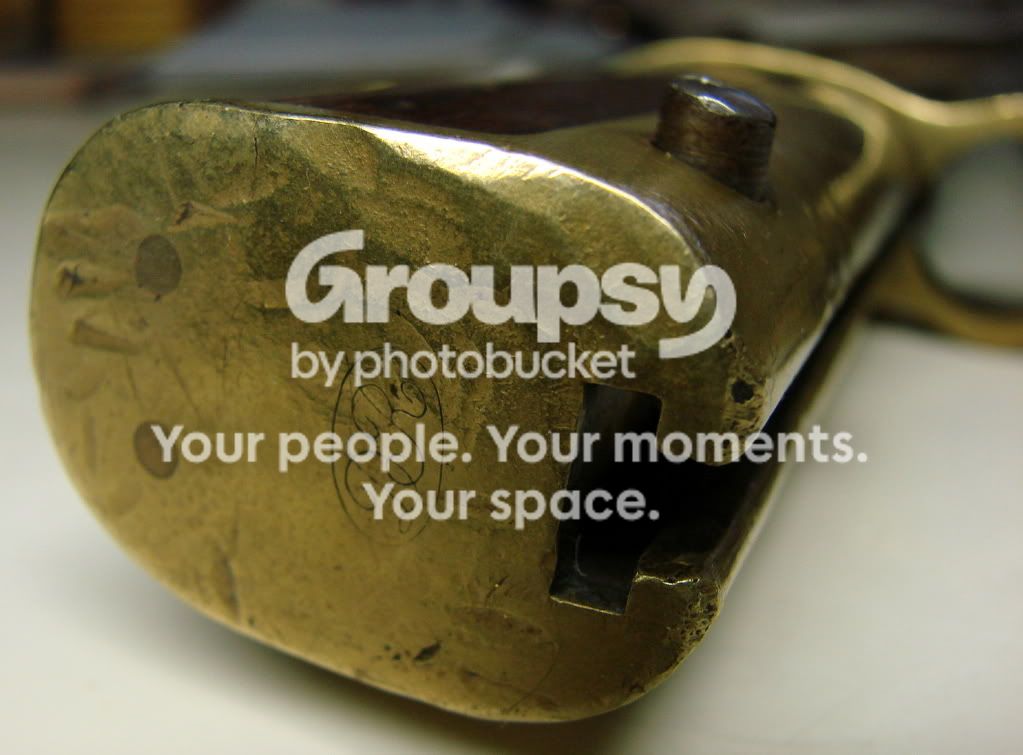
Very well marked and dated 1844.

DSC04174.jpg


U.S. Navy inspector Daniel Reynolds' stamp.
DahlgrenbayonetDRmarkingDanielReyno.jpg


CroppedresizedUSNDR1864DSCN0007.jpg

Dahlgrenbayonetmaunufacturersmarkin.jpg

Dahlgrenbayonetandscabbard.jpg


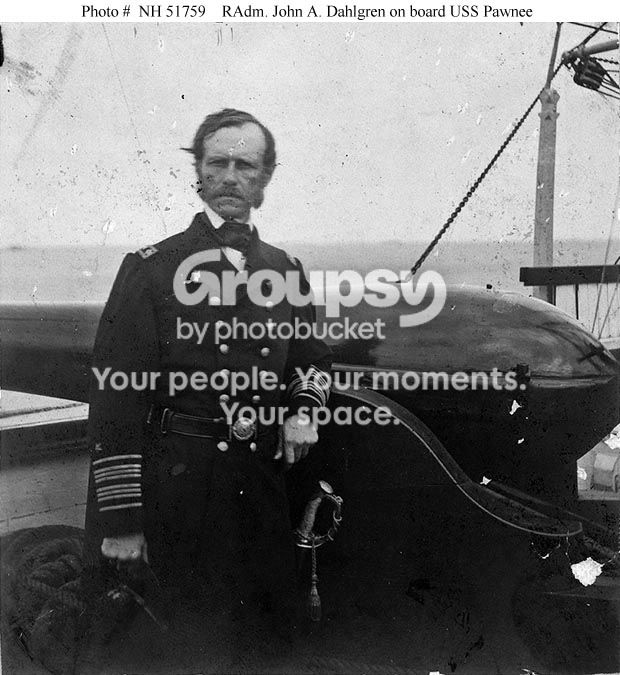
The Dahlgren knife bayonet... (Named after Admiral John A. Dahlgren, U.S. Navy)... one of two bayonets associated with the Whitney Model 1861 Percussion Navy ("Plymouth") .69 calibers Rifle.
The Whitney "Plymouth" rifle, named after the U.S.S. PLYMOUTH, a naval ordnance testing ship which had been built under Dahlgren's supervision, has the distinction of being the only U.S. contract arm to be originally rifled in .69 calibers.

The first Knife Bladed bayonet is considered to be the Model 1861 for the Plymouth / Whiteville rifle. It is perhaps better known by its nickname the Dahlgren Bowie Bayonet, named for it inventor Admiral John A. Dahlgren. Many articles have been written about the Dahlgren bayonet but what is most intriguing are the actual letters from the Admiral himself regarding its design and use. As we know the basic use of a bayonet is mounted to the end of a rifle or musket. To Dahlgren's thinking this is not the proper use of his newly invented arm. It should be known that Admiral Dahlgren was in command of several Navy ships and knew first hand what close quarters fighting was about. With this in mind perhaps we can relate to the admirals thought when he wrote that the bayonet was best used in the hand not mounted on the end of the rifle it was designed for. It is also interesting to note that the 1861 rifle already had a sword bayonet designed for it at the time of Dahlgren's invention of the new bayonet. In Dahlgren's own words he called it the "most useless thing in the world at the end of a musket." Perhaps this explains why most Dahlgren bayonets do NOT fit the Model 1861 rifle. They were meant to but they were also designed to be used as a close quarters fighting weapon in a sailors or marines hand. The Admiral invented a bayonet because a knife would not be sanctioned by the Ordnance Board. But being the clever fellow he was the bayonet did not really have to fit the rifle either.

(This stuff was not written by me...I wish I could remember where I found it to give credit to the original author.)

h51759.jpg


Thanks for all your interest in this thread.

David

 
Last edited:
droooool .....

David - PLEASE, adopt me!

The Smith carbine really caught my eye. I've got a Gallagher carbine by ERMA that I had relined to .50.

Love shooting it, but it ain't the same as an original.
 
Back
Top Bottom