












































AARRRRGGGG!!!!! what am i doing wrong?

aesache

Member
Rating - 100%
3   0   0
Location
London Ontario
Hi Everyone, I have reloaded for a multitude of other calibers but this is the first time i have had this issue.

Why is this creating a ridge on the top of the bullet. It seats just fine and no lead "shaving" from what i can see. Same type of lead i us on all my bullets (wheel weights) The dies i am using are RCBS this is the first time i have used a set all other have been lee. Must say RCBS feel much better made but why are they doing this. I have no doubt it is me and not the die set. Also i have checked and there is no dirt or anything in the dies. Is this just in the setup?


Pic of what i am talking about below. There should be no "Step" on the head of that bullet just rounded. I am not pushing hard. its a 30-30 round if anyone is curious
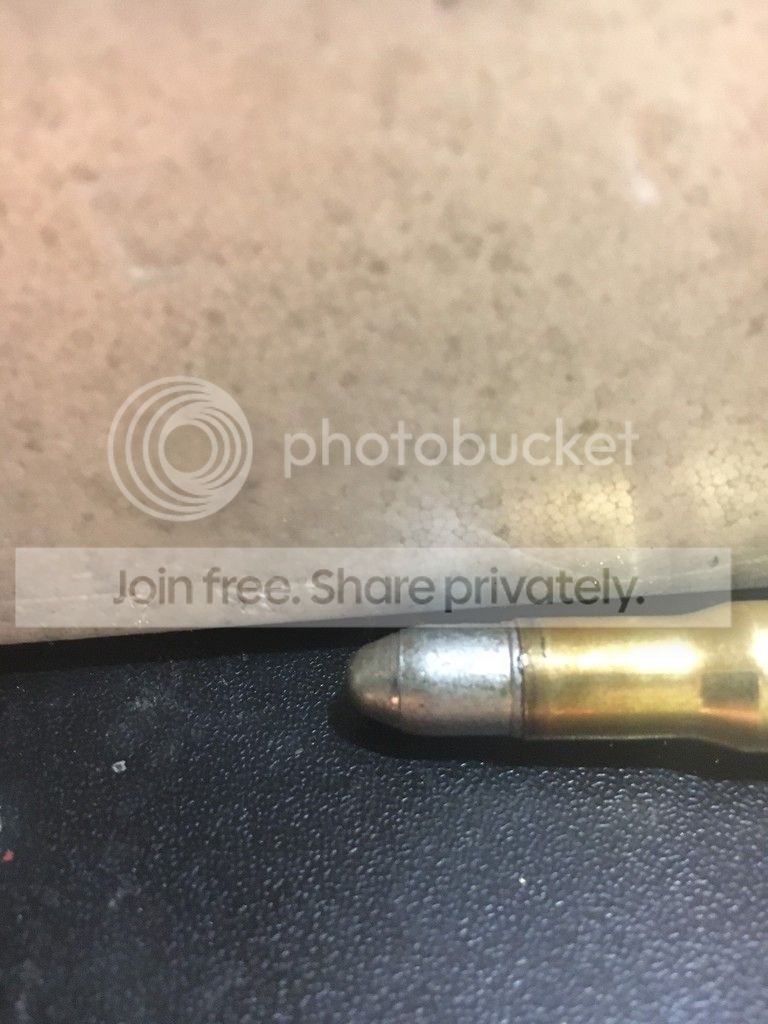
 
Softer lead with a mismatched seating die.

Either use harder lead or re shape your seating die stem to fit that bullet profile.

I'm not sure if RCBS will do it but with lee you can send in a couple bullets and have them modify or custom make a seating stem perfectly fit for that specific bullet profile.
 
The bullet is not seated deep enough. Its well short of getting to the crimping groove and it looks like your seating die is set to put crimping pressure on the bullet.
Seat deep enough to get the mouth to be over the crimping groove and the trouble should end.
 
I get the same ring around the boolit when I use WW. Some have used hot glue to make a custom forming nose punch to tone down that ring
 
How do they shoot as is? You may not have a problem. Have you ever seen the tip of an Eley Match 22 LR bullet? They resemble the nose of a Mig 21 fighter yet shoot superbly.
 
Might be crimping to soon.100% ww lead should be harder then the mix I am using and mine do not deform at all (also in 30-30). My mix consists of 3 pounds pure to one pound of wheel weight. Mine are powder coated but still shouldn't make that big of a difference.
 
I would agree that it's the shape of your bullet seating stem. It's shaped for the typical .30-30 round nose bullet, which is less blunt than the cast ones that you are using. It's also that you are using WW alloy, which is fairly soft compared to say Lyman #2.
And, I think that it may also be that the crimp is occurring a little too soon, such that the bullet gets crimped and stops moving but the ram still has a bit of travel left, causing it to reshape the bullet tip rather than move it further in to the case.

You could try backing off the die, such that it does not crimp at all, and adjust the seating stem downward until a bullet is seated to the crimp groove when the ram is fully up. Then, back off the seating stem well above the bullet, and adjust the die body until the bullet is properly crimped in to the groove with the ram fully up. Then, lock the die ring.
Again, with the ram fully up, adjust the seating stem again until it is pressing on the crimped bullet with a little pressure.

Sorry if I am describing a procedure that you already know. (You did mention that you have experience hand loading with various die sets.)
I just thought that it might work if it was something that you had not tried.
I suspect that you will still get a little reshaping of the bullet anyway though.
 
From the look of the crimp on the case mouth and the look on the bullet, I'd say you are crimping too soon. As pointed out the bullet stops when crimped but there is still travel to seat the bullet which is marking the lead. I'd readjust the die to crimp a bit later.
 
I would agree that it's the shape of your bullet seating stem. It's shaped for the typical .30-30 round nose bullet, which is less blunt than the cast ones that you are using. It's also that you are using WW alloy, which is fairly soft compared to say Lyman #2.
And, I think that it may also be that the crimp is occurring a little too soon, such that the bullet gets crimped and stops moving but the ram still has a bit of travel left, causing it to reshape the bullet tip rather than move it further in to the case.

You could try backing off the die, such that it does not crimp at all, and adjust the seating stem downward until a bullet is seated to the crimp groove when the ram is fully up. Then, back off the seating stem well above the bullet, and adjust the die body until the bullet is properly crimped in to the groove with the ram fully up. Then, lock the die ring.
Again, with the ram fully up, adjust the seating stem again until it is pressing on the crimped bullet with a little pressure.

^^This.
 
There is no "crimp groove" visible on that bullet, if it has one it is inside the case. That is a "nose rider" bullet specifically designed for the nose to ride on the lands. The ring that is visible is the front riding band that engages the rifling...there is no groove ahead of it and if you crimp ahead of this ring you don't have any ridge for the crimp to grip, it risks allowing the bullet to be pressed into the case deeper if you have an aggressive "springed" tube mag that you will be using it in.

That bullet might (and probably does) have a crimp groove hidden in the case but we cant see it. What is happening is that your die is set to initiate the crimp before your seating plug has stopped pushing on the bullet...just back the seating rod out the amount of "mark" on your bullet so it stops pushing at the same time the crimp is made and the problem will go away.
 
RCBS seating dies are the worst IMHO. They are fixed solid when set with no "float" to align the bullet in the case.
Now I don't think what you show there will affect bullet performance at all and are fine to shoot as is.
 
I would agree that it's the shape of your bullet seating stem. It's shaped for the typical .30-30 round nose bullet, which is less blunt than the cast ones that you are using. It's also that you are using WW alloy, which is fairly soft compared to say Lyman #2.

I am using mostly pure lead in my 30-30 with flat nose bullets and don't have that problem with rcbs dies.
 
Back
Top Bottom





















