Abandoned old forts of Canada, with cannon!

pc45.jpg

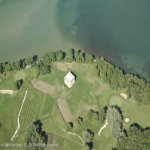
Fort Rouillé a French trading post located in Toronto, Ontario, Canada.
Fort Rouillé was named for Antoine Louis Rouillé, who at the time of its establishment around 1750 was Secretary of State for the Navy in the administration of Louis XV.
It served as a trading post with the local indigenous peoples.
https://www.google.com/maps/place/C...d713968828e0e1!8m2!3d43.6330556!4d-79.4226082

The fort was abandoned in 1759 due to the turbulence of the Seven Years' War.
The remains of the fort were demolished in the 19th century.
The fort site is now part of the public lands of Exhibition Place.
It is marked by an obelisk, the outline of the fort marked in concrete and several cannon.

https://www.google.com/maps/place/C...d713968828e0e1!8m2!3d43.6330556!4d-79.4226082
Fort_Rouille2_Plaque.jpg
 
Geeze, I had to read the title of the thread again. I thought it said abandoned old farts of Canada. Glad it wasn't because there's some interesting sites being disclosed that some people may not know about.
 
The truest abandoned forts in Canada were log palisades to keep the vicious marauders on one side and the good decent folk on the other. The French had many of them until the Iroquois were Christianized. But good luck locating too many of the forts.

FWIW, a namesake relative of mine many generations ago was killed by Mohawks from now Kahnawake in the Deerfield Raids ( https://en.wikipedia.org/wiki/Raid_on_Deerfield ). It seems the colonists in New England bought a church bell on the wharf in Boston; one that had been pirated off a French ship, but paid for by the Mohawks. The natives found out who had their bell, and trudged south to Massachusetts to take it back. The village remains as a historic site, and the raid is commemorated there on the weekend closest to February 29th.

History keeps changing the power dynamic as to whether the natives were willing or coerced by their French priests. Or whether there was even a bell involved at all. All very interesting to see how history keeps getting rewritten.

But at any rate, they took a large number of women, children and adults hostage, and one of them was cousin to my ancestor. The other cousin who was killed was, as we say today, a fighting age male guarding the palisade to keep the marauders on the other side. Some of the hostages refused to be repatriated and integrated into the native families.
 
https://halifaxbloggers.ca/builthalifax/wp-content/uploads/sites/16/2015/05/South_Aspect_of_Halifax_from_near_Point_Pleasant_Park_ca._1780_Inset.pngSouth end of Halifax
Along queen and south street

Was an old blockhouse style fort.

South_Aspect_of_Halifax_from_near_Point_Pleasant_Park_ca._1780_Inset.png


Nothing left of it today.
I seem to recall finding an old map of the layout. But my google-fu is weak tonight

https://halifaxbloggers.ca/builthalifax/2015/05/the-blockhouse/


Of course there are the fortifications in point pleasant park as well as the Halifax citadel.

I found the Martello tower quite an interesting stop.
https://halifaxbloggers.ca/builthalifax/2015/05/the-martello-towers-of-halifax/


And while not a fort. There are quite a few pieces on display at royal Artillery Park in Halifax
http://silverhawkauthor.com/artillery-preserved-in-canada-9-nova-scotia-halifax-royal-artillery-park_451.html
 
Last edited:
Fortress Louisburg, they only rebuilt a small portion of it, the rest was left as the British left it after the last time they captured it. My 6th great grandfather was one of the French officers in the fortress.

Interesting factoid about Louisbourg, obviously a lot of it has gone to ruin over time, but a lot of the brick/stone was taken to Boston to build one of the subdivisions there, and it's called Louisbourg Square. It's a super affluent area, with people like Senator John Kerry living there.

I thought about chipping away at the buildings to bring it back to Canada...
 
abandoned,,,,,,,,, almost!!!

Lets just say, there is not a lot of attention paid here.

The place is always in disrepair.

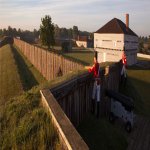
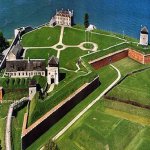
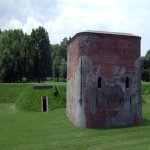
Fort Mississauga National Historic Site

Niagara on the Lake, Ontario

Fort Mississauga was constructed by British forces in 1814 to replace Fort George, which had been destroyed by the invading American forces in 1813 during the Battle of Fort George. Formerly the site of the first lighthouse in Upper Canada, Mississauga point held a commanding view of Lake Ontario and the Niagara River, and served as a counterpoise to Fort Niagara. The central tower was built in part from the remains of the lighthouse which was dismantled by the British, as well as bricks salvaged from the town after it was burned by retreating American forces in December, 1813.

Over the succeeding decades, Fort Mississauga was garrisoned on a limited and sporadic basis. By 1858, Fort Mississauga had been officially abandoned by the British Army. Volunteer Canadian militia companies reoccupied the fort during heightened periods of tension including the American Civil War and the Fenian Raids. The Fort once again fell into ruins until it was used as part of Camp Niagara during both World Wars.

Today, all that remains of the once impressive fortification is the original central tower, the sally ports and the unique star-shaped earthworks. In 2000, The Friends of Fort George constructed a trail for easier access to Fort Mississauga, located today on the Niagara-on-the-Lake Golf Course. Although the central tower is not open to the public, visitors can explore the grounds and enjoy a magnificent view of Lake Ontario and the opposing Fort Niagara.


Location
Fort Mississauga National Historic Site is located on the grounds of the Niagara-on-the-Lake Golf Club. A pedestrian trail starts at the corner of Simcoe and Front Streets and leads to the fort.

http://www.friendsoffortgeorge.ca/sites/fort-mississauga/index.html

I wish I was at home to add my personal pictures!

There is still writing (Graffiti - signatures and dates) on the bricks from the 1860's to WW2.

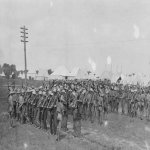
It was a very large training area during WW1.

I have found a lot of relics of the camp over the years.
20190215_170044.jpg

If your ever in the Niagara on the Lake, Ontario area, drop by, you won't be disappointed.

The view alone across the river to Fort. Niagara, USA is breathtaking.

While your at it, check out Fort George, then cross the river and check out Fort Niagara!!!!

Again, you won't be disappointed.

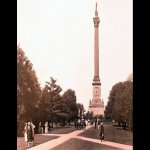
Brock's Monument is just down the river on the Canadian side.

Battle of Lundy's Lane National Historic Site, Niagara Falls, Ontario.

You could spend a long time here in the Niagara area, just checking things out.

Hell while your at it, Ridgeway, Ontario (Fenian Raids)!!!!!!!!


mississauga.jpg

18731.jpg

Fort George
sunset2.jpg

Fort George National Historic Site
Overlooking the Niagara River, Fort George was built between 1796 and 1802. This fortification served as the headquarters for the Centre Division of the British Army during the War of 1812, and played a pivotal role in the defence of Upper Canada. Fort George saw action during the Battle of Queenston Heights, was destroyed and captured by the Americans during the Battle of Fort George, and was reclaimed by the British seven months later.

Brock's Monument
Brock's_Monument_Queenston_Heights_circa_1920.jpg

Fort Niagara USA

fortniagara.jpg
 

Attachments

  • mississauga.jpg
    mississauga.jpg
    81.5 KB · Views: 91
  • 18731.jpg
    18731.jpg
    31 KB · Views: 91
  • sunset2.jpg
    sunset2.jpg
    89.4 KB · Views: 91
  • fortniagara.jpg
    fortniagara.jpg
    28 KB · Views: 91
  • Brock's_Monument_Queenston_Heights_circa_1920.jpg
    Brock's_Monument_Queenston_Heights_circa_1920.jpg
    60.8 KB · Views: 89
  • 20190215_170044.jpg
    20190215_170044.jpg
    50.2 KB · Views: 66
Last edited:
Back
Top Bottom