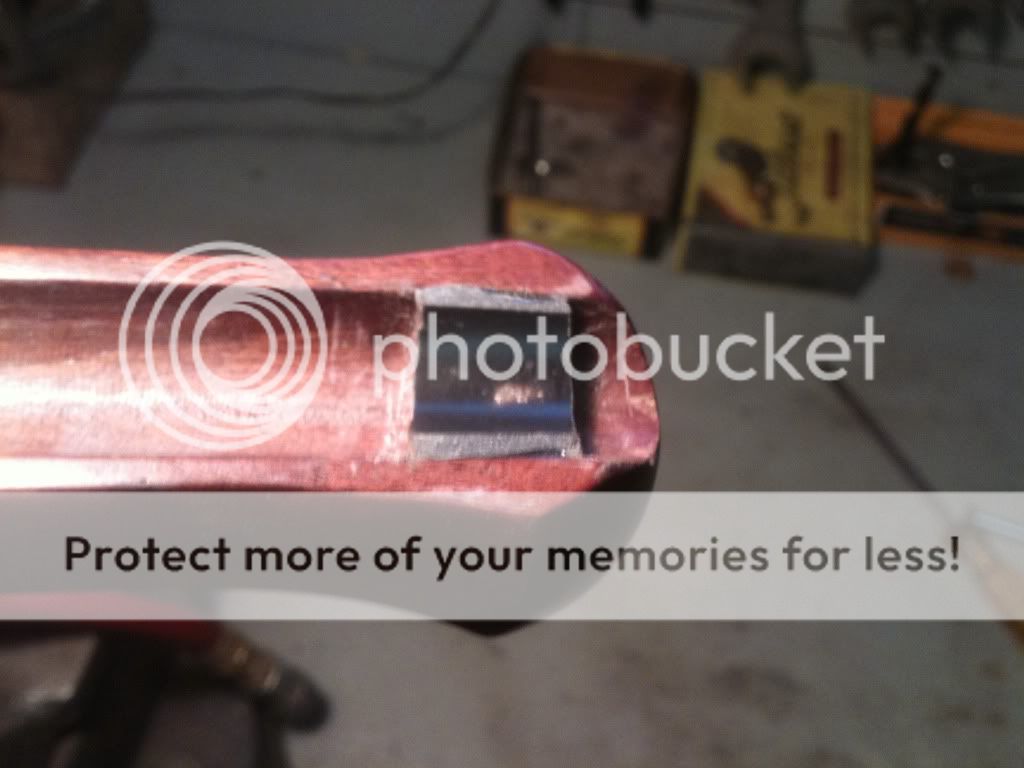
Accurizing/bedding the Lee Enfield No4... Success!

mikeystew

CGN Ultra frequent flyer
Rating - 100%
51   0   0
Location
Beautiful BC
Forgive me, I know this is a complex subject with no easy short answer. But I know some of you are experts and I trust your opinions. Where would I be able to find the best free online resource with info related to bedding and fitting the enfield forestock?

I'm not incompetent by any means and would like to give it a go if it's not too difficult to comprehend.
 
Last edited:
In the milsurps.com website, somewhere there are PDF copies of the armourers' instructions, and other excellent resources in which all the required info can be found. Can't remember in which section but a quick search will no doubt give you what you need :)

Lou
 
Well... I browsed Milsurps for an hour or so and I'm not sure I can comprehend it. From what I'm reading, there needs to be upward pressure on the barrel at the muzzle btwn 3-10 lbs, and the way to increase that pressure is to shim the draws? I get how the trigger guard screw acts as a fulcrum, but I don't see how the shims could add that much pressure? Also how would shimming the draws affect the wood to metal fit around the king screw, Knox area? Is it best to shim the draws until the adequate pressure is obtained and then epoxy bed the rest of the action? Should the portion of the forestock that contacts the barrel at the muzzle be bedded with epoxy? Do only the tops of the draws get shimmed or the face also?

... So many questions. I want to watch someone else do it, see some clearer pics or something.
 
I suppose it couldn't hurt to mention the reason for my curiosity. At my last range visit, the first for this rifle, I experienced wild vertical stringing... About 8 moa at 50m. Several shots grouped ok, but then it would throw a few 6" low. I first thought it might be my underpowered handloads causing the problem, because they were allowing a lot of gas to blow back into the action due to not expanding the cases much.

But now I'm not so sure. From what I've been reading this is a common problem related to poor forestock fit, and possibly the damned crack? Which I'm trying to find an example photo of.
 
Wild vertical stringing, about 8 inches at 50 yards.

I had 14 inches at 100 yards in an SMLE.

The Damned Crack.

Forestock is broken right at the back end where the sear arm goes down through the stock to meet the trigger which is pinned to the triggerguard. There is not a heck of a lot of wood right there, so that's where they crack when the wood shrinks around the m metal. On the Number 4 there is a thin metal Strap right at the back of the stock which prevents things coming massively abroad. It prevents a lot of cracked stocks but not all. If your stock has this, go to the veterinary and get a syringe (sans needle) about 5cc or 10cc so you can squirt the glue to where it will do some good. Otherwise, work it into place with the edge of a finger/thumb.

When you are working on this, check carefully and determine whether or not the stock is cracked AHEAD of the Magazine. This sometimes happens and is the original reason for "The Dreaded Ishy Screw", which was an Ishapore factory fix, often applied at manufacture as a preventive measure. IF the stock is cracked here, you then do ALL the repairs in one step. This is why you do NOT use 5-minute epoxy; you will need more than 5 minutes to do the work. Use the 20-minute stuff.

Remove forestock and handguards, locate the crack. Degrease, spread the crack and flush it out with Brake-kleen and allow to dry perfectly. Mix up a SMALL batch of Acra-Glas Gel (or Devcon or other 2-part epoxy, NOT the 5-minute variety) and glue the crack. CLAMP it and let stand for 24 hours, then TRIM any excess epoxy.

As to bedding the critter, the Number 4 likes to be bedded solid around the action and to the front of the Chamber, the barrel floated (check this with a PAPER banknote, first single, then folded once tightly) and generally 4 to 6 pounds upward pressure against the barrel at the muzzle reinforce. The old-time match shooters often would build up this reinforce with cork sheeting glued into place. I have seen aluminum pop cans used to provide a thin pressure-point, also brass shim-stock and even aluminum kitchen foil. They all WORK but some last longer than others. I use GREASE in a very thin coating on the METAL parts when I am bedding these; it makes for a tighter fit than the "parting compound" that the bedding kits supply and it is MUCH quicker and easier to clean off afterwards.

Good luck, friend.
.
 
Last edited:
Thanks Smellie.

mikey, I did a search here on CGN, and found one thread in which there's a bit of relevant info: http://www.canadiangunnutz.com/forum/showthread.php?t=531167&highlight=enfield+bedding

Lou

Lol... That was my thread. I was at that time workin on my Churchill sporter and understanding somewhat what I needed to do I got the gun to group very well by installing a pressure shim at the end of the schnabel forend. I drilled a hole and epoxied a dowel into the stock and fiddled with it by removing 1/16" at a time until I had 7 lb of pressure to the barrel tested with a fish scale. I then epoxied around it when the pressure was set.

f393581e.jpg


e28d3994.jpg


b94c2a27.jpg


The trouble I'm having understanding the full wood model is how to increase the pressure without pushing the barrel up. So I understand that it would be raising the draws. It is how to do that properly that I'm struggling to comprehend

Smellie I'll look for any cracks in the stock tonight. I didnt see any before but I could have missed it. For menthe most concerning thing at the moment is the minimal 2 lb of upward pressure on the barrel. I can't help but feel it should be more. Also... The barrel does not sit dead center at the muzzle. It can be pushed right and up, but not left.


... I kind of bummed that it doesn't shoot well, considering how good it looks. I thought being a '54 still rich with cosmoline that it should be fairly issue free.
 
Lol... That was my thread.

Doh! That'll teach me to not pay attention to details!

This being said, did you look at how much material you'd have to add at the front tip of the forend in order to have some upward pressure (as so elegantly described by Smellie)? It is true that thin shims at the back of the action do have similar effect, I think that if the upward pressure can be fixed by shiming at the front, it's probably a better solution. (of course a new forend could be an idea too but let's not jump to conclusions :D )

Also, with the forend installed tight, did you use a feeler gauge to see if most of the barrel is free floating?(i.e. touching only where it should) On a few No4 which I saw here, sometimes it didn't take much interference to influence what happens at the muzzle end. Just a few random thoughts,

Lou
 
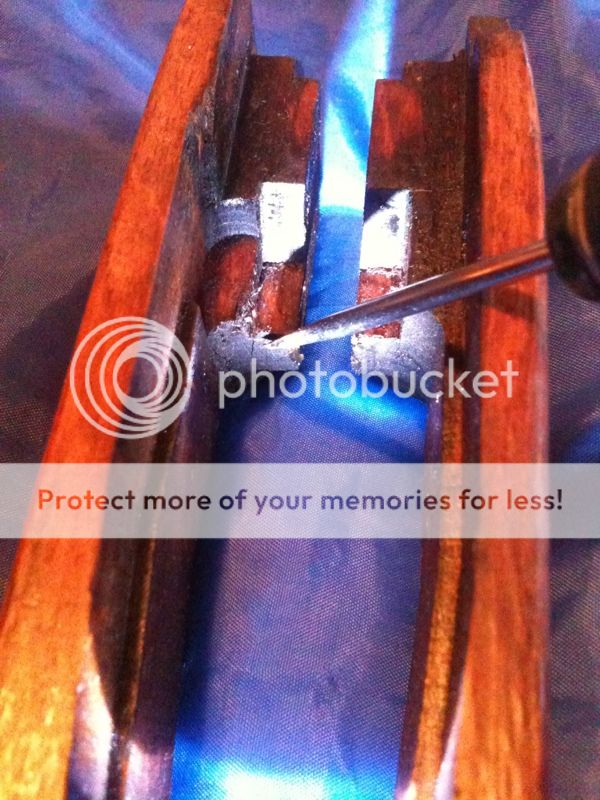
Ok, I did find two slight cracks just below the draws... Right where my little screwdriver is indicating;

34420118.jpg


Also I determined based on the position of the trigger guard screw head that the bushing is slightly too long and it's not allowing the forestock to snug up enough.

Is the crack shown here the "damned crack" or just a crack? Is it critical? I'm going to epoxy it tomorrow by drilling small holes through the crack and filling them with epoxy, I'll also shorten the bushing by a whisker and maybe, just maybe shim the muzzle.
 
You have the Number 4 Mark 2 version of The Damned Crack: draws are cracking out, likely from warpage and uneven bearing. Solution you have come up with should work, although I would use a screwdriver and spread the crack slightly and work some epoxy into it. Bedding, as described later, should build things up nice and solid.

Barrel should not touch on one side; it should sit centred and with upward pressure from beneath.

If the rifle were mine, I would take this in three stages, I think. Stage One would be checking the woodwork for defects (including cracks various and sundry) and points where the barrel might touch the wood. This includes that nasty place at the front, which should be sanded out until the barrel no longer touches. You will be able to SEE a polished bit where the barrel is bearing here, slapping around. Sand it out. You can do this easily with a chunk of doweling with 320 sandpaper wrapped around it. Sand out ANY place forward of the Chamber where the barrel has been slapping. If you have cracks, now is the time to repair them.

Stage Two begins once you have determined that everything is crack-free and solid and the barrel is free to move. NOW is when you bed the action and chamber, using as LITTLE bedding compound as you possibly can get away with. You are not trying to MAKE a bed for the action, you are just RESTORING the original Factory bedding, which actually was pretty darned good. They knew what they were doing; it's just that you are a victim of warpage from Time plus Humidity. I have done this to a number of rifles and I get 5 or 6 from a single Acra-Glas kit even though the instructions are to use the whole kit at one sitting; this is wasteful of materials as well as a shocking disrespect to the men who built your rifle. While you are doing this, pay special attention to the Draws, which are where the Recoil Lugs at the rear of the action meet the woodwork. The Draws should bear EVENLY; if they do not, build both up with the epoxy: the excess stuff will squish out when you assemble he rifle. Also, you will need to pay attention to where the Trigger-guard Screw (the so-called "King Screw", a term never used when the rifles were built) attaches to the Body. This is the main Recoil Lug and it must be solid. You will need to grease the screw itself, be careful putting in your bedding compound in this area, insert the horizontal screw in the rear of the Trigger-guard and use the forward screw to tighten the action down into the bedding. If you don't use quite enough of the bedding compound here, you can add more the following day, after wiping any Grease away from the epoxy which has set-up in the stock and cleaning carefully. Once everything has set-up, you can disassemble the rifle again, clean off any excess, put her back together and you SHOULD have a rifle with good, solid bedding and a totally-floating barrel.

Stage Three is making your Pressure Point at the muzzle...... and you already know how to do that. An easy way to get the pressure right is to clamp the STOCK (with your little dams already in place) into a vise upside-down, put in your epoxy and assemble the Rifle MOST of the way to it. Before tightening anything up, hang a bag with 4 to 6 pounds of buckshot in it from the Muzzle. NOW tighten the Rifle to the Stock. When everything sets-up, you SHOULD have something VERY close to what you want. If the finished Rifle needs a little more pressure, you can futz this with 1 or 2 strips of kitchen foil or a single shim from a pop can or a single strip of brass shimstock (it comes in a package of about 8 thicknesses from .001" to .030", available from your local auto wholesale or machine-shop supply). If the Rifle wants LESS pressure (which does happen some times) you can reduce the pressure with your dowel and 320-grit, sanding out a thou at a time until the rifle shoots its best.

It CAN be a long and laborious process, but the RESULTS are WORTH it. We used to go through this five-eighths of forever when getting the Number 4s ready for a shoot. Number 1s (SMLE) are MUCH worse, believe me, but, again, the results are WORTH the effort.

Good luck!
.

 
Stage Three is making your Pressure Point at the muzzle...... and you already know how to do that. An easy way to get the pressure right is to clamp the STOCK (with your little dams already in place) into a vise upside-down, put in your epoxy and assemble the Rifle MOST of the way to it. Before tightening anything up, hang a bag with 4 to 6 pounds of buckshot in it from the Muzzle. NOW tighten the Rifle to the Stock. When everything sets-up, you SHOULD have something VERY close to what you want. If the finished Rifle needs a little more pressure, you can futz this with 1 or 2 strips of kitchen foil or a single shim from a pop can or a single strip of brass shimstock (it comes in a package of about 8 thicknesses from .001" to .030", available from your local auto wholesale or machine-shop supply). If the Rifle wants LESS pressure (which does happen some times) you can reduce the pressure with your dowel and 320-grit, sanding out a thou at a time until the rifle shoots its best.

I am following this quite closely, and will be putting it into the knowledge binder. I have a question though. I am not quite 100% on what you are describing here (bold text).

So one would put the stock in the vise with the bottom facing up, then bring the barreled action UP into the stock. Then we start the trigger guard screws but leave them loose (to keep the barrel and action there while hang the bag of shot). Then hang the bag of shot on the muzzle, and tighten the trigger guard screws.

Have a grasped this correctly?
 
I am following this quite closely, and will be putting it into the knowledge binder. I have a question though. I am not quite 100% on what you are describing here (bold text).

So one would put the stock in the vise with the bottom facing up, then bring the barreled action UP into the stock. Then we start the trigger guard screws but leave them loose (to keep the barrel and action there while hang the bag of shot). Then hang the bag of shot on the muzzle, and tighten the trigger guard screws.

Have a grasped this correctly?

Thats the way I understand it yes. Have the stock ready filled with dams and epoxy, then bring the action up into it, loosely assemble, hang shot, tighten.
 
On the Enfield rifle vertical stringing is caused by a loose fore stock, horizontal stringing is caused by a loose butt stock.

The draws area is a tapered wedge on the receiver, shimming the forward part of the draws forces the rear of the stock "DOWN" and "INCREASES" up pressure at the fore end tip.

fulcrumpoint-1.jpg


This fulcrum point makes the stock act like a kids teeter-totter when the stock is loose and causes vertical stringing.

totteranimationsmall.gif


If you can insert a feeler gauge between the fore stock and receiver ring you have wood shrinkage and the draws needs to be shimmed and tightened. It also means the trigger guard bushing/collar needs to be shortened.

IMGP0921.jpg


Below, the contact points of the draws area, shimming at the white arrow pushes the fore stock to the rear and "DOWN" when it contact the receiver ring. (and INCREASES up pressure)

IMGP2022.jpg


Below, draws area contact points.

IMGP2023.jpg


Top photo is where the shims are placed to tighten the draws area. Bottom photo, the rear of the fore stock (shaded areas) must be making contact with the receiver socket, it does not need to be 100% "BUT" contact needs to be equal on both sides. (this contact centers the barrel in the barrel channel)

drawsarea-b.jpg


Now please look carefully at the Australian photo on the left and the Canadian drawing on the right. They "BOTH" have shims added below the receiver to keep and maintain a constant up pressure at the fore end tip. The rear of the receiver "rests" on these shims and the thickness of the shim can be used to change the up pressure.

theshim-a.jpg


If you need more up pressure at the fore end tip on the military Enfield rifle you shim the "REAR" draws area and NOT the fore end tip which doesn't fix anything in the rear draws area. Remember this, the draws area acts like the second "missing" bedding screw at the rear and keeps the stock tight and in contact with the receiver socket.
 
Bedding part two. (British Air Force PAM)

Image15.jpg


Image16.jpg


Image17.jpg


Canadian No.4 manual

beddingpoints.jpg


beddingpoints-2.jpg


NOTE: Thin shims cam be made from brown paper shopping bags fastened with super glue or varnish, coat wood and soak paper and set in place. Thicker shims can be made from the table and counter top material "Formica" in American English or aborite? in Canadian English. ;)
 
Thanks big Ed. I have discovered that the rear of the stock is making contact with the socket on one side but not the other. The other side has a gap of about .006-.007 when measured with a feeler. It would then make sense why the barrel is not centered at the tip, because the side making contact with the socket, is the same as the side making contact with the barrel at the tip.

So to fix this do I shim face of the draws only on the side thats not contacting the socket? Would it make sense to make the shim the same thickness as the gap, about .007?

If so I might shim one side with one shim, and the other with double shims to increase the tip pressure also.

On a side note, I discovered that if I tried to shim under the barrel at the tip, the barrel contacted the top handguard. So I see what you are talking about Ed. Interesting...
 
Now I'm just confused... If I build up the draws on the side not touching the socket, in theory it would push the tip even further the way I don't want as opposed to centering it. If I relieve the loose side draws it would straighten the stock, but only if I relieved the wood where it meets the socket on the tight side. And in this case it would relieve pressure at the muzzle...

Would it make sense to remove wood on the tight side from the rear bearing where it meets the socket and build up the draws on that side?

Or should I just shim the rear bearing where it's not touching the socket? Build it up thick so as to force the draws down and center the barrel?
 
Last edited:
Step number one of bedding an Enfield rifle.

Oil the stock with a 50/50 mix of raw linseed oil and turpentine, the oil will soak in and "should" cause the wood to swell. Ask yourself "WHY" did the wood get smaller or shrink causing the bedding change.

Answer: because the stock wasn't oiled monthly.

Below to save maintenance time for the armourers the raw linseed oil was issued to the troops and the stocks were no longer hot dipped in a tank of raw linseed oil by the armourers during the yearly inspection.

RLO.jpg


Below is a photo of wood crush below the receiver and trigger guard, and you now need to decide which "way" to bed your Enfield rifle or "WHERE" to place your shims. Meaning the military way or the "home fix" method which means shimming the very rear area of the draws where it contacts the receiver socket. This deviation from "military bedding" is easer BUT non-standard.

READ CAREFULLY

If you shim the forward area of the draws the receiver will move forward on to "uncrushed" wood. This will "DECREASE" up pressure because of the "step" in the wood will raise the reciever slightly.

You have two choices here, remove the raised wood and make the intire area flat and the same hight "OR" just shim the very rear of the stock which will move the reciever "away" from the raised area. (its a push-pull decision) :D

woodcrush-2.jpg


Below a draws repair done by a British armourer

IMGP2590a.jpg
 
I admit I find all of this very fascinating. It's as challenging as my Sunday puzzles!

Anyway, I fooled around with pieces of tape that are .005 thick in different positions. I found that by shimming the face of the draws on both sides and shimming the rear bearing surface on the "short" side, I got a perfectly centered barrel with a nice 4.5 lb of upward pressure at the muzzle. I also shortened the "king" screw bushing to correspond with the same screw head placement that I got by torquing it down without the bushing. I just put a piece of masking tape beside the screw slit and made a witness mark, and kept reliving bit by bit metal from the bushing until it was snug at the witness mark.

When I get home I will affix brown paper/superglue shims where my tape is now.
As a side note, there was no crushed wood like in the pics above under the action. There was a bit of an imprint under the trigger guard, but under the action looks as new.
 
Back
Top Bottom