achieving better loads, asking for advices

vince514

CGN Regular
Rating - 100%
41   0   0
Hey guys

New reloader here, i reloaded only +/- 1500 bullets until now.

I can achieve pretty good accurate .45 acp rounds.. (230 gr campro FCP, CFE pistol powder, federal large primers)

But cant do good 9mm (125 gr X-metal coated RN, CFE pistol powder, s&b small pistol primers)

Im trying to diagnosis the problem but somehow i cant... lack of XP i guess.

I got a glock34 and a m9a3 beretta, i can shoot palm size group with commercial ammo... but when i shoot my reloads... accuracy is not there.

I know its my bullets.

What could it be?

Bad combination between reloading components? bad powder? bad bullets? crimp/no crimp? bad recipe?

Im a little bit confused, im trying to use to the hodgdon reloading data.. but of course x-metal bullets are not listed(Hornady hap, Sierra FMJ or LCN->Lead Conical Nose?)
X-metal suggest cast standard loads.
and i got the Lyman 49th reloading bible.

One of my friend is reloading 9mm with Titegroup, x-metal bullets.. told me its really fine.

Next time im buying reloading supplies ill make sure everything is listed in my books.
and ill keep the CFE pistol powder for my 1911 and H&K usc45.

Thanks in advance
 
The first thing that comes to my mind is the quality of the bullets themselves. Measure and weight ten or twenty of them picked at random and see if they're really almost identical to each other. If they vary by more than a thousandth or two, they may well be the problem.

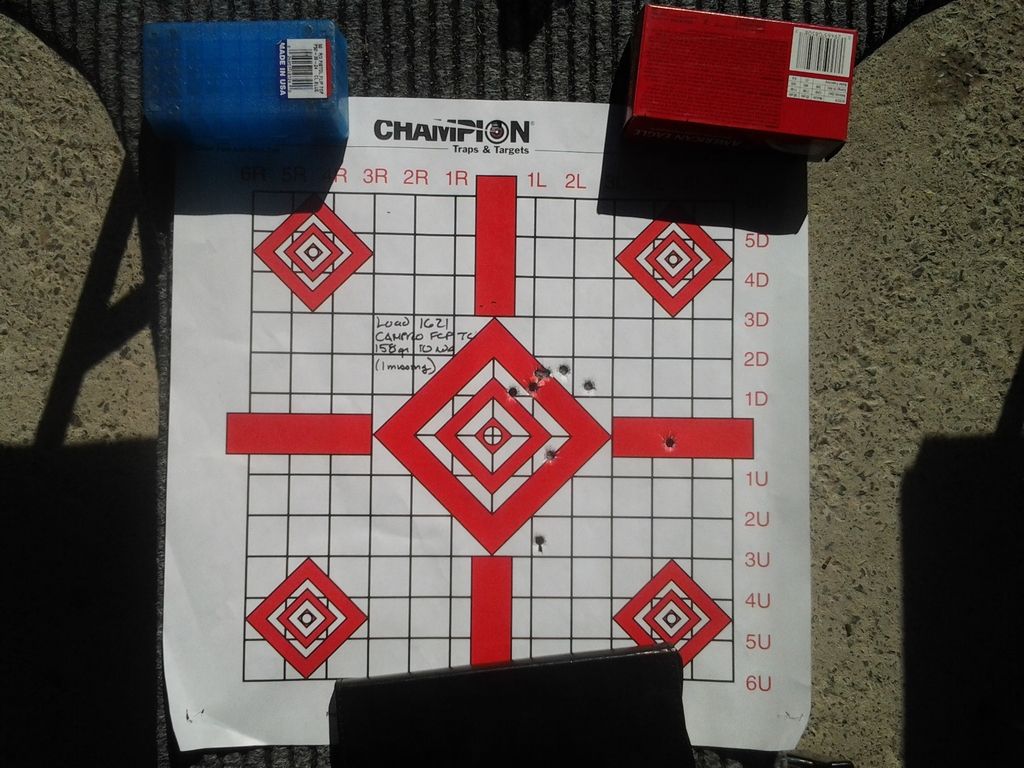
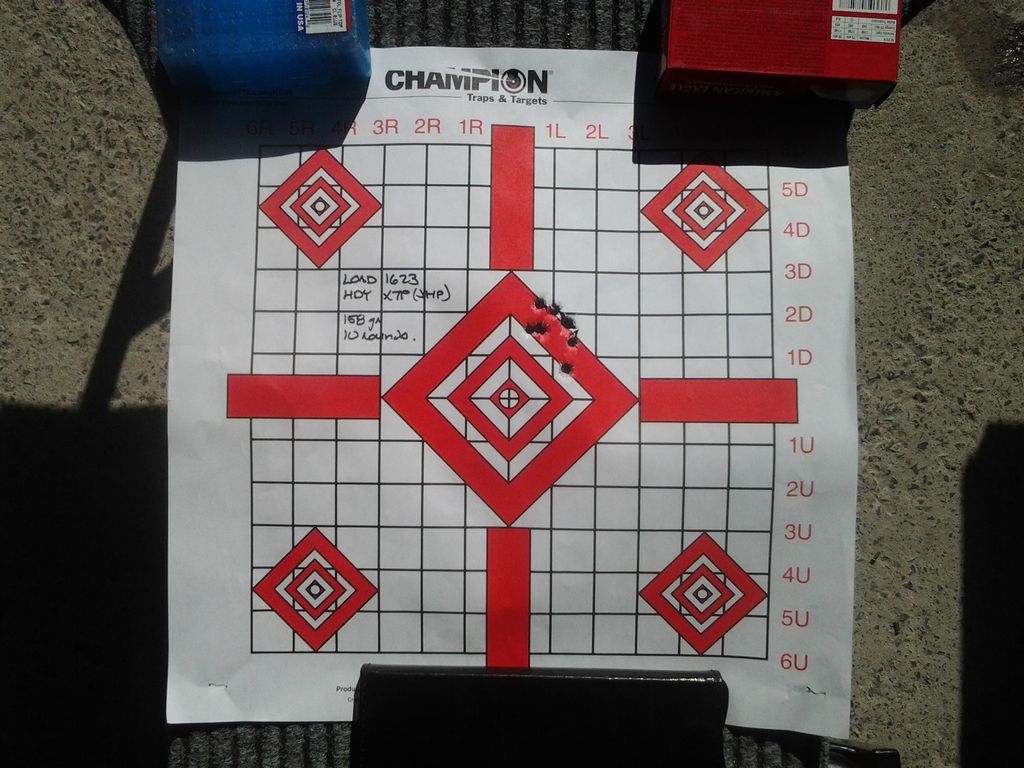
Here's an example of what I mean, using some .357mag loads I was making for my lever action carbine (Henry Big Boy Steel):

1. Both targets were shot on the same day with 10 rounds at 100m, with plenty of wait time in between shots to let the barrel cool to near-ambient temp.

2. Both loads use the same exact cases (Winchester fired once before), primer (CCI 550), powder charge (15.0gr of Hodgdon H110) and COAL (1.590") and are properly roll-crimped into the cannelure of the bullet.

3. Load 1621 uses CamPro 158gr FCP-TC (Full Copper Plating Truncated Cone) bullets costing about $0.13 per bullet. Load 1623 uses Hornady 158gr XTP JHP (Jacketed Hollow Point) costing about $0.35 per bullet:​

Load%201621_zpsvyfz5mg5.jpg


Load%201623_zpslqstwsht.jpg


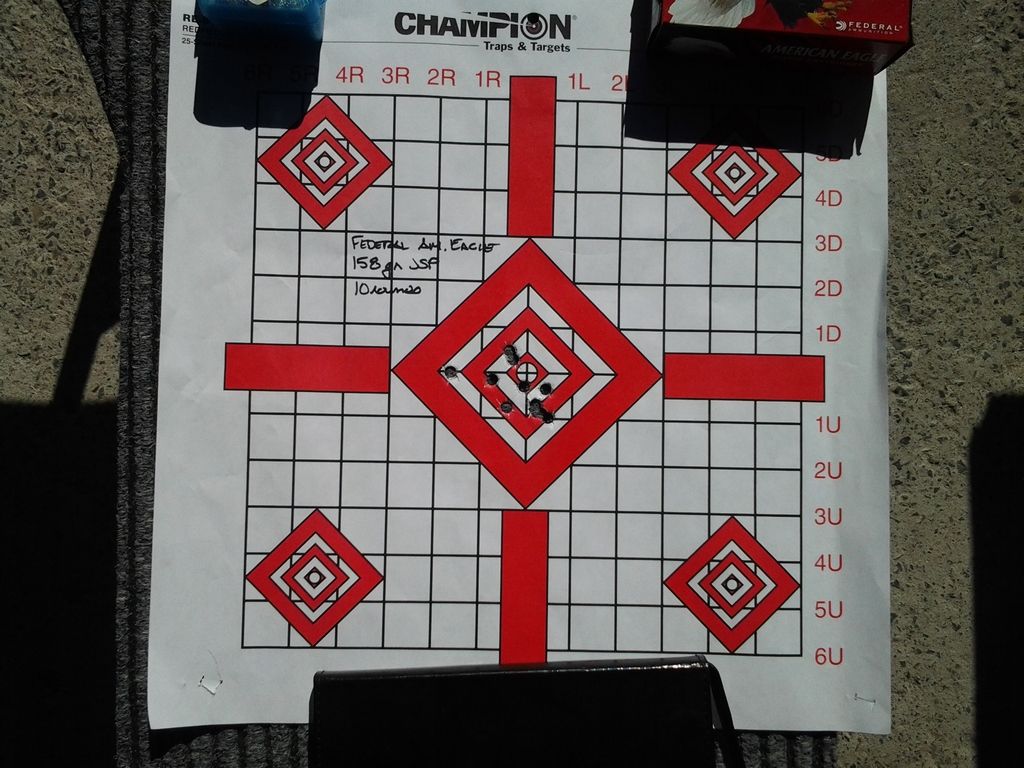
For baseline comparison, here's what happens when I shoot commercial Federal American Eagle 158gr Jacketed Soft Point:

Fed%20158gr%20JSP_zpsmd4nmrcm.jpg


See the effect of the brand/model of bullet on the accuracy? It's a case of "you get what you pay for", in essence. The same thing may well happen with your 9mm rounds.

I shoot a Beretta Cx4 in 9mm too, and I'm still trying to find a load that would give me a consistent 2 MOA accuracy at 100m with it. Best I've managed is about 3.0 MOA. Oh, and I use CFE Pistol powder also, because it's about the slowest burning powder I could find for 9mm. Perhaps with a faster powder like Titegroup you might get better results, but that's absolutely impossible to predict.

This being said, there's other possible sources for the spreading of your shots, I'm no expert so shooters with more experience than I might be able to help you better. Are the taper crimp pretty even in tightness between batches? Have you tried different charges of powder (still between the min and max of course) for the bullets you're using? Are the reloads of the same general COAL as the commercial loads that work well in your pistols?
 
Last edited:
thanks for the interesting reply!

I did 2 huge batch ---> 1 recommanded light starting load(4.5) and 1 mild load(4.7-4.8)
I always followed the recipe found on hodgdon started with light recommanded to mild load.
I respect they COAL too. but didnt compared commercial ammo with it.

I feel a little bit confused about what should i follow when the bullets type is not listed in reloading charts.

I got xmetal hitek bullets, LRN right?

http://www.x-reload.com/xmetal-bullet-9mm-125gr-rn-coated-super-hitek-2-1000-box/

On hodgdon website for 9mm 125 gr i have to choose between FMJ or LCN.

And in my book FMJ or JHP.

COAL varies between 1,075 to 1,125... for 125 grainers
 
I did a small bit of testing ,last summer. Using same bullits and powder,but 3 diff brands of primers.
I found the CCI primers to be much better than the S&B and Dominion primers.

Just saying ,that was my experience,maybe not yours.
 
I did a small bit of testing ,last summer. Using same bullits and powder,but 3 diff brands of primers.
I found the CCI primers to be much better than the S&B and Dominion primers.

Just saying ,that was my experience,maybe not yours.

thanks for sharing your experience

I would like to know how "better" they were? You mean you were having better accuracy using these primers?

Im still curious if some reloading supplies does have some kind of synergy when used together..
 
thanks for sharing your experience

I would like to know how "better" they were? You mean you were having better accuracy using these primers?

Im still curious if some reloading supplies does have some kind of synergy when used together..
Yes I found them to be way more accurate. I was shooting off a bench,with the gun rested on a sandbag. CZ Shadow.
 
thanks for sharing your experience

I would like to know how "better" they were? You mean you were having better accuracy using these primers?

Im still curious if some reloading supplies does have some kind of synergy when used together..

To a point yes, but it's more like find the right combination for your particular gun. Even things like the quality of the finish on the outside of the barrel can make a difference.
Which leads to one of the best things about reloading in that you can try different charge weights and COAL easily and find out what works best for you.
 
would you be able to shoot some of your friends 9mm ammo?

If it works in his pistol, maybe it will work in yours?

My 9mm loads consume titegroup.... cci primers mostly but Win primers have worked well for others.

Testing is important as each gun has their own tastes. Some bullets like a small charge of fast powder to bump up the bullet to fit the bore... sometimes, you need a bit more pressure to make things shoot at their best.

Jerry
 
thanks for the interesting reply!

I did 2 huge batch ---> 1 recommanded light starting load(4.5) and 1 mild load(4.7-4.8)
I always followed the recipe found on hodgdon started with light recommanded to mild load.
I respect they COAL too. but didnt compared commercial ammo with it.

I feel a little bit confused about what should i follow when the bullets type is not listed in reloading charts.

I got xmetal hitek bullets, LRN right?

http://www.x-reload.com/xmetal-bullet-9mm-125gr-rn-coated-super-hitek-2-1000-box/

On hodgdon website for 9mm 125 gr i have to choose between FMJ or LCN. And in my book FMJ or JHP.

COAL varies between 1,075 to 1,125... for 125 grainers

Interpolating a load data for a bullet that's not listed in the charts or using a different COAL (or primer, or case for that matter) that what's used in the load data charts is where you leave the safe side of the street and start taking some (hopefully small and informed) risks. You have to make some assumptions and you have to keep a sharp eye on each piece of spent brass in between shots to see whether there's any signs of overpressure being shown. And even then you're still always making a guess from that brass' appearance, because reading spent brass is a lot like reading tea leaves: some brass will show signs of pressure while other for the same bullet/primer/powder charge will not.

Doesn't mean you can't approximate the load data, but it means you have to be careful and err on the side of caution at all times. People DO develop loads outside of the manuals, after all, by starting with informed approximations, minimal powder charges and increasing it one small step at a time. They also have balls of brass, those guys, because making a major mistake can result in a ruined firearm and serious injuries.

For me, the first rule is to use the load data entries for a bullet of the same weight (at plus or minus one grain, like 125gr data for 124gr bullet). Then I look for bullets of the same material and construction: lead vs polymer-coated vs copper-plated vs copper-jacketed. And when the first two criteria are met, I look for bullets of the same general geometry (RN, JSP, JHP, SWC, etc). What I don't ever do is to substitute a powder that doesn't appear in the load data chart for one that does, even if the bullet from the chart is the same exact one that I'm using in the press. If I don't have the exact brand/model of powder on hand which is specified by the load data, I just don't reload. Perhaps one day I'll grow those brass balls I was speaking about, but not today! :)


Your LRN bullet is coated with a polymer called Hi-Tek to act as a lubricant. That coating is apparently claimed to be at least as though as the plating of a copper plated round. So I think you'd be right to treat it as a copper plated or jacketed bullet of the same weight, since the geometry is so similar. Checking what I could find on the Hi-Tek coating FAQs on the web, it seems those bullets will simply be a little faster down the barrel than the FMJ or LRN for the same amount of powder in the cartridge. No issues there that I can see.

Fiddling with the COAL does demand a little caution, though. The SAAMI specs call for 9mm Luger to be anywhere between 1.000" and 1.159" in length, so you have real leeway. From my understanding of internal ballistics:

1. when you increase the COAL, the peak chamber pressure at firing will be slightly lessened, so you can keep using up to the max powder charge specified by your load data.

That is, unless you make that COAL so long that you actually jam the ogive of the bullet into the leade of the throat when you're chambering it. Then the resistance it encounters as the burning powder tries to force it down the rifling will increase the chamber peak pressure. By how much? We can't know, it depends of the geometry of the throat, of the geometry of the bullet, of the material of the bullet, the burning rate of the powder, the primer used, etc... Here's a diagram of what I mean, from a website about the 38 super that has an interesting page on COAL (http://www.38super.net/Pages/Overall%20Length.html):

chamberfitwebsite.jpg

2. When you decrease the COAL, the peak chamber pressure at firing will increase. That means you need to be careful if you were planning to use the maximum charge allowed by the load data. Depending on the density of the powder you use (i.e. how much space it occupies in the casing), you might also be causing a "compressed load" which can be harder to properly ignite by the primer. Rule of thumb, I avoid shortening my 9mm COAL, and if I can't avoid it I don't use the max powder loads figures from the load data: I cut it down by about 5% (in my case, about 0.2gr) just to stay safe.

So in the diagram, to properly chamber that flat nose (aka "truncated cone") bullet without jamming it into the leade, they had to reduce its COAL, meaning increase the chamber pressure a little bit at firing time. That's what I meant by "fiddling with COAL" and keeping in mind the effect it may have.​

To make things more interesting, while the max pressures allowed by your load charts probably conform to the 9mm normal pressures (35k PSI), it's possible that your pistol may be rated to safely handle +P loads that create 10% more peak chamber pressure (38.5k PSI). In which case... well, you're working with a safety margin that's 10% greater to begin with. :)


One last caveat, and it's an important one: don't let my writing style fool you, do not take anything I wrote up there as pure gospel. Check with other sources. I told you honestly about how I go about reloading my 9mm, but that does not mean it's the only, much less the best or safest method to reload! All I can say is that my firearms haven't blown up in my face... YET.

:wave:
 
Interpolating a load data for a bullet that's not listed in the charts or using a different COAL (or primer, or case for that matter) that what's used in the load data charts is where you leave the safe side of the street and start taking some (hopefully small and informed) risks. You have to make some assumptions and you have to keep a sharp eye on each piece of spent brass in between shots to see whether there's any signs of overpressure being shown. And even then you're still always making a guess from that brass' appearance, because reading spent brass is a lot like reading tea leaves: some brass will show signs of pressure while other for the same bullet/primer/powder charge will not.

Doesn't mean you can't approximate the load data, but it means you have to be careful and err on the side of caution at all times. People DO develop loads outside of the manuals, after all, by starting with informed approximations, minimal powder charges and increasing it one small step at a time. They also have balls of brass, those guys, because making a major mistake can result in a ruined firearm and serious injuries.

For me, the first rule is to use the load data entries for a bullet of the same weight (at plus or minus one grain, like 125gr data for 124gr bullet). Then I look for bullets of the same material and construction: lead vs polymer-coated vs copper-plated vs copper-jacketed. And when the first two criteria are met, I look for bullets of the same general geometry (RN, JSP, JHP, SWC, etc). What I don't ever do is to substitute a powder that doesn't appear in the load data chart for one that does, even if the bullet from the chart is the same exact one that I'm using in the press. If I don't have the exact brand/model of powder on hand which is specified by the load data, I just don't reload. Perhaps one day I'll grow those brass balls I was speaking about, but not today! :)


Your LRN bullet is coated with a polymer called Hi-Tek to act as a lubricant. That coating is apparently claimed to be at least as though as the plating of a copper plated round. So I think you'd be right to treat it as a copper plated or jacketed bullet of the same weight, since the geometry is so similar. Checking what I could find on the Hi-Tek coating FAQs on the web, it seems those bullets will simply be a little faster down the barrel than the FMJ or LRN for the same amount of powder in the cartridge. No issues there that I can see.

Fiddling with the COAL does demand a little caution, though. The SAAMI specs call for 9mm Luger to be anywhere between 1.000" and 1.159" in length, so you have real leeway. From my understanding of internal ballistics:

1. when you increase the COAL, the peak chamber pressure at firing will be slightly lessened, so you can keep using up to the max powder charge specified by your load data.

That is, unless you make that COAL so long that you actually jam the ogive of the bullet into the leade of the throat when you're chambering it. Then the resistance it encounters as the burning powder tries to force it down the rifling will increase the chamber peak pressure. By how much? We can't know, it depends of the geometry of the throat, of the geometry of the bullet, of the material of the bullet, the burning rate of the powder, the primer used, etc... Here's a diagram of what I mean, from a website about the 38 super that has an interesting page on COAL (http://www.38super.net/Pages/Overall%20Length.html):

chamberfitwebsite.jpg

2. When you decrease the COAL, the peak chamber pressure at firing will increase. That means you need to be careful if you were planning to use the maximum charge allowed by the load data. Depending on the density of the powder you use (i.e. how much space it occupies in the casing), you might also be causing a "compressed load" which can be harder to properly ignite by the primer. Rule of thumb, I avoid shortening my 9mm COAL, and if I can't avoid it I don't use the max powder loads figures from the load data: I cut it down by about 5% (in my case, about 0.2gr) just to stay safe.

So in the diagram, to properly chamber that flat nose (aka "truncated cone") bullet without jamming it into the leade, they had to reduce its COAL, meaning increase the chamber pressure a little bit at firing time. That's what I meant by "fiddling with COAL" and keeping in mind the effect it may have.​

To make things more interesting, while the max pressures allowed by your load charts probably conform to the 9mm normal pressures (35k PSI), it's possible that your pistol may be rated to safely handle +P loads that create 10% more peak chamber pressure (38.5k PSI). In which case... well, you're working with a safety margin that's 10% greater to begin with. :)


One last caveat, and it's an important one: don't let my writing style fool you, do not take anything I wrote up there as pure gospel. Check with other sources. I told you honestly about how I go about reloading my 9mm, but that does not mean it's the only, much less the best or safest method to reload! All I can say is that my firearms haven't blown up in my face... YET.

:wave:

Lots of great info right there^
 
Over-crimping can give you accuracy problems too. For my semi-auto reloads, I just crimp down enough to remove the belling at the neck and pass case gauging. For 9mm, that's .378 for me.

 
turns out my reloads were not that bad at all TODAY. i think what my problem was...
I made every cartridge the same as last time, but this time didnt tried to hit IPSC plates @ 25m only
i was missing plates and blamed my reload before really knowing if the sights were on point.

On paper the results cant lie.. i think i got over-confident in my skills,my reloads when i seen i could hit plates @ 25m with my own .45 acp reloads...
Tried the same with new m9a3 maybe too fast.. good gun shooting well but turns out its shooting little left(might be me) but i noticed the sights my be off set by 1/32..

Anyway i learned from this..and i would like to thank everyone once again...
 
Last edited:
Back
Top Bottom