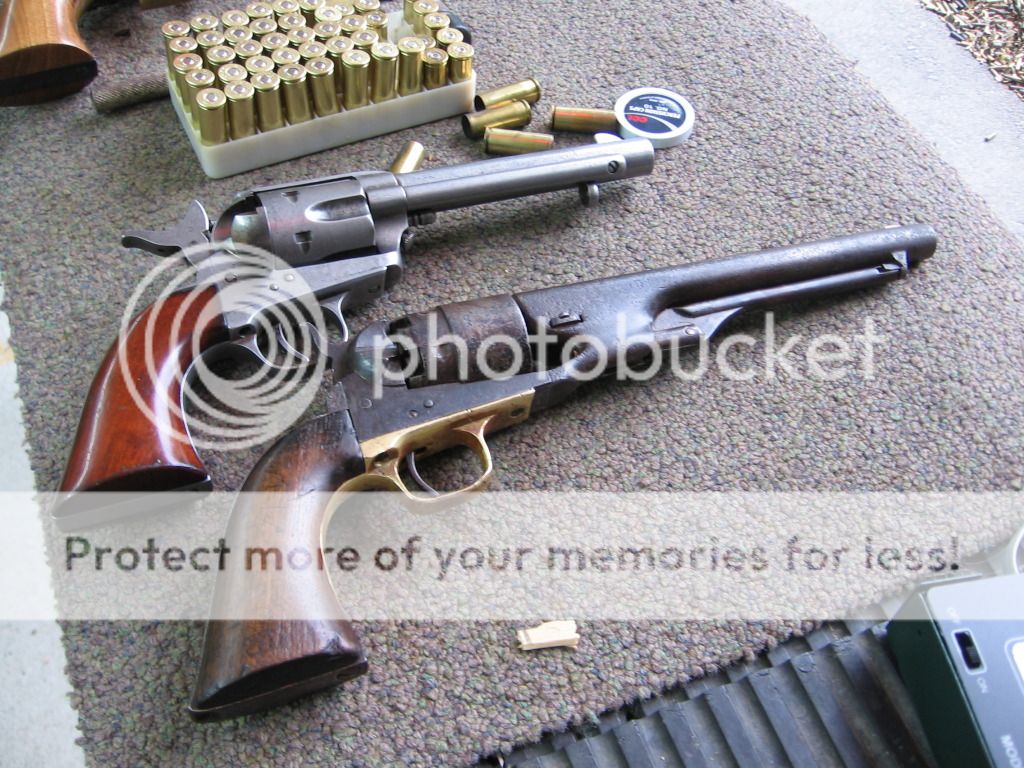
Hey, no worries. Thanks for the advice. Are reloading dies for the 45 Schofield readily available? I know that 44 Russian dies are out there. Any issues with getting brass for either that I should be aware of?
Edit: also, would these chamberings need a cast bullet, or would a plated bullet like one from Berry's be ok?
Anything other than soft lead bullets. (not harder alloys like wheel weights) are considered to be a bad idea that leads to failure. There was a very good post about this with regards to the French 1873 Chamelot Delvigne and I managed to find it again. Originally posted by Kelt on Gunboards scroll down to post #23 here:
http://forums.gunboards.com/showthread.php?87563-Mle-1873-revolver-modifacation
It is long but I am posting the text below as it has some good information. In short, You should be running some pretty weak loads (by today's standards) in these old guns if you don't want to run into problems.
Original post by Kelt:
Some revolvers model 1873 may have been rechambered in the USA to overcome the lack of useable ammunitions and attrack prospective buyers, but as for the transformation in France during WWII, it is a proven fact that an unknown quantity of revolver Mle 1973 were modified for the 45 ACP cartridge in the early stage of the occupation 1941/1943.
It is well documented that in many instances, steel factory workers managed to make gun parts for the resistance fooling the German military supervision placed in all metalwork factories.
Under the 1940 Armistice agreement, most of the French military weaponry was deactivated by removing essential parts and stored under lock and Nazi supervision, the Vichy regime was allowed to keep only a 100.000 strong military force with no antitank capacity, and instead of being sent back to civilian life as planned more than 1.500.000 soldiers were sent to camps in Germany.
The civilians didn't fare better, all weapons, handguns, rifles, shotguns had to be handed out to the authorities with the penalty for anyone caught with a gun in his or her possession after the handover date.
The Nazis helped themselves with the hardware stored in the occupied zone, but a large part of the military equipment stored in the Vichy zone disappeared from their storage before the Nazis could grab it when they invaded the "free zone" in November 1942 in retaliation of the Allied landings in North Africa.
The work carried out by the resistant metal workers was good enough that many "FFI reactivated" guns like the LMG 24/29, MAC 31 were kept in use "as is" after WWII.
The modification of model 1873 revolver to shoot the 45 ACP was a desesperate action, and the weak point on the revolver 1873 was soon discovered as being the top strap of the frame, a few revolver were destroyed that way shooting hardball 45ACP ammunition, there are no stories about cylinder failure.
On a personnal note, I have direct link to a Mle 1873 modified that way. My father was incorporated in July 1939 and fought from Belgium to the Loire in may/June 40, he avoided capture in late june and went home to Paris and his pregnant wife (my eldest brother). He returned to his prewar job of driving long haul trucks for the STA (a trucking company subsidiary of the national railways SNCF). The maintenance shop of the STA was well equipped with qualified personnel and tooling such as lathes, milling machines, dedicated to produce hard to get spares for the motorpool. That maintenance shop managed to make many small components needed by the resistance including gun parts.
Below is a picture of a revolver 1873 modified by the STA maintenance shop to fire 45ACP ammo, the work was done very professionally, that particular reolver has digested in the late 60s and early 70s a very large quantity of 45 ACP mild target handloads with lead bullets.
There was a lot of discusions about these modified Mle 1873 revolver among the French shooting community in the 1990s, when they were listed as antics and ownership became free of paperwork.
The consensus was that technically, in the hands of a very knowledgeable shooter, a revolver 1873 still in good condition for shooting that had its cylinder chambers professionally machined to the correct dimensions for 45 ACP cases is strong enough to shoot safely very light handloads with soft lead bullets, but manufactured ammunitions and specifically jacketed bullets would destroy it and injure the shooter.
In France, a 1873 revolver with its cylinder modified to accept 45 ACP cartridges is no longer an antic gun and requires identical paperwork than a 1911 A1 pistol.
Modern technology was put to use to assess the quality of the 1873 revolver components, I made some calculations on the top strap resistance to pressure, based on the weakest steel data collected from several revolvers. I posted it here in 2003 and it was later translated by The Stonemaster :
Posts
Posted - 10/11/2003 : 10:22:53 AM
--------------------------------------------------------------------------------
Hello to all:
Just back from France. Went to my yearly "pilgrimage" to the Invalides last Wednesday! (With my better half in tow, which accelerated things a bit!).
Anyway, here's my data on the '73 which could be added to the listing:
Mle. 1873 Armee, Ser. G 36488 S1877. Bright polished, all matching except side plate screw.
I liked the treatise on loading limits. If there is any interest, I will translate it and post.
All the best
The Stone Master
Starting Member
USA
9 Posts
Posted - 10/11/2003 : 2:03:16 PM
--------------------------------------------------------------------------------
Here's my translation of the file in question:
REVOLVER CHAMELOT DELVIGNE TYPE 1873
Computation of the forces transmitted to the top strap during firing:
At firing, pressure is transmitted to the cylinder frame through the case’s base.
Area of the chamber : 11.43mm X 11.43mm X 3.14/4 = 1.02 sqcm (0.1581 sqin)
Distribution of the force over the upper and lower surfaces of the frame, (distance of the application point of the force to the reaction points)
Distance from top of frame to barrel axis: 8.5 mm (.335”), top strap thickness: 3 mm (.118”).
Distance from top strap cross-section mid-point to barrel axis: 8.5 mm + 1.5 mm= 10 mm (.393”)
Distance from the bottom of the frame to the barrel’s axis: 37 mm (1.456”)
Lower frame thickness: 12 mm (.472”)
Distance from lower frame cross-section mid-point to barrel axis: 37 mm + 6 mm= 43 mm (1.69”)
Distance between mid-points of top and bottom frame cross-sections: 10 mm + 43 mm=53 mm (2.09”)
Force exerted on the rear of the frame, assuming an 800 bar [11,600 psi] loading:
800 x 1.02 = 824 kgf (1816 lbs)
Force acting on top strap:
824 x 43/53 = 669 kgf (1475 lbs)
Force acting on frame bottom:
824 x 10/53 = 155 kgf (342 lbs)
Case of a 48 kg/sqmm (34.136 ton/sqin) yield strength steel revolver frame :
Area of the top strap at its weakest point: 36 sqmm (.056 sqin)
HENCE: firing a 600 bar (11,600 psi) load exerts a force on the top strap of:
669/36 = 18.6 kg/sqmm (13.2 ton/sqin)
Without precisely knowing the tensile limit of a 48 kg/sqmm steel, which is somewhere between 70 and 80% of the minimum yield strength, an 18.6 kg/sqmm is only 39% of the yield strength and is well within the tensile limit of the steel.
Dangerous loads:
If the minimum tensile limit of a 48 kg/sqmm steel is 70% (or 33 kg/sqmm), the danger point for the top strap is therefore 36 x 33 = 1180 kgf; the force applied to the rear of the frame is therefore 1180 X 53/43 = 1464 kg/sqmm, which would require a 1464/1.02 – 1435 bar (20813 psi) load minimum to be dangerous.
These calculations do not take into consideration the friction between cylinder chamber and cartridge case which will reduce the rearward force by at least 10%.
The use of 800 bar (11,600 psi) loads in the Mle, 73 is quite reasonable IF the revolver has never fired loads that might have overstressed the top strap beyond its tensile limit (in which case top strap rupture would be inevitable as even weak loads induce stretching).