airline transport issues?

mshundal

CGN Regular
Rating - 100%
17   0   0
Location
GTA
Hi there,

I am hoping to take a couple of pistols to Calgary/Edmonton to my in-laws who are gun nuts and go out to a range with them; the ST ATT is not an issue but wondering if anyone who has traveled with their pistols on an airline can outline the dos and don't dos please?

thanks in advance
 
call your airline and ask them the procedure for bringing firearms with you on your trip?
a simple google search would of given you all the info that you needed.
 
Which airline and where're you flying out of?

A Google search will give you the rules that are "supposed" to be followed, but I've had various morons make up their own rules in the face of common sense. If you do a search for "Another Win for Air Canada" (IIRC), you may be able to find my post-by-post dealings with the most useless airline in this country. I've also got a few stories of made up rules that make even less sense.

Y'know what? I don't need to air this all again. PM me if you want, I'll give you a few tips.
 
Last time I flew WestJet, the girls were very pro-gun. I had more than one gun and they just charged me a flat $25 fee. They thought the guns were cool. No problems, no issues.

Rich
 
I've traveled from Toronto to Calgary with pistols plenty of times. It is no big deal. As you say, get your ATT. Fly WestJet, as they are generally more cool with the situation. Air Canada will charge you $50 just for saying you are bringing firearms. Definitely check your airlines baggage policy on their website. Look in the "sporting equipment" section. It varies almost every time I fly: sometimes you have to call their 1-800 number a day or two before the flight and tell them you will be flying with firearms and to add it to your "traveller profile". Other times it's not necessary. Pack your pistols in something like a pelican case, and your ammo in your luggage. No loose rounds, keep them all in nice boxes. When you get to the check in counter, tell the nice person "I need to fill out a firearms declaration". I think this is more professional than just blurting out "I have a gun" at some point. The "declaration" is just a stupid piece of paper saying that your firearms are unloaded. Depending on the day, sometimes you just keep the paper with you, but more recently they have been saying to open the case and put the paper inside with the firearms. Occasionally, the person at the desk will ask you to open the case and show that your firearms are unloaded. Sometimes that's freaky, as now it's possible for a whole line up behind you to suddenly see pistols. But with the pelican case, if I turn it to face the ticket person, I can open it and no-one see's anything. Usually the person doesn't even know what they are looking at, so I don't do a full "ACTS-PROVE" kind of thing. They just gawk and say "okay" and I lock it back up. Then what happens 9 times out of 10 is that you will be escorted to the 'oversized luggage' screening area and they will x-ray your luggage and maybe ask to see the firearms/ammo. It's pretty painless as long as you are prepared and have your paperwork in order.
 
Last time was WestJet , Montreal-Vancouver.
Excellent treatment and service, except for lack of food. :)
Would do it again, when I can afford it.
Call airline ahead of time and ask what they need and what you need to do.
 
I flew in March, 2011, out of YHZ. About ten minutes and forty feet past the point where I'd checked my bags (with declared firearms, with a professional US Air agent who knew the rules), I was directed by a CATSA agent over to a secondary CATSA checkpoint. I was informed by CATSA that there were firearms in my bag. :eek: This is just ten minutes after I'd declared them. I was required to produce my copy of the firearms check tag, which I did. I was required to identify my bag, which I did. I was required to describe the manner in which the firearms and ammunition was packed, which I did. They then inspected my bag, while I watched, and mumbling agents conferred (as though they had stumbled onto something big.) "He has firearms in his bag!" The CATSA agents didn't know the rules and then proceeded to try to BS me, telling me that I was not in compliance. I tried to smile as I explained that I had checked their own rules and was - in fact - in compliance. A male agent spoke with me and a female agent as she talked into the phone with a supervisor. They swapped my bag for residue. I was required to produce a firearms license, which I did. I remember thinking to myself, "What a Gong Show." In the end, they conceded that everything was in compliance.

Bottom line? Know before you fly, because you may have to explain their own policy to Canada's guardians of air safety. Each airline also has it's own rules. To be compliant, you'll have to check with your airline(s) to see what their rules are.

CATSA FIREARMS & AMMUNITION
<http://www.catsa.gc.ca/page.aspx?id=5&pname=PermittedItems_ArticlesPermis&lang=en&CategoryID=2>

Air Canada Hunting Equipment
<http://www.aircanada.com/en/travelinfo/airport/baggage/hunting_equip.html#-firearms>

WestJet Restricted items
<http://www.channelgroup.org/wjpassengers/main_search.htm>
 
Last time I flew WestJet, the girls were very pro-gun. I had more than one gun and they just charged me a flat $25 fee. They thought the guns were cool. No problems, no issues.

Rich

Well, those 'girls' ripped you off because Westjet does not charge for firearms.
 
thanks did a search and saw everyone's mileage varied on this so was curious about the general dos and don'ts and any unwritten rules/tips.

and westjet for sure.
 
Julie G.: Flying with firearms

The key to successful airline travel with guns is all in the preparation.
<http://womensoutdoornews.com/2011/06/julie-g-flying-with-firearms/>
Julie G.: Flying with firearms

June 2, 2011 by Julie Golob 18 Comments

The idea of airline travel with a firearm and ammunition puts some people in a cold sweat. Those nightmare tales of people missing flights due to difficult airline and Transportation Security Administration (TSA) agents, and the cases where competition shooters have been detained by police, are enough to make anyone prefer piling the car with all their guns and gear to make a road trip to their destination instead. As someone who travels with firearms 12 to 15 times a year, I can say that I am fortunate not to have too many tales of woe.

The key to successful airline travel with guns is all in the preparation. Researching what is acceptable for TSA and your airline is the first step. If you are traveling to a new destination, contact your fellow shooters or hunters to see if they have checked in at the airports you are flying from. Some airports, including Hartsfield International in Atlanta, have a specific TSA drop-off for those traveling with firearms. At other airports, be prepared to lose sight and control of your luggage. I have watched my luggage disappear with the instructions, “Wait over there for 15 minutes. If we don’t call you, then you are all set to go through security to your gate.”

Not exactly much of a confirmation, is it? I have even been at airports where they have taken my keys and combination behind a screen or into another room to go through my bags. In those cases I have been left wondering what was done, and whether I will be able to find somewhere to test and re-zero my firearm in case it was dropped or handled poorly.

Expect inconsistency, especially with the placement of your firearms declaration form, an orange tag that basically states that you are traveling with unloaded firearms. You must ask for this form. You will need to both sign and date it, but make sure that the agent initials it as well. Some agents have directed me to place my form anywhere inside my luggage. Others want it inside my gun case, on top of my firearm. Don’t sweat it. Just follow directions.

JulieG_WON1.jpg

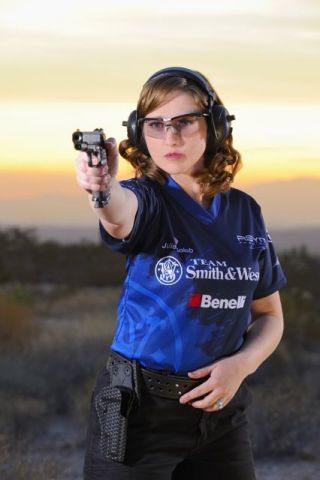
Julie Golob. Photo by Yamil R. Sued.

Here are some tips I have found to be helpful when traveling with firearms:

1. Bring paperwork with you indicating that you are legal to possess a firearm, both where you are coming from and where you are going. If competing or attending a class, bring a copy of the match entry form or confirmation letter.

2. Print out airline and TSA regulations to reference, just in case. Visit your airline’s website for their rules. TSA information can be found here.

3. Invest in appropriate luggage that will protect your firearms. Long gun cases should be strong and lockable. For traveling with handguns, I use a lightweight, hard-sided, lockable suitcase that I put my hard-sided, lockable gun case in. It may seem like overkill, but this way I am always covered.

4. Airlines have specific rules pertaining to ammunition and how it is packed. Either follow these rules or, if possible, consider shipping your ammo to your destination. This can also help you avoid paying additional baggage and weight fees.

5. Pack your bags wisely, and plan for them to be searched. If you’re traveling with ammunition, it will need to be in proper packaging, but also place it in another box or bag that is easily accessible. Your ammo is likely to set off warnings and cause a search by TSA. Utilize compartments, and bags within your bag, to organize your gear so that in the event that TSA goes through it, they can put it back easily. Easy = faster!

6. Give yourself PLENTY of time to check in and go through TSA. The minimum I suggest is 1½ hours, though I usually plan two hours to be safe.

7. Be up front about declaring firearms to airline and TSA agents. The language I prefer to use is, “How are you? I am going to ______. I also need an unloaded firearms declaration form.”

8. Smile! Be as helpful and friendly as possible throughout the entire process. Even if you come across an agent who seems to have a significant disdain for you and your firearm, be courteous. A negative attitude won’t help the situation.


Copyright © 2011 · Delicious Theme on Genesis Framework
http://womensoutdoornews.com/2011/06/julie-g-flying-with-firearms/
 
Make sure they place the destination tag back onto your gun case after they've opened it up and swapped it for "explosives". My buddy had his case sitting at the bottom of the loading ramp without a destination tag.

Also, at destination, don't assume the gun cases will be delivered to Special Handling. They have sent it out to general carousal where it went round and round for everyone in the public waiting area to see as the case has high visibility tags indicating firearms inside....anyone could have walked out with it.
 
Newark airport sets up new body scanners

The new system uses a screen that displays a grey silhouette of a generic body.
http://thechronicleherald.ca/World/1261515.html
Halifax, NS | Sat, September 3rd, 2011​
WORLD IN BRIEF

Sat, Sep 3 - 4:54 AM
Newark airport sets up new body scanners

NEWARK, N.J. (AP) — Newark Liberty International Airport became the first New York-area airport to install body scanning technology that will replace a system that was harshly criticized for invading travellers’ privacy by displaying naked images.

Transportation Security Administration officials unveiled the software at the airport on Friday, where more than eight million passengers boarded planes last year. The technology was originally tested in February in Atlanta, Las Vegas and Washington and rolled out in July.

In all, the technology will be installed in 241 security machines at 40 airports around the country over the next few months at a cost of $2.7 million that includes research and development, according to the TSA. The agency plans to install it in all airports eventually.

The new system uses a screen that displays a grey silhouette of a generic body.

© 2011 The Halifax Herald Limited
http://thechronicleherald.ca/World/1261515.html
 
Cameron Hopkins: Flying With a Gun - 8 Tips for Airborne Hunters

Airborne hunters can fly with firearms without much hassle if they know what to expect and how to deal with the most commonly encountered hiccups.
<http://www.americanhunter.org/articles/flying-with-a-gun-eight-tips-for-airborne-gun-hunters/>
Flying With a Gun: 8 Tips for Airborne Hunters

2010112295510-airborne_hunter_m.jpg


By Cameron Hopkins

11/22/2010

1. How To Pack
Airline regulations as well as TSA rules require that firearms must be unloaded and packed in an “airline approved” gun case. Any hard-sided gun case with either a built-in lock or a provision for a padlock is “approved.” Prices for gun cases vary from low-end Doskocil to high-end StormCase to my personal favorite, a TuffPak (the cylindrical gun case that looks like a golf club case).

Render your firearm inoperable by removing the bolt from a bolt-action rifle, removing the barrel(s) from a shotgun, taking the slide off a pistol or removing the cylinder from a revolver. Make it easy for the TSA or ticket agent to see your firearms are unloaded.

2. Ammunition “Rules”
Airlines differ in their policies for the way ammunition must be packed in checked luggage. Some require that the ammunition be in the same case as the firearms, others specify the ammunition cannot be in the same case as the firearms. However, all airlines agree that ammunition must be “packed in original factory containers,” or a hard, plastic container and cannot exceed 5 kilograms (11 pounds) in total weight.

When you check in and declare your firearms, also declare that you’re carrying, “less than five kilos of ammunition in the original factory boxes.” By using this terminology, you’re speaking the same language as the ticket agent, and he or she will know that you know the rules, simply by your using the correct phrasing.

Some international airlines require that ammunition be packed in a totally separate locked case. Accordingly, I always pack my ammo in a small Pelican case with separate padlocks and then place this case inside my “suitcase” which is a large StormCase with its own padlocks. If I’m asked to check my ammo separately, it’s all ready to go in its own case.

3. First Impression
As your mother always told you, first impressions are everything. The most important person you will encounter on your trip is the ticket agent when you check in. Dress nicely. Wear a collared shirt or, my favorite, a well-kept polo with a law enforcement affiliation, such as an embroidered NYPD logo. You’re not being deceitful, you actually like the NYPD. If the ticket agent assumes you’re a cop, hey, that’s not your doing.

When I wear a polo with the logo of the U.S. Embassy, Kabul, Afghanistan that a buddy sent me from the sandbox—a favorite for when I have to clear U.S. Customs—I invariably get asked if I’m in the military. I reply truthfully, “No, a friend who is serving his country sent this to me.” I’ve still made a positive impression without being dishonest.

4. Declare “Unloaded Firearms”
Be polite. Smile. Let the agent check you in normally. The agent will ask how many bags you wish to check, and at that point you matter-of-factly state, “two bags, one of which contains unloaded firearms.” The key phrase is “unloaded firearms.” This is the term the agent is accustomed to using. Don’t say, “huntin’ rifles” or any other descriptor— they are “unloaded firearms.”

The agent should then give you a tag that says—surprise—“Unloaded Firearms” which you sign, declaring the firearms are indeed unloaded. Place the tag inside your gun case as instructed.

5. Inspection Request
Lately, I’ve noticed that fewer and fewer ticket agents ask to personally inspect your “unloaded firearms” but this can arise. Back to what mom said—be polite.

I open my case and show the agent my “unloaded firearms,” and point to the open action (I mostly travel with bolt-action rifles with the bolts removed). Make it obvious that the firearms are unloaded by rendering them easy to inspect (as noted earlier).

6. TSA Inspection
Sometimes the ticket agent places your bag on the conveyor belt and away it goes into the airport’s lower intestine where it will be X-rayed. Sometimes the agent asks you to wait 10 or 15 minutes, and if you’re not paged by TSA to provide the key to your gun case, you’re good to go. Other times you’re asked to physically carry your gun case to a nearby TSA screening area.

When a TSA agent takes your case, inform him or her that it contains—what does it contain, class?—“unloaded firearms.” Sometimes they wave you on without opening the case and sometimes they open it and swipe a patch to check for explosives. I can’t remember a time when a TSA agent has actually removed a firearm from the case to inspect it, but it could happen. Watch the proceedings, and make sure an agent relocks your case and gives you back your keys.

7. Plan On Losing A Bag
The one good thing about pessimists is they’re never disappointed. I’ve had bags delayed so many times that whenever I fly to reach a hunting destination, I always pack my carry-on as if it’s the only bag that will make it. I wear my hunting boots. I pack a set of hunting clothes and three changes of socks and underwear, carry all medications and vitamins in my carry-on as well as my binoculars. I have the bare essentials to be able to hunt.

8. Coming Home
If your destination is outside the U.S., when you come home you must declare to U.S. Customs that you’re carrying “unloaded firearms.” You will be ushered into the “red line” and asked to show your firearms and proof of ownership. By far the best and most universally accepted form of proof is a Form 4457, a “declaration of personal effects” that U.S. Customs issues for free. Simply go to an airport with a Customs office with your personal effects—your firearms—and ask for a Form 4457.


© 2011 National Rifle Association
<http://www.americanhunter.org/articles/flying-with-a-gun-eight-tips-for-airborne-gun-hunters/>

 
This sounds intense. I've never had a problem. Call the airline and ask what they want. The people doing the "inspection" don't really know anything at all. Once I was asked if the bolt was removed from my Browning Citori. I remained calm and instead of informing them that that was impossible I just said yes. With regard to the winchester '94 I said the bolt doesn't come out. Trigger locks good enough for the federal government, but not good enough for the airline? Once I bought a Browning trombone from a farmer in Alberta and didn't have time to register it before I got to the airport. I barely had time to get to Wholesale Sports to get a gun case. They never asked for my licence or registration. When I go to the special x-ray/MRI machine I ask if I can come behind the counter and look so I can see what it looks like. They never have a problem with it. I still don't understand how Vancouver does not have an x-ray machine and you have open the case in front of all those yuppies. Other airports just put it in the machine and you are good to go.

Some airlines put a tag on it that says "firearms". This is just asking for it to be stolen. I was at a party once and I was talking to a guy that worked at the airport that loved his Sig and his Glock. The Glock was registered and the Sig wasn't and he would have loved his Glock more if it weren't registered. THIS GUY WORKED AT THE AIRPORT HANDLING LUGGAGE!

Once I had my Marlin 1895G and the foam in the case was pact-in so I put the rifle in long socks and when I opened the case I stated "Aha, a case of socks". The guy was not amused. I've traveled with a kids biathlon team mostly without incident. Once they made us go into a back room and take the bolts out of the Izhmash rifles. You need to take the rear sight off to do this so it was a little bit of a pain in the ass. Lucky we didn't have the anchutz with the fortner bolts that require 400 precise German movements to remove the bolts.

Edit: Forgot about this one. Flying out of Langley in the lower mainland once I declared I had a firearm, signed the forms took it over to the machine (yes, Langley has an X-ray machine and vancouver doesn't) and the lady said it was fine. After about 3 minutes she comes running after me. I thought something was really wrong. She asked me to come back and answer a few questions. I asked if something was wrong and she said she thought it was a trumpet! She was a little surprised when it went through the machine. So I told her it was unloaded, it had a trigger lock on it and that there was no ammunition in the case. That was it.

The only thing that really got me was when I was traveling with my XD-40 and my CZ SP-01 was that is showed up on the ramp with all the other sports equipment. Anyone could have come by and grabbed it on their way out. What would you choose: the ski bag or the little black case with two pad locks on it that said "Gun Guard" on the side?

Don't sweat it. Follow the rules, obey the laws and cover your ass (forms, signatures, licence, LTATT etc...). It's no big deal. You probably know more than they do. It's just another piece of sporting equipment. You could always take the barrels out and put them in your luggage to feel more at ease.
 
Last edited:
In MCO (of all places), the US Air agent was unsure of the (international flight) declaration process and - try though he might - he was unable to contact any Canadian authorities to satisfy him that the Canadian documentation was genuine. I think he called every three-letter agency in the book. (None gave him the assurance that he desired.) The other US Air agents, each processing dozens of customers to his one, politely suggested to him that he allow me to proceed, but he just ignored them. (He wasn't willing to take any chances, or to be the guy that let that guy on the plane.)

Standing at the counter for over an hour an a half, I was feeling rather conspicuous and more and more concerned that - because of this extended public spectacle - I would be targeted for theft.

I confessed my fear to the TSA agent who searched my bags; he looked me in the eye and said, "Don't worry about it." (Because, in this matter, TSA's eyes-in-the-sky had my back.)
 
Back
Top Bottom