












































You are using an out of date browser. It may not display this or other websites correctly.
You should upgrade or use an alternative browser.
You should upgrade or use an alternative browser.
alaskan moose
- Thread starter grizzlyo
- Start date


Suka
CGN Ultra frequent flyer
If it were me deciding, anticipated shot distance would determine the pick.
Oh, and if you're going on an Alaskan or Yukon moose hunt, I wish you the best of luck.
Please post pics when you return.
Oh, and if you're going on an Alaskan or Yukon moose hunt, I wish you the best of luck.
Please post pics when you return.


John Spartan
CGN frequent flyer
- Location
- Just a little more to the right...
If one can shoot either the .375 or the.338 ultra mag well, then no problem.
If not...
The ol' 30 aught 6 would do just fine with the proper bullet.
If not...
The ol' 30 aught 6 would do just fine with the proper bullet.

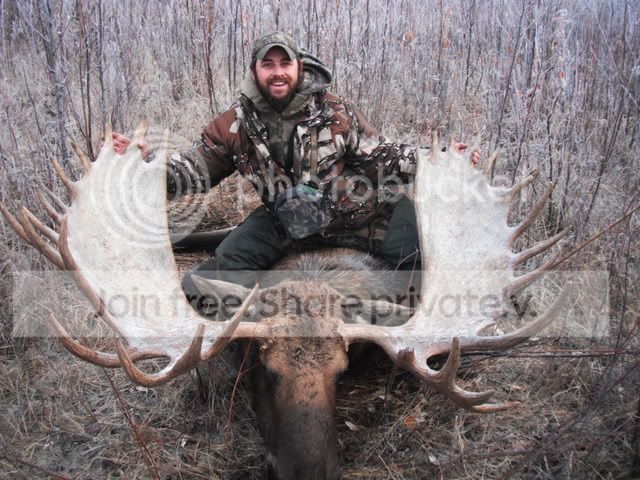
The Alaskan moose is a sub specie of moose, the largest of the moose group. They are found in Alaska, the Yukon and northern BC.
I have shot two of the big fellows in northern BC. In each case my trusty 30-06 quickly ended their career. In one case it was with the 150 grain Barnes bullet, that Fred Barnes designd shortly after WW2 and one shot was all it took.
I have shot two of the big fellows in northern BC. In each case my trusty 30-06 quickly ended their career. In one case it was with the 150 grain Barnes bullet, that Fred Barnes designd shortly after WW2 and one shot was all it took.

The Alaskan moose is a sub specie of moose, the largest of the moose group. They are found in Alaska, the Yukon and northern BC.
I have shot two of the big fellows in northern BC. In each case my trusty 30-06 quickly ended their career. In one case it was with the 150 grain Barnes bullet, that Fred Barnes designd shortly after WW2 and one shot was all it took.
Yukon/Alaska moose are only found in Alaska, Yukon and NWT. While there are some big moose in northern BC, they are not considered Alaska/Yukon moose.


Yukon/Alaska moose are only found in Alaska, Yukon and NWT. While there are some big moose in northern BC, they are not considered Alaska/Yukon moose.
Sheephunter, I would think you, of all people, would be aware of the moose distribution in BC.
I would think you, of all people, would know the facts, or check the facts, before you straight out and say some one is wrong.
Here is a picture of a publication representing the final word on animals in BC. The British Columbia Provincial Museum handbook.
Surely I don't have to explain to you, who the late Dr. Ian McTaggart Cowan was!
This book is quite old, October 1965, so game distribution can change, and it is generally accepted that Alaska Moose have spread much further south than was known in 1965. Still, note in the text that the southern and eastern boundry of them in BC was not really known.
Alaska moose have distinctive antlers. They spread wide, then just turn up near the ends, whereas the Canada moose go much higher, in relation to the width. I have personally seen the antlers from an Alaska Moose less than 100 miles from Prince George.


H4831, I like to rely on info that isn't 46 years out of date. Call it what you like but if you want to hunt Yukon/Alaska moose, you better be in Alaska, Yukon or NWT.
From the B&C website, Feb 14, 2011
From the B&C website, Feb 14, 2011
Canada, Alaska-Yukon, and SHIRAS' Moose
The boundaries for the three classes of moose have remained essentially unchanged since the beginning of the records keeping. But, hunting opportunities for moose have increased in recent years so that moose are now hunted in the Mackenzie Mountains of Northwest Territories, northern Utah, northeastern Washington, northern Minnesota, Maine, New Hampshire and Vermont.
The Alaska-Yukon moose category includes moose from Alaska, Yukon Territory and Northwest Territories.The Canada moose category includes moose from all of the remaining provinces of Canada, plus Maine, Minnesota, New Hampshire, North Dakota and Vermont.
The Shiras’ moose category has the Canadian border as its northern boundary. Its range includes all of the Rocky Mountain region south of Canada and west to the Pacific Ocean, including the following states: Colorado, Idaho, Montana, Utah, Washington, and Wyoming.

the spank
CGN Ultra frequent flyer
- Location
- Planet Earth Wearing My Tinfoil Hat
Sheephunter, I would think you, of all people, would be aware of the moose distribution in BC.
I would think you, of all people, would know the facts, or check the facts, before you straight out and say some one is wrong.
Here is a picture of a publication representing the final word on animals in BC. The British Columbia Provincial Museum handbook.
Surely I don't have to explain to you, who the late Dr. Ian McTaggart Cowan was!
This book is quite old, October 1965, so game distribution can change, and it is generally accepted that Alaska Moose have spread much further south than was known in 1965. Still, note in the text that the southern and eastern boundry of them in BC was not really known.
Alaska moose have distinctive antlers. They spread wide, then just turn up near the ends, whereas the Canada moose go much higher, in relation to the width. I have personally seen the antlers from an Alaska Moose less than 100 miles from Prince George.
TOUCHE'
Congratulations on the slam dunk!! Nothing like facts to back one self up!!

bearkilr
CGN Ultra frequent flyer
- Location
- Nowhere, ......just past the middle
H4831, I like to rely on info that isn't 46 years out of date. Call it what you like but if you want to hunt Yukon/Alaska moose, you better be in Alaska, Yukon or NWT.
From the B&C website, Feb 14, 2011
They have to draw boundaries for record books, it has little to do with actual size since Moose don't know where the boundary is, hence the reason all top Canada Moose come from northern BC.
SE British Columbia are classed as Canada Moose as well, though everyone pretty much considers them Shiras.
They have to draw boundaries for record books, it has little to do with actual size since Moose don't know where the boundary is, hence the reason all top Canada Moose come from northern BC.
SE British Columbia are classed as Canada Moose as well, though everyone pretty much considers them Shiras.
Exactly, you need geographical boundaries somewhere and close to those borders there will undoubtedly be animals crossing back and forth but it still doesn't make a pheasant a ruffed grouse. Taxonomy with a species that shows no physical differences between sub species other than size rely soley on these geographical boundaries. It's absolutely all about size. Moose are moose are moose no matter where they exist. It's only the geographical boundaries that seperate the subspecies and those were established by size. There are no absolutely defined geographical boundaries by taxonomists for moose but there is by B&C so it seems logical that hunters use it. If H4381 was talking about taxonomy, then yes, I'm sure many would agree with him...I was talking hunting. Sorry for the confusion.

Either way I don't think the side of the border the Alaskan or Canada Moose lives on should effect cartridge selection.
Either one would work great, personally I would like pick a 375 H&H over an Ultramag...because it's cooler.
Sheephunter and H4831 this thread has all the makings of the Eland thread of a few years ago.
Either one would work great, personally I would like pick a 375 H&H over an Ultramag...because it's cooler.
Sheephunter and H4831 this thread has all the makings of the Eland thread of a few years ago.
Sheephunter and H4831 this thread has all the makings of the Eland thread of a few years ago.
LOL...gawd I hope not....
H4831, I like to rely on info that isn't 46 years out of date. Call it what you like but if you want to hunt Yukon/Alaska moose, you better be in Alaska, Yukon or NWT.
From the B&C website, Feb 14, 2011
Try again!
The Boone and Crocket Club never did recognise Alaska moose as being in BC.
Here is a copy from the very first Boone and Crocket Club book published, with the type of measuring now used, Records of North American Big Game, Book #1. It came out in 1952.
This is why, as has been pointed out, if you want to get a record Canada Moose, you better hunt northern BC.
I hope you are not rying to tell me the Boone and Crocket Club is the authority on moose distribution in BC, and not the British Columbia Provincial Museum.


what would you perfer for hunting alaskan,yukon moose? a .375 h&h or .338 ulramag?
The 3006 is still a best choice for Alaskan hunters!!!
http://forums.outdoorsdirectory.com/showthread.php/25489-Calibers-for-Alaska.
bearkilr
CGN Ultra frequent flyer
- Location
- Nowhere, ......just past the middle
Exactly, you need geographical boundaries somewhere and close to those borders there will undoubtedly be animals crossing back and forth but it still doesn't make a pheasant a ruffed grouse. Taxonomy with a species that shows no physical differences between sub species other than size rely soley on these geographical boundaries. It's absolutely all about size. Moose are moose are moose no matter where they exist. It's only the geographical boundaries that seperate the subspecies and those were established by size. There are no absolutely defined geographical boundaries by taxonomists for moose but there is by B&C so it seems logical that hunters use it. If H4381 was talking about taxonomy, then yes, I'm sure many would agree with him...I was talking hunting. Sorry for the confusion.
Regardless of your opinion, there is no size difference between the moose of northern BC and the southern Yukon.
In order to remain on topic, I'd pick the 375 H&H.






















